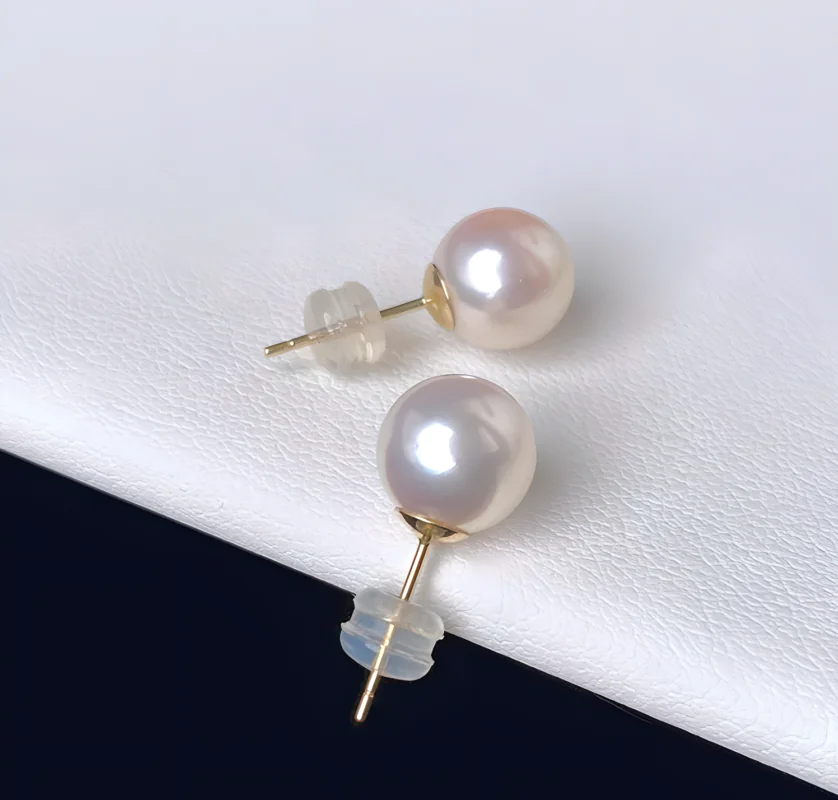
No. A half-round appearance does not automatically mean a pearl is low quality. Shape is only one part of pearl evaluation, and a flatter or less-than-spherical profile can be exactly what makes a pearl work well in studs, rings, pendants, and other designs that are viewed mainly from one side.
The more important issue is terminology. Half-round is not used consistently enough to tell you exactly what kind of pearl you are looking at. Depending on the seller or market, it may refer to a slightly off-round full pearl, a button-shaped pearl with a flatter profile, or a mabé-style cultured half-pearl. Those are different products, so the right first question is not “Is half-round bad?” but “What does half-round mean in this listing?”
Quick Answer
| Question | Short answer |
|---|---|
| Are half-round pearls low quality? | No. Shape alone does not determine overall quality. |
| Why can they cost less than round pearls? | Perfect roundness is relatively rare and usually carries a premium when other factors are comparable. |
| What jewelry suits flatter pearls? | Stud earrings, rings, pendants, brooches, clusters, and some strand designs. |
| Is “half-round” the same as “button”? | Sometimes sellers use the terms loosely, but they should not be assumed to mean exactly the same thing. |
| Is a mabé pearl just a flat button pearl? | No. A mabé is an assembled cultured blister product with a different structure from a conventional whole button-shaped pearl. |
First, Identify What “Half-Round” Means
Pearl shape terminology is useful, but the boundaries are not perfectly uniform across sellers and markets. This matters especially with words such as half-round, semi-round, high button, flat round, and half-pearl.
Authoritative references use more specific shape and structure terms. GIA describes common pearl shapes using categories such as round, near-round or semi-round, button, drop, oval, semi-baroque, and baroque. The World Jewellery Confederation (CIBJO) defines a button or bouton-shaped pearl as a symmetrical domed shape with or without a flattish bottom, while it treats an assembled cultured blister—commonly known as mabé—as a separate product.
That is why a single label is not enough. If you are comparing pearls online, ask for a side view, dimensions, and a description of the pearl's structure.
| Term you may see | What it may describe | What to check |
|---|---|---|
| Semi-round / near-round | A whole pearl that remains broadly spherical but is not perfectly round | How noticeable the deviation is when the pearl is rotated |
| Button / high button | A symmetrical pearl with a domed face and a noticeably flatter profile | Width-to-height proportion and front-view symmetry |
| Half-round | An informal trade description that may overlap with the categories above | Actual photos, side profile, dimensions, drilling, and seller definition |
| Mabé / cultured half-pearl | A cultured blister grown against the shell and later assembled with a backing | Construction, backing, nacre dome, edge condition, and intended setting |
If you want a broader visual framework, see our pearl shape guide, which compares round, near-round, button, oval, drop, ringed, baroque, and specialty shapes.
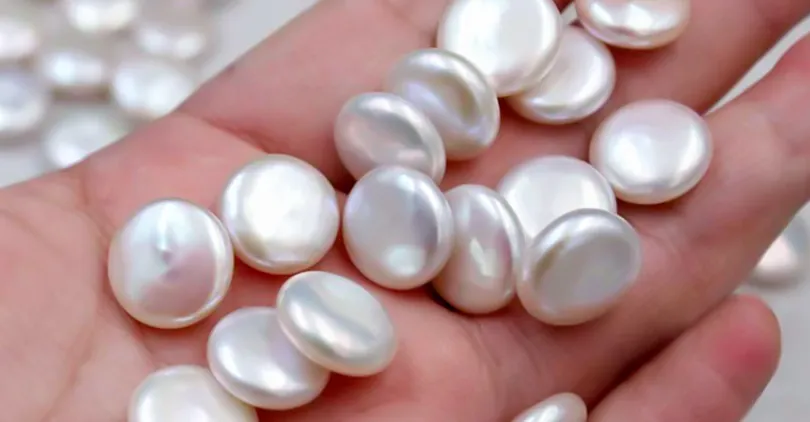
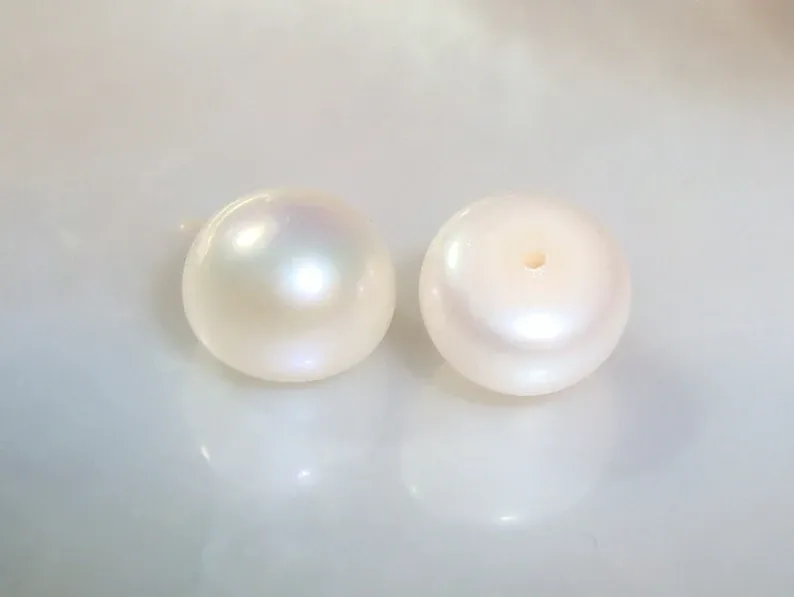
Why Half-Round Does Not Mean Low Quality
A pearl can be beautifully lustrous, clean-surfaced, well matched, and attractively colored without being perfectly spherical. Likewise, a very round pearl can still have weak luster, distracting surface characteristics, poor nacre quality, or poor matching.
GIA's pearl value framework evaluates size, shape, color, luster, surface quality, nacre quality, and matching for multi-pearl jewelry. Shape matters, but it is not the whole evaluation.
Roundness affects rarity and price, not the entire quality judgment
When other factors are equal, round pearls generally command a premium because true roundness is harder to produce. This is an important value difference—but it should not be turned into the false rule that “round equals good” and “not round equals bad.”
A pearl bought for a classic spherical necklace is being asked to do a different job from a pearl bought for a stud earring where the back is hidden. In the second case, paying extra for perfect three-dimensional roundness may add less visual benefit.
Flattening is shape; pits, cracks, and peeling are surface or condition issues
This distinction is especially useful when shopping from photographs. A naturally flatter profile is not itself a blemish. Surface pits, scratches, wrinkles, cracks, peeling, or other visible characteristics should be assessed separately.
For a more complete quality framework, our pearl grading guide explains how luster, surface, shape, size, color, nacre, and matching work together rather than treating one feature as the entire grade.
Which Jewelry Works Best for Half-Round or Flattened Pearls?
The best designs are usually those in which one face of the pearl is meant to be seen and the flatter side can sit against a setting, the ear, or another structural element.
1. Stud earrings: often an excellent match
Stud earrings are one of the strongest uses for button-like or half-round pearls. A flatter back can allow the pearl to sit closer to the earlobe, while the visible front still presents a rounded, luminous face.
This can be especially useful when you want a larger face-up diameter without the projection of a similarly wide fully round pearl. For a pair, however, matching height matters as much as matching width. Two pearls can look identical from the front but sit at noticeably different angles if one is much deeper than the other.
If you are comparing finished pieces, browse pearl earrings with the setting profile in mind, not just the stated millimeter size.
2. Rings: good visually, but the setting matters
A flatter pearl can sit lower in a ring and create a broad face without making the design unnecessarily tall. This can improve proportion and reduce the “pearl perched on top” effect seen in some high-profile settings.
Rings receive more knocks and abrasion than earrings or pendants, so protection still matters. A secure cup, bezel-like surround, halo, or other supportive design can help protect the pearl and its attachment point. This is especially important for mabé pieces, whose assembled structure is different from that of a conventional whole pearl.
When evaluating pearl rings, look at how much of the pearl edge is exposed as well as how attractive the pearl looks from above.
3. Pendants and brooches: ideal for a strong face-up effect
Pendants and brooches let a domed pearl present its best face directly to the viewer. A flatter underside can make setting easier and keep the finished piece from projecting too far from the body or fabric.
Mabé pearls are particularly associated with this kind of design because their half-dome construction is naturally suited to settings where the back will not be visible. If a listing uses half-pearl to mean mabé, read our guide to mabé pearls before comparing it directly with whole cultured pearls.
4. Necklaces and bracelets: suitable, but profile consistency becomes more important
Half-round or button-like pearls can also be used in strands, especially when the repeated flattened profile is part of the design. Here, the shape is more visible because the pearls are seen from multiple angles.
Matching therefore matters differently than it does in studs. Look for consistency in height, width, dome shape, drilling orientation, luster, color, and spacing. An intentionally button-shaped strand can look polished; a strand in which every pearl has a different degree of flattening may look visually uneven unless that variation is part of the design concept.
5. Designer and cluster jewelry: shape can become an advantage
Flatter pearls can be easier to arrange into floral motifs, clusters, geometric layouts, or low-profile compositions. In these designs, a pearl does not need to imitate a sphere. It needs to fit the visual architecture of the piece.
When Is a Half-Round Pearl Actually a Poor Choice?
The shape becomes a problem only when it conflicts with the intended design or when the pearl has separate quality or condition issues.
- For a classic round strand: obvious flattening can interrupt the spherical look you are trying to create.
- For freely moving earrings: the side and back may be visible, so a very flat profile may look less balanced than a round or drop pearl.
- For poorly matched pairs: different heights can make earrings sit differently even if the face-up diameters match.
- For exposed rings: a setting that leaves vulnerable edges or weak attachment points unprotected may be impractical for frequent wear.
- When “half-round” hides a structural difference: a mabé should be evaluated as a mabé, not priced or described as though it were simply a flattened whole round pearl.
In other words, the right question is not whether the pearl failed to become round. It is whether the pearl's shape and structure suit the job the jewelry asks it to do.
How to Buy Half-Round Pearls More Intelligently
If a seller uses the term half-round, do not rely on the label alone. Use a simple checklist.
- Ask whether it is a whole pearl, button-shaped pearl, or mabé/assembled cultured blister.
- Request both front and side views. Face-up photographs can hide flattening.
- Ask for width × height measurements. One “8 mm” label does not tell you whether the pearl is nearly round or only 4–5 mm deep.
- Judge luster independently. Look for bright, clear reflections appropriate to the pearl type.
- Inspect the surface separately from shape. Do not treat normal flattening as a blemish—or overlook real damage because the front looks round.
- For pairs and lots, compare profile matching. Height, orientation, color, and luster can matter as much as diameter.
- Check drilling and setting direction. A useful flattened shape can become awkward if the drill axis does not suit the design.
Jewelry makers and designers sourcing components can compare wholesale loose pearls by actual dimensions, shape, drilling, luster, and matching rather than buying from the shape name alone.
So, Should You Avoid Half-Round Pearls?
No. Avoiding every pearl that is not fully round would mean ignoring many shapes that are useful, attractive, and intentionally chosen in jewelry design.
If you want a classic strand where every pearl is visible from all sides, roundness may deserve a larger share of your budget. If you want studs, a low-profile ring, a pendant, or a design with one main viewing face, a flatter pearl can be a very efficient choice.
The key is to separate three questions:
- What is the pearl actually called and how is it constructed?
- How good are its luster, surface, color, nacre, and matching within that category?
- Does its profile suit the jewelry you want to make or wear?
Once those questions are separated, “half-round” stops sounding like a defect. It becomes what it should be: a description that needs context.
FAQ
Are half-round pearls real pearls?
They can be. A whole cultured pearl may have a semi-round or button-like profile, and a mabé is also a cultured pearl product, although it has a different shell-grown and assembled structure. The phrase half-round by itself does not prove whether a pearl is natural, cultured, imitation, or assembled.
Are half-round pearls cheaper than round pearls?
Often they can be, because perfect roundness usually carries a rarity premium when comparable pearls are otherwise similar. Price still depends on pearl type, size, luster, surface, color, nacre, matching, and the finished jewelry.
Are half-round pearls the same as button pearls?
Not always. Some sellers may use the words loosely or overlap them in trade descriptions, but button has a clearer shape meaning: a symmetrical domed pearl with a flatter profile. Ask for side-view photos and dimensions when the distinction matters.
Is a mabé pearl the same as a half-round pearl?
A mabé may be described as a half-pearl because it has a domed front and flat back, but it is structurally different from a conventional whole button-shaped pearl. CIBJO classifies mabé as an assembled cultured blister product.
What jewelry is best for half-round pearls?
Stud earrings, pendants, brooches, rings, and cluster designs are especially suitable because they can use the rounded face while hiding or supporting the flatter side. Semi-round whole pearls can also work well in necklaces and bracelets when the profile is intentionally matched.