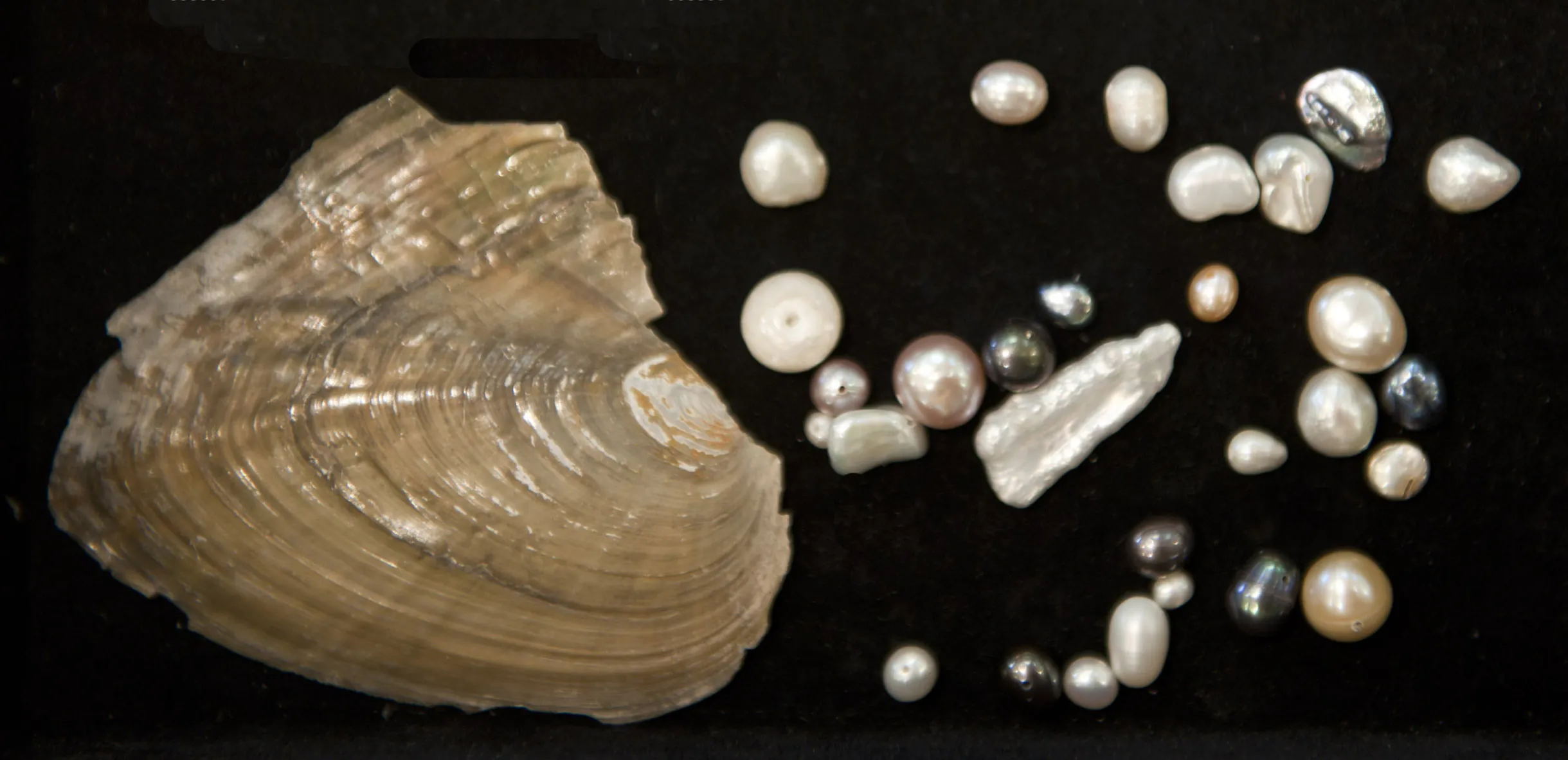
The same pearl type can differ by place of origin because “origin” is not just a country name. It represents a whole growing system: the local oyster or mussel stock, water temperature and seasonal cycle, salinity and water movement, food and water quality, farm-management methods, grafting choices, cultivation time, and harvest timing.
Two pearls can therefore both be genuine Akoya pearls, for example, yet come from different regions and show different typical patterns of luster, color, nacre development, surface condition, or size. The same principle applies to other cultured pearl types.
The important point is that geography does not act like a quality stamp. Place of origin changes the conditions under which a pearl develops; it does not predetermine the quality of every pearl from that place. There is substantial overlap between origins, and fine and commercial qualities can occur within the same producing country, region, or even farm.
For the broader relationship between geography, mollusk species, and pearl categories, see our guide to why pearl origin matters. Here, the narrower question is: why can pearls of the same type still come out differently?
Quick answer: origin changes several variables at the same time
| Origin-related variable | What can differ | Possible effect on the harvested pearls |
|---|---|---|
| Oyster or mussel stock | Local populations, hatchery lines, hybrids, donor selection | Different biological potential for nacre growth, color, survival, and other traits |
| Water temperature and seasonality | Average temperature, seasonal range, timing of cooler and warmer periods | Changes in nacre deposition rate and, under some conditions, nacre microstructure and luster |
| Farm environment | Salinity, currents, depth, water exchange, oxygen, plankton, pollution, fouling pressure | Different growth and stress conditions for the mollusk |
| Culture technique | Graft selection, nucleus size, surgery, stocking density, cleaning, husbandry | Different rates of survival, nucleus retention, shape, surface condition, and nacre development |
| Culture and harvest schedule | How long pearls remain in the mollusk and when they are harvested | Differences in size, nacre development, surface condition, and final luster |
| Sorting and post-harvest handling | Which qualities are retained, how lots are sorted, and what processing is used | Different commercial appearance even when farming conditions are similar |
The Japan Pearl Promotion Society makes this point explicitly in its Pearl Standard: the same pearl-oyster species may be used in different regions, yet differences in farm environment and culturing technique can produce significant differences in pearl characteristics and quality.
“The same pearl type” does not mean the mollusks are biologically identical
A pearl type is a useful commercial and gemological category, but it does not mean every mollusk used to produce that type is genetically identical.
Akoya cultured pearls are a good example. They are principally associated with the Pinctada fucata species complex and are cultured in more than one country. Farms may work with different local stocks, hatchery lines, or hybrids. Those biological differences can matter because pearl formation is a living process rather than a factory coating process.
In bead-cultured saltwater pearls, a small piece of mantle tissue from a donor oyster is implanted with the bead nucleus. That tissue forms the pearl sac that secretes nacre. Research on pearl oysters has shown that donor characteristics can influence pearl traits, including color-related outcomes. The recipient oyster, donor tissue, and environment all contribute to the final result.
This means that even before water conditions are considered, two farms producing the “same type” of pearl may not be starting with exactly the same biological material.
A recent GIA report on hybrid Akoya pearls from Vietnam provides a useful illustration. The pearls were reportedly produced from hybrid mollusks involving P. fucata and P. radiata, and the study documented unusually thick nacre in part of the material. The point is not that hybrid Akoya is automatically better. It is that the label Akoya can sit above meaningful differences in oyster stock and growth behavior.
Water temperature can change how fast nacre is deposited
Among environmental variables, water temperature is one of the clearest examples of why location can matter.
Pearl-producing mollusks are ectothermic animals, so their metabolism and growth respond to the surrounding water. Studies on both Akoya and black-lip pearl oysters have found that warmer conditions can increase the rate of shell and nacre deposition, while cooler conditions can slow deposition.
Faster deposition is not automatically the same as better pearl quality. In a controlled study on Pinctada margaritifera, lower water temperature during the final stage of pearl formation produced thinner nacre tablets and was associated with better luster and fewer surface defects than the warmer treatment. Research on Akoya nacre has also shown strong temperature-related changes in nacre growth.
That helps explain why two farms using the same pearl type can develop different typical results when their seasonal temperature patterns differ.
It is still important not to turn this into a simplistic rule such as “colder water always makes better pearls.” Different species and oyster stocks have different biological tolerances, and a farm needs healthy mollusks first. Excessive heat, unusually cold water, sudden changes, or conditions outside the animal’s preferred range can create stress rather than quality.
Temperature is only one part of the farm environment
A pearl farm is not simply “saltwater” or “freshwater.” Local conditions can vary considerably from one bay, lagoon, lake, or pond to another.
For marine pearl culture, factors such as salinity, water movement, depth, dissolved oxygen, primary productivity, sediment, fouling, pollution, and extreme weather can affect the health and growth of the oysters. The FAO’s pearl-oyster culture guidance treats site selection as a major production decision precisely because these environmental conditions influence oyster growth and the ability to produce high-quality pearls.
These factors also interact. Strong water exchange may improve oxygenation and move food through a farm, but a location may also face storms or changing currents. A nutrient-rich site can support growth, but excessive organic loading or poor circulation can create other problems. Heavy rainfall can change salinity. Disease and fouling pressure can vary by season and locality.
So when a seller says two pearls were grown in different places, the scientifically useful question is not “which country is better?” It is: what growing conditions were different, and how did the farm manage them?
Farm technique can matter as much as geography
Two farms in similar water can still produce different pearl distributions because farmers make many decisions during the culture cycle.
Those decisions can include the age and health of the mollusks, donor selection, nucleus size, graft preparation, surgical technique, stocking density, cleaning frequency, depth changes, how quickly weak animals are removed, how long the pearl remains in culture, and when the harvest takes place.
This is why “origin” often acts as shorthand for a regional production system rather than a single environmental variable.
GIA’s field report on pearl farming in Vietnam is especially useful here. It documented Akoya production in both northern and southern Vietnam and noted differences between farms even though both were producing Akoya from Pinctada fucata martensii. The northern farm produced a higher proportion of silver, gray, and blue pearls than the southern farm. GIA also emphasized that individual farms have their own handling, hatchery, pre-operation, and grafting practices.
That is an important reality check: variation can occur inside one country as well as between countries. “Vietnamese Akoya,” “Japanese Akoya,” or “Chinese Akoya” is still a broad label compared with the actual farm, oyster stock, season, and production method.
Harvest timing can change the final layers you see
The outermost nacre is especially important because it is the surface that interacts with light and determines much of the pearl’s visible luster.
If a farm harvests at a different season, the final period of nacre formation may have occurred under different temperatures and physiological conditions. That can change the structure of the outer nacre even when the pearl spent most of its growth cycle under similar conditions.
This is one reason the harvest month itself can be part of a farm’s quality strategy. A producer may be balancing several goals at once: more time can add nacre and size, while the final seasonal conditions may influence the surface and luster. There is no universal “best number of months” that applies to every pearl type and location.
A concrete example: Akoya pearls from different growing regions
Akoya is one of the easiest pearl types to use when explaining origin differences because genuine Akoya pearls are cultured in multiple countries, including Japan, China, and Vietnam.
The pearl type remains Akoya, but several variables can change:
- Oyster stock: farms may use different local lines or hybrids, with different growth and temperature responses.
- Climate: northern and southern farming areas can experience different seasonal temperature profiles.
- Farm practice: hatchery systems, grafting preparation, husbandry, and harvest schedules can differ.
- Selection: each market may sort and retain different proportions of the harvest for higher-value jewelry use.
- Processing: pearls may later be cleaned, processed, sorted, or matched in a different country from the one in which they were cultured.
For that reason, it is possible for two genuine Akoya lots to have different typical appearance even when both are correctly labeled as Akoya. It is also possible for excellent pearls from different origins to overlap strongly in appearance.
For a country-specific comparison, see our guide to Japanese and Chinese Akoya pearls. If you first need a broader introduction to the pearl type itself, start with our Akoya pearl guide.
The same principle applies to South Sea and black-lip cultured pearls
South Sea cultured pearls are associated with Pinctada maxima and are produced in several Indo-Pacific regions. Local oyster populations, silver-lipped or gold-lipped shell characteristics, farm selection, water conditions, nucleus strategy, and harvest practices can all influence the distribution of colors, sizes, shapes, and surface qualities that enter the market.
Black-lip pearl oysters, Pinctada margaritifera, are also cultured across different Pacific locations. Research in French Polynesia has shown that donor phenotype and culture environment can both affect resulting pearl traits. Even within French Polynesia, different archipelagos can experience different temperature regimes.
The terminology needs care here. A pearl grown from a black-lip oyster outside French Polynesia should not automatically be described as “Tahitian” merely because it resembles a Tahitian cultured pearl. Pearl type, mollusk, cultivation origin, and trade name are related questions, but they are not interchangeable.
Our guide to global pearl-producing regions gives the larger geographic picture.
What can origin explain—and what can it not prove?
| Origin can help explain | Origin alone cannot prove |
|---|---|
| The farm environment in which the mollusk lived | That an individual pearl has excellent luster |
| Which oyster stocks and culture systems are common in a region | That every pearl from the region has the same nacre quality |
| Why some colors, sizes, or production styles may be more common | That a particular color is natural rather than treated |
| Why typical harvest results can differ between regions | That a pearl came from a specific country or farm based on appearance alone |
| Useful provenance and production context | A universal grade or guaranteed value |
That last distinction matters. Pearl quality is still judged from the pearl itself. GIA’s pearl value framework looks at size, shape, color, luster, surface, nacre, and matching for multiple-pearl items. Place of origin can help explain how a pearl developed, but it is not a substitute for evaluating those visible and structural characteristics.
For the quality factors themselves, see our Pearl Grading Guide.
Not every visible difference is actually caused by the growing origin
This is one of the easiest mistakes to make when comparing pearls from different countries.
A finished pearl lot reflects more than farming. After harvest, pearls are cleaned, sorted, drilled or left undrilled depending on use, matched, and in some categories may undergo accepted forms of processing or treatment. A lot selected for a premium export market may also look very different from a broad unsorted harvest from the same region.
Processing location can create further confusion. Pearls grown in one country may be processed, sorted, matched, certified, or sold in another. A pearl handled in Japan is not automatically Japanese-grown; a pearl traded through Hong Kong is not automatically Chinese-grown.
So when comparing “origin,” separate three questions:
- Where was the pearl cultured?
- How was it produced and harvested?
- What happened to it after harvest?
Only the first question is cultivation origin. The second and third can strongly affect what the buyer ultimately sees.
Can you identify the exact origin just by looking at a pearl?
Usually, no. Regional tendencies can be useful for education, but they are not reliable enough to turn visual appearance into proof of country or farm.
Fine pearls from different origins can overlap in size, color, luster, shape, and surface quality. Conversely, pearls from the same farm can vary widely because each mollusk is a biological individual.
The Japan Pearl Promotion Society notes that research involving pigments, trace elements, and DNA has been explored for pearl and oyster origin work. In ordinary commercial buying, however, exact farm or country provenance is usually established more practically through supply-chain records and traceability rather than by looking at the pearl alone.
This is why provenance claims should be documented when the origin itself is part of the price or marketing story.
How should you compare the same pearl type from different origins?
A useful comparison keeps origin in context instead of using it as a shortcut. Work through the following questions in order:
- Confirm that the pearls are actually the same type. Do not compare Akoya with bead-nucleated freshwater pearls simply because both are round and white.
- Confirm the cultivation origin if it matters. Country, region, or farm information is stronger when the supply chain can support it.
- Compare like with like. Match size range, shape, color family, and intended use before judging one origin against another.
- Judge the pearl itself. Compare luster, surface, nacre quality, shape, color, and matching rather than relying on the country name.
- Ask about treatments and post-harvest processing separately. These are not the same thing as cultivation origin.
- Look at a representative lot, not one exceptional pearl. Origin differences are often differences in distributions and typical production, not absolute visual rules.
This last point is especially useful for wholesale buying. One unusually fine pearl does not describe an entire origin, and one weak harvest does not define a country. Comparing documented lots under the same lighting and grading criteria is much more meaningful than comparing stereotypes.
The key takeaway
The same pearl type can differ by place of origin because the pearl develops inside a living mollusk responding to a local production system. The mollusk stock, donor tissue, water temperature, seasonal pattern, salinity, water movement, farm management, culture duration, and harvest timing can all vary from one place to another.
Origin therefore helps explain why typical results may differ. It does not mean every pearl from one country will look a certain way, and it does not turn a geographic name into a quality grade.
The most accurate way to think about it is simple: pearl type defines the category; origin describes part of the production context; the individual pearl shows the final result.
FAQ
Can two genuine Akoya pearls look different because they were grown in different countries?
Yes. Akoya pearls can be cultured in different regions using different oyster stocks, seasonal conditions, farm practices, culture periods, and harvest schedules. Those variables can shift the typical appearance of a harvest even though the pearls are all genuine Akoya.
Does colder water always produce better pearls?
No. Research shows that temperature can influence nacre growth and luster, but each pearl-oyster species and stock has its own biological range. Cooler final-stage conditions can improve some traits under certain circumstances, but water that is too cold or otherwise stressful is not automatically beneficial.
Can place of origin change pearl color?
Origin can influence the distribution of colors seen in a harvest through local oyster stock, donor selection, growing conditions, and farm practices. It does not create a fixed color rule, and a pearl’s color should not be used by itself to prove country of origin.
Are Japanese Akoya pearls automatically better than Akoya pearls from Vietnam or China?
No. Different origins can have different production histories and typical market profiles, but country alone does not grade an individual pearl. Actual luster, surface, nacre, shape, color, and matching still need to be evaluated.
Can a laboratory identify exactly which farm a pearl came from?
Not routinely from appearance alone. Specialized analytical research can provide information about species or possible geographic origin in some cases, but ordinary farm-level provenance is usually established through traceability and supply-chain documentation.
If a pearl was processed in Japan, is its origin Japanese?
Not necessarily. Cultivation origin refers to where the pearl was grown. A pearl can be cultured in one country and later processed, sorted, matched, certified, or sold in another.
References and further reading
- Japan Pearl Promotion Society — Pearl Standard 2020 — discusses globalization of pearl culture, use of the same pearl-oyster species in multiple regions, and the role of farm environment and culturing technique in pearl characteristics.
- GIA Gems & Gemology — Vietnam: Shell Nuclei, Pearl Hatcheries, and Pearl Farming — field observations of Vietnamese Akoya farms, including differences between northern and southern production and farm practices.
- GIA Gems & Gemology — Exceptional Nacre Thickness of Hybrid Akoya Bead Cultured Pearls — an example of how hybrid oyster stock can affect Akoya nacre growth potential.
- PLOS ONE — Influence of Water Temperature and Food on the Last Stages of Cultured Pearl Mineralization — controlled research on how temperature affected nacre deposition, luster, and defects in Pinctada margaritifera.
- FAO — Pearl Oyster Farming and Pearl Culture: Selection of Culture Sites and Environmental Conditions — technical overview of temperature, salinity, water movement, depth, and other site factors in pearl-oyster farming.
- GIA — Pearl Quality Factors — GIA’s seven-factor framework for evaluating pearl quality and value.