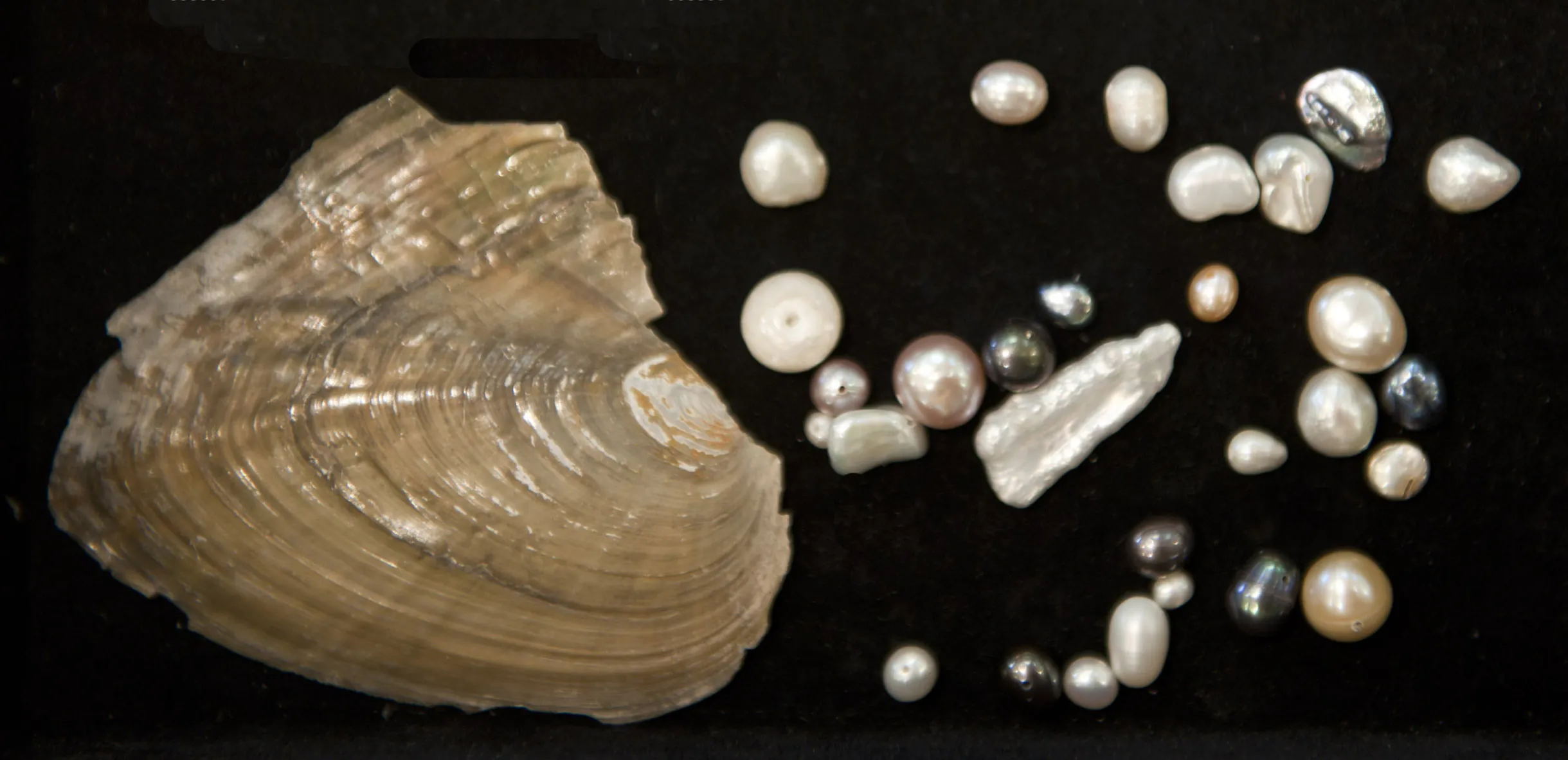
Yes. A single freshwater mussel can produce many cultured pearls during the same cultivation cycle. This is possible because pearl farmers can place multiple small pieces of donor mantle tissue into different areas of the mussel. Each successful implant can form its own pearl sac and grow a separate pearl.
But there is an important qualification: there is no universal number of pearls that every mussel produces. The result depends on the mussel species, cultivation method, number of implants, survival of those implants, growth period, and the farmer's quality target. Modern freshwater pearl culture also includes both tissue-nucleated and bead-nucleated methods, so simple claims such as “every mussel makes 20, 30, or 50 pearls” are too broad.
Why Can a Freshwater Mussel Grow More Than One Pearl?
The key is that a pearl does not need the entire mussel to itself. It develops inside a pearl sac, a small structure of epithelial cells that secretes nacre around the developing pearl.
In traditional tissue-nucleated freshwater cultivation, a technician inserts several tiny pieces of mantle tissue from a donor mussel into the mantle of a host mussel. If an implant survives and develops normally, the surrounding cells form a pearl sac. Because several implants can be placed at separate sites, several pearl sacs can develop inside one mussel at the same time.
This is one of the major differences between freshwater pearl culture and the simplified image many people have of “one oyster, one pearl.” For a fuller explanation of the process, see our guide to how cultured pearls are grown.
How Many Pearls Can One Mussel Produce?
The safest answer is: potentially many, but not a fixed number.
Historical Gemological Institute of America (GIA) documentation gives useful examples. A 2001 report showed a freshwater mussel that had received 14 pieces of mantle tissue in each of its two mantle lobes, for a theoretical total of 28 pearls. That same report noted that some farmers were already reducing the number of tissue implants to encourage the growth of larger pearls.
A later GIA review described Chinese freshwater mussels as being capable of producing dozens of pearls at a time, while contrasting them with akoya pearl oysters, which typically produced one or two in the cultivation systems discussed there.
Those examples are helpful for understanding what freshwater mussels can do, but they should not be treated as a modern production standard. Cultivation methods have continued to change. Today's freshwater industry includes non-bead cultured pearls, bead-cultured pearls, multi-site implantation, larger pearl targets, and quality-focused production strategies. The number of pearls per mussel therefore varies considerably.
Why Do Some Farmers Use Fewer Implants?
More implantation sites can increase the potential number of pearls, but maximum quantity is not always the goal.
A mussel has limited biological resources. Farmers may reduce the number of implants when they are trying to produce larger pearls or when a particular cultivation method requires more space around each developing pearl. Fewer implantation sites can also make management easier when the target is a more specific size, shape, or quality range.
This is why pearl farming is better understood as a balance between yield and quality targets, not as a contest to place the largest possible number of pearls inside one mussel.
Freshwater Mussels vs. Saltwater Pearl Oysters
Many confusing answers online come from treating all pearl-producing mollusks as if they were cultured in the same way. They are not.
| Feature | Freshwater Mussels | Saltwater Pearl Oysters |
|---|---|---|
| Common cultivation approach | Historically, multiple mantle-tissue implants; modern methods also include bead nucleation | Commonly bead nucleus plus mantle tissue placed in the gonad |
| Pearls per mollusk | Can be multiple and, in some methods, many | Usually far fewer per cultivation cycle |
| Typical production effect | Higher potential output per mussel | Lower potential output per oyster |
| Does this determine quality? | No | No |
The most useful distinction is therefore not simply “freshwater versus saltwater,” but what cultivation method was used and what the farm was trying to produce.
Are All the Pearls Inside One Mussel the Same?
No. Pearls from the same mussel can still differ noticeably in shape, surface, luster, size, and color.
Each pearl develops in its own pearl sac. Even though the pearls share the same host and the same pond environment, each implantation site can respond differently. Some grafts may fail. Some pearls may grow irregularly. Others may develop stronger luster or cleaner surfaces.
This is one reason sorting remains an essential step after harvest. A large number of pearls from one mussel does not mean a large number of perfectly matched jewelry-quality pearls.
If you want to understand why tissue-only freshwater pearls often show such a broad range of shapes, see our guide to freshwater non-nucleated pearls.
Does Producing Many Pearls Make Freshwater Pearls “Low Quality”?
No. Production efficiency and pearl quality are two different questions.
The ability of freshwater mussels to produce multiple pearls helps increase supply, which is one reason freshwater pearls can be available across a broad range of price points. But the number of pearls inside the host does not, by itself, tell you whether an individual pearl is good or poor.
A pearl still needs to be evaluated by characteristics such as luster, surface quality, shape, size, color, nacre quality, and—when several pearls are used together—matching. A high-quality freshwater pearl can be far more desirable than a poorly formed pearl from a lower-yield cultivation system.
For a broader framework, read our guide to how pearl value is evaluated.
What About Large Bead-Nucleated Freshwater Pearls?
This is where the simple “one mussel makes dozens of pearls” explanation becomes incomplete.
Modern freshwater pearl culture is no longer limited to the older tissue-only model. Bead-nucleated freshwater pearls use a solid nucleus together with mantle tissue, allowing farmers to pursue larger and more consistently round pearls. Depending on the technique, fewer implantation sites may be used than in traditional high-output tissue-nucleated culture.
At the same time, recent GIA reporting shows that freshwater bead culture continues to evolve, including multi-site implantation and regenerative cultivation methods. In other words, modern production is diverse: some systems aim for many pearls, while others give more space and time to a smaller number of larger pearls.
See our overview of nucleated freshwater pearls for the other side of this cultivation story.
Can One Mussel Produce Pearls More Than Once?
In some cultured freshwater systems, yes. Regenerative or sequential cultivation can allow a mussel to be used for more than one pearl-growing cycle when its health and the farming method make that practical.
This should not be confused with saying that every harvested mussel is automatically returned to the water and used again. Whether re-cultivation is possible depends on the technique, the condition of the animal, the type of pearl being produced, and farm management decisions.
What If You Mean Natural Pearls?
The “many pearls from one mussel” discussion mainly concerns cultured freshwater pearls, where farmers intentionally create multiple pearl-forming sites.
Natural pearl formation is uncontrolled. A wild mollusk can theoretically contain more than one natural pearl, but there is no planned set of implants and no predictable farm-style yield. It would therefore be misleading to take cultured-pearl production numbers and apply them to natural pearls.
If you want the biological foundation first, our article on how pearls form inside mollusks explains the role of the pearl sac and nacre formation.
The Short Version
One freshwater mussel can produce many cultured pearls at the same time because several separate pearl sacs can be started inside the same animal. Historical freshwater cultivation sometimes used enough tissue implants to produce dozens of pearls from one mussel.
But “dozens” is a capability, not a universal rule. Modern freshwater farming uses several different techniques, and farmers may deliberately reduce the number of pearls per mussel when aiming for larger, rounder, or otherwise more specific products.
So the better question is not simply “How many pearls can one mussel make?” It is: What type of freshwater pearl is being cultured, and what production method is being used?
Frequently Asked Questions
Can a freshwater mussel really produce dozens of pearls?
Yes. GIA has documented freshwater cultivation systems in which a single mussel could produce dozens of pearls. However, the exact number varies, and modern farms may use fewer implantation sites when targeting larger or more specific pearls.
Why can freshwater mussels produce more pearls than saltwater pearl oysters?
Traditional freshwater culture can place multiple mantle-tissue implants at different sites in the mussel. Each successful site can form a separate pearl sac. Saltwater bead-nucleated systems generally use far fewer implantation sites per animal.
Does every implanted tissue piece become a pearl?
No. Some implants may fail, and the pearls that do form can vary widely in quality. The number of implantation sites is therefore not the same as the number of finished jewelry-quality pearls.
Are pearls from the same mussel identical?
No. They can differ in size, shape, luster, surface quality, and color because each pearl develops in its own pearl sac.
Does a higher number of pearls make freshwater pearls less valuable?
Not automatically. Higher production efficiency can increase supply, but an individual pearl's value still depends on its quality characteristics, rarity, size, shape, luster, surface, color, nacre, and matching.
Sources and Further Reading
- GIA — Different Pearl Types & Colors: overview of cultured-pearl formation, including multiple mantle-tissue pieces in freshwater cultivation.
- GIA, Gems & Gemology, Summer 2001: historical documentation of Chinese freshwater cultured pearl practices, including a 28-implant example and the move toward fewer implants for larger pearls.
- GIA, Gems & Gemology, Fall 2007: documents freshwater mussels producing dozens of pearls at a time and contrasts this with akoya production.
- GIA, Gems & Gemology, Summer 2026: overview of modern Chinese freshwater pearl culture, including bead-cultured, multi-site, and regenerative techniques.