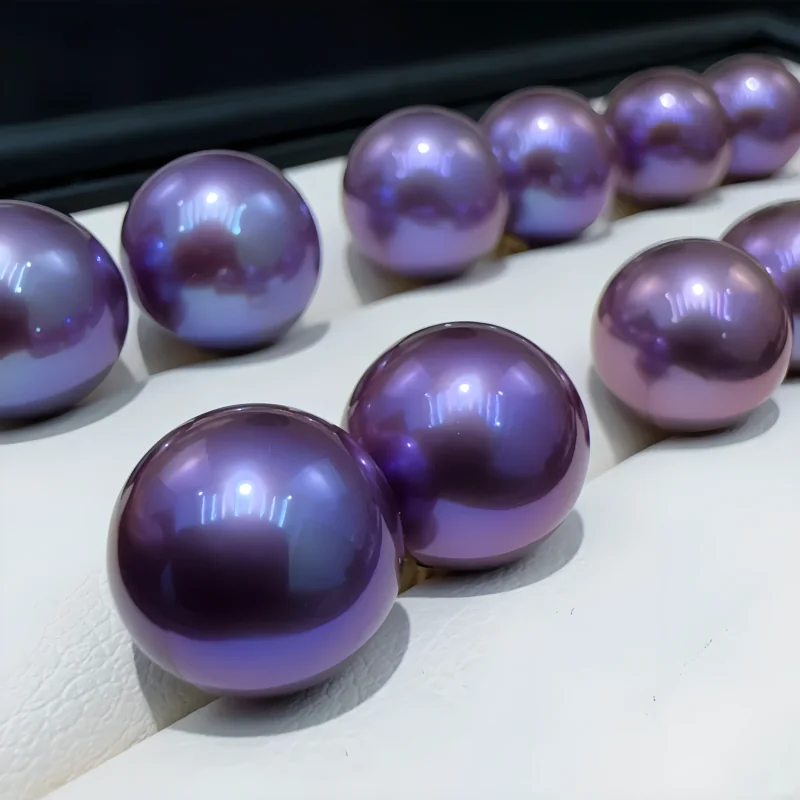
If your total budget is under RMB 500, start with freshwater cultured pearls. They give you the most room to choose attractive luster, a wearable size, and a design you actually like without spending most of the budget on the pearl type name itself.
At this price, the most useful priority order is usually: well-lustrous freshwater pearls first; small or intentionally shaped freshwater pieces second; bead-nucleated freshwater pearls for a larger single-pearl look; and Akoya only when you specifically want Akoya and are willing to buy a small, simple piece. Tahitian and South Sea pearls should not be your main target at RMB 500.
The important idea is not that freshwater pearls are “cheap pearls.” Modern freshwater cultured pearls cover a very wide quality range. GIA describes freshwater pearls as versatile, available in many colors and shapes, and generally more approachable in price than the major saltwater categories. If you are still learning the basic differences among pearl types, our Pearl Buying Guide gives the broader framework.
Quick Answer: What Should You Buy Under RMB 500?
| Pearl type or option | Priority under RMB 500 | Best use of the budget | Main compromise |
|---|---|---|---|
| Freshwater cultured pearls | Highest | Studs, pendants, small-to-medium necklaces, bracelets, everyday jewelry | May need to accept slight off-roundness or small surface features |
| Small / near-round / button / baroque freshwater pearls | Very high | Maximizing luster and design value without paying a roundness premium | Less classic than a perfectly round strand |
| Bead-nucleated freshwater / Edison-type pearls | Selective | One larger pendant pearl, ring, or simple pair | A full high-quality matched strand can exceed this budget |
| Akoya cultured pearls | Low unless Akoya itself is the goal | Small studs or a simple single-pearl design when a genuine, clearly disclosed option fits the budget | Smaller size, lower grade, simpler metalwork, or fewer pearls |
| Tahitian or South Sea pearls | Usually skip | Only a deliberate single-pearl bargain with clear identity and acceptable quality | RMB 500 leaves very little room for the premium normally attached to these types |
That ranking is about where RMB 500 buys the most visible pearl quality. It is not a permanent ranking of which pearl type is “best.” Increase the budget, change the jewelry format, or make the pearl type itself part of the goal, and the answer changes.
Why Freshwater Pearls Should Usually Come First
RMB 500 is enough to buy real cultured pearls, but it is not enough to demand every premium characteristic at once. The easiest way to waste this budget is to chase a prestigious category name while accepting weak luster, poor surface condition, tiny size, or flimsy jewelry construction.
Freshwater cultured pearls give you more flexibility. You can choose among round, near-round, button, oval, rice, drop, and baroque shapes; white, cream, pink, peach, lavender, and other colors; and many different sizes. That range lets the seller sort a pearl that is strong in the characteristic you care about without requiring it to be rare in every other way.
For a first purchase, that flexibility matters more than prestige. A bright, attractive freshwater pearl can look more convincing in normal wear than a saltwater pearl bought mainly because the listing says “Akoya.” If you want to browse finished pieces by this category, see freshwater pearl jewelry.
Priority 1: Traditional Freshwater Pearls for the Best Overall Value
For most buyers under RMB 500, traditional freshwater cultured pearls are the strongest default choice. Many are cultured without a spherical bead nucleus, which gives producers a broad range of shapes and sizes and gives buyers many ways to trade perfect geometry for better visible quality.
This is where you can often obtain the most balanced result: decent size, good luster, acceptable surface quality, and a practical jewelry format without forcing one feature to consume the entire budget.
For everyday wear, useful targets include:
- small-to-medium pearl studs where the front-facing luster matters more than absolute roundness;
- a simple single-pearl pendant where one attractive pearl receives most of the attention;
- a small freshwater strand when you prefer a youthful or minimalist necklace;
- near-round or oval freshwater necklaces when you want a classic impression without paying the full premium for strict roundness;
- baroque or irregular designs when you like organic shapes and want the form to become part of the design.
The key is to stop treating perfect roundness as mandatory. GIA notes that round cultured pearls generally command a premium when the other quality factors are equal. Under RMB 500, relaxing shape can therefore be an efficient way to preserve luster and size.
Priority 2: Small, High-Luster Freshwater Pearls Instead of Larger Dull Pearls
If two pieces cost roughly the same, the smaller pearl with stronger luster is often the better budget purchase. GIA lists luster among the seven major pearl value factors and describes it as one of the most important contributors to pearl beauty.
This is especially relevant to the Chinese market, where small “rice pearls,” seed-like freshwater strands, and 5–8 mm everyday pearls are common budget options. A smaller pearl can still look refined if the reflections are bright and the jewelry is proportioned well.
Do not assume that “bigger” means you are getting more value. Large diameter, perfect roundness, a very clean surface, and strong luster all compete for the same budget. At RMB 500, it is often more efficient to give up one millimeter of size than to give up the feature that makes the pearl look alive.
If you are unsure how millimeter size changes the visual effect, the Pearl Size Guide is more useful than choosing by age-based rules or vague labels such as “small,” “medium,” and “large.”
Priority 3: Button, Near-Round, Oval, and Baroque Pearls When Shape Is Not the Goal
One of the best ways to stretch RMB 500 is to buy a shape that works naturally with the jewelry instead of paying to make every pearl perfectly round.
Button pearls can work particularly well in stud earrings because the visible front can look round while the flatter back sits close to the ear. Near-round pearls can preserve a classic look at normal viewing distance. Oval and drop shapes suit pendants and dangling earrings. Baroque pearls make irregularity intentional rather than something that needs to be hidden.
This is not the same as buying a low-quality pearl. Shape and surface quality are separate questions. A baroque pearl can have strong luster and a clean visible surface, while a round pearl can be dull or heavily blemished.
If shape is the main trade-off you are considering, use the Pearl Shape Guide to compare what each form actually looks like in jewelry.
What About Edison or Other Bead-Nucleated Freshwater Pearls?
Bead-nucleated freshwater pearls—including pearls sold under the Edison name or Edison-style descriptions—can be attractive when you want a larger, rounder single pearl without moving directly into South Sea pricing.
Under RMB 500, however, the most efficient format is usually one pearl or a small number of pearls, not a high-grade full strand. A simple pendant, ring, or pair can concentrate the budget on a larger pearl. A necklace needs dozens of pearls plus matching, drilling, stringing, and a clasp, so the same budget is spread much more thinly.
Do not buy Edison simply because it sounds more premium than ordinary freshwater. Judge the actual luster, surface, shape, color, and size. A smaller traditional freshwater pearl with stronger luster can still be the better purchase.
Is “Freshwater Akoya” or “Freshwater AK” Actually Akoya?
No—if the pearl is freshwater cultured, it is not Akoya in the gemological sense. Akoya and freshwater are separate cultured pearl categories. Some sellers use expressions such as “freshwater AK,” “freshwater Akoya,” or “Akoya-like freshwater” to describe small, round, highly lustrous freshwater pearls whose appearance is intended to resemble the crisp look associated with Akoya.
The appearance may be attractive, and the product may be good value. The problem begins only when the wording makes you think you are buying actual Akoya cultured pearls.
Under RMB 500, read the material line rather than the marketing headline. If it says freshwater cultured pearl, compare it as a freshwater pearl. If it says Akoya cultured pearl, the seller should be able to stand behind that identity.
Can You Buy Real Akoya Pearls Under RMB 500?
Sometimes, but Akoya should not be your default target at this budget. A small pair of studs, a single pearl, an older-stock item, a lower grade, or a very simple setting may occasionally fit under RMB 500. That does not mean the same budget is realistic for a well-matched classic Akoya strand.
If you specifically want Akoya, make the category itself your priority and simplify everything else:
- choose fewer pearls rather than a full strand;
- accept a smaller diameter;
- use a simple setting instead of elaborate metalwork;
- accept minor surface features if the luster is still attractive;
- verify that “Akoya” is the actual pearl type, not a style description.
If the goal is simply “a beautiful white pearl,” do not pay the Akoya premium by default. If the goal is specifically the classic Akoya look and identity, then a small genuine piece can make sense. Our Akoya pearl jewelry category is the relevant comparison point once your budget or format supports it.
Should You Buy Tahitian or South Sea Pearls Under RMB 500?
For a beginner with a hard RMB 500 ceiling, usually no. Tahitian and South Sea pearls normally carry higher price expectations because of their pearl type, typical size range, cultivation economics, and market positioning. Trying to force one into a very low total budget often means accepting a very small selection, conspicuous surface issues, an unusual shape, a minimal setting, or uncertainty about what the listing actually is.
A genuine single pearl with visible imperfections can still be worthwhile if you understand exactly what you are buying. But if a listing promises a large, perfectly round, flawless “Tahitian” or “South Sea” pearl in finished jewelry for an unusually low price, slow down and verify the identity, treatment disclosure, size, photographs, and return terms.
The same rule applies to dark pearls. A black or gray pearl is not automatically Tahitian; freshwater pearls can be treated to produce dark colors. Color and pearl type are separate claims.
Which Jewelry Format Gives the Best Value Under RMB 500?
| Jewelry format | Value under RMB 500 | Why |
|---|---|---|
| Stud earrings | Excellent | You only need two pearls, so more of the budget can go into luster, front-facing surface quality, and matching |
| Single-pearl pendant | Excellent | One pearl can receive most of the quality budget; matching is irrelevant |
| Small freshwater necklace | Good | Small diameter and simple matching can still produce a complete real-pearl strand |
| Baroque / mixed-shape necklace | Good | Irregular shape is part of the design, so less budget is spent on strict roundness |
| Large, round, highly matched strand | Poor target | The budget must pay for many pearls plus size, roundness, matching, stringing, and clasp |
This leads to a useful rule: when the budget is very tight, buy fewer better-looking pearls before buying many weak-looking pearls. A bright pair of studs can be a more satisfying first purchase than a dull full necklace that only wins on quantity.
Do Not Let the Setting Consume the Whole Budget
RMB 500 is a total jewelry budget, not just a pearl budget. Metal, chains, posts, clasps, stones, plating, labor, design complexity, packaging, and brand markup all compete with the pearl itself.
If the pearl is your main priority, a simple sterling-silver setting or a restrained design can leave more room for visible pearl quality. Precious-metal settings may still be available in tiny or simple pieces, but you should understand that every extra gram of gold or every added stone reduces what remains for the pearl.
This matters most when comparing two pieces that look similar in a product grid. One may be charging for better pearls; the other may be charging for the setting, brand, or design. Neither is automatically wrong—but they are not buying you the same thing.
Within the Same Pearl Type, Protect These Qualities First
Once you have chosen freshwater—or found an Akoya option that genuinely fits—use the quality budget carefully. GIA evaluates pearls through size, shape, color, luster, surface quality, nacre quality, and matching.
For an RMB 500 purchase, a practical order is:
- Protect luster. Stronger reflections make the whole pearl look more alive.
- Avoid serious condition problems. Minor growth marks are different from cracks, peeling, or obvious structural damage.
- Protect the visible face. A small mark on the back of a stud or pendant may matter much less than one in the center of the visible surface.
- Protect matching only when you need it. It matters for stud pairs and strands, not for a single pendant pearl.
- Relax size and perfect roundness before sacrificing overall beauty. These are common places to save money intelligently.
For a deeper explanation of these factors, see the Pearl Grading Guide. If you want the broader spending ladder beyond RMB 500, our Pearls by Budget guide shows what tends to change as more budget becomes available.
A Practical Online Checklist for a RMB 500 Pearl Purchase
Low-priced listings often use more marketing language and fewer useful specifications. Before paying, try to get clear answers to the following:
- What is the pearl type? Freshwater cultured pearl, Akoya cultured pearl, Tahitian, South Sea, or imitation?
- What is the actual size range in millimeters? Do not rely on “small,” “large,” or model photos alone.
- What is the shape? Round, near-round, button, oval, baroque, rice, or another form?
- What metal is used? Sterling silver, gold, plated metal, alloy, or another material?
- Is the color natural to the pearl type or treated? Treatment is not automatically bad, but it should not be hidden.
- Are the photos of the exact item or representative stock? This matters when surface features and matching affect the purchase.
- What does the seller's grade mean? AAA, AAAA, “Aurora,” “top grade,” and similar labels are only useful when the seller defines them.
- Can you return the item after seeing it in normal light? Pearls are highly visual, so a fair return policy is especially useful for online buying.
A laboratory report is not necessary for every inexpensive freshwater purchase. It becomes more useful when a claim materially affects price—such as whether a pearl is actually Akoya, Tahitian, South Sea, naturally colored, or otherwise represented as something more specific than an ordinary freshwater cultured pearl.
Common Mistakes to Avoid Under RMB 500
- Trying to buy “the best pearl type” instead of the best-looking pearl for the money.
- Choosing large diameter over luster. A bigger dull pearl is not automatically a better purchase.
- Paying heavily for perfect roundness. Near-round, button, oval, and baroque shapes can be far more budget-efficient.
- Assuming “freshwater AK” means genuine Akoya. Read the actual pearl-type disclosure.
- Buying a full strand when two good pearls would make you happier. Quantity spreads a small budget thinly.
- Ignoring the setting and construction. Weak posts, rough drilling, poor stringing, or unreliable clasps can ruin the value of decent pearls.
- Trusting grade letters without definitions. Compare the actual pearl, not just the label.
Frequently Asked Questions
Can RMB 500 buy real pearls?
Yes. Genuine cultured freshwater pearls are widely available within this budget. “Cultured” does not mean fake; cultured pearls form in mollusks with human assistance. Imitation pearls are manufactured materials made to resemble pearls.
What pearl type gives the best value under RMB 500?
For most buyers, freshwater cultured pearls offer the best balance of luster, size, shape choice, and finished-jewelry options. The exact best choice still depends on whether you want studs, a pendant, a strand, or a larger single pearl.
Can I buy Akoya pearls for less than RMB 500?
Sometimes, especially in small studs, single-pearl pieces, lower grades, or simple settings. But if your only goal is to get the most attractive pearl jewelry for the money, freshwater usually gives you more room to protect visible quality.
Is “freshwater Akoya” the same as Akoya?
No. If the pearl is freshwater cultured, it belongs to the freshwater category, even if a seller uses “AK,” “Akoya-like,” or similar wording to describe its appearance. Actual Akoya pearls are a distinct saltwater cultured pearl category.
Should I buy Edison pearls under RMB 500?
They can make sense if you want a larger single pearl. A pendant, ring, or simple pair can concentrate the budget on one or two bead-nucleated freshwater pearls. A high-quality matched Edison strand is a different budget problem.
Should I buy a necklace or earrings with RMB 500?
If visible pearl quality is the priority, studs or a single pendant are usually easier to optimize because you only need one or two pearls. If you specifically want a necklace, smaller freshwater pearls or intentionally non-round shapes generally use the budget more efficiently.
Do I need a certificate for a pearl under RMB 500?
Not necessarily for a straightforward freshwater cultured pearl purchase. A report becomes more valuable when identity, treatment, origin, or another specific claim changes what you are willing to pay. The report should verify the claim that matters rather than simply add another piece of paper.
Final Takeaway
Under RMB 500, prioritize freshwater cultured pearls and spend the budget on visible beauty rather than category prestige. Start with strong luster, acceptable condition, a wearable size, and a shape you like. Near-round, button, oval, baroque, and smaller pearls can all be smart compromises because they let you preserve the qualities you notice most.
Consider Akoya only when Akoya itself is part of what you want—and then simplify the piece rather than expecting a premium full strand at an entry budget. Treat Tahitian and South Sea pearls as exceptions, not targets, unless you clearly understand why a particular single pearl fits the price.
RMB 500 is not too little to buy good-looking real pearl jewelry. It is simply a budget where choosing the right pearl type matters more than trying to buy every premium feature at once.