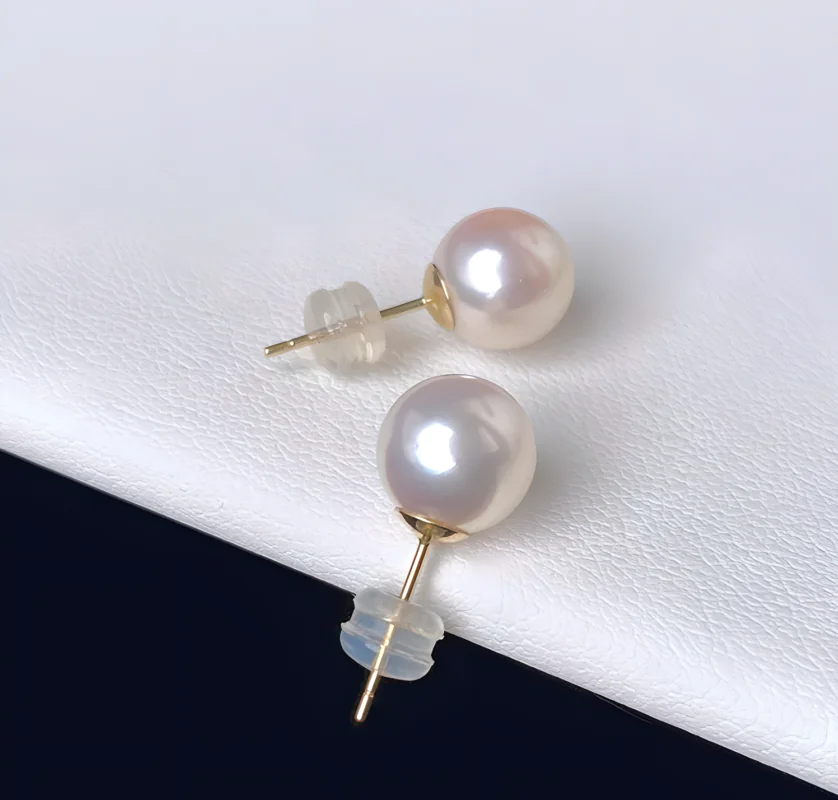
No. High luster is one of the most important signs of pearl quality, but it does not automatically make a pearl the best choice. A pearl can have bright, sharp reflections and still be heavily blemished, poorly matched, the wrong shape for the design, or simply less suitable for you than another pearl with a different character.
The better rule is: judge luster first, but judge the pearl as a whole before you buy. The Gemological Institute of America (GIA) evaluates pearl quality through seven value factors: size, shape, color, luster, surface, nacre, and matching for multi-pearl pieces. Luster may be especially influential, but it is only one part of that system.
Why High Luster Matters So Much
Pearl luster describes the intensity and sharpness of light reflected from the surface and the nacre beneath it. Fine luster gives a pearl bright, clearly defined reflections and a sense of depth. Weaker luster tends to look hazier, flatter, or more chalky.
That is why luster often creates the strongest first impression. GIA notes that, within a pearl type and when the other value factors are equal, higher luster generally means higher value. If you want to learn how to judge reflection sharpness in practice, see our Pearl Luster Guide.
But the phrase “when the other factors are equal” is important. In real buying, they usually are not equal. One pearl may have better luster but more surface marks; another may be rounder but slightly softer in reflection. A strand may contain individually beautiful pearls but look inconsistent as a group.
So the practical question is not “Which pearl has the most luster?” It is “Which pearl has the best combination of qualities for this pearl type, this piece of jewelry, and my budget?”
First Check: Are You Comparing the Same Kind of Luster?
One of the easiest mistakes is to use a single visual standard for every pearl variety. Fine pearls do not all need to look equally mirror-like.
CIBJO's pearl classification guidance describes typical luster tendencies that differ by pearl type: Akoya pearls are associated with sharper luster, South Sea pearls commonly show a more satiny character, Tahitian pearls can range from sharp to metallic, and freshwater pearls can range from satiny to sharp.
This does not mean every pearl of a given type will look the same. It means you should compare like with like. A fine South Sea pearl should not be rejected simply because its glow is broader and softer than that of a fine Akoya pearl.
Before deciding that one pearl is “better,” first confirm:
- the pearl type you are comparing;
- that the lighting and photography are reasonably similar;
- that the pearls are in a comparable size and quality range; and
- that you are judging the characteristic beauty of that pearl type, not forcing every pearl into an Akoya-style mirror standard.
What Should You Check After Luster?
1. Surface Quality: How Serious Are the Marks?
Most cultured pearls have some surface characteristics. Small pits, wrinkles, spots, growth marks, or shallow irregularities can be normal. The important questions are how large they are, how many there are, where they are located, and whether they affect durability or the overall appearance.
A high-luster pearl with one small blemish can still be a very attractive choice. In fact, a minor mark may be visually less important than dull luster because the eye often notices the pearl's brightness and life before a tiny imperfection.
However, high luster should not distract you from serious damage. Deep cracks, peeling, broken nacre, or large defects in prominent areas deserve more caution. GIA notes that severe or numerous surface characteristics can reduce both beauty and value and, in some cases, affect durability.
For a closer look at the difference between ordinary surface features and more concerning defects, see our Pearl Surface & Blemishes Guide.
2. Nacre Quality: Does the Pearl Look Structurally Sound?
Luster and nacre are closely related, but they are not the same thing. Nacre is the material deposited by the mollusk that forms the pearl's outer structure. Its quality affects appearance and can affect durability.
A lustrous surface is a good sign, but it is not a precise measurement of nacre thickness. You should still look for warning signs such as obvious chalkiness, exposed or visible nucleus effects, peeling, severe banding, or structural-looking cracks.
This is especially important when evaluating bead-nucleated cultured pearls. Do not assume that a dramatic studio reflection proves everything underneath the surface is ideal.
3. Shape: Is the Premium for Roundness Worth It to You?
Round pearls are generally rarer and, all else being equal, more valuable. But roundness and luster answer different questions.
If you want a classic strand or highly symmetrical stud earrings, shape may matter a great deal. If you prefer baroque, drop, oval, or organic designs, paying extra for perfect roundness may add little value to you personally.
This creates one of the most useful pearl-buying trade-offs: a slightly off-round pearl with excellent luster can be a better purchase than a perfectly round pearl with noticeably weaker luster. It depends on the design and the price difference, not on a universal ranking.
If shape is part of your decision, our Pearl Shape Guide explains the practical differences among round, near-round, oval, drop, button, and baroque pearls.
4. Size: More Millimeters Do Not Equal More Quality
Size strongly affects price because larger pearls are generally rarer within the same pearl type. But size is a value factor, not a shortcut for quality.
A 10 mm pearl with flat luster does not automatically become a better pearl than an 8 mm pearl with excellent luster, cleaner surface, and stronger overall appearance. The larger pearl may be more expensive because of rarity and visual presence, but it may not be the more beautiful or better-made option.
Choose size according to how much presence you want when the jewelry is worn. Then compare quality within that size range instead of treating “largest” as “best.”
5. Color: Is It Attractive to You, and Is It Accurately Described?
Pearl color includes bodycolor and may also include overtone and orient. Unlike luster, which has a clearer quality direction, color is partly a matter of preference, pearl type, rarity, and market demand.
A very high-luster pearl can still be the wrong color for the wearer or the design. A cooler silver-white pearl, a warmer cream-white pearl, a peacock Tahitian pearl, and a golden South Sea pearl can all be beautiful for different reasons.
When color has a meaningful effect on price, also pay attention to disclosure. Natural color and treated color should not be presented as if they were the same thing. The right purchase is not simply the rarest color; it is the color you actually want, described honestly.
6. Matching: Does the Whole Piece Look Consistent?
Matching matters for earrings, necklaces, bracelets, and other pieces containing more than one pearl. GIA treats matching as a separate value factor because a multi-pearl piece is judged not only by the quality of its individual pearls, but also by how well they work together.
A pair of earrings can contain two high-luster pearls and still look wrong if one is noticeably pinker, larger, rounder, or brighter than the other. A necklace can contain several excellent pearls but appear uneven if luster changes dramatically from pearl to pearl.
Good matching does not always mean identical pearls. A graduated strand, multicolor necklace, or intentionally mixed baroque design can be well matched when the variation is deliberate and harmonious. The important question is whether the piece looks coherent, not merely whether its best individual pearl is impressive.
7. Grade Labels: What Does “AAA” or “Top Grade” Actually Mean?
Seller grade labels can be useful within one seller's own system, but they should not replace visual evaluation. Terms such as “AAA,” “AAAA,” “top grade,” “mirror luster,” or “gem quality” are not automatically equivalent across unrelated sellers.
Instead of buying the letters, check what the seller means by them. Ask how luster, surface, shape, nacre, and matching are assessed. Our Pearl Grading Guide explains why pearl grading systems should be read through their criteria rather than the grade label alone.
When Is the Highest-Luster Pearl Not the Best Choice?
There are several common situations where “pick the brightest pearl” is too simple.
- When you are comparing different pearl types: a fine South Sea pearl may have a satiny glow rather than the sharpest mirror reflection in the group.
- When the surface has a serious defect: exceptional luster does not cancel deep cracks, peeling, or structural damage.
- When the piece is poorly matched: one spectacular pearl cannot rescue a pair or strand that looks inconsistent.
- When the shape does not suit the design: the brightest baroque pearl is not automatically the best choice for a client who specifically needs round studs.
- When color matters more to the wearer: a slightly softer-luster pearl in the preferred color may be the better real-world purchase.
- When the price premium is disproportionate: a small increase in luster may not justify a large price jump if the difference is barely visible at normal wearing distance.
“Best” should therefore mean best balanced for the intended use, not simply best at one measurable-looking characteristic.
A Practical Buying Order: What to Prioritize First
If you are comparing several pearls and do not want to overcomplicate the decision, use this order:
- Confirm the pearl type and compare under similar conditions.
- Check luster. Prefer lively, well-defined reflections over flat or chalky appearance.
- Reject serious surface or nacre problems. Minor natural marks are different from damage.
- Check matching if there is more than one pearl.
- Choose shape and size for the design you actually want.
- Choose color for preference, rarity, and honest disclosure.
- Only then compare price and seller grade labels.
This order is not a universal grading formula. It is a buying framework. It prevents two common mistakes: paying mainly for size while accepting dull pearls, and paying mainly for luster while overlooking more serious problems.
For a broader first-purchase framework, see our Pearl Buying Guide.
Three Quick Comparisons
Example 1: Excellent luster, one small pit vs. clean surface, weak luster
If the pit is minor and not visually dominant, the high-luster pearl will often be the more attractive choice. A tiny mark may disappear at normal viewing distance, while weak luster affects the entire pearl.
Example 2: Near-round high-luster pearl vs. perfectly round medium-luster pearl
If perfect roundness is not essential to the design, the near-round high-luster pearl may offer stronger visual value. If you are building a very formal matched strand, the shape premium may matter more.
Example 3: Very lustrous pearl vs. slightly softer pearl in a much better-matched pair
For earrings, choose the pair that works together. Matching can have more impact on the finished jewelry than the maximum luster of one individual pearl.
So, Are High-Luster Pearls the Best?
High luster is one of the strongest signs of a fine pearl, but the best pearl is rarely chosen by luster alone.
Start with luster because it has an immediate effect on beauty. Then check surface condition and nacre, compare shape and size against the design, consider color, and inspect matching across the whole piece. Most importantly, compare pearls within the correct pearl type.
A useful final rule is:
Prefer high luster when the other factors are reasonably sound—but do not let high luster hide a serious weakness elsewhere.
If you are ready to compare finished pieces with these factors in mind, browse our pearl jewelry collection.
Frequently Asked Questions
Is luster the most important pearl quality factor?
Luster is often considered one of the most important pearl value factors because it strongly affects how bright, deep, and lively a pearl looks. However, overall quality also depends on surface, nacre, shape, size, color, and matching.
Is a high-luster pearl with blemishes still good quality?
It can be. Minor surface marks are common and may be an acceptable trade-off for excellent luster. Large, deep, numerous, or structurally concerning defects should be judged more cautiously.
Are mirror-like pearls always better than satin-luster pearls?
No. Different pearl types can show different characteristic luster. Fine Akoya pearls are often associated with crisp reflections, while South Sea pearls may show a broader, satiny glow. Compare quality within the pearl type.
Should I choose better luster or a larger pearl?
If the size difference is modest, stronger luster is often the more visible quality upgrade. If size is central to the design or look you want, the larger pearl may still be the better personal choice.
Does high luster prove that a pearl has excellent nacre?
No. Luster and nacre quality are related, but visible luster alone does not prove nacre thickness or rule out every structural issue. Nacre should still be considered separately when relevant.