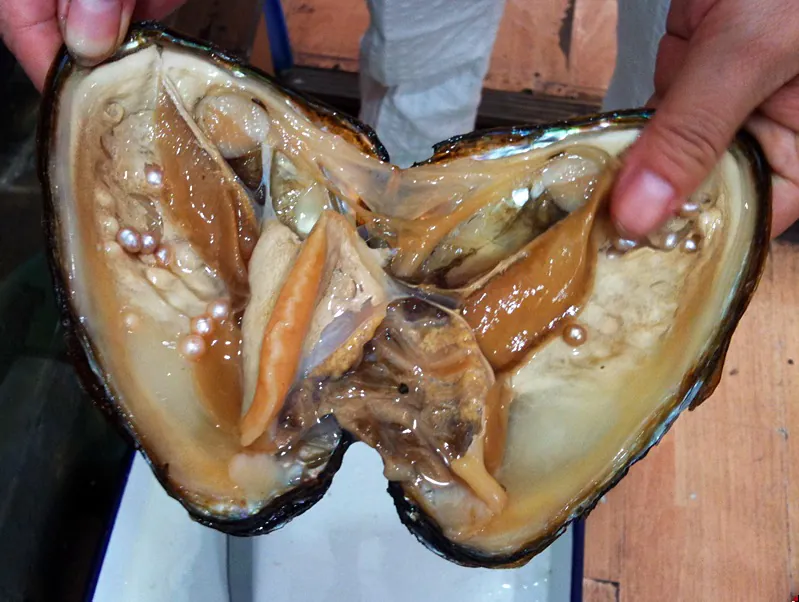
Harvesting is not the end of a pearl’s journey. Once a pearl is removed from the mollusk, it is usually cleaned, inspected, sorted and graded. Depending on the pearl type and the intended market, it may also be polished, treated, drilled, matched with other pearls, or set into jewelry.
The important point is that these steps are not all the same. Cleaning, sorting and drilling are ordinary preparation steps; color or appearance treatments are separate processes and are not applied to every pearl. The exact sequence also varies by pearl type, producer and final use.
1. Freshly Harvested Pearls Are Cleaned First
A pearl that has just come out of a mollusk is not automatically ready for a jewelry counter. It may have moisture, organic residue or other material on its surface from the harvest process. The first job is therefore basic cleaning so the pearl can be inspected accurately.
This is an important distinction: cleaning does not automatically mean the pearl has been “treated.” Cleaning removes residue so the existing surface can be seen. A treatment, by contrast, generally refers to a process intended to alter color, appearance, composition or durability.
Trade terminology is not completely identical everywhere. The World Jewellery Confederation (CIBJO), for example, distinguishes common post-harvest procedures such as cleaning, drilling, polishing and buffing from treatments that more substantially alter a pearl. That distinction is useful for buyers because it focuses attention on what was actually done, not merely on a vague word such as “processed.”
2. The Harvest Is Screened Before Fine Grading
A pearl harvest is naturally mixed. Pearls from the same farm—or even the same harvest period—can differ in size, roundness, color, luster, surface condition and overall usability.
Before detailed grading begins, obvious differences are separated. Severely damaged pearls, poorly formed material or pearls unsuitable for the intended product may be set aside. The remaining pearls are divided into groups that can be compared more meaningfully.
This first screening is not the same as assigning a final commercial grade. It is closer to organizing the harvest so that later decisions make sense. Comparing a small baroque pearl with a large round pearl as though they belonged to one grade would tell a buyer very little.
3. Pearls Are Sorted Again and Again
Sorting is one of the most important—and often underestimated—parts of post-harvest work. Pearls may be separated by:
- diameter or millimeter range,
- shape family,
- bodycolor and overtone,
- luster,
- surface characteristics,
- nacre quality,
- whether they are drilled or undrilled, and
- their intended use, such as earrings, strands, pendants or wholesale lots.
Sorting may happen several times rather than once. A group that is first separated by size may later be divided by color, then luster, then surface quality. The tighter the final match needs to be, the more selective this process becomes.
If you want to understand how these visible qualities affect commercial evaluation, see our pearl grading guide.
4. Some Pearls Receive Additional Processing or Treatment
This is where many explanations become too simple. There is no single post-harvest recipe used for every cultured pearl.
White and light-colored Akoya and freshwater cultured pearls, for example, are commonly discussed in gemological literature in connection with bleaching, luster enhancement or optical brightening. Other pearls may reach the market with much less appearance-changing treatment. Dyeing, irradiation and coatings also exist, but they should not be treated as universal steps.
In other words, the accurate question is not “Are pearls processed after harvest?”—almost all commercial pearls undergo some form of preparation. The more useful questions are:
- What kind of processing was used?
- Did it merely clean or prepare the pearl?
- Did it deliberately change the color or optical appearance?
- Is that treatment relevant to value, care or disclosure?
For a deeper explanation of bleaching, dyeing, irradiation, coating and other methods, read our guide to cultured pearl treatments.
5. Polishing Does Not Always Mean Reshaping
The word “polishing” can also cause confusion. Gentle surface polishing or buffing may be used to improve presentation or remove minor residue. That is different from deliberately grinding, carving or reshaping a pearl.
The distinction matters because pearls are layered organic gemstones. Aggressive removal of material can affect the nacre surface and may change the pearl in a much more significant way than routine cleaning or buffing.
This is another reason not to judge a pearl from one broad label. “Polished,” “treated,” “natural color” and “processed” can refer to very different things unless the specific method is explained.
6. Grading Comes After the Pearl Can Be Compared Fairly
Once pearls are clean and organized into comparable groups, graders can evaluate their commercial quality more consistently. GIA describes seven pearl value factors: size, shape, color, luster, surface, nacre and matching for multi-pearl pieces.
Not every seller uses the same letter-grade system. One company’s “AAA” is not automatically identical to another company’s “AAA.” For that reason, the underlying quality factors are more useful than relying on a grade label alone.
Grading is also not simply a hunt for “perfect” pearls. A strongly lustrous baroque pearl can be desirable precisely because of its individual shape. A round pearl may command a premium when roundness is important for the intended jewelry. Quality has to be judged within the right category and use.
7. Pearls May Then Be Drilled, Paired and Matched
Many pearls are drilled before they become jewelry, but drilling is not mandatory. Some are sold undrilled as loose pearls, while others receive a half-drill for earrings, pendants or rings. Pearls intended for strands are usually drilled through.
The exact point at which drilling happens can vary. Some operations drill earlier; others complete more sorting and grading first. What matters is precision. A poorly positioned hole can make a pearl sit incorrectly, complicate matching or waste usable material.
After drilling, pearls intended for multi-pearl jewelry often go through another matching stage. A well-matched pair of earrings may require two pearls close in size, color, luster, shape and surface appearance. A necklace can require dozens of pearls that look harmonious together.
This is why a finished strand is more than a collection of individually attractive pearls. Matching itself requires selection and labor. For businesses that need drilling, matching, inspection or custom production, our pearl sourcing and processing services explain the types of work that can happen between loose pearls and finished jewelry.
8. The Final Destination Depends on the Pearl
After grading and preparation, pearls can take several different paths. Some are sold individually as loose pearls. Others are paired for earrings, matched into strands, selected as center pearls for pendants or rings, grouped into wholesale lots, or sent directly into jewelry manufacturing.
Higher-value pearls often require tighter selection because small differences become more noticeable when several pearls are placed next to each other. Lower-priced commercial lots may allow wider variation depending on the intended style.
For designers and makers, this is why buying a “pearl” is often really a choice about product form and consistency: a loose focal pearl, a matched pair and a full strand require different levels of sorting. Our wholesale pearl selection includes loose pearls and strands for different sourcing needs.
Why Two Pearls from the Same Harvest Can End Up at Very Different Prices
Post-harvest work does not create all of a pearl’s value, but it reveals, organizes and sometimes modifies what came out of the mollusk.
Two pearls harvested at the same time can end up in different price groups because one may have stronger luster, a cleaner surface, a more desirable shape, thicker or more attractive nacre, a rarer color, or simply be easier to match with other high-quality pearls.
The finished product adds another layer. A pearl that works beautifully as a single pendant may not have a close enough match for a pair of earrings. A strand requires many pearls that belong together visually, so matching can significantly affect the final value of the piece.
What Should a Buyer Ask About Post-Harvest Processing?
You do not need to know every factory step to buy pearls intelligently. A few specific questions are more useful than asking whether a pearl is simply “processed.”
- Is the color natural or has it been altered?
- Has the pearl been bleached, dyed, irradiated, coated or otherwise treated?
- Is it drilled, half-drilled or undrilled?
- How was the pearl graded, and which quality factors matter most in this lot?
- For pairs or strands, how tightly are the pearls matched?
The goal is not to treat every intervention as suspicious. The goal is to know the difference between ordinary preparation and a process that materially changes what you are buying.
The Main Takeaway
After harvesting, pearls usually pass through several stages before they become jewelry or wholesale goods: cleaning, screening, sorting, optional treatment, grading, drilling and matching. The order can vary, and not every pearl receives every step.
The most useful distinction is between routine preparation and appearance-changing treatment. Once you understand that difference, the journey from mollusk to finished jewelry becomes much easier to evaluate—and labels such as “processed,” “treated” or “graded” become far less confusing.
Frequently Asked Questions
Are pearls ready to sell immediately after harvesting?
Usually not in their final commercial form. Newly harvested pearls generally need cleaning, inspection and sorting before they can be graded, matched or prepared for jewelry. Some may be sold loose after relatively limited preparation, while others go through additional steps.
Are all cultured pearls bleached after harvest?
No. Bleaching is common in some categories—particularly white and light-colored Akoya and freshwater cultured pearls—but it is not a universal step for every pearl type or every producer.
Does polishing mean a pearl has been reshaped?
Not necessarily. Light polishing or buffing can be a surface-preparation step. Grinding, carving or deliberate reshaping removes or alters material more substantially and should be considered separately.
Are pearls drilled before or after grading?
There is no universal sequence. Some workflows drill earlier, while others complete more sorting and grading first. The order depends on the pearl type, production system and intended final product.
Why are pearls matched after they are graded?
Individual quality and group harmony are different problems. A pair of earrings or a strand needs pearls that look compatible in size, color, luster, shape and surface appearance, so matching often requires another round of selection after individual grading.