Tahitian pearls are often grouped together as “black pearls,” but the color that makes one pearl look green, teal, rose, or almost purple is usually more complicated than a single label. Three names appear especially often in listings: peacock, blue-green, and cherry.
The fastest way to understand them is to separate three different ideas: the pearl’s bodycolor, its overtone, and, when present, its orient. A seller may call two pearls “peacock,” for example, even though one looks predominantly green and the other shows a much stronger pink or purple flash. Likewise, “blue-green” and “cherry” are useful trade descriptions, but they are not universal grades with identical boundaries from every seller.
This guide focuses on how these three color families actually differ in appearance, how to compare them more reliably, and what the labels can—and cannot—tell you about quality or value. For the wider palette, including silver, charcoal, pistachio, aubergine, and other dark colors, see our guide to the natural dark color range of Tahitian pearls.
First, Separate Bodycolor from Overtone
GIA describes pearl color as potentially having three components. Bodycolor is the dominant overall color. Overtone is one or more translucent colors seen over that bodycolor. Orient is a more iridescent, rainbow-like effect visible on or just below the surface. Not every pearl shows all three components.
This distinction matters especially with Tahitian cultured pearls because their naturally dark nacre can combine gray, silver, green, brown, blue, pink, and purple effects in many different ways. A pearl may have a dark gray bodycolor but a clear green overtone. Another may have a greener bodycolor with a pink-to-purple surface effect. From a distance, both may simply be sold as “dark Tahitian pearls.”
In practice, it helps to ask two questions in order:
- What is the main color of the pearl when I ignore the brightest flash? That is the bodycolor.
- What secondary color seems to float over the surface or appear as I rotate the pearl? That is the overtone or, in more complex cases, part of the orient.
Once you separate those layers, the terms peacock, blue-green, and cherry become much easier to compare.
What Does “Peacock” Mean in Tahitian Pearls?
Peacock is the most recognized Tahitian pearl color term, but it should not mean merely “dark and colorful.” GIA now uses “peacock” as a trade-color comment for a defined range of cultured pearls from Pinctada margaritifera, the black-lipped pearl oyster associated with Tahitian pearls.
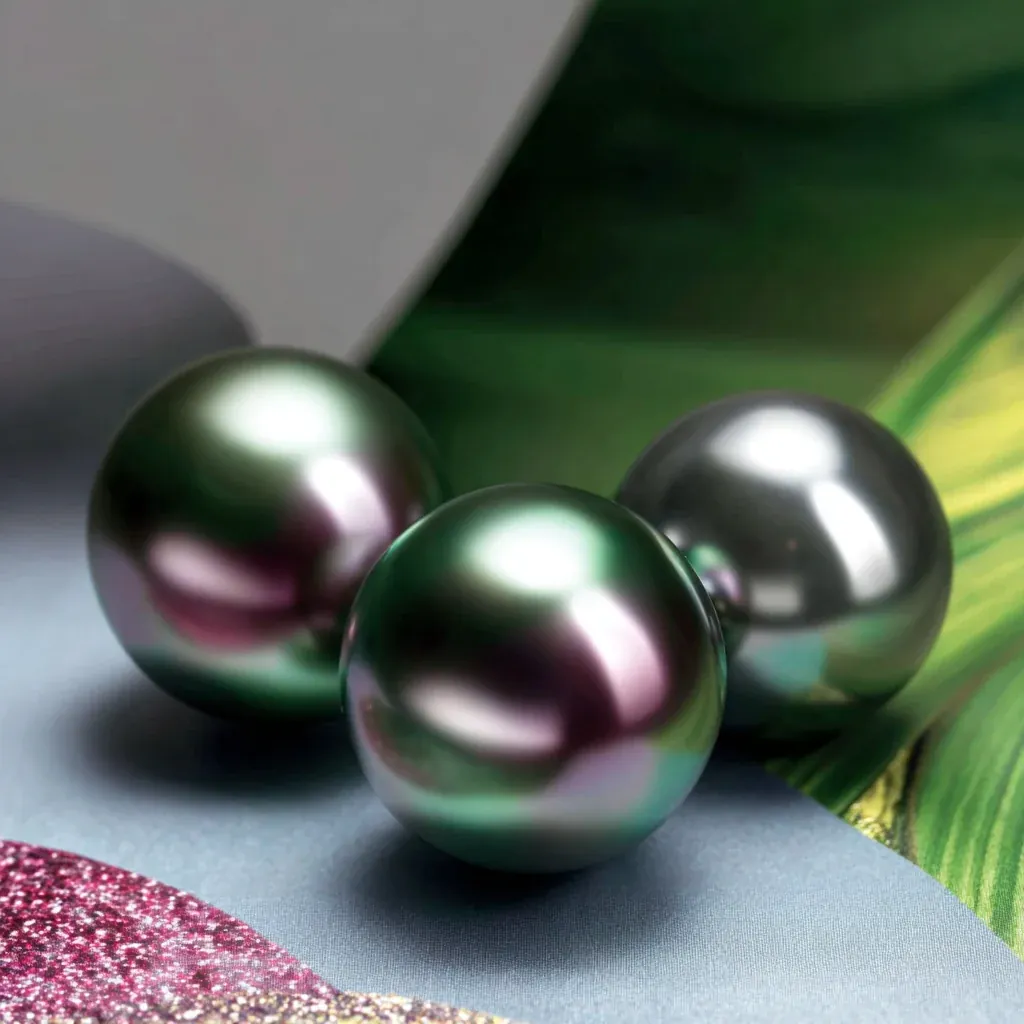
GIA describes that range as having a bodycolor whose hue contains green, with medium-to-strong saturation and a medium-to-dark tone, together with a moderate or stronger overtone or orient—usually pink, although other hues can occur. That definition explains why the classic peacock look is often described as a contrast between green and rose, pink, or purple, rather than simply as “green.”
A strong peacock pearl may therefore show:
- a medium-dark or dark green-containing bodycolor;
- a visible pink, rose, purple, or mixed secondary color;
- enough saturation that the color looks distinct rather than muddy;
- good luster, which makes the color contrast appear sharper and more alive.
The important point is that peacock describes a color relationship. A dark gray pearl with only a weak green cast is not necessarily a convincing peacock pearl, and a vivid green pearl with no contrasting overtone may be better described simply as green.
GIA’s introduction of a defined “peacock” report comment is useful because it gives this particular trade term more structure than many other romantic color names used in pearl listings. You can read GIA’s explanation of the peacock color range for the laboratory’s wording.
What Does Blue-Green Look Like?
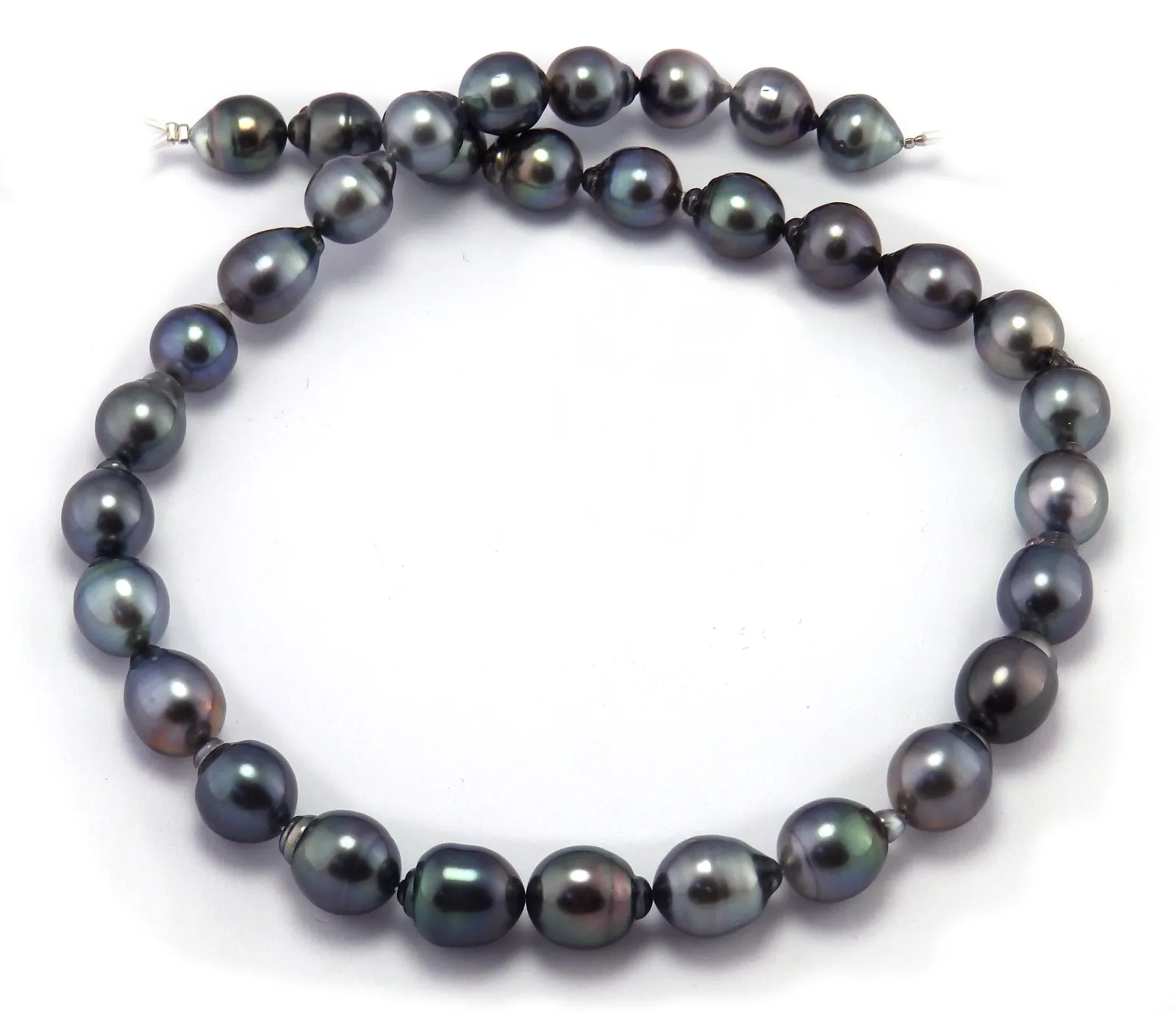
Blue-green Tahitian pearls sit on the cooler side of the color spectrum. Depending on the pearl, the eye may read them as teal, petrol blue, deep ocean green, or a gray-green color with a cool blue flash.
Unlike peacock, blue-green does not have one universally enforced trade definition. One seller may use the term for a green bodycolor with a blue overtone; another may use it for a blue-gray pearl with a strong green modifier. That is why the actual pearl matters more than the label.
When comparing blue-green pearls, look for three things:
- Which color dominates? Is the pearl mainly green with blue on top, or mainly blue-gray with green?
- How saturated is the color? A strong teal-like pearl will look very different from a muted steel-gray pearl with only a slight green cast.
- How does the color behave as the pearl turns? A strong overtone should remain visually coherent instead of appearing only as one accidental reflection from the light source.
Blue-green pearls are sometimes confused with cooler versions of peacock. The simplest distinction is that classic peacock usually relies on a noticeable contrast between a green-containing body and a warmer pink, rose, purple, or mixed orient. Blue-green is usually a cooler, more closely related pairing of blue and green, without that same green-versus-rose contrast.
What Is a Cherry Overtone?
Cherry is generally used for a noticeable pink, reddish-pink, or magenta-like surface color over a darker Tahitian bodycolor. The effect can range from a restrained wine-red flash to a brighter magenta appearance, depending on the underlying bodycolor, the strength of the overtone, the luster, and the lighting.
As with blue-green, “cherry” is primarily a descriptive trade term rather than a universal grade. It can overlap visually with rose, aubergine, or purple descriptions. A pearl with more red or pink may be called cherry, while a similar pearl with a stronger violet component may be described as aubergine. Different sellers may draw that line differently.
Cherry tends to be most obvious when there is enough contrast between the dark bodycolor and the warmer surface hue. On a very dark pearl, a saturated magenta overtone can look dramatic. On a lighter gray pearl, the same family of color may read more as rose or pink than “cherry.”
For this reason, it is more precise to describe a pearl as something like “dark gray bodycolor with a strong magenta overtone” than to rely on the word cherry alone.
Peacock vs. Blue-Green vs. Cherry: A Practical Comparison
| Color term | Typical visual direction | What usually creates the impression | Common confusion |
|---|---|---|---|
| Peacock | Green with contrasting rose, pink, purple, or mixed iridescence | Green-containing medium-to-dark bodycolor plus a noticeable contrasting overtone/orient | Any dark green pearl being called peacock |
| Blue-Green | Teal, ocean green, petrol blue, cool green-gray | Blue and green appearing together, often over a gray or dark base | Cool peacock, plain green, or steel-blue pearls |
| Cherry | Pink-red, magenta, wine-red, or warm reddish-purple flash | A strong warm overtone over a darker bodycolor | Rose, aubergine, or purple |
The table is a practical guide, not a laboratory grading chart. Tahitian pearl colors form continua rather than clean boxes, and trade names often overlap at the edges.
Why the Same Pearl Can Look Different in Different Photos
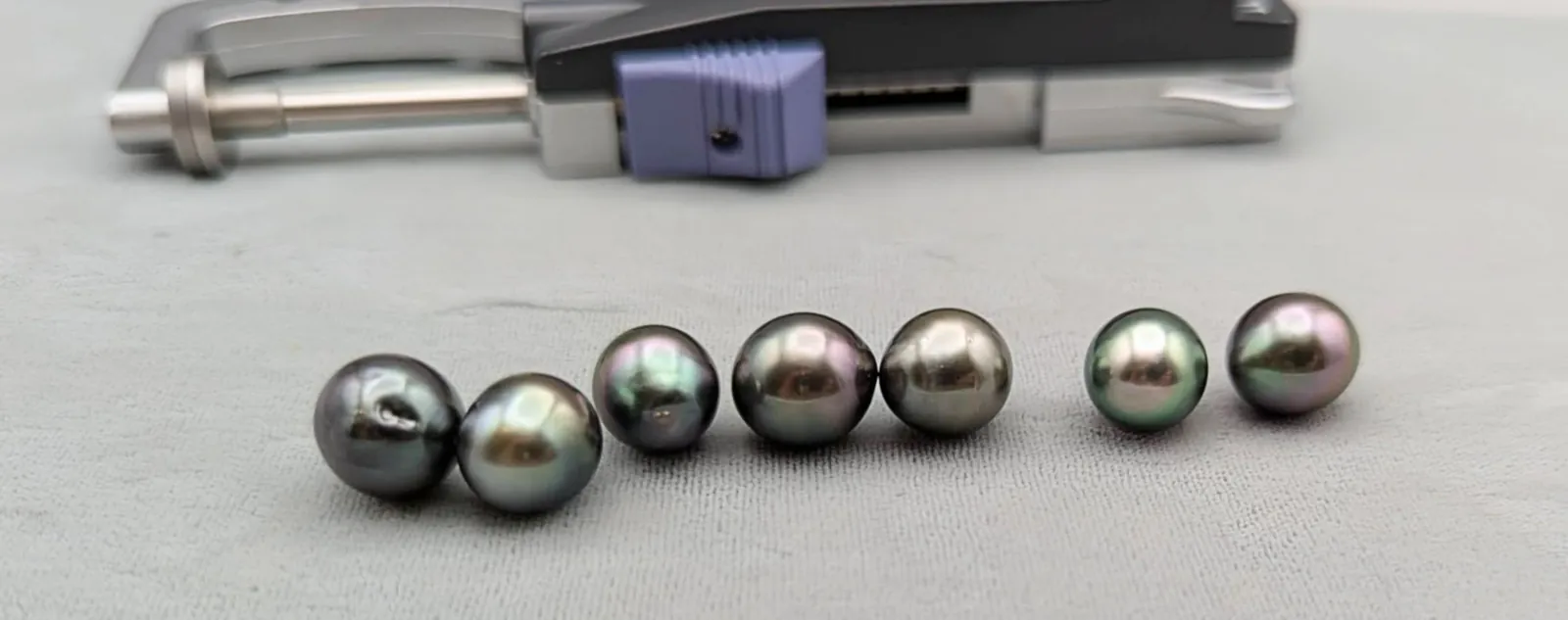
Tahitian colors are unusually sensitive to the conditions in which they are photographed. A pearl that looks blue-green in one image may look mostly green in another. A cherry flash can become stronger under one light and nearly disappear under another.
Several factors can change what you see:
- Light temperature: warm indoor lighting can push colors toward bronze, pink, or brown; cooler light can emphasize blue and green.
- Light direction: concentrated jewelry lighting can create strong highlights that exaggerate one surface color.
- Background: white, gray, black, skin, or colored fabric can change the apparent contrast.
- Camera processing: automatic white balance, HDR, saturation, and phone-camera algorithms can noticeably shift pearl color.
- Viewing angle: overtone and orient can strengthen or weaken as the pearl rotates.
For an important purchase, one studio photograph is rarely enough to judge a subtle Tahitian color. Ask for more than one view, ideally including neutral daylight or neutral white light and a short video of the pearl rotating.
Do These Color Names Tell You Which Pearl Is More Valuable?
Not by themselves. Color is one of the major pearl value factors, but the label alone is not a quality grade. GIA evaluates pearls using multiple value factors, including size, shape, color, luster, surface, nacre quality, and matching.
A well-known color can attract a premium when it is vivid, attractive, and difficult to match, but a weakly lustrous pearl does not become exceptional just because a seller calls it peacock. Likewise, an intense blue-green or cherry pearl with sharp luster and attractive surface quality may be more compelling than a dull pearl carrying a more fashionable color name.
When comparing prices, judge the pearl in this order:
- Is the luster strong enough to make the surface look bright and dimensional?
- Is the bodycolor attractive and reasonably even?
- Is the overtone clear, saturated, and harmonious?
- How clean is the surface?
- What are the shape and size?
- If it is a pair or strand, how difficult and successful is the color matching?
For a broader framework, see our pearl grading guide and GIA’s overview of pearl quality factors.
Does Strong Color Prove the Pearl Is Naturally Colored?
No. The black-lipped oyster Pinctada margaritifera is capable of producing naturally dark and strongly colored pearls, which is why Tahitian pearls are so well known for gray, green, blue, pink, purple, and mixed color effects. GIA research also documents characteristic natural-color features in pearls from this mollusk.
However, treatment is still possible. Pearls can be color modified, and unusual colors should not be declared natural solely because they look plausible. GIA has documented treated Pinctada margaritifera cultured pearls as well as analytical methods used to investigate color origin.
For ordinary jewelry, seller disclosure may be enough. If a rare natural color is a major reason for a high price, an independent gemological report provides stronger evidence than photography alone. Our guide to pearl color enhancement treatments explains the broader treatment issue.
How to Compare Tahitian Colors Before Buying
Instead of asking only, “Is this peacock?” use a short comparison checklist:
- Name the bodycolor first. Gray, charcoal, green, blue-gray, brownish gray, or another base?
- Name the overtone second. Green, blue, pink, magenta, purple, bronze, or mixed?
- Check saturation. Is the color vivid or muted?
- Check tone. Is the pearl light, medium, dark, or very dark?
- Judge luster separately. Strong luster makes color look more vivid but is not the same thing as color.
- Compare under neutral light. Do not rely on one warm spotlight or one heavily edited image.
- Ask about treatment disclosure. Especially when the color is a major part of the price.
- For pairs and strands, judge matching. Matching several strongly colored pearls can be much harder than finding one attractive single pearl.
If you want to browse finished pieces by pearl type, see our Tahitian pearl jewelry. Buyers sourcing loose pearls or strands for design and production can instead use our Tahitian pearl wholesale collection.
The Simplest Way to Remember the Difference
Peacock is about contrast: a green-containing Tahitian color with a noticeable contrasting overtone or orient, often pink or purplish.
Blue-green is about cool harmony: blue and green blend together into a teal, ocean, or cool green-gray appearance.
Cherry is about a warm flash: a pink-to-magenta or reddish overtone becomes prominent over a darker bodycolor.
These descriptions are more useful when treated as visual families rather than rigid boxes. The exact appearance of a Tahitian pearl depends on bodycolor, overtone, orient, tone, saturation, luster, lighting, and viewing angle. That is why the best comparison is not the most romantic color name—it is a clear description of what the pearl actually looks like.
FAQ
Is peacock the same as green Tahitian pearl color?
No. A green Tahitian pearl may simply have a green bodycolor or overtone. Peacock generally involves a green-containing medium-to-dark color combined with a noticeable contrasting overtone or orient, often pink, rose, or purple.
Are blue-green Tahitian pearls naturally colored?
They can be. Pinctada margaritifera can naturally produce dark pearls with green and blue color effects. However, visual appearance alone cannot prove that a specific pearl is untreated.
Is cherry the same as aubergine?
Not necessarily. Cherry usually leans more pink, red, or magenta, while aubergine usually leans more purple or violet. The terms overlap in trade usage, so a precise bodycolor-plus-overtone description is more reliable.
Which Tahitian pearl color is the most valuable?
There is no single color label that always makes a pearl the most valuable. Peacock is highly recognized in the market, but luster, surface, size, shape, saturation, matching, rarity, and overall beauty all affect value.
Why does my Tahitian pearl look greener in daylight?
Different light sources have different color temperatures and spectral output. Daylight, warm indoor light, jewelry spotlights, camera processing, background color, and viewing angle can all change how strongly green, blue, pink, or purple overtones appear.