To evaluate Tahitian pearl color well, do not start by asking whether a pearl is “black,” “green,” or “peacock.” Start by separating what you actually see: the dominant bodycolor, its tone and saturation, any overtone or orient, the strength of the pearl’s luster, and—if you are judging a pair or strand—how consistently or intentionally those colors work together.
A useful color evaluation therefore asks more than “Which color is rarest?” It asks whether the color is attractive under consistent lighting, whether it stays lively as the pearl turns, whether strong luster supports the color, and whether the description matches the pearl in front of you.
First, Know What “Color” Means in a Pearl
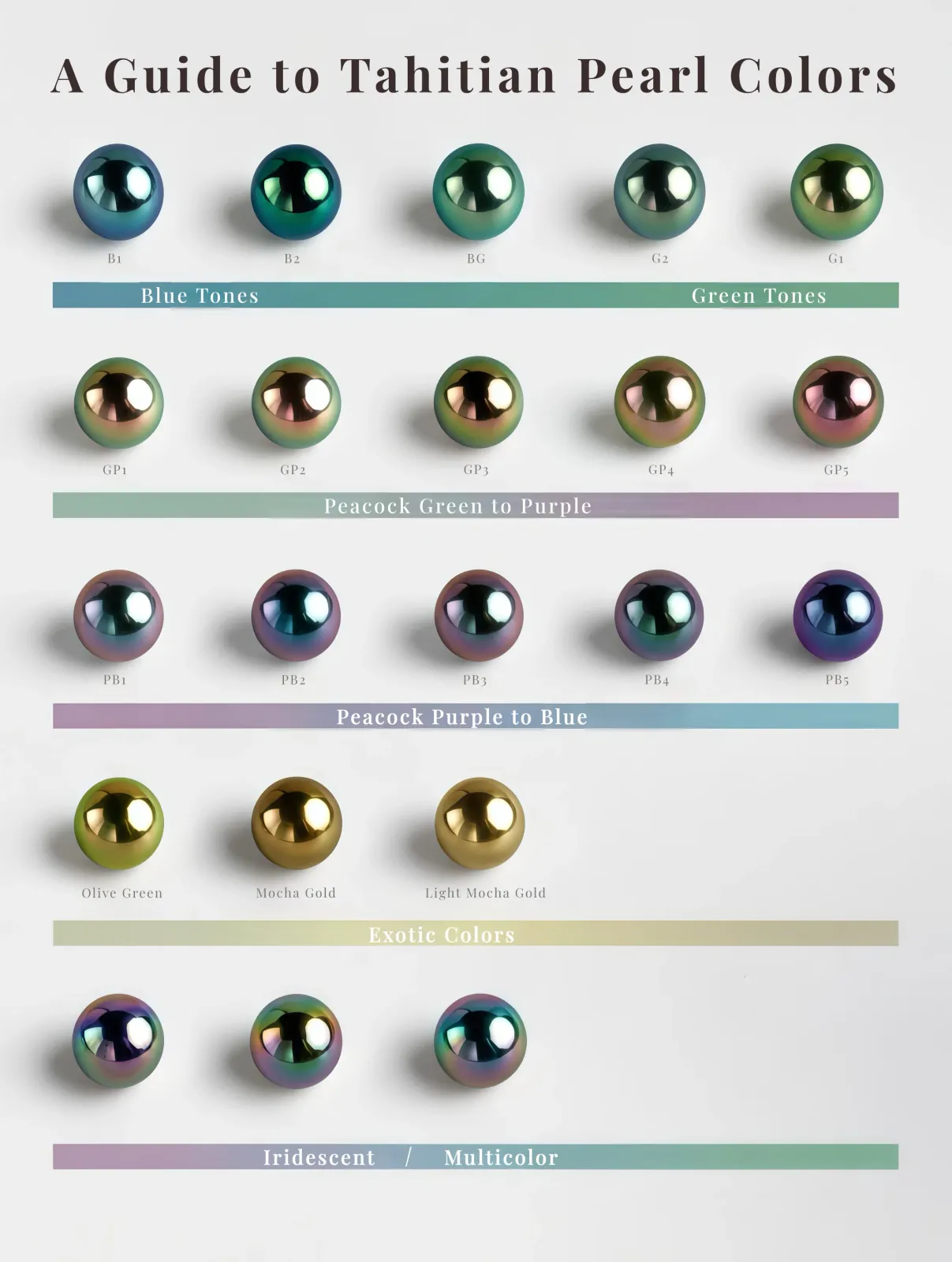
Tahitian pearls are often called black pearls, but their appearance is much more complex than a single dark color. GIA describes pearl color using three components: bodycolor, overtone, and orient.
- Bodycolor is the dominant overall color of the pearl.
- Overtone is a noticeable translucent secondary color that appears over the bodycolor.
- Orient is an iridescent play of colors that can shimmer on or just below the surface.
Not every pearl shows all three. A Tahitian pearl may have a relatively simple silver-gray bodycolor with little obvious overtone, while another may combine a dark green bodycolor with pink, purple, or blue effects that become stronger as the pearl moves.
GIA also describes bodycolor through hue, tone, and saturation. Hue is the basic color direction, tone is how light or dark it appears, and saturation is how strong or muted the color appears. Thinking in these terms is more useful than relying only on trade names.
If you need the broader background on this pearl type first, see our Tahitian Pearls Guide.
A Practical 7-Step Method for Evaluating Tahitian Pearl Color
1. Compare Pearls Under the Same Lighting
Color comparison becomes unreliable when one pearl is photographed under warm light, another under cool light, and a third under a strong spotlight. For a useful comparison, keep the lighting, background, distance, and exposure as consistent as possible.
Neutral, diffused light is especially helpful because it reduces the chance that colored surroundings or a dramatic point light will dominate what you see. This does not turn a home inspection into a gem laboratory, but it makes side-by-side judgment much more meaningful.
If you are buying online, compare photos from the same seller and the same setup whenever possible. A pearl that looks vivid only in one highly edited photograph is harder to evaluate than a pearl shown in several consistent views.
2. Identify the Bodycolor Before Naming the Overtone
Ask: What color does the pearl look like overall when I first see it? That is your starting point.
Common Tahitian bodycolor directions include silver, gray, charcoal, greenish gray, brownish gray, and darker near-black appearances. GIA notes that Tahitian cultured pearls are known for naturally dark bodycolors and colorful overtones rather than a uniform jet-black appearance.
Do not let a dramatic pink or green flash distract you from the base. A pearl can have a gray bodycolor with a green overtone, or a green-containing bodycolor with a pink overtone. Those descriptions are not the same.
3. Judge Tone and Saturation Separately
Two green Tahitian pearls can look very different even if both are accurately described as green.
- Tone: Is the pearl light, medium, medium-dark, or very dark?
- Saturation: Does the green look muted and grayish, or strong and vivid?
This distinction helps prevent a common mistake: assuming the darkest pearl is automatically the best pearl. Very dark tone can be attractive, but excessive darkness can also make subtle color harder to see. A medium-dark pearl with strong saturation and bright luster may look more alive than a nearly black pearl with weak color expression.
4. Separate Overtone from Orient
Next, look for secondary color. Is there one translucent color washing over a large part of the pearl, or do several colors seem to shift and shimmer as the pearl moves?
A more stable secondary wash is generally described as overtone. A multi-colored, iridescent effect is orient. Both can add depth and complexity, but they are not required for every beautiful Tahitian pearl.
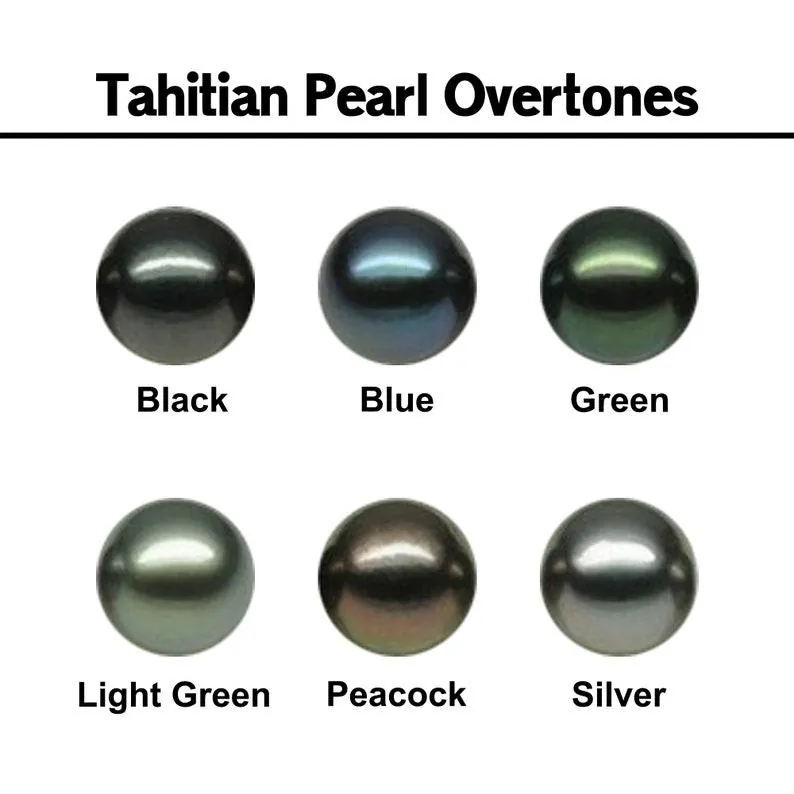
This is where familiar trade descriptions such as peacock, aubergine, blue-green, cherry, pistachio, or bronze can become useful—as long as they describe what is actually visible rather than replacing careful observation.
5. Evaluate Luster Together with Color
Color and luster are separate pearl value factors, but visually they interact strongly. GIA describes luster as one of the most important contributors to pearl beauty, and strong luster can make Tahitian colors look deeper, sharper, and more dimensional.
A pearl can have an unusual bodycolor yet still look flat if its reflections are weak and blurred. Conversely, strong luster can make a relatively restrained silver-gray or green pearl look exceptionally lively.
When comparing pearls, look beyond the bright white highlight. Check whether reflected shapes have reasonably sharp edges and whether the pearl maintains strong contrast as it rotates. For a fuller method, see our Pearl Luster Guide.
6. Rotate the Pearl and Judge More Than One Angle
Tahitian pearls can change noticeably as the viewing angle changes. A pearl may look green from the front, show rose or purple from the side, and become more neutral when turned again.
That changing appearance is part of the appeal, but it also means one carefully chosen photograph is not enough for a high-confidence color judgment. Rotate a loose pearl slowly, or ask for a short neutral-light video when shopping remotely.
What you want to know is not whether every angle is identical. Instead, ask whether the color remains attractive and coherent as the pearl moves.
7. For Pairs and Strands, Evaluate Color Relationships
Matching becomes important whenever two or more pearls are used together. GIA treats matching as one of the seven pearl value factors for multi-pearl jewelry.
For a matched pair, compare bodycolor, tone, saturation, overtone, luster, size, and shape together. Two individually attractive pearls can look mismatched if one is strongly rose-peacock and the other is cool blue-green.
For a single-color strand, look for continuity rather than isolated “best” pearls. For a multicolor strand, exact sameness is not the goal; instead, look for deliberate transitions and overall harmony. A well-designed multicolor strand can be well matched in the sense that the variation is balanced and intentional.
A Simple Tahitian Pearl Color Scorecard
If you are comparing several loose pearls, pairs, or strands, record the same observations for every sample. This makes the process more consistent and prevents a dramatic trade name from dominating the decision.
| What to Check | Question to Ask | What Good Comparison Looks Like |
|---|---|---|
| Bodycolor | What is the dominant overall hue? | Described consistently without confusing the base with the overtone |
| Tone | How light or dark is it? | Compared under the same light rather than different photos |
| Saturation | How strong or muted is the color? | Vividness is judged separately from darkness |
| Overtone / orient | What secondary colors appear, and how do they move? | Visible from more than one staged angle |
| Luster | Are reflections bright and reasonably sharp? | Color looks lively rather than flat or chalky |
| Visual balance | Do the bodycolor and secondary colors work together? | The pearl looks coherent rather than muddy or visually confused |
| Matching | Do multiple pearls belong together visually? | Uniformity or deliberate multicolor harmony suits the design |
This scorecard is not a laboratory grading system. It is a practical buying tool for making your own observations more disciplined.
Is Darker Tahitian Pearl Color Better?
No. Darkness is not a complete quality grade.
Tone is only one part of color, and color itself is only one of several pearl value factors. A very dark pearl can be beautiful, but it can also have weak luster, heavy surface characteristics, poor matching, or a less attractive color balance.
Likewise, a lighter silver-gray Tahitian pearl can be highly desirable if it has excellent luster, an attractive overtone, a clean appearance, and good matching.
The practical rule is to compare like with like. If two pearls are similar in size, shape, surface quality, and luster, then color preference and rarity can meaningfully affect desirability. But color should not be used to erase the rest of the pearl.
Is Peacock the Best Tahitian Pearl Color?
Peacock is one of the most recognized and highly desired Tahitian color ranges, but it should not be treated as a universal “highest grade.”
In 2023, GIA introduced a specific “Peacock” color-range comment for qualifying cultured pearls from Pinctada margaritifera. GIA describes this range as having a bodycolor whose hue contains green, with medium-to-strong saturation and medium-to-dark tone, plus a moderate or stronger overtone—usually pink—or orient.
That is a useful description because it shows why peacock is more than “dark green.” The appeal comes from the layered relationship between green bodycolor and noticeable secondary color.
Current market reporting also shows strong demand for peacock Tahitian pearls, but market demand is not the same as an eternal color hierarchy. GIA notes more generally that pearl color value is affected by supply, demand, fashion, and cultural preference.
So if you prefer a clean silver, cool blue-green, deep aubergine, or another Tahitian color, there is no gemological rule saying you should abandon it for peacock. Choose the strongest overall pearl in the color family you actually want.
How Much Should Color Influence Tahitian Pearl Value?
Color can influence value, especially when a pearl combines attractive hue, strong saturation, pleasing overtone or orient, and rarity. But there is no reliable universal price multiplier for a specific color name.
GIA evaluates pearl quality through seven value factors: size, shape, color, luster, surface quality, nacre quality, and matching. In practice, those factors interact.
For example, a vivid green-peacock pearl with heavy surface damage and weak luster may be less desirable than a quieter green pearl with excellent luster and a cleaner surface. A perfectly round pearl may also be priced differently from an equally colorful baroque pearl because shape and rarity are different.
For pairs and strands, matching adds another layer of scarcity. Finding one beautiful pearl is easier than finding many pearls whose size, shape, luster, bodycolor, tone, and overtone work together.
For a broader quality framework beyond color, see our Pearl Grading Guide.
Can You Tell Whether Tahitian Pearl Color Is Natural by Eye?
Not reliably in every case.
Pinctada margaritifera can naturally produce the dark bodycolors and colorful overtones associated with Tahitian pearls. However, pearl color can also be altered, and other pearl types can be treated to imitate dark or unusual colors.
GIA advises pearl buyers to ask whether color is natural or treated. Laboratory analysis may be needed when treatment identification materially affects the purchase.
This matters because visual inspection has limits. A suspiciously uniform color, unusual drill-hole concentration, or an appearance that seems inconsistent with the stated pearl type can raise questions, but the absence of such clues does not prove natural color.
When color origin matters, ask for written disclosure and use an independent laboratory report for higher-value purchases. Our Pearl Treatments Guide explains why treatment and pearl identity should be considered separately.
How to Evaluate Tahitian Pearl Color When Buying Online
Online evaluation is possible, but you should ask for evidence that reduces the influence of photography.
- Ask for neutral-light images. Avoid judging color only from dramatic spotlit photographs.
- Request side-by-side comparisons. A pearl is easier to understand when shown next to similar Tahitian pearls under the same setup.
- Ask for video. Movement reveals whether overtone and orient remain attractive across different angles.
- Check whether exposure changes between images. A brighter image can make the same pearl appear lighter and more saturated.
- Confirm the written description. Ask the seller to state the bodycolor, main overtone or orient, and whether the color is natural or treated.
- For pairs or strands, request a full-layout image. Close-ups can hide mismatching that becomes obvious when the whole piece is viewed together.
A useful online listing should help you understand the pearl, not force you to infer everything from one glamorous photograph.
Common Mistakes When Judging Tahitian Pearl Color
- Choosing the darkest pearl automatically. Darkness does not equal better color or better overall quality.
- Treating “peacock” as a complete grade. Peacock describes a color range, not luster, surface, shape, nacre, or matching.
- Confusing overtone with bodycolor. A green flash over gray is not described the same way as a green-dominant bodycolor.
- Ignoring luster. Strong color can still look dull if reflections are weak.
- Comparing different photographs instead of different pearls. Lighting and exposure can create more difference than the pearls themselves.
- Expecting a multicolor strand to be uniform. Intentional color variation can still be well matched when the arrangement is balanced.
- Assuming appearance proves natural color. Treatment questions sometimes require disclosure or laboratory testing.
Frequently Asked Questions
What is the most important thing to check in Tahitian pearl color?
Start by separating bodycolor from overtone or orient, then judge the color under consistent lighting together with luster. A dramatic color name is less useful than understanding what the pearl actually shows.
Which Tahitian pearl color is the most valuable?
There is no permanently universal winner. Peacock is highly desired and can command premiums when other quality factors are comparable, but pearl color value also depends on rarity, supply, demand, fashion, and the pearl’s complete quality.
Are darker Tahitian pearls more valuable?
Not automatically. Very dark tone can be desirable, but luster, saturation, overtone, surface quality, shape, nacre, size, and matching also affect appearance and value.
How can I tell bodycolor from overtone?
Bodycolor is the dominant overall color you see across the pearl. Overtone is a translucent secondary color layered over it. Rotating the pearl under consistent light can make the distinction easier.
Should Tahitian pearl earrings match exactly in color?
They should usually look harmonious when worn together, but exact microscopic identity is not necessary. Compare bodycolor, tone, saturation, overtone, luster, size, and shape as a pair.
Can a multicolor Tahitian strand still be well matched?
Yes. Matching does not always mean every pearl has the same color. In an intentional multicolor design, good matching means the variations are balanced and the strand looks coherent as a whole.
Can photos accurately show Tahitian pearl color?
They can be useful, but lighting, background, exposure, white balance, editing, and viewing angle can change the result. Several consistent images plus a neutral-light video are more informative than one dramatic still photo.
The Bottom Line
The best way to evaluate Tahitian pearl color is to use a repeatable process: standardize the viewing conditions, identify the bodycolor, judge tone and saturation, separate overtone from orient, evaluate luster, rotate the pearl, and then check matching if multiple pearls are involved.
Do not reduce the decision to “blackest,” “greenest,” or “peacock.” Tahitian pearl color is valuable because it is layered and variable. The strongest choice is the pearl whose color remains attractive under honest viewing conditions and whose luster, surface, shape, nacre, and matching support that color rather than fight it.
If you are comparing loose pearls or strands for a project, you can also browse our wholesale pearl selection and evaluate color alongside the other quality factors that matter for matching and production.