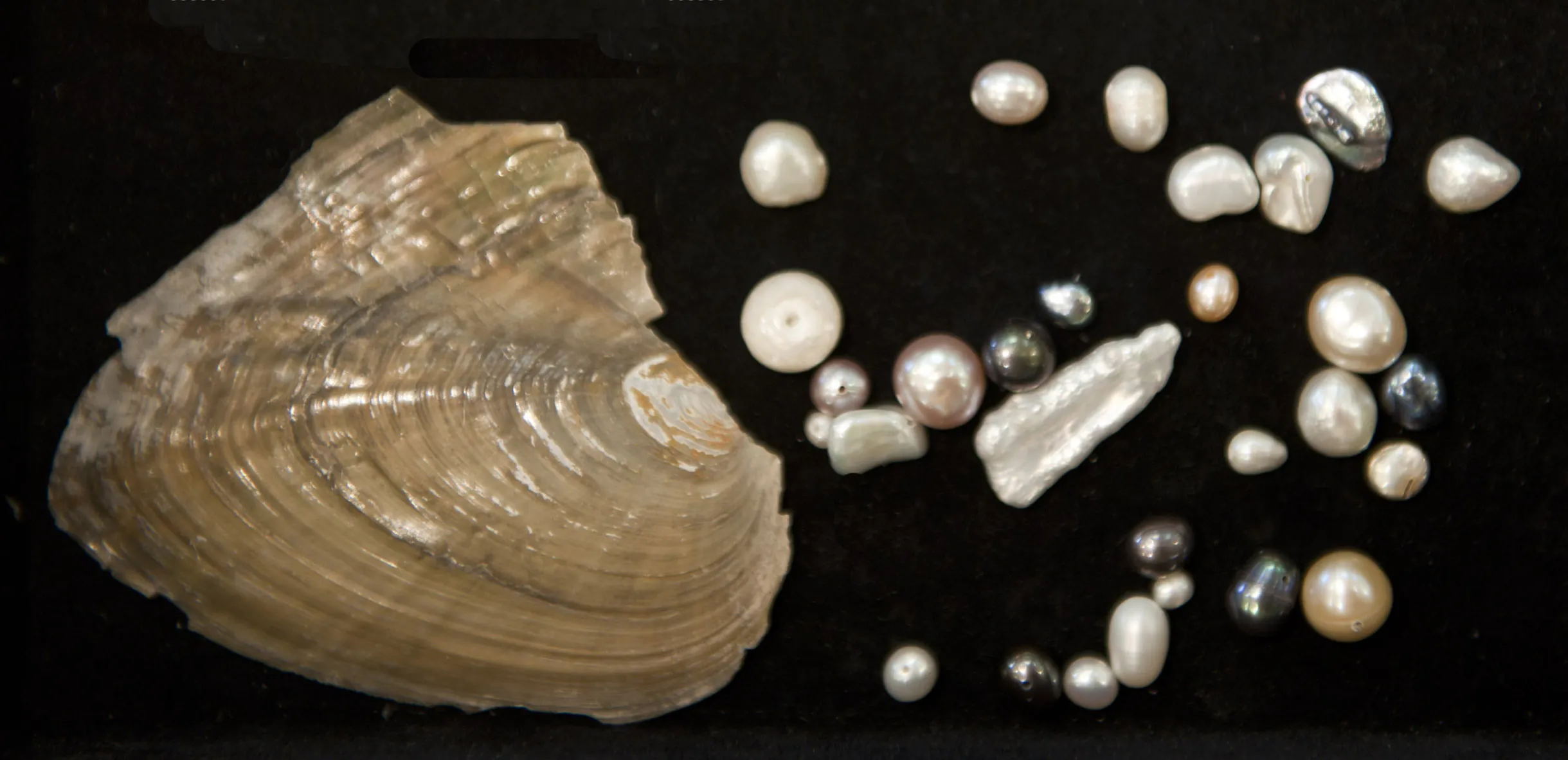
Akoya pearls are cultured by surgically placing a round shell bead and a tiny piece of donor mantle tissue inside a living Akoya oyster. The mantle tissue develops into a pearl sac around the bead. That pearl sac then secretes layer after layer of nacre, gradually turning the bead into a cultured pearl.
The surgery is only the beginning. Before nucleation, farmers may spend one or two years raising and conditioning healthy oysters. Afterward, the oysters must recover, return to the sea, be cleaned and monitored through changing water conditions, and remain healthy long enough to build good nacre. Depending on the farm, environment, pearl size, and quality target, the post-nucleation growing period may be around a year or considerably longer.
This is why Akoya pearl culture is better understood as a controlled biological process rather than a simple act of “putting a bead into an oyster.”
What Oyster Produces Akoya Pearls?
Akoya cultured pearls are produced by small saltwater pearl oysters in the Pinctada fucata group, often referred to in the trade as Akoya oysters. Japan is the historical center of Akoya culture, while Akoya pearls are also produced in places such as China and Vietnam.
The relatively small size of the oyster helps explain why Akoya pearls are generally smaller than South Sea pearls. It also makes the surgical operation especially delicate: the host must be large and healthy enough to accept the selected nucleus without excessive stress.
For a broader look at the pearl type itself—including typical size, color, luster, and nacre characteristics—see our Akoya pearl guide.
Step 1: Farmers Raise Healthy Akoya Oysters
Pearl culture starts well before a pearl nucleus is inserted. Young Akoya oysters are raised in the sea until they are large and strong enough for the operation. Japanese pearl farms commonly describe a mother-oyster growing stage of roughly one to two years before nucleation, although exact timing varies by farm and local conditions.
During this period, the oysters are held in baskets, nets, or cages suspended in suitable coastal waters. Farmers repeatedly clean the shells because barnacles, algae, sponges, sea squirts, and other organisms can interfere with feeding, shell movement, and overall health.
Not every oyster is used. Farmers select hosts that appear healthy enough to survive surgery and continue growing afterward. This selection matters because a weak oyster may reject the nucleus, fail to recover, die during cultivation, or produce a poorer pearl.
Step 2: The Oysters Are Conditioned for Nucleation
Before surgery, Akoya oysters are prepared so the technician can work with as little stress and injury as possible. The exact method varies among farms, but the goal is similar: bring the oyster into a suitable physiological condition, open the shell carefully, and stabilize it for the grafting operation.
This preparation is easy to leave out of simplified explanations, but it is a real part of pearl farming. Successful culture depends not only on the surgeon's hand but also on the condition of the oyster before the operation begins.
Step 3: A Round Bead Nucleus Is Prepared
Akoya pearls are generally bead-nucleated cultured pearls. The nucleus is a carefully shaped spherical bead, traditionally made from thick freshwater mussel shell. Its diameter is chosen to suit the host oyster and the pearl size the farmer hopes to produce.
The bead provides a round foundation, which is one reason Akoya cultivation can produce a high proportion of round and near-round pearls. But the bead alone cannot make a pearl. It must be paired with living mantle tissue.
Step 4: Donor Mantle Tissue Is Cut into Tiny Grafts
A second Akoya oyster provides the mantle tissue used for grafting. The mantle is the tissue responsible for producing the nacreous lining of the shell. A skilled worker cuts suitable mantle tissue into very small pieces, often only a few millimeters across.
These tiny pieces contain epithelial cells capable of developing into the tissue structure that will eventually secrete nacre around the nucleus.
This is one of the most important points to understand: the round bead gives the pearl its central form, but the donor mantle tissue provides the living cells needed to create the pearl-producing sac.
Step 5: The Bead and Mantle Graft Are Surgically Inserted
During nucleation, a trained technician makes a small incision in the host oyster's gonad and carefully places the shell bead and mantle-tissue graft together. Their position matters. The tissue must remain in effective contact with the bead so it can develop around it correctly.
This operation requires considerable skill. Poor placement can contribute to nucleus rejection, irregular growth, weak recovery, or a misshapen pearl. The oyster itself also matters: nucleus size, host condition, surgical timing, and environmental conditions can all affect the result.
Some descriptions of pearl culture say that the oyster coats the bead simply because it is an “irritant.” That explanation is incomplete. The more important biological event is the formation of a pearl sac from the implanted mantle cells.
Step 6: A Pearl Sac Forms Around the Nucleus
After successful grafting, cells from the mantle tissue proliferate and form a pearl sac around the bead. This sac becomes the nacre-producing tissue surrounding the nucleus.
Once the pearl sac is functioning, it deposits microscopic layers of nacre onto the bead. Nacre is the same general material that creates the lustrous inner surface of the oyster shell. Layer by layer, the coating thickens and the bead-nucleated structure becomes an Akoya cultured pearl.
If you want to understand the biology behind this stage in more detail, our guide to how pearls form explains the role of the pearl sac and nacre deposition.
Step 7: The Oyster Recovers After Surgery
Nucleation is stressful. The oysters are therefore usually kept in a controlled recovery stage before being returned to full offshore culture. Japanese farms may refer to this temporary holding stage as curing or temporary hanging.
Farmers watch whether the oysters recover normally and whether the implanted nucleus remains retained. Some oysters will reject the nucleus or fail to survive. Pearl farming always involves biological loss; successful surgery does not guarantee a marketable pearl.
Step 8: The Oysters Return to the Sea for Nacre Growth
Once recovered, the oysters are moved back to suitable marine growing areas, often suspended from rafts or long-line systems. From this point onward, the farmer's job is largely to keep the oyster healthy enough for the pearl sac to continue depositing nacre.
Regular work may include:
- cleaning shells and culture equipment;
- monitoring water temperature and seasonal change;
- watching food availability and water quality;
- responding to storms, red tides, disease, and other environmental stress;
- moving or adjusting oysters when local conditions require it.
The pearl is growing inside the oyster, but the process is not passive. Farm management continues throughout the cultivation period.
How Long Do Akoya Pearls Grow?
There is no single growth period that applies to every Akoya pearl.
GIA has documented Akoya oysters commonly remaining in the water for about 10 to 14 months after nucleation in some production systems. Japanese farms also describe longer grow-out periods, depending on the farm and the type of pearl being produced. On top of that, the mother oyster may already have been raised for one or two years before nucleation.
So when a seller says an Akoya pearl was “cultured for one year,” that usually refers to the pearl's post-nucleation growing period—not the entire time required to raise the oyster, prepare it, operate on it, recover it, and bring the pearl to harvest.
More time in the water can allow additional nacre deposition, but time alone does not guarantee higher quality. Host health, water conditions, pearl-sac function, season, and farm management all matter. For a deeper discussion, see our guide to pearl cultivation time and maturity.
Step 9: Akoya Pearls Are Often Harvested in Winter
Many Japanese Akoya farms prefer winter harvesting. As water temperatures fall, oyster metabolism slows and nacre deposition becomes slower. Producers associate this late-stage cold-water period with the fine surface structure and sharp luster prized in good Akoya pearls.
Harvest timing is still a farm decision rather than a universal calendar date. Farmers may check part of a crop first and then harvest more widely when the pearls appear to have reached the desired condition.
After the oysters are opened, the pearls are removed, cleaned, dried, and sorted. They are then separated by characteristics such as size, shape, luster, surface quality, color, nacre quality, and matching potential.
Why Does Akoya Cultivation Produce So Many Round Pearls?
The round shell bead provides Akoya pearls with a spherical core. If the bead and graft remain correctly positioned and nacre forms evenly around the nucleus, the resulting pearl can be very round.
But bead nucleation does not guarantee perfection. Pearls may still become near-round, off-round, or irregular because the pearl sac does not always develop symmetrically. Biological growth, graft position, host condition, and disturbances during cultivation can all influence the final shape.
That is why roundness is still a quality and sorting factor even in a bead-nucleated pearl type.
Are Cultured Akoya Pearls Real Pearls?
Yes. A cultured Akoya pearl is a real pearl produced by a living oyster.
The human role is to initiate the process by implanting the bead and mantle tissue and then managing the oyster through cultivation. The nacre itself is produced biologically by the pearl sac inside the oyster.
This is fundamentally different from an imitation pearl, where a manufactured bead is coated outside a living mollusk.
What Actually Determines the Final Quality?
Understanding the culture process explains why two Akoya pearls from the same general region can still look very different. Final quality is influenced by several linked stages:
- the health and size of the host oyster;
- the quality and preparation of donor mantle tissue;
- the size and placement of the bead nucleus;
- the precision of the grafting operation;
- successful pearl-sac formation;
- nacre deposition and cultivation time;
- water temperature, food, and environmental stability;
- harvest timing;
- post-harvest sorting and processing.
In other words, “cultured” does not mean standardized. Farmers can guide the process, but they cannot completely control a living oyster or the sea.
Akoya Pearl Culturing Process at a Glance
- Raise healthy young Akoya oysters.
- Clean, select, and condition suitable host oysters.
- Prepare a round shell bead nucleus.
- Cut tiny grafts from donor mantle tissue.
- Insert the bead and tissue into the host oyster.
- Allow the graft to form a pearl sac around the bead.
- Give the oyster time to recover from surgery.
- Return it to the sea for months of nacre growth and farm care.
- Harvest when the pearl has reached the desired condition, often in winter for Japanese Akoya production.
- Clean, sort, grade, and match the harvested pearls.
What to Remember
The simplest accurate explanation is this: an Akoya pearl begins with a shell bead and a tiny piece of mantle tissue, but it becomes a pearl only after that tissue forms a pearl sac and the living oyster deposits nacre around the bead over time.
The skill of nucleation matters, but so do oyster health, recovery, environmental management, cultivation length, and harvest timing. That combination of human control and biological uncertainty is exactly what makes cultured pearls different from manufactured beads.
If you are sourcing Akoya pearls for jewelry making or resale, you can also browse our Akoya pearls wholesale collection and compare size, luster, surface, shape, and matching rather than judging by the word “Akoya” alone.
Frequently Asked Questions
Do Akoya pearls have a bead inside?
Usually, yes. Akoya pearls are typically bead-nucleated. A round shell bead is implanted together with a small piece of donor mantle tissue, and nacre is deposited around the bead.
How long does it take to culture an Akoya pearl?
The post-nucleation growing period is often around a year in some Akoya production systems, but it can be longer. The total farming cycle is longer because the oyster must first be raised to a suitable size and later recover after surgery.
Why is mantle tissue needed if there is already a bead nucleus?
The bead provides the shape, but the mantle tissue provides the living epithelial cells that form the pearl sac. The pearl sac is the tissue that secretes nacre around the nucleus.
Are Akoya pearls cultured in every oyster successfully?
No. Some oysters reject the nucleus, fail to recover, die during cultivation, or produce pearls that are too irregular or low in quality for certain markets. Pearl farming involves significant biological variation.
Why are Akoya pearls often harvested in winter?
In Japanese production, colder water slows oyster metabolism and nacre deposition. Farmers often associate this slower late-stage growth with the fine nacre structure and sharp luster desired in Akoya pearls.
References
- GIA: Very Small Akoya Cultured Pearls — Akoya oyster species, bead nucleation, typical post-nucleation growth period, and winter harvest.
- Kitamura Pearl Culture Co.: How Pearls Are Made — mother-oyster raising, conditioning, graft preparation, nucleation, recovery, grow-out, and harvest.
- K. Otsuki Pearl: Culturing — Japanese Akoya nucleus insertion, recovery, offshore care, nacre growth, and winter harvest.