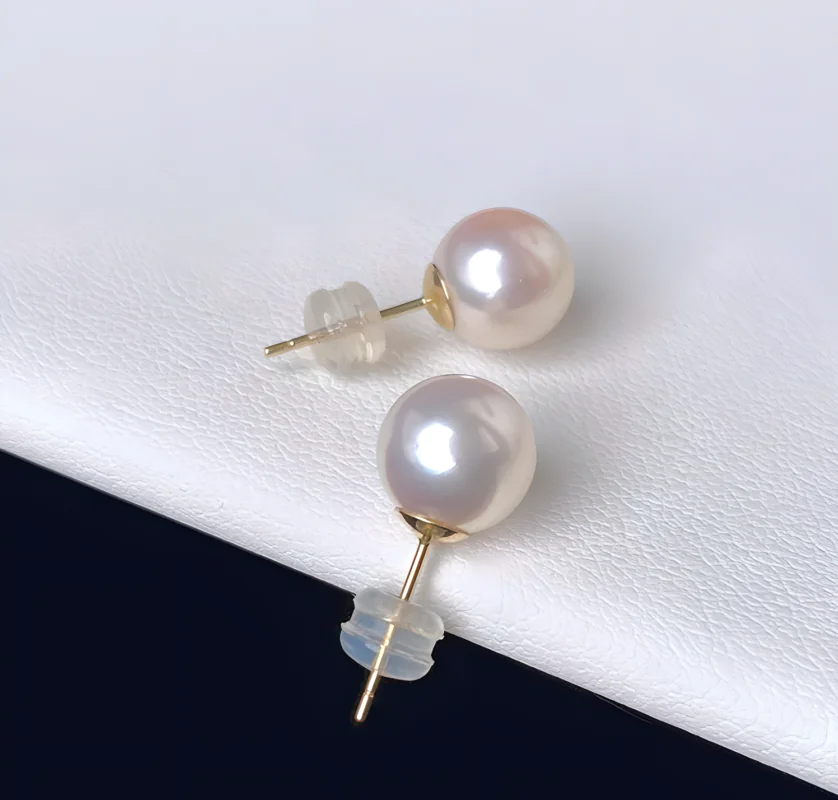
Deep gold, tea gold, and treated gold can all describe pearls that look richly golden in a photograph. They do not mean the same thing.
Deep gold is mainly a description of strong golden bodycolor and saturation. Tea gold can be a loose market description, but “Aurora Chakin” (often translated as tea gold) is also a specific special designation used by Japan’s Pearl Science Laboratory. Treated color means the pearl’s appearance was modified after harvest rather than being entirely the color produced during growth.
The most important point for buyers is that color depth alone cannot prove color origin. Some treated golden pearls show visible clues, but modern treatments can be difficult to identify by eye. For a valuable pearl, the safest approach is to separate pearl identity from color origin, ask for written disclosure, and use an independent laboratory report when the price justifies it.
Deep Gold, Tea Gold, and Treated Gold at a Glance
| Term | What it usually means | Is it a universal grade? | Main buyer question |
|---|---|---|---|
| Deep gold | A strongly saturated golden bodycolor in a Golden South Sea cultured pearl | No. It is primarily descriptive trade language. | Is the deep color natural, and how good are the luster, surface, shape, and matching? |
| Tea gold | May be used loosely for a brownish, orange-gold, or very rich gold; “Aurora Chakin” is a specific Pearl Science Laboratory designation | No. “Aurora Chakin” belongs to one laboratory’s grading system. | Is this merely a seller’s color name, or is there an authentic PSL Aurora Chakin report? |
| Treated golden color | Color altered after harvest, for example by dyeing or other color-modification processes | Not a grade; it is a treatment status. | What was treated, was it disclosed, and is the price appropriate for treated material? |
| Gold-colored freshwater pearl | A freshwater cultured pearl that may naturally be yellowish or may have been color-treated | No. | Is it being accurately sold as freshwater rather than as a South Sea cultured pearl? |
These distinctions matter because a pearl can be genuine and cultured yet still have treated color. Conversely, a pearl can be naturally colored but not be a South Sea pearl. “Real pearl,” “South Sea pearl,” and “natural color” are three different questions.
Start with Two Separate Questions: What Is the Pearl, and Where Did the Color Come From?
Many buying mistakes happen because identity and color are collapsed into one judgment. A better framework is to ask two questions in order.
1. What type of pearl is it?
Golden South Sea cultured pearls are associated with the gold-lipped form of Pinctada maxima, a large saltwater pearl oyster. Their natural bodycolor can range from pale cream and champagne through stronger yellow-gold and deep gold. If you want the broader background on this pearl family, see our guide to South Sea pearls.
A freshwater cultured pearl dyed to a similar color is still a real cultured pearl, but it is not a Golden South Sea pearl. A seller should not use color similarity to blur that difference.
2. Is the color natural to the pearl, or was it modified after harvest?
This is a separate identification problem. GIA has published research on both dye-treated yellow or “golden” cultured pearls and heat-treated “golden” South Sea cultured pearls. GIA also notes that treatment techniques have improved enough that advanced instrumentation may be required to separate some treated colors from natural ones.
That is why a dark golden appearance by itself is evidence of color, not proof of color origin.
What Does “Deep Gold” Actually Mean?
“Deep gold” usually describes the saturation of the pearl’s main bodycolor. It is the richer end of the natural Golden South Sea color spectrum, beyond pale champagne or light gold. In general market practice, deeper and more even natural gold can command a premium because highly saturated natural color is less common and difficult to match across a pair or strand.
But deep gold is not a universal laboratory grade. Terms such as “18K gold,” “22K gold,” or “24K gold” are often used as visual analogies to metal color. They can help shoppers imagine saturation, but they should not be treated as standardized gemological categories.
Color depth also does not override the other quality factors. A very dark pearl with dull luster, heavy surface damage, poor shape, or weak matching is not automatically superior to a slightly lighter pearl with exceptional luster and cleaner nacre. Our pearl value guide explains why color should be judged together with luster, surface, shape, size, and matching.
The practical buyer question is therefore not “Is it dark enough?” It is: Is the strong gold natural, attractive, well matched, and supported by the rest of the pearl’s quality?
What Is “Tea Gold,” and Is It the Same as Deep Gold?
This is where terminology becomes more complicated.
In ordinary sales language, “tea gold” may be used loosely for a deep, warm, slightly orange or brownish gold. When a seller uses the phrase this way, it is simply a color description. It does not by itself prove natural color, high quality, or laboratory certification.
However, Aurora Chakin is something more specific. Japan’s Pearl Science Laboratory (PSL) lists “Aurora Chakin” as a special designation for top-quality gold-series South Sea pearls (Pinctada maxima). The laboratory explains that “Chakin” is an industry term and associates it with high saturation and vivid interference color.
That distinction matters. A pearl advertised as “tea gold” is not automatically an Aurora Chakin pearl. If the seller is invoking the PSL designation, ask to see the actual Pearl Science Laboratory report and verify that the report belongs to the pearl or strand being sold.
It is also important not to confuse a laboratory’s proprietary quality designation with a universal grading standard. GIA does not use “Aurora Chakin” as one of its own grades. Different laboratories may describe color and quality differently, so always read the report rather than relying on a prestigious-sounding term alone.
What Counts as a Treated Golden Color?
A color treatment changes or enhances a pearl’s appearance after harvest. For golden-colored pearls, published gemological research has documented several approaches to color modification. Dyeing is an obvious example, and GIA has also studied heat-treated “golden” South Sea cultured pearls. Pearl color treatments more broadly can include processes such as irradiation, although the exact treatment used should be identified rather than assumed.
A treated-color South Sea cultured pearl is not necessarily an imitation. If the pearl itself is a genuine Pinctada maxima cultured pearl, the correct description may be a treated-color South Sea cultured pearl. The problem begins when treatment is hidden or when a different pearl type is sold under a South Sea identity.
Treatment is therefore not a simple “real versus fake” issue. It is a disclosure, value, and identification issue. For a broader explanation of common enhancement methods, see our guide to pearl color enhancement treatments.
Can You Spot Treated Golden Pearls by Eye?
Sometimes you can spot warning signs. You should not treat those signs as a home laboratory.
Older or more obvious dye treatments may show color concentration around drill holes, pits, cracks, or other surface irregularities. Under magnification, a suspiciously darker ring at a drill hole or localized color pooling can justify further investigation.
But the absence of those clues does not prove natural color. GIA’s research on yellow and “golden” cultured pearls found that improved dye treatments can show little surface evidence. GIA researchers used instrumental methods such as UV-Vis reflectance and Raman photoluminescence spectroscopy to identify treatment even when routine visual observation was insufficient.
That changes how visual inspection should be used. It is best treated as a screening step:
- Check drill holes and blemishes: localized color concentration can be suspicious, but clean drill holes do not certify natural color.
- Compare multiple pearls under the same neutral light: extreme uniformity or unexpected color behavior can raise questions, but natural matched strands can also be very consistent.
- Compare color to price: a large, round, clean, highly lustrous, intensely deep-gold strand offered at an unusually low price deserves extra scrutiny. Price is a commercial warning signal, not a gemological test.
- Do not rely on “color movement” alone: natural pearls can show complex overtone and orient, but a sophisticated treatment does not always look flat or obviously artificial.
- Avoid destructive home tests: rubbing with solvents, scratching the surface, or attempting to remove color can damage the pearl and still fail to identify modern treatment reliably.
The useful rule is simple: visual clues can justify suspicion, but only proper testing can resolve a difficult case.
Why Laboratory Testing Matters for Expensive Deep-Gold Pearls
Natural yellow nacre in Pinctada maxima has measurable optical characteristics. GIA’s published work has shown differences between natural-color and certain treated golden pearls in ultraviolet-visible reflectance and fluorescence behavior. Later research on dye-treated yellow or golden cultured pearls further demonstrated that instrumental features can reveal treatment even when surface evidence is minimal.
For a high-value loose pearl, pair, or strand, an independent pearl report is therefore more meaningful than a seller saying “looks natural.” GIA’s pearl services state whether detectable treatments are present and can provide identification and classification information depending on the report type.
When reading any certificate, separate three things:
- Identity: what type of pearl is being examined?
- Color / description: how is the observed color described?
- Treatment conclusion: does the report indicate detectable treatment or color modification?
Do not assume that a quality name alone answers all three questions. Our pearl grading certificate guide explains how to read laboratory terminology without turning a certificate title into a substitute for the actual findings.
What Are the Real Risks of Buying Treated Color Without Knowing It?
Treated pearls are not automatically “bad.” A disclosed treated pearl can be attractive and completely suitable for jewelry. The risk comes from buying it under the wrong assumptions.
1. Paying a natural-color premium for treated color
Deep natural gold can command a substantial premium because saturated natural color is relatively scarce. If a treated pearl is represented as naturally deep gold, the buyer may be paying for rarity that is not actually present.
2. Confusing pearl type with color
A gold-colored freshwater pearl can look convincing in a listing photo. If it is sold as a Golden South Sea cultured pearl, the problem is not only treatment disclosure; it is a basic identity misrepresentation.
3. Unexpected color stability or care requirements
Not every treatment behaves the same way. GIA notes that some dyes can fade with prolonged light exposure or be affected by solvents such as alcohol or acetone. That does not mean every treated golden pearl will fade, but it does mean buyers should know the treatment and follow any specific care instructions rather than assuming the color behaves exactly like untreated nacre.
4. Problems with appraisal, resale, or replacement
A later laboratory examination may identify treatment that was never disclosed at purchase. That can affect appraisal expectations, resale discussions, insurance documentation, or the ability to source a truly comparable replacement pearl.
5. Matching problems in pairs and strands
If the original color source is unclear, replacing a damaged pearl can become difficult. A natural deep-gold pearl, a treated South Sea pearl, and a dyed freshwater pearl may look similar in one photograph but behave differently under real lighting and may not match once placed side by side.
6. Relying on marketing language instead of documentation
Terms such as “24K gold,” “royal gold,” “tea gold,” and “collector gold” can sound like formal grades even when they are not. The safer approach is to ask what the term means in that seller’s listing and whether it is supported by a recognized laboratory report.
Treatment Disclosure Is Not Just a Courtesy
Major jewelry trade guidance treats treatment disclosure as material information. The U.S. Federal Trade Commission states that sellers should disclose pearl treatments when a treatment is not permanent, creates special care requirements, or significantly affects value. CIBJO’s Pearl Book also sets out specific disclosure rules for treated natural and cultured pearls.
For an online buyer, the most practical protection is to get the answer in writing before purchase. A useful invoice or product description should not stop at “golden pearl.” It should identify the cultured pearl type and disclose relevant treatment information.
If you are sourcing pearls for jewelry production or resale, written disclosure is even more important because the description must survive through your own supply chain. Buyers comparing lots can use our South Sea pearls wholesale category as a starting point for material sourcing, but any high-value color claim should still be confirmed lot by lot.
A Practical Buying Checklist for Deep-Gold and Tea-Gold Pearls
- Ask for the pearl identity in writing. Look for a clear description such as South Sea cultured pearl rather than a vague “golden pearl.”
- Ask one direct question about color: “Is the color natural, or has it been treated or enhanced?”
- If treatment was used, ask what kind. “Treated” is more useful when the process and any care implications are disclosed.
- If the seller says “tea gold,” ask what they mean. If they mean PSL Aurora Chakin, request the original Pearl Science Laboratory report. If there is no PSL report, treat “tea gold” as the seller’s descriptive color term.
- Do not buy color in isolation. Compare luster, surface, shape, size, nacre appearance, and matching. Deeper color does not rescue weak overall quality.
- Inspect high-resolution photos under neutral lighting. Avoid judging a color premium from heavily warm, saturated, or contrast-enhanced images.
- For expensive purchases, use an independent laboratory. A lab report is particularly worthwhile when treatment status materially affects the price.
- Keep the sales description and report together. Documentation matters later if the pearl is appraised, insured, resold, or matched.
If you are still comparing overall quality rather than only color, our pearl grading guide provides a broader framework for evaluating luster, surface, shape, color, size, and matching together.
The Most Useful Rule: Buy the Disclosure, Not the Adjective
A naturally deep-gold Golden South Sea pearl can be exceptional. A PSL-certified Aurora Chakin pearl can represent a very specific high-quality category within that laboratory’s system. A treated-color pearl can also be beautiful and completely legitimate when it is described and priced honestly.
The dangerous shortcut is assuming that a darker color or more prestigious-sounding name proves natural color and higher value.
For important purchases, ask what the pearl is, ask where the color came from, and make sure the answer is documented. That is more reliable than trying to turn a photograph, a drill-hole glance, or a term such as “tea gold” into a definitive identification test.
Frequently Asked Questions
Is deep gold the same as tea gold?
No. “Deep gold” is mainly a descriptive term for strong golden saturation. “Tea gold” may be used descriptively by sellers, while “Aurora Chakin” is a specific special designation used by Japan’s Pearl Science Laboratory. They should not be treated as interchangeable universal grades.
Does a tea-gold pearl mean the color has been treated?
No. The word “tea” in tea gold does not mean dyed or treated. Treatment status is a separate question. If the term refers to PSL Aurora Chakin, verify the actual laboratory report rather than inferring treatment status from the name.
Can a treated Golden South Sea pearl still be a real pearl?
Yes. A genuine South Sea cultured pearl can have its color modified after harvest. It remains a cultured pearl, but the color should be accurately disclosed as treated when required. A dyed freshwater cultured pearl is also a real cultured pearl, but it should not be represented as a South Sea cultured pearl.
Can I prove natural color by looking at the drill hole?
No. Dye concentration at a drill hole can be a useful warning sign, but a clean drill hole does not prove that the color is natural. Modern treatments can leave little obvious surface evidence, which is why gemological laboratories use spectroscopy and other instrumental methods.
Are treated-color pearls always lower quality?
Not necessarily. Treatment status and physical quality are different issues. A treated pearl can have strong luster and a clean surface. The important questions are whether treatment was disclosed, whether it affects durability or care, and whether the price reflects the pearl’s actual identity and treatment status.
When is a laboratory report worth getting?
It becomes more worthwhile as the price premium for natural deep color increases. For a high-value loose pearl, matched pair, or strand where natural color materially affects value, an independent report can reduce uncertainty that visual inspection cannot resolve.
References and Further Reading
- GIA — Pearl Research: Color Treatments and Processes
- GIA Gems & Gemology — Update on the Identification of Dye Treatment in Yellow or “Golden” Cultured Pearls
- GIA Gems & Gemology — Natural-Color and Heat-Treated “Golden” South Sea Cultured Pearls
- Pearl Science Laboratory — Chakin (茶金)
- U.S. Federal Trade Commission — Advertising Diamonds, Gemstones and Pearls
- CIBJO — Industry Standards Resources and Pearl Book