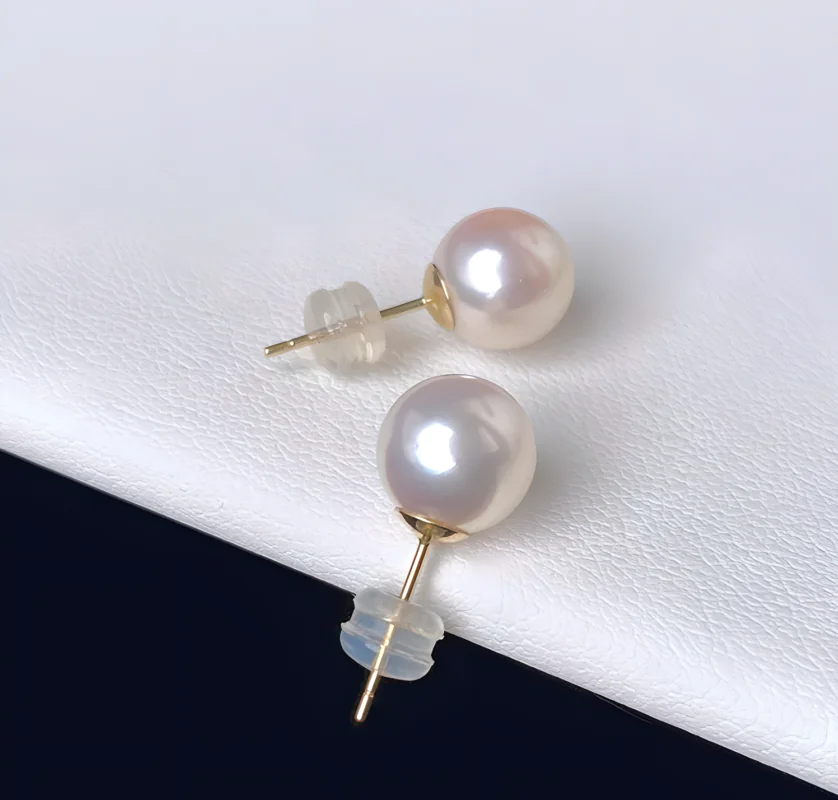
Short answer: yes, but only within the right grading context. Aurora Madama is a highest-quality designation for blue-series Akoya pearls in the grading system of Japan’s Pearl Science Laboratory (PSL). It is not a universal grade that sits above every Hanadama, Tennyo, or other Akoya pearl.
The easiest way to understand Madama is to stop imagining one single Akoya grading ladder. PSL uses different special designations for different Akoya body-color categories and size ranges. Madama occupies the top-quality position for blue-series Akoya pearls of the applicable size, while white-series Akoya pearls use names such as Hanadama and Tennyo.
If you first want the broader definition of the term, see our guide to what Akoya Madama pearls are. Here, we will focus specifically on where Madama sits in the quality hierarchy—and where the phrase “highest grade” becomes misleading.
Why the Answer Is Both Yes and No
PSL’s current certification materials place Aurora Madama in its “highest quality” series for blue-body-color Akoya pearls. In that narrow and accurate sense, calling Madama a highest-grade or highest-quality blue Akoya designation is reasonable.
But “Madama is the highest grade of Akoya pearl” is too broad. It leaves out two important facts:
- PSL uses parallel designations for different Akoya color families, rather than one name for the best pearl of every color.
- Pearl grading is not governed by one universal worldwide grade scale. Laboratories and sellers may use different systems and terminology.
So the more precise statement is:
Madama is a highest-quality designation for qualifying blue-series Akoya pearls within the PSL grading system, not a universal “number-one grade” for all Akoya pearls.
Where Madama Sits in the PSL Akoya System
PSL separates several Akoya categories by body color and, for some names, by size. Its current materials identify the following special designations:
| PSL designation | Akoya category | Size context | What it means |
|---|---|---|---|
| Aurora Madama | Blue series | 6.0 mm and above | Highest-quality blue-series Akoya designation |
| Aurora Saiundama | Blue series | Under 6.0 mm | Highest-quality designation for smaller blue-series Akoya |
| Aurora Hanadama | White series | 6.0 mm and above | Highest-quality white-series Akoya designation |
| Aurora Tennyo | White series | 6.0 mm and above | A special designation for Hanadama-quality pearls with especially outstanding luster |
| Aurora Sairindama | White series | Under 6.0 mm | Highest-quality designation for smaller white-series Akoya |
This is why a question such as “Is Madama higher than Hanadama?” does not work very well. They belong to different color categories. A better comparison is: Madama is the top-quality blue-series designation, while Hanadama is a top-quality white-series designation.
If the grade names themselves feel confusing, our pearl grading guide explains why pearl labels should always be read together with the actual quality factors behind them.
Is Madama Higher Than Hanadama?
No—not in the sense of one sitting above the other on a single ladder.
Under PSL’s system, Aurora Hanadama applies to qualifying white-series Akoya pearls, while Aurora Madama applies to qualifying blue-series Akoya pearls. Both sit within the laboratory’s highest-quality Akoya series for their respective color categories.
This distinction matters because color and quality are not the same thing. A blue Akoya is not automatically better because it is blue, and a white Akoya is not automatically lower because it is not Madama. Each pearl still has to be judged for luster, nacre, surface, shape, and—for strands or pairs—matching.
That is also why calling Madama simply “blue Hanadama” can be useful as a rough shortcut but is not technically ideal. The names belong to related quality concepts, yet the laboratory treats them as separate designations with different color-category boundaries.
What About Tennyo? Is Tennyo Higher Than Madama?
This comparison needs even more care.
PSL describes Aurora Tennyo as a special designation given to pearls within the Aurora Hanadama quality range that have especially outstanding luster. In other words, Tennyo is a further luster-focused distinction inside the white-series Hanadama context.
Madama, by contrast, is the highest-quality designation for the blue-series category. There is no simple PSL statement that says “Tennyo > Madama” or “Madama > Tennyo” across all Akoya pearls.
If your priority is a classic white Akoya strand with exceptional luster, Tennyo may be the more relevant name. If your priority is a certified, high-quality blue-series Akoya, Madama is the relevant designation. They answer different buying questions.
What Does a Madama Certificate Actually Tell You?
PSL’s current highest-quality Akoya criteria are much more useful than the word “highest” by itself. For the applicable 6.0 mm-and-above highest-quality categories, the laboratory lists requirements that include:
- nacre thickness of at least 0.4 mm,
- a round-category shape,
- only slight surface blemishing under its criteria, and
- strong emphasis on luster, including evaluation of both brilliance and interference color.
PSL has also published technical work describing its grading method in terms of several quality characteristics, including luster, cultured-process blemishes, surface smoothness, shape, and nacre thickness. That is an important reminder: Madama is not just a blue color label. It is a quality designation applied after multiple characteristics are evaluated.
For a practical explanation of what laboratories do—and what a certificate does not prove by itself—see our pearl grading certificate guide.
Does Madama Always Mean Natural Blue and Untreated?
PSL’s own description of Aurora Madama ties the designation to the blue-series Akoya category and historically explains the name in connection with blue pearls in their natural, unaltered state. Even so, shoppers should avoid turning a trade name into a blanket treatment claim.
When treatment status matters, read the exact wording on the report for the exact pearls being sold. Do not rely only on a product title that says “Madama,” “natural blue,” or “Japanese Akoya.” The report issuer, designation, color comments, and item description should all correspond to the strand, pair, or loose pearl you are buying.
This is particularly important because “blue Akoya” is a color description, while “Madama” is a much narrower certification term. Our more detailed Madama guide explains that distinction in depth.
Why “Highest Grade Akoya” Can Be a Misleading Shopping Phrase
There is no single global pearl grade scale in which every seller, laboratory, and country uses exactly the same labels. Terms such as AAA, AAAA, Hanadama, Tennyo, Madama, and seller-specific premium grades can come from different systems.
For example, GIA now recognizes a Hanadama quality range on qualifying Akoya classification reports using its own pearl value factors. GIA’s requirements include round to near-round shape, white body color, excellent luster, suitable nacre quality, clean to lightly spotted surfaces, and strong matching for pairs or strands. That is useful and credible—but it is not the same thing as saying every Akoya grade name worldwide belongs to one universal ladder.
When you see “highest grade,” always ask: highest according to whom, for which color category, under which report, and using which quality criteria?
Can Two Madama Strands Still Look Different?
Yes. A certification threshold does not make every certified strand visually identical.
Two Madama strands can differ in how silver, gray, or blue they appear, how their overtones behave under different light, how tightly the pearls are matched, and how strongly their luster reads to your eye. Size can also affect price substantially.
This is why certification should be treated as a quality filter, not as a substitute for looking at the actual pearls. If you are comparing two certified strands, judge the exact pieces—not just the label printed on the certificate.
The same principle applies to other Akoya pearls. Our Akoya pearl guide covers the broader characteristics of the pearl type, while the Akoya pearl jewelry collection is the more useful next step if you are comparing finished pieces rather than loose pearls or strands.
How to Check a Madama Listing Before You Buy
A strong listing should make it easy to answer the following questions:
- Who issued the report? Do not treat “Madama” as self-explanatory without knowing the laboratory or grading system.
- What is the exact designation? Look for the report wording, not just a seller-created quality title.
- What is the pearl size? Under PSL’s current special-designation structure, blue-series Akoya below 6.0 mm use the Saiundama name rather than Madama.
- What does the report say about color or treatment? Use the report itself for treatment-related claims.
- How does the exact strand or pair look? Compare luster, surface, matching, overtone, and overall visual balance under neutral lighting.
If a seller simply says “Madama = the best Akoya pearl in the world,” that description is missing too much context to be useful.
So, Are Madama Pearls the Highest Grade?
Madama is a highest-quality designation for qualifying blue-series Akoya pearls within the Pearl Science Laboratory grading system. That is the accurate “yes.”
But Madama is not a universal grade above Hanadama, Tennyo, and every other Akoya category. Hanadama belongs to the white-series highest-quality category; Tennyo is a special high-luster designation within that white-series context; smaller blue Akoya have their own Saiundama designation.
The practical rule is simple: do not buy the word “highest.” Buy the specific pearl, the specific certificate, and the quality factors you can actually evaluate.
FAQ
Is Madama higher grade than Hanadama?
Not as a universal ranking. Under PSL, Madama is a highest-quality designation for blue-series Akoya, while Hanadama is a highest-quality designation for white-series Akoya. They are better understood as parallel categories.
Is Tennyo higher grade than Madama?
They are not directly comparable. Tennyo is a special white-series designation for Hanadama-quality pearls with particularly outstanding luster. Madama is the highest-quality designation for the blue-series category.
Can an Akoya pearl under 6 mm be called Madama?
Under PSL’s current special-designation system, Aurora Madama applies to blue-series Akoya of 6.0 mm and above. Blue-series Akoya under 6.0 mm use the Aurora Saiundama designation when they meet the corresponding highest-quality standard.
Is every natural blue Akoya pearl a Madama pearl?
No. Natural blue describes color origin or appearance; Madama is a specific quality designation. A blue Akoya should not automatically be treated as Madama simply because its color is natural or attractive.
Does a Madama certificate guarantee it is the best-looking strand?
No certificate can replace visual preference. Certification can establish that the pearls meet defined quality criteria, but individual strands can still differ in color character, overtone, matching, size, and overall appearance.