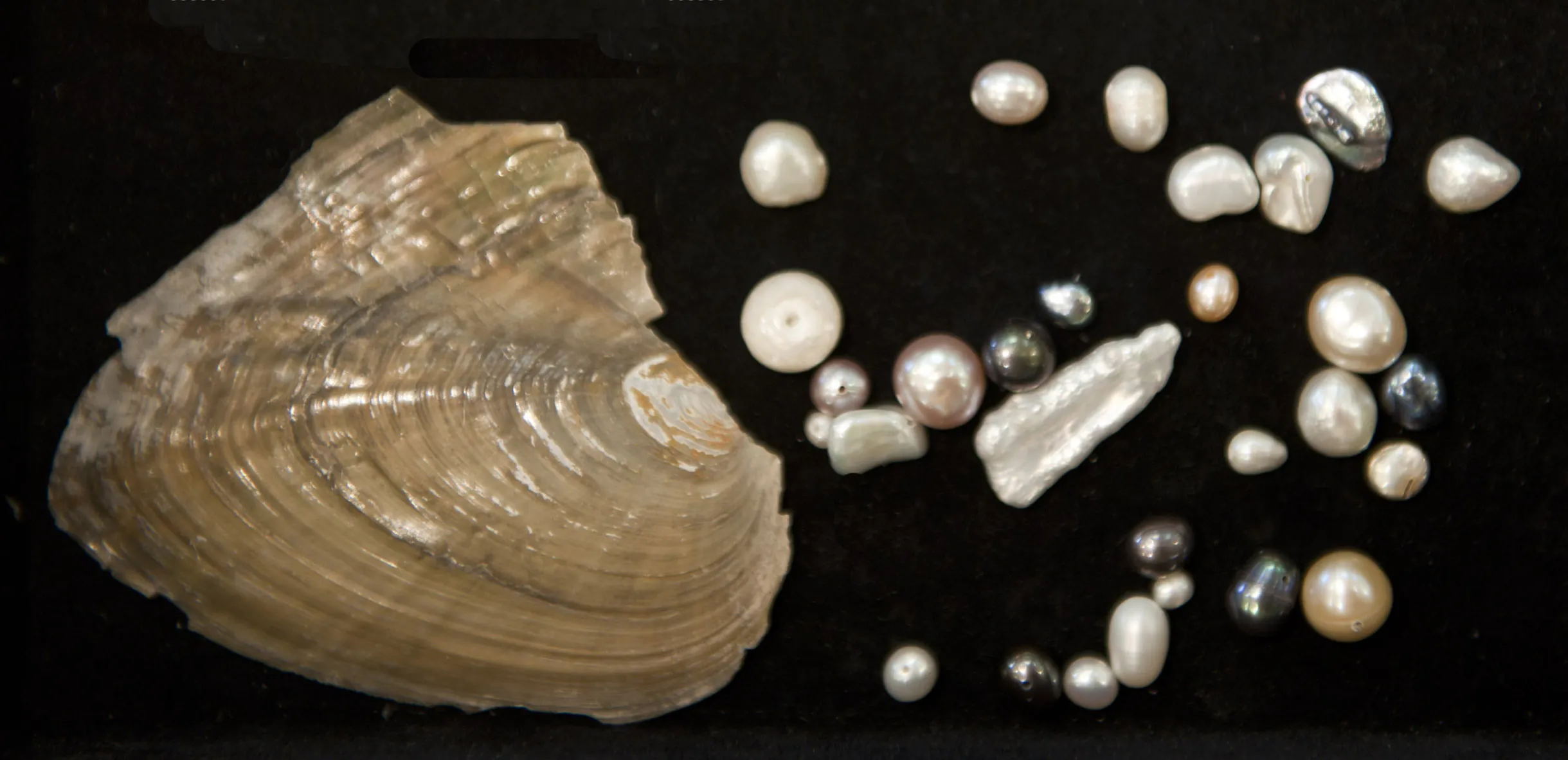
Short answer: no. Every baroque pearl is non-round, but not every non-round pearl is baroque. “Non-round” is a broad descriptive phrase. In more precise pearl terminology, oval, button, drop, near-round, semi-baroque, and baroque pearls can be separated into different shape categories.
This distinction matters because pearl shape is not just a choice between “round” and “everything else.” A symmetrical oval pearl and a strongly irregular free-form pearl may both fail a roundness test, yet they have very different outlines, design uses, matching requirements, and commercial descriptions.
If you want a broader visual overview before going deeper, our Pearl Shape Guide compares round, near-round, button, oval, drop, ringed, baroque, and other common forms.
The simplest way to understand the difference
Think of non-round as an umbrella description rather than a precise gemological category.
A pearl can be non-round for many reasons. It may be slightly off-spherical, elongated, flattened, pear-shaped, ringed, or completely irregular. Those forms are not automatically equivalent.
GIA’s current educational material separates pearl shapes into categories including round, near-round, drop, oval, button, semi-baroque, and baroque. In that framework, oval, button, and drop pearls are non-round but still have recognizable symmetry. Baroque pearls are the irregular, free-form end of the spectrum.
So the useful relationship is:
- Baroque → non-round: yes.
- Non-round → baroque: not necessarily.
This is similar to saying that every square is a rectangle, but not every rectangle is a square. “Non-round” tells you what the pearl is not. “Baroque” tells you more about what the pearl’s actual form looks like.
Which non-round pearl shapes are not necessarily baroque?
Several common pearl shapes are clearly non-round while remaining regular enough to deserve their own names.
Near-round pearls
Near-round pearls still look broadly spherical, but slight flattening or elongation becomes visible when the pearl is rotated. They may resemble round pearls face-up, which is why judging shape from only one photograph can be misleading.
A near-round pearl is therefore not normally called baroque simply because it is not perfectly spherical.
Oval pearls
Oval pearls are elongated but usually retain a balanced, recognizable outline. The two sides may be reasonably symmetrical even though the pearl is clearly longer in one direction.
An oval pearl is non-round by definition, but a well-proportioned oval is not the same thing as a free-form baroque pearl.
Button pearls
Button pearls have a rounded, domed appearance with a noticeably flattened dimension. They can work especially well in earrings and rings because the lower profile may sit closer to the setting or ear.
Again, the pearl is not spherical, but its shape can still be highly regular and symmetrical.
Drop pearls
Drop pearls taper toward one end and may have a pear- or teardrop-like silhouette. Fine drop pearls can be strongly symmetrical, which is exactly why they are often desirable for pendants and earrings.
Calling every drop pearl “baroque” would erase an important distinction between a controlled symmetrical shape and a genuinely irregular one.
Where does semi-baroque fit?
Semi-baroque is the bridge between clearly symmetrical shapes and strongly irregular baroque shapes.
GIA describes semi-baroque pearls as showing some irregularity while retaining more symmetry than fully baroque pearls. In practice, you may see pearls that resemble an oval, button, or drop but are slightly distorted, off-axis, compressed, or uneven. These can fall into semi-baroque territory rather than the fully baroque category.
This is also where real-world naming becomes less tidy. Two sellers may look at the same borderline pearl and choose slightly different trade language. One may call it “semi-baroque oval,” while another may simply list it under “baroque.”
That does not mean shape terminology is useless. It means buyers should treat the name as a starting point and still inspect the actual pearl from multiple angles.
What actually makes a pearl baroque?
A baroque pearl is best understood by its lack of regular symmetry. Its outline may be lumpy, curved, pinched, ridged, flattened in an uneven way, or sculptural enough that it does not fit comfortably into oval, button, or drop.
That irregularity can be subtle or dramatic. Some baroque pearls have a gentle organic silhouette. Others have pronounced projections, valleys, folds, or highly individual profiles.
The important point is that “baroque” is not simply a synonym for “less round.” It describes a different visual structure.
For a broader introduction to how these pearls are evaluated, including luster, surface, matching, and value, see What Are Baroque Pearls? Shape, Value, and Buying Notes.
Why do sellers sometimes use “baroque” for almost any irregular pearl?
Because trade language is often looser than laboratory or educational classification.
On a retail page, “baroque” is easy for customers to understand as a general signal for organic or non-classic shapes. A seller may therefore group mildly irregular ovals, off-round pearls, circled pearls, and strongly free-form pearls together in one commercial collection.
That can be useful for browsing, but it should not be mistaken for a strict shape definition.
There is another complication: different pearl references do not always use exactly the same list of shape names. Some distinguish circled or ringed pearls separately. Some use “pear” and “drop” differently. Some emphasize broad shape families, while others use more detailed trade names.
Despite those vocabulary differences, the practical distinction remains stable: a pearl can be non-round and still possess enough symmetry to be described more precisely as oval, button, drop, or another named shape instead of baroque.
Are ringed or circled pearls baroque?
Not automatically.
Ringed or circled pearls have one or more visible grooves around the body. A pearl can be circled while still having a generally drop-like, oval, or rounded overall silhouette. The rings describe an important growth feature, but they do not necessarily make the entire pearl fully baroque.
In everyday commerce, circled pearls are sometimes grouped with baroque pearls because both are visually less uniform than classic round pearls. For a careful product description, however, it is better to describe what is actually visible rather than collapse every non-round form into one label.
Does “baroque” mean lower quality?
No. Shape and quality are related in pearl valuation, but they are not the same question.
A baroque pearl can have excellent luster, attractive color, a clean or appealing surface, and a strong sculptural form. A round pearl can still have dull luster, distracting blemishes, weak nacre appearance, or poor matching.
This is why judging pearl quality requires more than asking whether the pearl is round. GIA’s pearl value framework considers multiple factors, including size, shape, color, luster, surface, nacre, and matching.
MJ Pearls follows the same general principle in commercial sorting: the word “baroque” identifies shape, while quality must still be judged through factors such as luster, surface condition, color, consistency, and the attractiveness of the intended form. Our Pearl Grading Guide explains why shape should not be confused with an overall quality grade.
How should you describe a pearl when the shape is borderline?
Use the most specific accurate description you can, but do not force precision that the pearl does not really have.
For example:
- A clearly elongated and balanced pearl can be described as oval.
- A rounded pearl with a flat profile can be described as button.
- A symmetrical tapering pearl can be described as drop.
- A slightly distorted oval or drop may be better described as semi-baroque.
- A strongly irregular pearl with no clear symmetry is appropriately described as baroque.
For online buying, photographs from multiple directions are more useful than a single shape word. A front-facing image may make a pearl look almost round or oval even when the side profile is substantially irregular.
This is one reason our shape guidance emphasizes viewing pearls from more than one side rather than relying entirely on a label.
Why the distinction matters when buying or designing jewelry
Shape names affect expectations.
If a buyer orders oval pearls, they usually expect repeated elongation and a reasonably consistent silhouette. If they order drops, they expect tapering forms that can be oriented in earrings or pendants. If they order baroque pearls, controlled variation and individual character may be part of the design brief.
This becomes even more important in pairs and strands. Matching two symmetrical drops is a different task from pairing two intentionally irregular baroque pearls. A baroque strand may look cohesive without every pearl having the same outline, while an oval strand normally needs a more consistent rhythm of proportion and orientation.
For buyers comparing shape, luster, surface, size, and budget together, the Pearl Buying Guide provides a broader decision framework. Designers and makers sourcing pearls for production can also browse the Wholesale Pearls Shop and compare materials according to the shape requirements of the project.
A practical rule to remember
If you only remember one thing, use this:
“Non-round” means a pearl is not perfectly spherical. “Baroque” means the pearl is irregular enough that its free-form asymmetry becomes the defining shape.
That rule will not eliminate every borderline case, because natural pearls do not grow according to perfect geometric boundaries. But it prevents the most common mistake: treating all non-round pearls as if they belong to one baroque category.
FAQ
Are all baroque pearls non-round?
Yes. Baroque pearls are irregular rather than perfectly spherical, so they fall within the broad everyday idea of non-round pearls.
Are all non-round pearls baroque?
No. Oval, button, drop, near-round, and other shapes can all be non-round without being fully baroque. In more precise classifications, these shapes are distinguished from baroque pearls.
What is the difference between semi-baroque and baroque pearls?
Semi-baroque pearls retain some recognizable symmetry but show noticeable irregularity. Baroque pearls are more strongly irregular and free-form, with little or no apparent symmetry.
Is an oval pearl a baroque pearl?
Not necessarily. A well-formed oval pearl is elongated but symmetrical and is normally described as oval. An irregular or distorted oval may instead be described as semi-baroque, depending on the classification and seller.
Are button pearls baroque?
A regular button pearl is usually treated as its own shape category. It is flattened rather than spherical, but its outline can still be symmetrical.
Are baroque pearls lower quality than round pearls?
Not automatically. Baroque describes shape. Luster, surface quality, color, nacre, size, and matching still need to be evaluated separately.
Conclusion
Baroque pearls are non-round, but “non-round” and “baroque” are not interchangeable terms. Non-round includes many organized shapes such as oval, button, drop, and near-round. Baroque is more specific: it describes pearls whose irregular, free-form asymmetry is the defining feature.
For buyers, this distinction leads to better comparisons. Instead of asking only whether a pearl is round, ask what shape it actually has, how symmetrical it is, whether the shape works for the intended jewelry, and how its luster, surface, color, and matching perform alongside that shape.