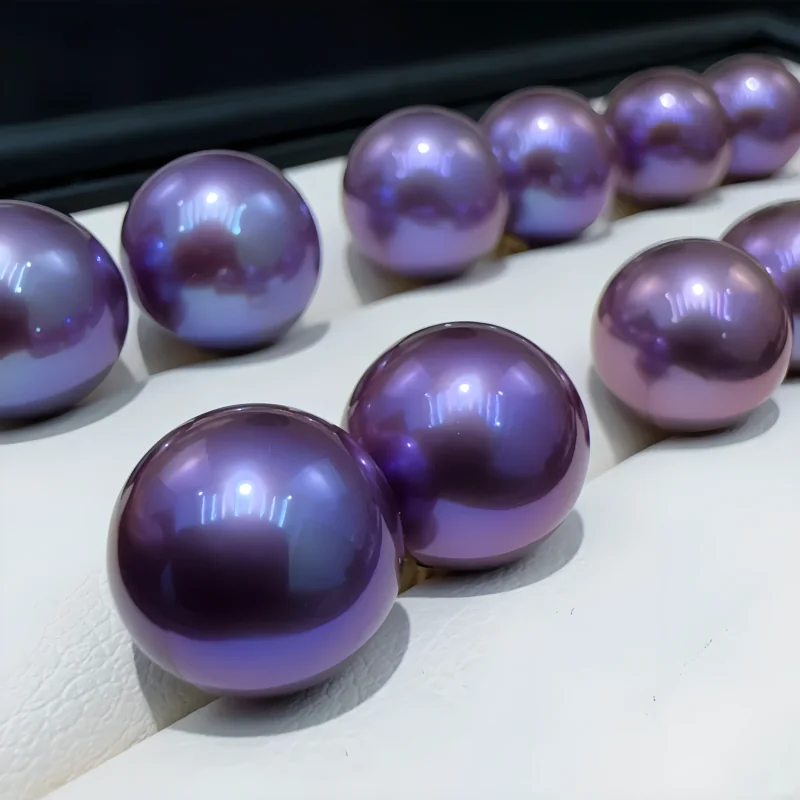
Large pearls are usually more expensive because they are harder to produce in fine quality—not simply because they contain more pearl material. As size increases, fewer pearls reach that diameter while also keeping strong luster, an attractive shape, a relatively clean surface, and good nacre quality. If several large pearls must also match one another for earrings, a bracelet, or a necklace, the supply becomes narrower still.
The most important qualification is this: “large” is relative to the pearl type. A size that is unusually large for Akoya may be ordinary for South Sea pearls. So size only makes sense when you compare like with like.
A Large Pearl Is Valuable Only in Context
It is tempting to compare pearls by millimeter size alone. That can be misleading because different mollusks naturally produce different size ranges.
According to the Gemological Institute of America (GIA), Akoya cultured pearls are typically under 9 mm, Tahitian pearls commonly range from about 8 to 14 mm, and South Sea pearls commonly range from about 8 to 18 mm. Freshwater cultured pearls occur across a much wider range of sizes and production styles.
| Pearl type | Typical size context | What “large” may mean in practice |
|---|---|---|
| Akoya | Usually under 9 mm | Moving above the normal commercial range can create a strong rarity premium. |
| Tahitian | Commonly around 8–14 mm | Sizes above the common range become less available, especially in round, clean, high-luster quality. |
| South Sea | Commonly around 8–18 mm | Large sizes are normal for the category, but exceptional size plus fine quality can still be scarce. |
| Freshwater | Wide range | Size should be judged together with culture method, shape, luster, surface, and overall quality. |
This is why a 9 mm pearl cannot be priced intelligently without knowing what kind of pearl it is. A 9 mm Akoya sits near the upper end of its typical size range, while a 9 mm South Sea pearl is relatively small for its category.
If you want to compare millimeter sizes visually, see our Pearl Size Guide.
Why Does the Price Rise So Quickly at Larger Sizes?
Pearl prices do not follow a simple “one more millimeter equals a fixed amount more” formula. The price can rise sharply when a pearl moves beyond the size that is commonly produced for its type.
1. You are moving into the rare end of the harvest
Pearl farming produces a distribution of results, not a tray of identical pearls. Many pearls fall within the normal commercial size range; fewer reach the upper end. The farther a pearl moves into that uncommon range, the smaller the available pool tends to become.
That scarcity is type-specific. GIA has described Japanese Akoya pearls measuring roughly 11.0–12.2 mm as remarkably large. The same diameter would not be extraordinary for a South Sea pearl.
2. The mollusk sets a biological size ceiling
Different pearl-producing mollusks have different physical capacities. South Sea cultured pearls come from the much larger Pinctada maxima oyster, which is one reason they can reach sizes that would be highly unusual for Akoya. GIA notes that South Sea cultured pearls are the largest of the major cultured pearl types.
This means farmers cannot simply decide that every pearl should be 15 mm. The species, the health and maturity of the mollusk, the culture method, the nucleus where one is used, the environment, and the growth period all constrain what is realistically achievable.
3. More growth time also means more time for something to go wrong
In many culture systems, larger pearls require either a larger starting setup, more time in the mollusk, or both. Longer growth can create more opportunity for surface characteristics, shape deviation, stress, or other quality problems to develop. GIA specifically notes that larger Tahitian pearls take longer to grow, are more limited in supply, and become more likely to show slight irregularities as they grow.
So the rare product is not merely a large pearl. It is a large pearl that also finishes well.
The Real Premium Is “Large + Fine Quality”
GIA evaluates pearls using seven value factors: size, shape, color, luster, surface quality, nacre quality, and matching. Size is only one of them. A large pearl with dull luster, heavy blemishing, weak nacre quality, or an undesirable shape can be worth less than a smaller pearl with much better overall quality.
That distinction matters because shoppers often notice diameter first. On a product page, 12 mm sounds automatically “better” than 10 mm. On a sorting table, however, the larger pearl still has to earn its premium.
Luster can outweigh a size advantage
A smaller pearl with crisp, bright reflections can look more lively and luxurious than a larger pearl with flat or chalky luster. GIA describes luster as one of the most important pearl value factors. If your budget forces a choice between size and luster, the larger pearl is not automatically the better buy.
Clean surface becomes harder to combine with extreme size
Natural surface characteristics are normal in cultured pearls. What raises rarity is finding a pearl that is both unusually large and relatively clean. Add roundness and strong luster to that requirement, and the available pool narrows further.
Roundness adds another scarcity filter
Round cultured pearls are generally more difficult to produce than irregular shapes. A very large baroque pearl may be far easier to find than a very large round pearl of similar luster and surface quality. This is one reason two pearls with the same diameter can have very different prices.
For a fuller quality framework, compare the factors in our Pearl Grading Guide and Pearl Value Evaluation guide.
Why a Few Millimeters Can Look Like a Big Difference
Pearl size is measured by diameter, but a pearl is three-dimensional. That makes small changes in diameter visually more significant than they sound.
As a simple geometric illustration, if two perfectly spherical pearls measured 8 mm and 10 mm, the 10 mm sphere would have about 95% more volume. That does not mean it should cost 95% more—pearl prices are not calculated by volume—but it explains why a 2 mm difference can create a much stronger visual presence than shoppers expect.
The price jump comes from scarcity and quality, not from a mathematical price-per-volume formula.
Matched Large Pearls Are Even More Expensive
A single large pearl is one challenge. A matched pair is harder. A full strand is harder again.
For multi-pearl jewelry, GIA treats matching as a separate value factor. The pearls may need to coordinate in size, shape, bodycolor, overtone, luster, and surface appearance. A necklace therefore requires not just one rare result, but many rare results that look coherent together.
This is an important reason a high-quality strand of large pearls can cost disproportionately more than a pendant using one pearl of similar size. The necklace is paying for selection and matching across dozens of pearls, not simply for the number of millimeters in each bead.
Why a 10 mm Pearl Can Be Cheap and Another 10 mm Pearl Expensive
Absolute size is only meaningful after you identify the pearl type and quality. Two 10 mm pearls can sit in completely different parts of their respective supply curves.
For example, 10 mm is unusually large for traditional Akoya production, but it is within the normal size territory of Tahitian and South Sea pearls. Large freshwater pearls are also available, including bead-cultured varieties. That does not make one type automatically better than another; it means the rarity of 10 mm is different in each production system.
When comparing prices, ask:
- What pearl type is it?
- Is this size common or unusual for that type?
- How strong is the luster?
- How clean is the surface?
- Is the shape round, symmetrical, or baroque?
- What is the nacre quality?
- If there are multiple pearls, how well are they matched?
This comparison is more useful than asking whether “12 mm pearls are expensive” in the abstract. Our Pearl Buying Guide follows the same principle: compare pearls within the correct type and quality context before judging value.
Are South Sea Pearls Expensive Just Because They Are Large?
No. Their size is an important part of the story, but not the whole story.
South Sea pearls have the biological potential to grow larger than the other major cultured pearl types, which gives them a naturally higher size range. Fine examples can also combine substantial size with attractive color, satiny luster, good surface quality, and round or symmetrical shapes. It is that combination—not diameter alone—that creates the strongest premium.
A lower-quality South Sea pearl can therefore cost less than a smaller but exceptional pearl of another type. If you are comparing this category specifically, our South Sea Pearls Guide explains its size, color, and quality characteristics in more detail.
So, Is Paying More for a Larger Pearl Worth It?
It depends on what you want the size to do.
If you want stronger visual presence, a large pearl can make a dramatic difference—especially in studs, pendants, rings, and short necklaces where the pearl is seen at close range. But if the larger option requires a major sacrifice in luster or surface quality, the smaller pearl may look better in real life.
A practical buying rule is:
First choose the pearl type and quality level you like. Then buy the largest size that still preserves the luster, surface, shape, and matching you care about.
That approach avoids paying for diameter while giving up the qualities that make pearls beautiful in the first place.
Frequently Asked Questions
Are bigger pearls always more valuable?
No. Larger pearls are generally more valuable when other factors are comparable, but luster, surface, shape, color, nacre quality, pearl type, and matching can outweigh a size advantage.
Why do pearl prices sometimes jump after only 0.5 or 1 mm?
Because pearl supply is not evenly distributed by size. Once a pearl moves beyond a common size range for its type, the number of available high-quality pearls may fall quickly. There is no universal price multiplier per millimeter.
Is a 10 mm pearl considered large?
It depends on the pearl type. Around 10 mm is unusually large for Akoya, but it is within the normal range for Tahitian and South Sea pearls. Freshwater pearls can also occur at 10 mm and larger.
Which cultured pearls are usually the largest?
South Sea cultured pearls generally have the largest typical size range among the major cultured pearl types. GIA commonly lists them at about 8–18 mm, although individual pearls can fall outside typical ranges.
Why are large pearl necklaces more expensive than a single large pearl pendant?
A strand requires many pearls that match in size, color, luster, shape, and overall appearance. Finding dozens of compatible large pearls is much harder than finding one suitable center pearl.