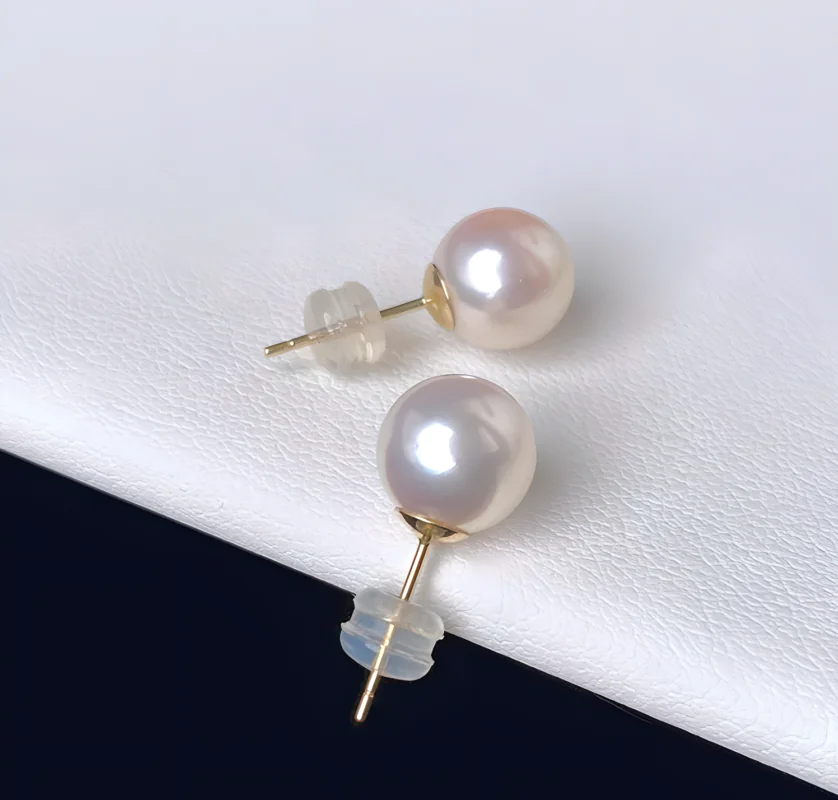
Fake pearls are more accurately called imitation or simulated pearls. They are manufactured to look like pearls but are not pearl formations grown inside a mollusk. The most common types are plastic pearls, glass pearls, shell-based imitation pearls, and newer fiber or composite imitations such as cotton pearls. Premium branded imitations may use more sophisticated versions of the same basic constructions.
The important point is that “fake pearl” is not one material. Two imitation strands can look similar while being completely different inside. A lightweight plastic bead, a solid glass bead, and a coated shell bead may all be sold with a pearl-like finish, but they differ in weight, durability, surface behavior, and how convincing they look.
If your main concern is identification rather than classification, see our guide on how to tell if pearls are real or fake. This article focuses on what imitation pearls are actually made from.
First: Cultured Pearls Are Not Fake Pearls
Before dividing imitation pearls into types, it helps to separate three terms that are often confused:
- Natural pearls form in a mollusk without deliberate human initiation.
- Cultured pearls also form inside a living mollusk, but pearl cultivation begins through human intervention.
- Imitation pearls are manufactured objects made to resemble natural or cultured pearls.
So Akoya, freshwater, Tahitian, and South Sea cultured pearls are real pearls. They are not “fake” simply because people are involved in the cultivation process. GIA likewise distinguishes cultured pearls from imitation beads made from materials such as plastic, shell, or composites.
It is also important not to confuse treated pearls with imitation pearls. A cultured pearl may be bleached, dyed, irradiated, polished, or otherwise processed and still remain a cultured pearl. Treatment disclosure is a separate question from whether the object is actually a pearl. For more detail, see our pearl treatments guide.
The Main Types of Fake Pearls
The clearest way to classify imitation pearls is by their core or base material, because marketing names can overlap or change. In practical jewelry markets, most imitation pearls fall into four broad groups.
| Type | Typical construction | Common feel | Main point to remember |
|---|---|---|---|
| Plastic pearls | Molded plastic or acrylic, often pearlescent-coated | Usually very light | Low-cost and highly uniform |
| Glass pearls | Solid or hollow glass bead with a pearl-like coating | Heavier and cooler than plastic | Can imitate pearl weight more convincingly |
| Shell-based imitation pearls | Shell bead, often with an artificial surface coating | Can feel substantial | Real shell material does not make the bead a real pearl |
| Fiber / composite imitations | Cotton, fiber, resin, or other manufactured base with coating | Varies; cotton types can be very light | Construction is manufactured rather than pearl-grown |
1. Plastic Pearls
Plastic pearls are among the simplest and most common imitation pearls. A plastic or acrylic bead is molded into the desired shape and then colored, coated, or finished to create a pearl-like sheen.
Their biggest practical advantage is cost. Plastic can be produced in large quantities with very consistent size and color, which is useful for costume jewelry, children’s accessories, decorative work, and fashion pieces where low weight matters.
Plastic pearls are often easier to suspect because they may feel unusually light for their size. Their surface can also appear very uniform, with a shine that sits on the surface rather than showing the more complex optical depth associated with nacre. However, appearance varies widely, so light weight or uniformity should be treated as a clue rather than proof by itself.
One important correction to common online advice: a perfectly round pearl is not automatically fake. High-quality cultured pearls can be very round and carefully matched. Manufacturing uniformity becomes more useful only when it is considered together with weight, surface texture, drill holes, luster, and other evidence.
2. Glass Pearls
Glass-based imitation pearls have a long history and can be much more convincing than inexpensive plastic beads. The core may be solid glass or, in some older constructions, hollow glass. A pearl-like coating is then applied to create color and iridescence.
Because glass is denser than plastic, glass pearls can have a more substantial weight in the hand. This is one reason a simple “heavy means real” test is unreliable. A convincing glass imitation may feel closer to a cultured pearl than a lightweight plastic bead does.
The surface coating is especially important. Historically, some high-quality glass imitations used pearlescent coatings sometimes described as “pearl essence” or “essence of orient.” Modern coatings can use other formulations, but the underlying principle is similar: the pearl appearance comes from a manufactured surface rather than nacre deposited by a living mollusk.
GIA has documented both solid and hollow glass imitation pearls, as well as glass beads coated to simulate nacre’s iridescence. Under wear or magnification, some imitations may reveal coating behavior that differs from genuine pearl nacre.
3. Shell Pearls and Other Shell-Based Imitations
“Shell pearl” is one of the most confusing terms in the market because the raw material can genuinely come from a mollusk shell. That does not make the finished bead a real pearl.
A shell-based imitation may use a bead cut or formed from shell and then apply an artificial coating to imitate the appearance of a natural or cultured pearl. GIA has examined shell beads sold as “shell pearls” and found that they can closely imitate white, golden, or dark cultured pearls in both appearance and heft.
The distinction is structural. A genuine pearl is a biological formation produced inside a mollusk. A shell bead is a manufactured object cut, shaped, reconstructed, coated, or otherwise processed outside the animal. Even when the shell material contains aragonite or nacreous material, the bead itself did not grow as a pearl.
This matters because terms such as “shell pearl” can sound more natural than they really are. For a buyer, the safest question is not “Does this contain real shell?” but “Was this object grown as a pearl inside a mollusk, or was it manufactured from shell material?”
4. Cotton Pearls and Other Fiber or Composite Imitations
Imitation pearls are not limited to plastic, glass, and shell. GIA has also documented “cotton pearl” imitations used in fashion jewelry. These are lightweight manufactured beads designed to reproduce the appearance of pearls while keeping larger jewelry pieces comfortable to wear.
This group is best understood as a broader fiber or composite imitation category. The exact recipe can vary by manufacturer: the core may involve compressed fibers, resin, or another lightweight material, while the surface receives a pearl-like finish.
Cotton pearls are useful evidence of why a material-based classification works better than memorizing brand names. New imitation products can appear without changing the basic definition: if the object is manufactured to simulate a pearl rather than grown as a pearl in a mollusk, it is an imitation.
Are Majorica Pearls a Separate Type?
Not in the biological or gemological sense. Majorica pearls are high-quality imitation pearls, historically associated with glass cores and multiple layers of a proprietary pearlescent coating. GIA has studied Majorica imitation pearls in detail and described their glass bead nuclei and pearl-like coating system.
This is a useful distinction because search results often list “Majorica pearls” beside glass, plastic, and shell pearls as though all four were equivalent material categories. A more accurate hierarchy is:
- Glass pearl = a construction/material category.
- Majorica = a branded or trade-name example of a sophisticated glass-based imitation.
The same principle applies to other branded “crystal pearl,” “faux pearl,” or “fashion pearl” products. A brand name can describe a particular manufacturing system or quality level, but it does not create a new biological type of pearl.
Can Fake Pearls Contain Real Mother-of-Pearl?
Yes. This is one of the most important points for buyers to understand.
An imitation pearl can contain genuine shell or mother-of-pearl material and still be an imitation. What defines a pearl is not simply the chemical presence of calcium carbonate, aragonite, shell, or nacre-like material. The key issue is how the object formed.
If a spherical bead is cut from shell and coated to look like a pearl, it remains a manufactured shell bead. It did not form as a pearl inside a pearl sac.
This is also why phrases such as “made from real shell,” “natural shell pearl,” or “mother-of-pearl pearl” should not automatically be interpreted as meaning natural or cultured pearl. Trade descriptions should make the product’s imitation status clear.
How Imitation Pearls Are Usually Made
Although manufacturing methods differ, many imitation pearls follow the same general logic:
- A base bead is formed from plastic, glass, shell, fiber, resin, or another material.
- The bead is shaped and drilled.
- A pearlescent coating is applied to imitate pearl luster and color.
- Multiple coating, drying, polishing, or finishing steps may be used for higher-quality products.
- The beads are matched and assembled into jewelry.
The quality gap between imitations can therefore be large. A very inexpensive molded plastic bead and a carefully coated glass imitation are both “fake pearls,” but they should not be expected to have the same weight, finish, durability, or visual quality.
Why the Type of Fake Pearl Matters
Knowing the construction helps explain why home identification tricks sometimes contradict one another.
For example, “fake pearls are always light” works poorly against glass or shell-based imitations. “Fake pearls always feel warm” can also be unreliable because different materials exchange heat differently. Even drill-hole appearance can vary depending on the core, coating, and manufacturing quality.
That is why identification is stronger when several clues are combined. Weight, temperature, magnified surface texture, drill-hole edges, coating wear, matching uniformity, and luster can all contribute, but no single observation identifies every imitation. For higher-value purchases or uncertain pieces, professional gemological testing is more reliable than one at-home test.
What Should Buyers Look for in a Product Description?
The most useful information is straightforward disclosure. In the United States, the Federal Trade Commission advises sellers to make clear whether pearls are cultured or imitation. International jewelry standards likewise emphasize clear use of terms such as “imitation” or “simulated” when a product is not a natural or cultured pearl.
For buyers, descriptions such as imitation pearl, simulated pearl, glass imitation pearl, plastic imitation pearl, or shell-based imitation pearl are much more informative than vague phrases designed to sound luxurious.
If you are buying real pearls, do not rely on the word “pearl” alone. Check whether the seller clearly identifies the pearl type, whether it is cultured, and whether any relevant treatment has been disclosed. Our pearl buying guide explains the broader quality and purchasing checks that matter after authenticity is established.
Fake Pearl Types: The Simple Framework to Remember
If you remember only one framework, use this:
- Plastic-based imitations — usually lightweight and inexpensive.
- Glass-based imitations — heavier and often more convincing.
- Shell-based imitations — made from real shell material but manufactured rather than pearl-grown.
- Fiber/composite imitations — including products such as cotton pearls and other manufactured alternatives.
Then treat names such as Majorica, crystal pearl, fashion pearl, or other branded terms as commercial descriptions that still need to be mapped back to the underlying construction.
The boundary is simpler than the marketing language: natural and cultured pearls are pearl formations produced by mollusks; imitation pearls are manufactured objects made to look like them.
FAQ
Are cultured pearls fake?
No. Cultured pearls are real pearls formed inside living mollusks with human intervention in the cultivation process. They are different from imitation pearls, which are manufactured from other materials.
Are shell pearls real pearls?
Usually, products sold as shell pearls are shell-based imitation pearls rather than pearls that formed inside a mollusk. The core may be made from genuine shell, but the finished bead is manufactured.
Are glass pearls fake pearls?
Yes, when a glass bead is manufactured and coated to resemble a pearl, it is an imitation pearl. Some glass imitations can be quite convincing because glass gives them more weight than plastic.
Are Majorica pearls real pearls?
No. Majorica pearls are high-quality imitation pearls. They are best understood as a branded glass-based imitation rather than a separate natural or cultured pearl type.
Does a perfectly round pearl mean it is fake?
No. Cultured pearls can be very round, and high-quality strands can be closely matched. Extreme uniformity can be one clue among several, but it is not proof of imitation by itself.