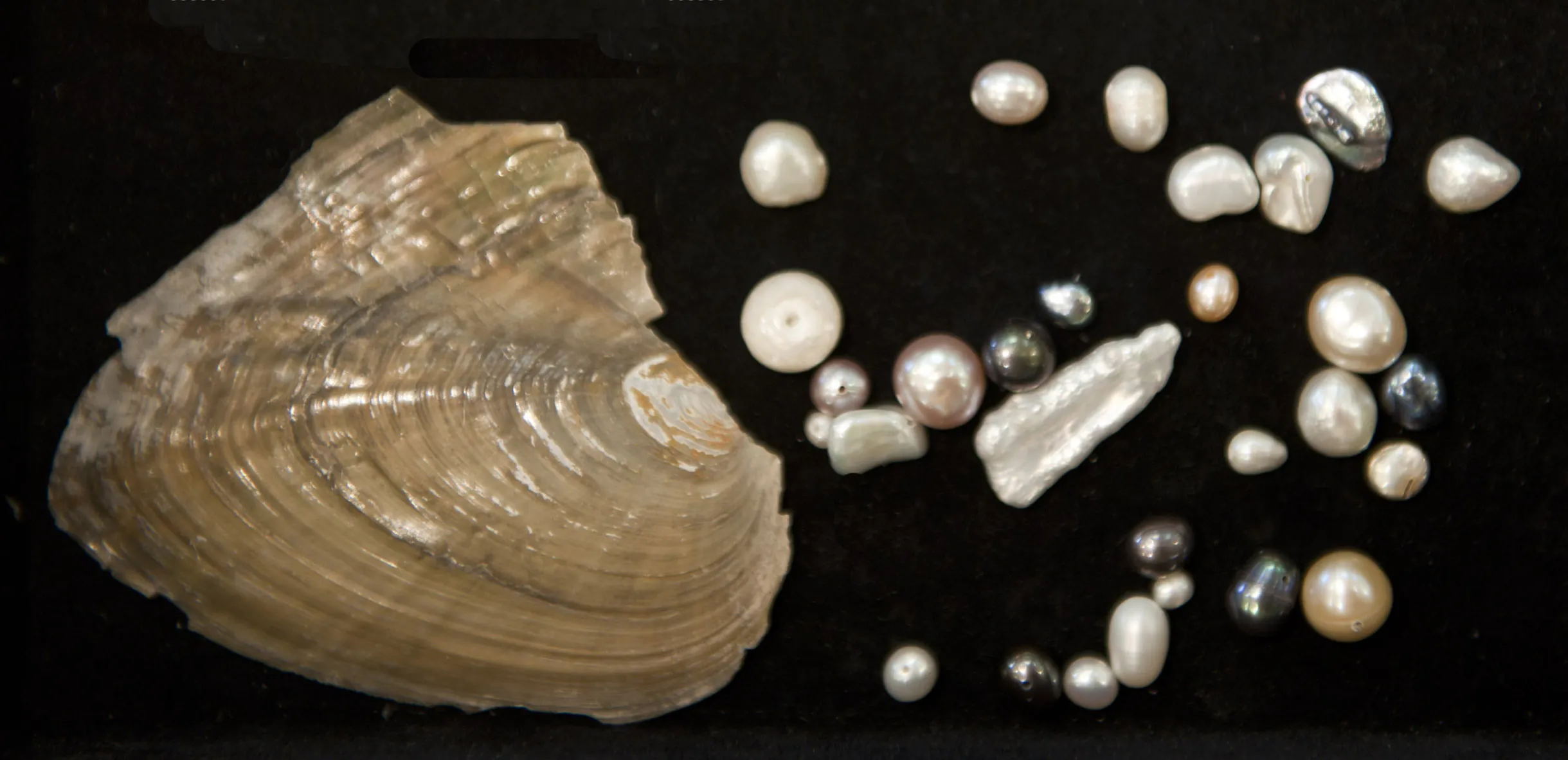
Japanese pearls are special not because every pearl from Japan is automatically better, but because Japan combines a distinctive pearl type with more than a century of cultivation experience, seasonal marine conditions, highly specialized farming, careful sorting and matching, and a mature pearl-processing tradition.
In international jewelry, the phrase “Japanese pearls” most commonly refers to Japanese Akoya cultured pearls. Fine examples are known for their compact round form, bright white-to-cream bodycolors, delicate rosé, silver or other overtones, and especially their sharp, mirror-like luster.
But the country name should not be mistaken for a quality grade. Two Japanese Akoya pearls can differ substantially in luster, surface condition, nacre, shape, color and matching. What makes the category special is the combination of material, environment and human skill behind it—not a guarantee attached to the word “Japan.”
First, What Does “Japanese Pearls” Actually Mean?
For most modern jewelry buyers, “Japanese pearls” means Japanese-cultured Akoya pearls. Akoya is a saltwater cultured-pearl type associated with the Pinctada fucata oyster. Japan is historically the best-known Akoya-producing country, although Akoya pearls are also cultured elsewhere, including China and Vietnam.
So these terms are related but not interchangeable:
- Akoya pearl describes a pearl type.
- Japanese Akoya adds a geographic cultivation claim.
- Japanese pearl is a broader geographic expression rather than a formal gemological species or grade.
There is an important exception to the retail shorthand. Japan has also produced freshwater cultured pearls. GIA has documented nucleated freshwater cultured pearls from Lake Kasumigaura, and Lake Biwa has an older freshwater-pearl tradition. These represent a much smaller part of modern production than Japanese Akoya, but they show why “Japanese pearl” should not be treated as a scientific synonym for Akoya.
If you want a fuller introduction to the Akoya category itself, see our Akoya pearl guide.
1. Fine Japanese Akoya Pearls Have a Recognizable Optical Character
The feature buyers notice first is usually luster.
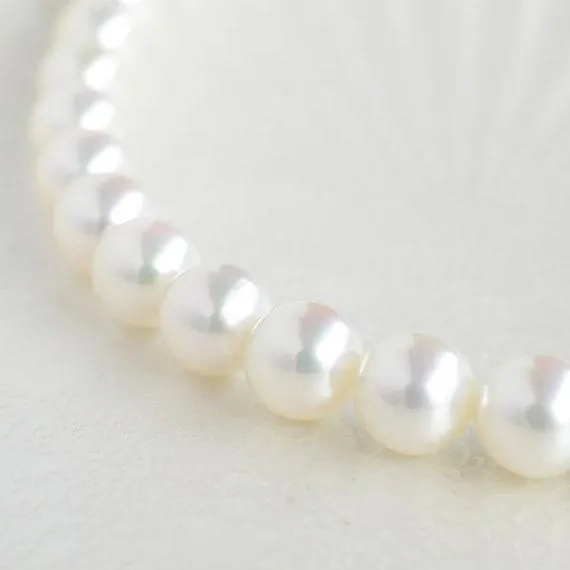
High-quality Akoya pearls can reflect light with very sharp edges. Under good lighting, a window, lamp or dark object may appear as a surprisingly clear miniature reflection on the curved pearl surface. This is why fine Akoya luster is often described as crisp, bright or mirror-like.
That look is different from simply being shiny. A pearl photographed under a strong lamp can appear bright even when its reflections are blurred. Good luster has both intensity and definition.
GIA identifies Akoya pearls with the classic white cultured-pearl appearance and notes that fine examples are particularly associated with round shape and sharp, mirror-like luster. Akoya pearls are also generally smaller than South Sea pearls, with the familiar jewelry range concentrated around modest sizes rather than exceptionally large diameters.
For a practical way to judge reflection sharpness rather than relying on labels such as “high luster,” see our pearl luster guide.
2. Japan's Marine Environment Helps Shape Akoya Production
Japanese Akoya pearls are grown in coastal marine environments rather than in a perfectly controlled factory. Temperature, plankton availability, water quality, salinity, disease pressure and seasonal change all affect the oysters during cultivation.
This matters because pearl nacre is biological material. The oyster must remain healthy enough to deposit nacre around the implanted nucleus while responding continuously to its environment.
Japan's Fisheries Agency identifies areas including Ehime, Mie and Nagasaki among the country's major pearl-producing regions. Government material on pearl cultivation also emphasizes the importance of monitoring oyster health and farm conditions throughout the production cycle.
Seasonality is one reason Japanese Akoya production has its own character, but it should not be reduced to the marketing shortcut that “cold water automatically makes better pearls.” Cooler conditions can influence nacre formation and harvest strategy, yet the outcome still depends on the oyster, grafting, cultivation duration, farm management and many other variables.
Environment creates conditions for quality; it does not guarantee quality.
3. The Human Skill Begins Long Before the Pearl Is Harvested
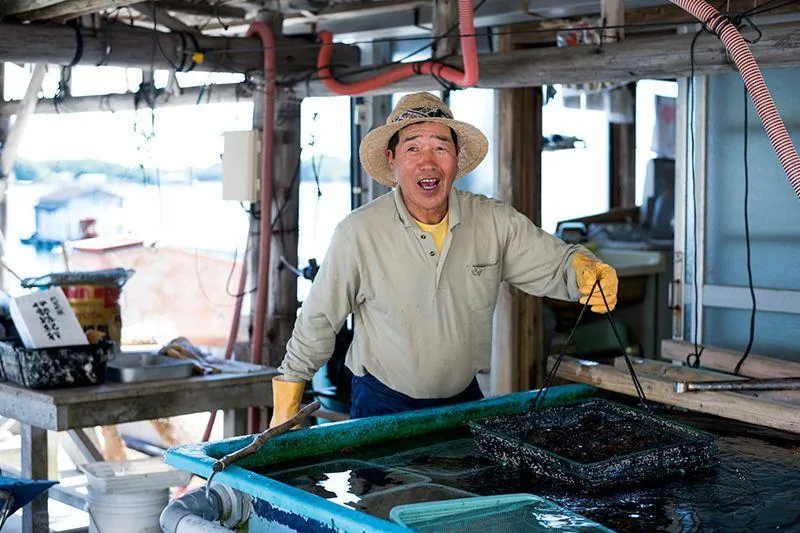
Akoya cultivation requires considerably more intervention than simply placing oysters in the sea and waiting.
A skilled technician introduces a bead nucleus together with mantle tissue into the oyster. The oyster then has to recover from the operation and survive a cultivation period while farmers monitor its condition and the surrounding water.
Small differences during this process can affect the final result. The health of the oyster, grafting skill, nucleus placement, timing, environmental stress and the way the animal responds biologically can influence whether the harvested pearl is round or distorted, lustrous or dull, clean or heavily marked.
This also explains why cultured pearls remain variable even when the farmer follows a repeatable system. A nucleus can be standardized; a living oyster cannot.
Japan's pearl tradition became especially strong because knowledge accumulated across generations of farmers, technicians, sorters, wholesalers and jewelers. That accumulated practical experience is part of what buyers are paying attention to when they value Japanese Akoya provenance.
4. Much of the “Japanese Pearl Look” Is Created Through Selection
Harvesting an attractive pearl and assembling an attractive necklace are two different jobs.
A single harvest contains a wide range of outcomes. Pearls may differ in diameter, roundness, overtone, surface characteristics, luster and nacre appearance. After harvest, that mixed material must be separated into increasingly consistent groups.
This is particularly important for Akoya strands. A necklace can contain dozens of pearls, and the eye immediately notices when one pearl is duller, greener, creamier, smaller or less round than its neighbors.
Good matching therefore involves more than measuring diameter. The sorter may need to compare:
- reflection strength and sharpness;
- white, cream or gray bodycolor;
- rosé, silver, greenish or other overtones;
- surface cleanliness;
- roundness;
- nacre appearance;
- the visual balance of the strand as a whole.
A major part of Japan's pearl reputation comes from this selection culture. The pearl farm creates the possibilities; sorting and matching determine which pearls finally appear together as a premium pair or strand.
5. Japan Developed an Entire Pearl Ecosystem, Not Just Pearl Farms
Japan's significance comes partly from the fact that cultivation did not develop in isolation.
The Ise-Shima area of Mie Prefecture is closely connected with the early history of modern pearl cultivation. Japan's official tourism organization describes Shima as a birthplace of Japanese pearl cultivation and links the region with Kokichi Mikimoto's work beginning in 1893.
Over time, pearl farming became connected with specialists in nucleation, sorting, processing, drilling, matching, laboratory examination, wholesale trading and jewelry manufacture. Places such as Kobe also developed important roles in pearl processing and distribution.
The Ministry of Agriculture, Forestry and Fisheries continues to identify Ehime, Mie and Nagasaki among important domestic production areas, while describing Kobe as an important processing and distribution center.
This network matters because the finished quality a customer sees does not depend only on what happened underwater. The final product is the result of repeated decisions made from oyster cultivation through final matching.
For the deeper historical explanation of how this system made Japanese Akoya internationally famous, see why Japanese Akoya pearls are famous.
6. Japanese Pearl Tradition Has Had More Than a Century to Develop
Japan occupies a special position in pearl history because experiments there helped transform cultured pearls from an uncertain idea into a modern jewelry industry.
Kokichi Mikimoto's successful cultured-pearl work in 1893 became one of the best-known milestones in that history, and his company later helped introduce Japanese cultured pearls to international consumers through exhibitions, jewelry production and overseas sales.
The technical history of round cultured pearls involved more than one Japanese innovator, so it is better not to reduce the invention of modern pearl culture to a single person. The larger point is more important for this article: Japan had an exceptionally long period in which farming methods, commercial standards, craftsmanship and customer expectations could develop together.
That history does not make an individual pearl beautiful. It does help explain why Japanese Akoya became such a mature and recognizable jewelry category.
7. What Japanese Origin Does Not Tell You
The reputation of Japanese pearls is useful context, but it can become misleading when buyers treat origin as shorthand for every quality characteristic.
| Claim | Better interpretation |
|---|---|
| “It is Japanese, so it must be top quality.” | Japanese Akoya occurs across different quality levels. Inspect the individual pearl. |
| “Every Akoya pearl comes from Japan.” | Akoya pearls are also cultured in other countries. |
| “A stronger Japanese name means stronger luster.” | Luster must be evaluated visually on the actual pearl or strand. |
| “Japanese pearls are always better than freshwater pearls.” | They are different categories. Fine modern freshwater pearls can also be round and highly lustrous. |
| “Japanese Akoya means Hanadama.” | Hanadama is a separate quality-related designation, not another name for all Japanese Akoya. |
This is why origin should be treated as context rather than a certificate of quality. For a fuller explanation, read why pearl origin matters.
8. Are Japanese Pearls Better Than Pearls from Other Countries?
There is no useful universal answer because different pearl types are trying to achieve different visual results.
A fine Japanese Akoya may be ideal when you want:
- compact, classic proportions;
- round or near-round pearls;
- bright white-based colors;
- very sharp reflections;
- a traditional matched strand or pair.
But another pearl type may be better for another goal. South Sea pearls can offer much larger sizes and a broad satin-like glow. Tahitian pearls offer naturally dark colors and complex overtones. Freshwater pearls offer an enormous range of shapes, colors, sizes and price levels, including modern high-luster varieties.
So “special” should not be translated into “universally superior.” Japanese Akoya is special because it performs exceptionally well within a particular aesthetic: refined size, roundness, sharp luster and precise matching.
9. How Should You Judge a Japanese Pearl?
If a seller describes a pearl as Japanese, begin by separating three questions:
- What is it? Is it actually an Akoya cultured pearl?
- Where was it cultured? Is the Japanese origin supported by the supply chain rather than merely by where it was processed or sold?
- How good is the individual pearl? What do its luster, surface, shape, color, nacre and matching actually look like?
GIA evaluates cultured pearls using seven pearl value factors: size, shape, color, luster, surface, nacre and matching. Those factors provide a much more useful quality framework than a country name alone.
For retail or wholesale comparison, pay particular attention to the following:
Luster
Look for sharp reflections rather than brightness alone. Fine Akoya should appear lively in more than one lighting condition.
Surface
Small natural growth features are normal. Judge their number, severity, location and overall visibility rather than demanding a biologically perfect surface.
Shape
If the pearl is sold as round, rotate it rather than judging from one photograph. Near-round pearls can appear perfectly round from a favorable angle.
Nacre
Nacre quality contributes to both appearance and durability. Do not assume strong origin branding makes nacre evaluation unnecessary.
Matching
For earrings and strands, compare the group rather than the best individual pearl. Similar luster and overtone can matter as much as matching diameter.
Our pearl grading guide explains how these factors work together in commercial sorting.
What About Hanadama Japanese Akoya?
Hanadama is often mentioned when discussing premium Japanese Akoya, but it should be understood separately from origin.
Japanese Akoya describes type plus provenance. Hanadama describes a qualifying quality range under defined laboratory criteria.
GIA now recognizes a Hanadama comment for qualifying Akoya cultured pearls that meet requirements involving factors such as round-to-near-round shape, excellent luster, strong nacre quality, appropriate surface quality and matching where applicable.
A certificate can therefore provide useful evidence, particularly in the premium market. But even two qualifying strands may differ visibly in size, overtone, surface, matching and overall character.
What Should Wholesale Buyers Pay Attention To?
For a jewelry maker or business buyer, Japanese origin is only one line in the specification.
A more useful wholesale description should also establish:
- pearl type and documented cultivation origin;
- diameter or size range;
- roundness or shape category;
- luster level;
- surface expectations;
- bodycolor and overtone;
- matching requirements;
- drilling status;
- relevant treatment information;
- certificate requirements when applicable.
This prevents “Japanese” from doing too much work as a marketing word. Professional sourcing becomes easier when origin and observable quality are described separately.
Designers and jewelry makers can also browse our wholesale pearl selection when comparing materials for different production requirements.
The Key Takeaway
What makes Japanese pearls special is not one secret feature. It is a system.
The Akoya oyster provides a pearl type capable of producing the compact round shape and crisp luster for which the category is known. Japan's coastal environments influence how those oysters grow. Experienced farmers manage nucleation, oyster health and harvest timing. After harvest, specialists sort and match pearls into increasingly precise groups. More than a century of pearl cultivation, processing, trade and jewelry manufacture has connected those skills into one mature industry.
That combination explains why Japanese Akoya remains an important reference point for classic pearl jewelry.
But the most useful buying rule remains simple: let Japanese origin tell you the pearl's story, then let the pearl itself tell you its quality.
Frequently Asked Questions
Are all Japanese pearls Akoya pearls?
No. In mainstream international jewelry, “Japanese pearls” usually refers to Japanese Akoya, which dominates the country's pearl identity. Japan has also produced freshwater cultured pearls, including small-volume production associated with Lake Biwa and Lake Kasumigaura.
Why do Japanese Akoya pearls look so shiny?
Fine Akoya pearls can develop very sharp luster because of the optical quality and structure of their nacre. Oyster health, cultivation conditions, seasonal water changes and farming decisions all influence the final result. Not every Akoya pearl has equally strong luster.
Are Japanese pearls better than Chinese pearls?
Not automatically. Origin influences production context, but individual quality still needs to be judged through luster, surface, nacre, shape, color, size and matching. This is especially important because China produces both freshwater cultured pearls and Akoya pearls, which should not be treated as one category.
Are Japanese Akoya pearls natural pearls?
Commercial Japanese Akoya pearls are generally cultured pearls. A technician intentionally nucleates the oyster, after which the living oyster deposits nacre around the nucleus. Cultured pearls are genuine pearls, but they are different from natural pearls formed without deliberate human initiation.
Does Japanese origin guarantee Hanadama quality?
No. Hanadama is a specific quality-related designation for qualifying Akoya pearls. A Japanese Akoya pearl does not become Hanadama simply because it was cultured in Japan.
What is the easiest feature to check when buying Japanese Akoya?
Luster is a useful place to start. Compare pearls under the same lighting and look at how sharp and lively the reflections appear. Then evaluate surface, shape, nacre, color and matching rather than making the decision from luster alone.
References and Further Reading
- Gemological Institute of America (GIA) — Different Pearl Types Explained: Akoya, South Sea, Tahitian & Freshwater Pearls.
- Gemological Institute of America (GIA) — Pearl Description and the Major Types of Cultured Pearls.
- Gemological Institute of America (GIA) — Pearl Classification: The GIA 7 Pearl Value Factors.
- Gemological Institute of America (GIA), Gems & Gemology — Cultured Pearls from Lake Kasumigaura: Production and Gemological Characteristics.
- Japan Fisheries Agency — Pearl Aquaculture Information and Production Structure.
- Japan National Tourism Organization — Pearl Cultivation in the Ise-Shima Area.
- MIKIMOTO — Brand Story and the History of Cultured Pearls.