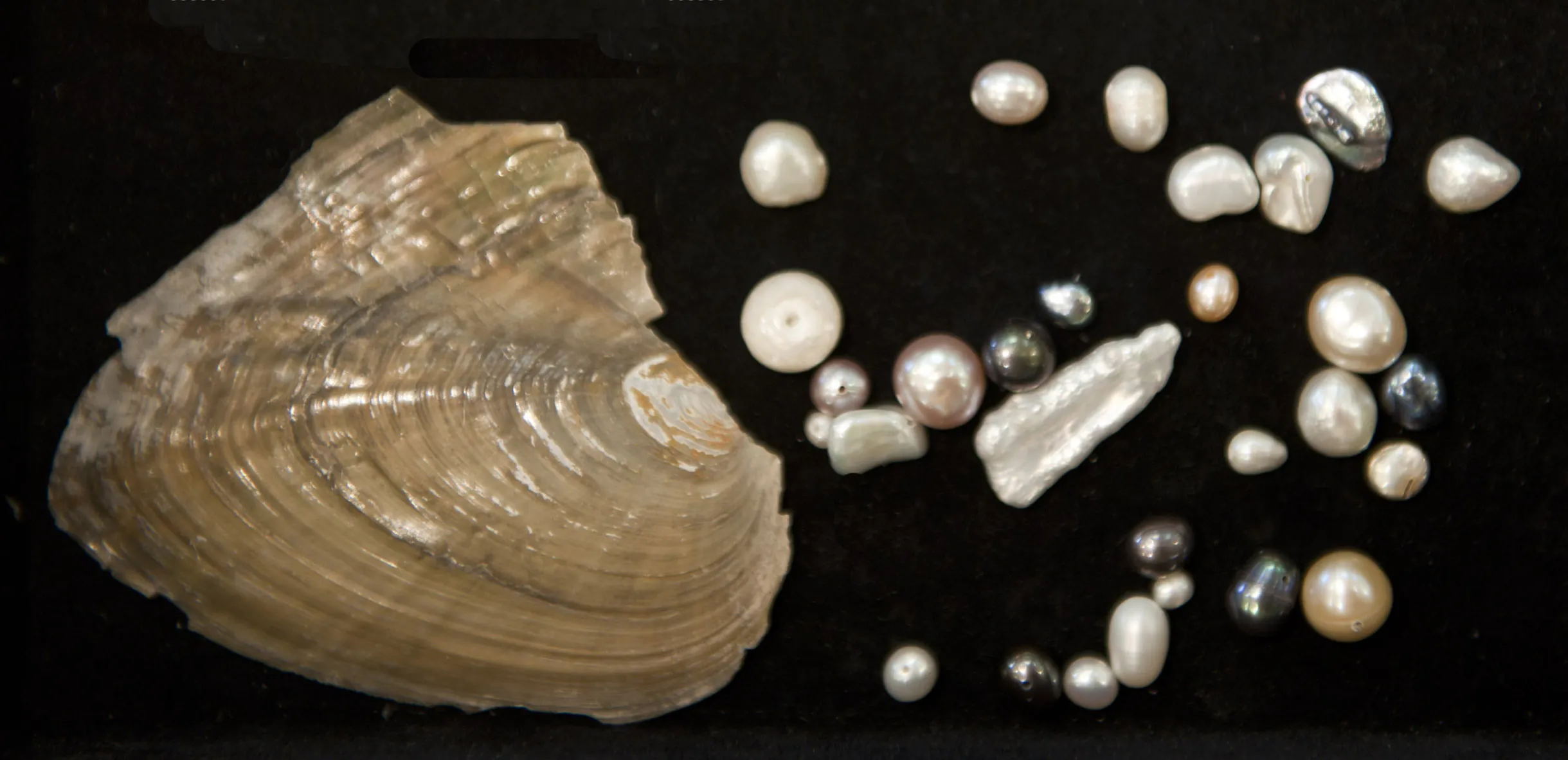
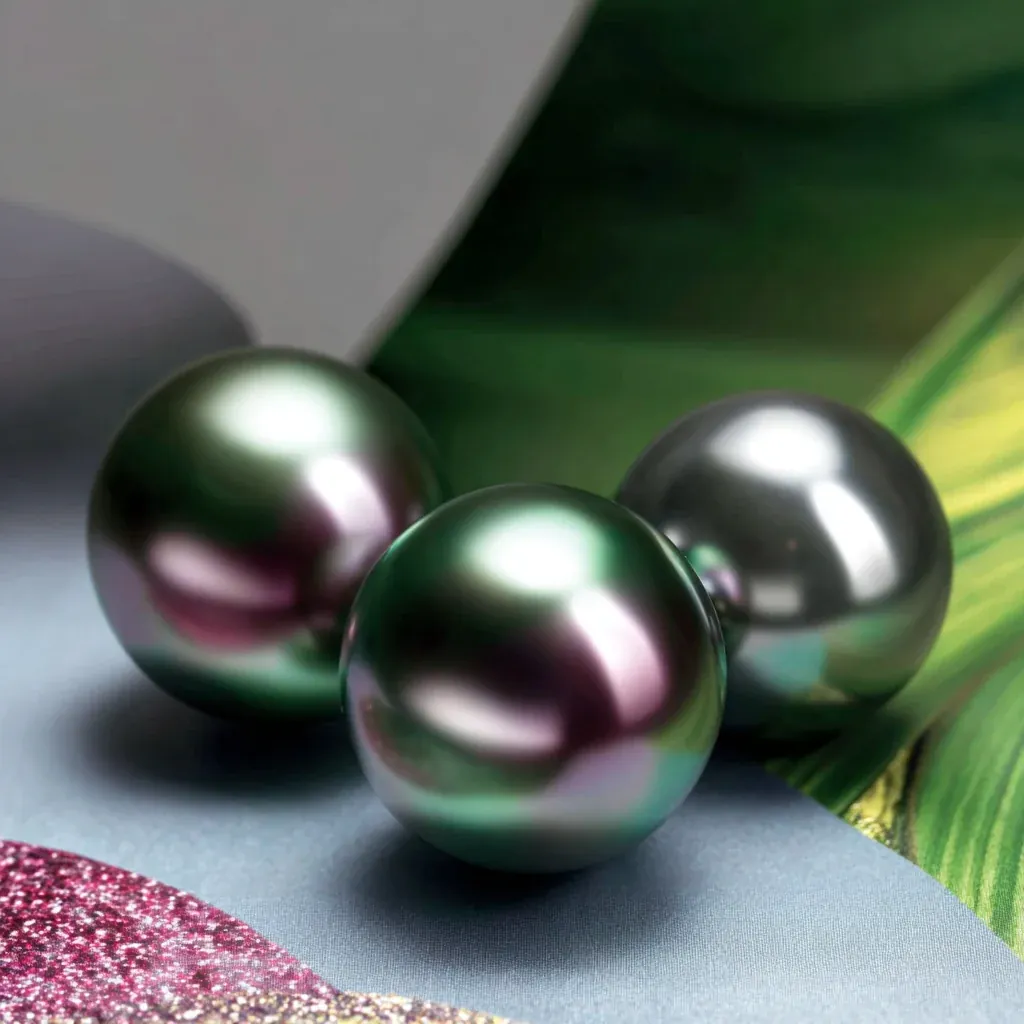
Peacock green is not simply a bright green Tahitian pearl. In the pearl trade, “peacock” describes a layered color effect: a Tahitian pearl has a green-containing bodycolor, usually at a medium-to-dark tone, together with a noticeable overtone or orient—very often pink, rose, or purplish. The contrast between those colors is what creates the peacock-like appearance.
This distinction matters because the word peacock is widely used in product descriptions, sometimes more loosely than it should be. A dark pearl with a weak green cast is not automatically a strong peacock pearl.
“Peacock” Is a Color Range, Not One Exact Shade
The most useful way to understand peacock color is to stop thinking of it as a paint swatch. Pearls are visually complex because their color can contain several components at once.
GIA describes pearl color using three ideas: bodycolor, overtone, and orient. Bodycolor is the dominant overall color. Overtone is a translucent secondary color that appears over that bodycolor. Orient is a more iridescent play of colors that can seem to shift across or just below the surface.
For the trade term “peacock,” GIA describes a selected range in cultured pearls from Pinctada margaritifera, the black-lipped pearl oyster associated with Tahitian pearls. The bodycolor contains green, with medium-to-strong saturation and a medium-to-dark tone, accompanied by a moderate or stronger overtone—usually pink, although other hues may occur—or orient.
That is why two pearls sold as “peacock” can look noticeably different. One may lean emerald green with a rose flash; another may look darker and shift toward purple or blue-green as it turns.
What Makes a Tahitian Pearl Look Peacock-Green?
Tahitian pearls are produced by the black-lipped pearl oyster, Pinctada margaritifera. Unlike the simple “black pearl” image many shoppers have in mind, this pearl type can naturally show gray, silver, green, brown, and other dark bodycolors, often modified by green, pink, purple, blue, or bronze-like overtones.
The peacock effect comes from the interaction of the pearl's underlying color with the optical effects created by its nacre. Light interacts with many thin nacre layers, producing translucent overtones and, in some pearls, iridescent orient. The result can look different as the pearl, light source, or viewer moves.
This is also why a good peacock pearl should not be judged from a color name alone. The word describes an appearance created by several visual factors working together.
If you want the broader context first, our Tahitian Pearls Guide explains the pearl type, while The Natural Dark Color Range of Tahitian Pearls maps peacock alongside silver-gray, charcoal, green, aubergine, and other trade color descriptions.
Peacock vs. Plain Green: What Is the Difference?
This is the distinction that causes the most confusion. A Tahitian pearl can be green without being strongly peacock.
| Appearance | What You Usually See | How It Reads Visually |
|---|---|---|
| Plain green | Green is dominant, but contrasting overtone or orient may be weak | Cleaner, simpler green impression |
| Peacock | Green-containing bodycolor plus a noticeable contrasting overtone or orient, commonly pink, rose, or purple | Layered, shifting, more iridescent appearance |
| Dark gray / near-black | Dark bodycolor with little obvious green or contrasting color | Deeper and more neutral, but not necessarily peacock |
In practical terms, look for color contrast. A pearl that is merely dark green can be attractive, but the classic peacock impression usually becomes much clearer when green is paired with a visible rose, pink, purplish, or multi-hued surface effect.
Why Does Peacock Color Change Under Different Light?
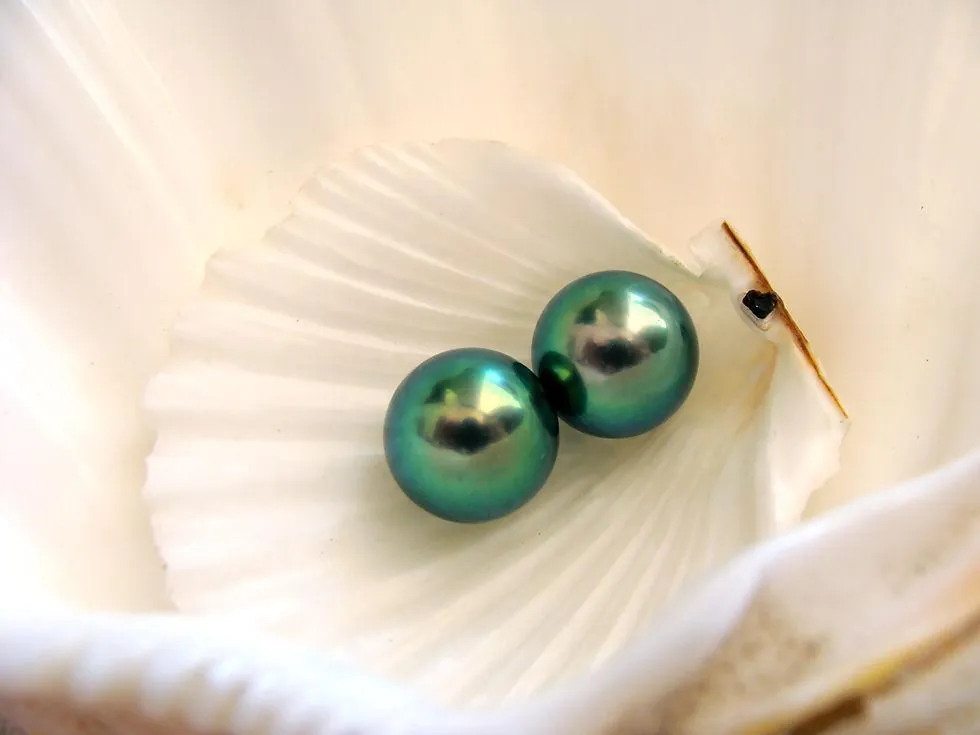
A peacock Tahitian pearl can look greener in one photograph, more rose or purple in another, and darker in person. That does not automatically mean the color description is wrong.
Three variables change what you see:
- Light source: daylight, warm indoor light, cool LEDs, and concentrated spotlights can emphasize different hues.
- Viewing angle: overtone and orient are directional optical effects, so turning the pearl can reveal colors that were weak from the previous angle.
- Luster: stronger, sharper reflections can make color appear more vivid and dimensional, while weak luster can make an otherwise interesting color look flat.
This is why product photography can exaggerate or suppress peacock color. A single dramatic photo under a spotlight is not the best way to judge it.
How to Judge Peacock Color More Reliably
If you are comparing loose pearls, a pair, or a strand, use a simple viewing routine rather than chasing the darkest or most saturated photo.
- Start with neutral, diffused light. Bright indirect daylight or a neutral white light makes comparison easier than colored or highly directional lighting.
- Use a neutral background. White or neutral gray helps prevent surrounding colors from contaminating your impression.
- Rotate the pearl slowly. Check whether the green and contrasting overtone remain attractive across several angles instead of appearing only at one carefully staged position.
- Look at luster separately from color. Ask whether reflections are bright and reasonably sharp. A beautiful color does not compensate for poor luster.
- For pairs and strands, judge matching. Two individually beautiful peacock pearls can still look mismatched if one leans rose and the other leans blue-green.
Color is only one part of quality. For a more complete framework, see our Pearl Grading Guide, which covers luster, surface, shape, nacre, size, color, and matching.
Does Peacock Mean the Highest Grade of Tahitian Pearl?
No. Peacock is a color description, not a complete quality grade.
A strongly colored peacock pearl may be highly desirable, but its overall quality still depends on the complete combination of factors. GIA's pearl value framework considers size, shape, color, nacre, luster, surface, and matching.
So a vivid peacock pearl with dull luster and heavy surface blemishing is not automatically “better” than a slightly quieter green pearl with excellent luster, a cleaner surface, and a shape that suits the intended jewelry.
The same principle applies to darkness. A near-black pearl is not automatically superior to a medium-dark pearl. In many cases, a medium-dark pearl with strong luster and lively color contrast can look more impressive than a very dark pearl whose color appears flat.
Are Peacock Tahitian Pearls More Valuable?
Peacock is one of the best-known and most desired Tahitian color appearances, so strong examples can command a premium when other quality factors are comparable. But there is no universal price multiplier for the word “peacock.”
Value depends on the entire pearl. A round, high-luster, clean-surfaced pearl with an attractive peacock effect is very different from a heavily blemished or poorly matched pearl carrying the same color label.
For a strand, matching can be especially important. The task is not only finding many colorful pearls; it is finding pearls whose tone, saturation, overtone, luster, size, and shape work together across the whole necklace.
Is Every “Peacock” Pearl Naturally Colored?
No color name by itself proves natural color origin.
Pinctada margaritifera can naturally produce the dark bodycolors and green, pink, purple, and blue effects associated with Tahitian pearls. However, pearl color can also be altered by treatment, and dark or green-treated pearls from other pearl types can be marketed with peacock-like language.
For an ordinary purchase, ask the seller to disclose whether the color is natural or treated. For a high-value pearl where color origin materially affects the purchase, an independent laboratory report can provide a stronger basis than appearance alone.
Visual clues can raise questions, but they should not be treated as laboratory proof. Even experienced buyers can be misled by lighting, photography, or sophisticated treatments. Our Pearl Treatments Guide explains why treatment disclosure matters and why simple at-home checks have limits.
Peacock, Green, and Aubergine Are Not the Same Thing
Trade color names are useful shorthand, but they should describe what the eye actually sees.
- Green: a pearl whose appearance is mainly green, without requiring a strong contrasting rose or purple effect.
- Peacock: a green-containing, medium-to-dark appearance with a noticeable overtone or orient, often pink or rose and sometimes purple or other hues.
- Aubergine: a purple to reddish-purple impression, often used when that family of color dominates more than green.
In real pearls, the boundaries are not always as neat as a chart suggests. A single pearl may move visually between green, peacock, blue-green, and aubergine depending on its dominant hue and viewing conditions. That is one reason reputable descriptions should be treated as useful labels, not mathematical color codes.
What Should You Look for If You Want a Good Peacock Tahitian Pearl?
Start with the pearl, not the label. A practical order of judgment is:
- Luster first: bright, sharp reflections usually make the color look deeper and more alive.
- Then color: look for a green-dominant appearance with a clearly visible contrasting overtone or orient that remains attractive as the pearl turns.
- Then surface and shape: decide how much blemishing or shape variation you are comfortable with for the price and jewelry style.
- Then matching: for earrings or strands, evaluate the group rather than each pearl in isolation.
- Finally, confirm color disclosure: especially if natural color is part of what you are paying for.
The key idea is simple: a fine peacock pearl should look lively, not merely dark. The strongest examples have enough green presence to establish the color family, enough contrasting overtone or orient to create the peacock effect, and enough luster to make those colors appear dimensional.
Frequently Asked Questions
Is peacock green an actual green bodycolor?
It can include a green bodycolor or a bodycolor whose hue contains green, but the peacock appearance is not defined by green alone. A noticeable overtone or orient—often pink or rose—is an important part of the effect.
Are peacock Tahitian pearls black?
They are often grouped commercially with “black pearls,” but Tahitian pearls are rarely a flat, jet black. Peacock pearls usually show a medium-to-dark green-influenced bodycolor plus secondary color effects.
Is “peacock” an official pearl grade?
No. It is a trade color term, not a complete grade. GIA uses a defined peacock color-range comment on qualifying reports, while overall pearl quality still depends on multiple value factors.
Is a darker peacock Tahitian pearl always better?
No. Tone is only one variable. Luster, saturation, overtone or orient, surface quality, shape, and matching can matter just as much or more to the finished appearance.
Can peacock-colored pearls be treated?
Yes. Natural peacock coloration occurs in Pinctada margaritifera pearls, but color treatments also exist in the pearl market. Ask for treatment disclosure, and consider laboratory testing when the value or color-origin claim is important.
The Short Answer
Peacock green in Tahitian pearls is best understood as a layered green-centered color range, not a single green shade. The classic effect combines a green-containing medium-to-dark bodycolor with a noticeable overtone or orient—often pink, rose, or purple—creating the shifting, feather-like appearance that inspired the name.
When judging one, do not ask only, “Is it green enough?” Ask whether the pearl has lively color contrast, strong luster, an attractive appearance from more than one angle, and quality that holds up beyond the color label.