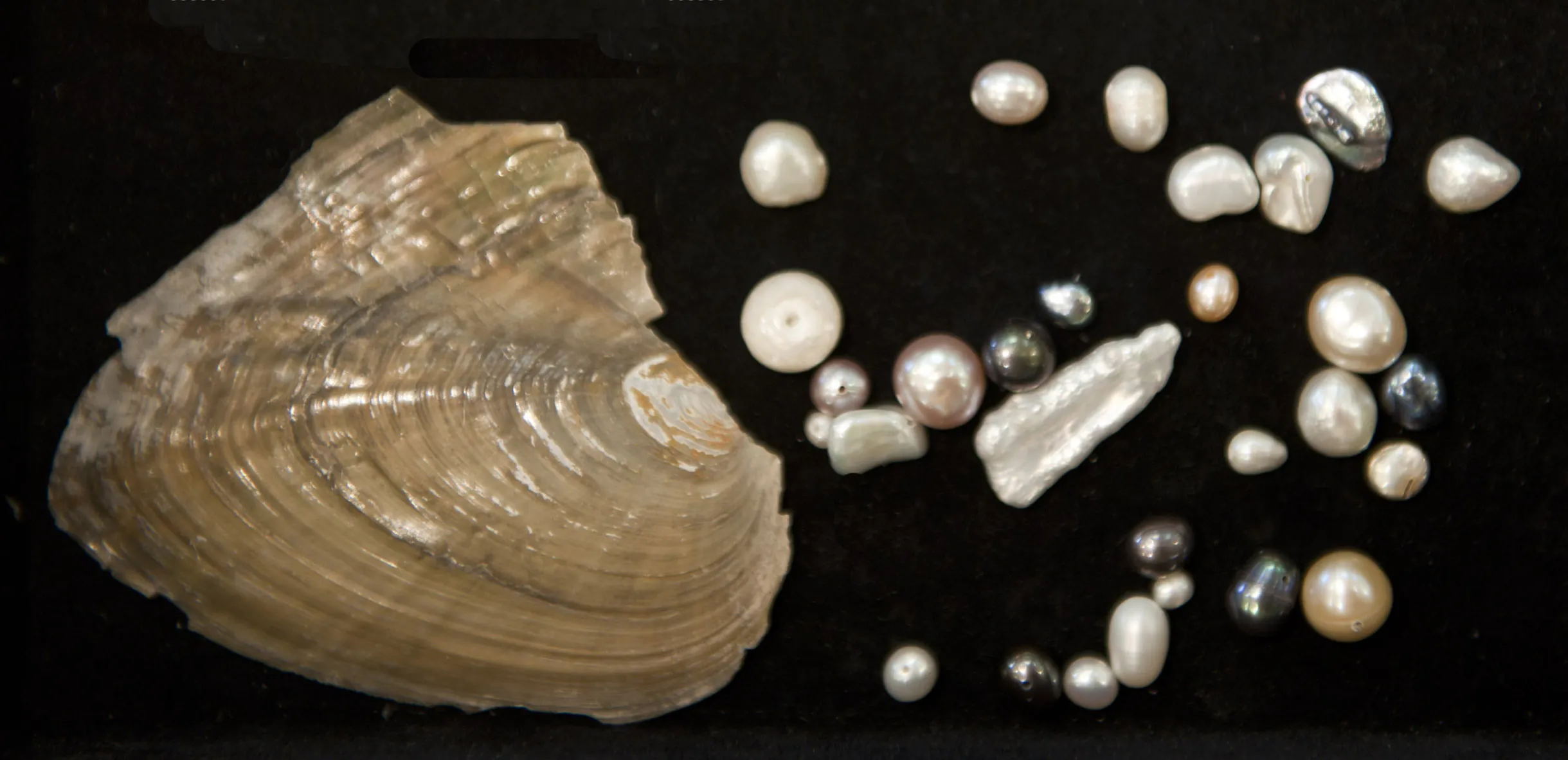
Pearls grow inside mollusks because these animals already possess specialized tissue that can build hard, mineralized shell material. The key tissue is the mantle. Under normal conditions, mantle cells help make and maintain the shell. If pearl-forming mantle-derived cells become established inside the animal's soft tissue, they can organize into a closed pearl sac and continue secreting mineral and organic material there.
That makes a pearl easier to understand: it is not a mysterious object that an oyster somehow decides to manufacture. In a nacre-producing mollusk, a pearl is essentially shell-building biology operating in an unusual internal location. The same general biomineralization ability used to make the inner shell can, under the right conditions, build a rounded body layer by layer inside a pearl sac.
This is also why the familiar explanation—“an irritant enters an oyster, so the oyster covers it for protection”—is incomplete. Irritation or injury may help start some natural pearls, but the crucial biological step is the formation of pearl-producing tissue in the right place.
The Short Answer: A Pearl Uses the Mollusk's Existing Shell-Building System
Mollusks such as pearl oysters and freshwater mussels do not begin with a special organ whose normal job is to make jewelry pearls. What they do have is a highly developed system for biomineralization: living cells control the deposition of calcium-carbonate minerals together with an organic matrix to construct a shell.
The mantle is central to this process. It is the soft tissue associated with shell formation, and specialized epithelial cells in the mantle secrete the materials from which shell layers are built. In nacre-producing species, the inner shell includes nacre, or mother-of-pearl.
When mantle-derived pearl-forming cells end up enclosed within the mollusk's body, they can keep performing a related job. Instead of depositing material as a broad shell surface, they form a small sac and deposit material inward around a center. Over time, that three-dimensional deposit becomes a pearl.
For the complete formation sequence, see our guide to how pearls form naturally and in culture.
Why Is the Mantle So Important?
The mantle is what connects pearl formation to ordinary mollusk biology. A mollusk's shell may look like a separate object, but it is built by living tissue. The mantle releases proteins, minerals, and other components that control where calcium carbonate forms and how its crystals are organized.
Different regions and different mollusk species can produce different shell structures. In familiar nacreous pearl mollusks, one of those structures is nacre: thin mineral layers organized with an organic matrix. The remarkable optical properties of nacre come not merely from its chemistry, but from its microscopic architecture.
So the ability to make a pearl does not appear from nowhere. The animal already knows how to make a controlled mineralized structure. Pearl formation redirects that existing capability into a small enclosed space.
If you want to go deeper into the material itself, our guide to the physical and chemical properties of pearls explains calcium carbonate, organic matrix, nacre, and pearl structure in more detail.
Why Does a Pearl Grow Inside the Body Instead of Becoming Part of the Shell?
The answer is location.
When shell-producing epithelium remains where it normally belongs, it contributes to shell growth or repair. When pearl-forming epithelial cells become displaced or deliberately transplanted into an internal location, they can proliferate and organize into a pearl sac. The sac surrounds a small internal space or nucleus and secretes material toward the center.
This change in geometry is important. Shell growth is largely deposition onto a surface. A pearl sac is closed around a center, so secretion builds a separate, roughly concentric structure inside the animal.
A useful mental model is therefore:
- Mantle in its normal position: builds and maintains shell.
- Mantle-derived epithelium forming a pearl sac: builds pearl material around an internal center.
The biology is related; the location and shape of the secreting tissue are different.
What Is a Pearl Sac?
A pearl sac is a small envelope of pearl-producing epithelial cells surrounding a developing pearl. It is the living tissue that actually deposits the pearl material.
This is one of the most useful concepts for understanding pearls because it corrects the idea that the object at the center does all the work. A parasite, tissue injury, bead nucleus, organic fragment, or other event may be involved in starting a pearl, but none of those objects manufactures nacre. The pearl sac does.
In a nacreous pearl, the sac can deposit extremely fine layers containing calcium carbonate—commonly aragonite—together with organic material. The process repeats as the pearl grows.
Researchers studying pearl microstructure have described the pearl sac as tissue programmed to reproduce shell-like mineral architecture in a closed internal setting. That is why calling it a “miniature shell-producing system” is a useful simplification, provided we remember that it is living tissue rather than a tiny physical shell.
Is Pearl Formation Really a Defense Mechanism?
It can be described that way, but “defense mechanism” is not the whole explanation.
Natural pearl formation may follow injury, the intrusion of a small organism, foreign material, or another disturbance. Enclosing an abnormal internal stimulus in mineralized material can isolate it from surrounding tissue, so the protective-response idea is biologically reasonable.
However, saying “the oyster is irritated, so it coats the irritant” skips the most important cellular step. The mollusk does not simply spray nacre onto anything that bothers it. Pearl-forming epithelial cells must become established, organize into a pearl sac, and then carry out biomineralization.
This distinction also explains why the popular grain-of-sand story is misleading. A random grain is not enough by itself. The more reliable model is mantle-derived cells → pearl sac → repeated biomineral deposition.
Why Don't All Mollusks Produce the Same Kind of Pearl?
Mollusks are a very large and diverse group. Their shells do not all have the same mineral structure, and their pearl-producing tissues do not all create the same surface architecture.
The jewelry trade is most familiar with nacreous pearls from pearl oysters and freshwater mussels. These include Akoya, Tahitian, South Sea, and most freshwater cultured pearls. Their surfaces are built from nacre, which gives them the familiar layered pearly luster.
Other mollusks can produce non-nacreous pearls. Conch, Melo, scallop, pen-shell, and other pearl types may have different microscopic structures and visual effects. They are still biological pearl formations, but they are not simply miniature versions of an Akoya or South Sea pearl.
This is why “mollusk makes shell, therefore every mollusk makes the same pearl” would be wrong. The animal's species, shell mineralogy, tissue behavior, genetics, and growth conditions all influence what kind of pearl structure can form.
Our pearl classification guide explains the major pearl families and the difference between nacreous and non-nacreous pearls.
Do Natural and Cultured Pearls Grow for the Same Biological Reason?
Yes, at the level of pearl-producing tissue, they rely on the same basic biological capability. Both natural and cultured pearls grow inside living mollusks and depend on a pearl sac that deposits pearl material.
The difference is how the process begins.
- Natural pearl: the pearl sac forms without deliberate human intervention.
- Cultured pearl: people intentionally create the starting conditions, usually by introducing mantle tissue and, in many production systems, a bead nucleus.
For many saltwater cultured pearls, a technician implants a small piece of donor mantle tissue together with a prepared shell bead. The grafted epithelial cells proliferate around the bead, form a pearl sac, and deposit nacre onto it.
Many traditional freshwater cultured pearls are produced without a large bead. Small pieces of mantle tissue can form pearl sacs that build pearls without a spherical bead nucleus at the center. Modern freshwater cultivation also includes bead-nucleated methods.
The important point is that human intervention does not manufacture the pearl surface outside the animal. The mollusk's living tissue still performs the biomineralization. You can follow the farming side of the process in our guide to pearl cultivation.
Why Does the Pearl Grow Layer by Layer?
A pearl grows by repeated secretion from the pearl sac. The sac does not create a finished gemstone in one event. It continuously deposits mineral and organic material at the pearl's surface.
In nacreous pearls, successive deposits form extremely fine structural layers. As the process continues, the pearl expands outward. The organization of these layers affects the way light interacts with the surface and therefore contributes to luster and orient.
This layered growth is another direct connection between a pearl and a mollusk's shell-building biology: both are constructed by controlled deposition rather than by a single crystallization event.
Does the Mollusk “Want” to Make a Pearl?
No intention is involved. A mollusk does not make pearls because pearls are useful objects in the human sense, and it does not aim to produce a round, lustrous gem.
Natural pearl formation is better understood as an uncommon consequence of tissue behavior, injury response, and biomineralization. In cultured pearl production, people deliberately exploit that biological capability by placing pearl-forming tissue where a pearl sac can develop.
This also explains why pearl farmers can influence the process without controlling every result. They can select mollusks, graft tissue, choose a nucleus, manage water conditions, and decide when to harvest, but the living animal determines how successfully the pearl sac develops and how consistently material is deposited.
Why Are Gem-Quality Pearls Still Unusual?
The ability to deposit mineral is only the beginning. A jewelry-quality pearl also needs a favorable combination of growth, shape, surface, luster, color, and structural integrity.
In nature, the right pearl-forming event must occur spontaneously, and the result may be tiny, irregular, attached to the shell, poorly surfaced, or otherwise unsuitable for jewelry. Cultivation makes pearl formation much more repeatable, but it still does not make the biological outcome perfectly predictable.
That is why the existence of a pearl is not surprising once you understand mollusk biology, while the existence of a large, clean, highly lustrous, well-shaped pearl can still be remarkable.
The Main Idea to Remember
If you remember one explanation, use this:
Pearls grow inside mollusks because mollusks already have living tissue capable of constructing mineralized shell material. When mantle-derived cells form a pearl sac inside the body, that shell-building system begins depositing material around an internal center instead of along the shell.
The “irritant” may explain how some natural events begin. The pearl sac explains how the pearl is actually built.
Frequently Asked Questions
Why do oysters make pearls?
Oysters can make pearls because mantle-derived epithelial cells are capable of secreting shell-related mineral and organic material. If those cells form a pearl sac inside the oyster's soft tissue, they can deposit pearl material around an internal center.
Are pearls just a mollusk's way of protecting itself?
Protection or isolation can be part of natural pearl formation, especially when injury or intrusion is involved. But the more precise mechanism is the formation of a pearl sac from pearl-producing epithelial cells. A simple irritation by itself does not explain the whole process.
Do all mollusks make nacreous pearls?
No. Mollusks differ in shell structure and biomineralization. Pearl oysters and freshwater mussels produce the familiar nacreous pearls used widely in jewelry, while some other mollusks produce non-nacreous pearls with different microscopic structures.
Why is a pearl inside the mollusk instead of on the shell?
A whole pearl forms when pearl-producing tissue creates a closed pearl sac within the mollusk's soft tissues. Because the secreting cells surround an internal center, mineral deposition builds inward around that center and produces a separate pearl rather than an ordinary shell layer.
Are cultured pearls real pearls?
Yes. Cultured pearls grow inside living mollusks through the same basic pearl-sac biomineralization process. Human intervention deliberately starts the process, but the mollusk produces the pearl material.
Is a pearl a disease or tumor?
It is better not to describe a pearl as a disease or tumor. A pearl is a biomineralized structure formed by pearl-producing epithelial tissue. Natural pearl formation can involve abnormal tissue location, injury, or intrusion, but those facts do not make every pearl equivalent to a disease process.