What Are Biwa Pearls? Their Relationship to Lake Biwa in Japan and Freshwater Pearls
Biwa pearls are freshwater cultured pearls associated specifically with Lake Biwa in Shiga Prefecture, Japan. The important point is that “Biwa” is fundamentally a geographic term, not simply a description of an elongated or baroque pearl shape. Lake Biwa became one of the most important early centers of commercial freshwater pearl culture, and its pearls helped establish the techniques and market expectations that later influenced the modern freshwater pearl industry.
Because the name became so famous, “Biwa pearl” was sometimes used loosely in the jewelry trade for freshwater pearls from other places. That is the source of much of today’s confusion. A modern Chinese freshwater pearl may resemble an old Japanese Biwa pearl in shape, color, or luster, but resemblance alone does not make it a Biwa pearl.
What Exactly Is a Biwa Pearl?
In strict gemological usage, a Biwa cultured pearl is a freshwater cultured pearl produced in Lake Biwa, Japan. This geographic distinction matters. International pearl nomenclature published by CIBJO specifically uses “Biwa Cultured Pearl” for cultured pearls grown in freshwater bivalve mollusks in Lake Biwa.
This means that “Biwa” should not be treated as another general pearl category alongside freshwater, Akoya, Tahitian, and South Sea pearls. Instead, the relationship is more precise:
- Freshwater cultured pearl describes the broad pearl type and growing environment.
- Biwa cultured pearl identifies a freshwater cultured pearl from a specific geographic origin: Lake Biwa.
So every genuine Biwa cultured pearl is a freshwater cultured pearl, but most freshwater cultured pearls are not Biwa pearls.
Why Is Lake Biwa So Important in Pearl History?
Lake Biwa is Japan’s largest freshwater lake and has a long-established aquatic ecosystem. Pearl-culture experiments around the lake took place in the early twentieth century, and commercially viable freshwater pearl production was established there in the early-to-mid 1930s using the native Biwa pearl mussel, Hyriopsis schlegelii.
Lake Biwa became historically important not simply because pearls were produced there, but because Japanese farmers developed successful methods for cultivating freshwater pearls in mussels on a commercial scale. After World War II, production increasingly focused on non-beaded cultured pearls, created by implanting mantle tissue rather than relying on a large spherical bead nucleus.
That method helped make Lake Biwa famous for pearls with substantial nacre and a wide range of organic shapes and colors. It also became an important technical predecessor to the tissue-cultured freshwater pearl industry that later expanded dramatically in China.
Readers interested in how human intervention starts pearl formation can continue with our guide to pearl cultivation.
Were Traditional Biwa Pearls Bead-Nucleated or Non-Beaded?
Many of the classic Lake Biwa pearls that built the region’s reputation were non-beaded freshwater cultured pearls. Instead of inserting a round shell bead like the nucleus commonly used in Akoya cultivation, farmers could use small pieces of mantle tissue to stimulate pearl-sac formation.
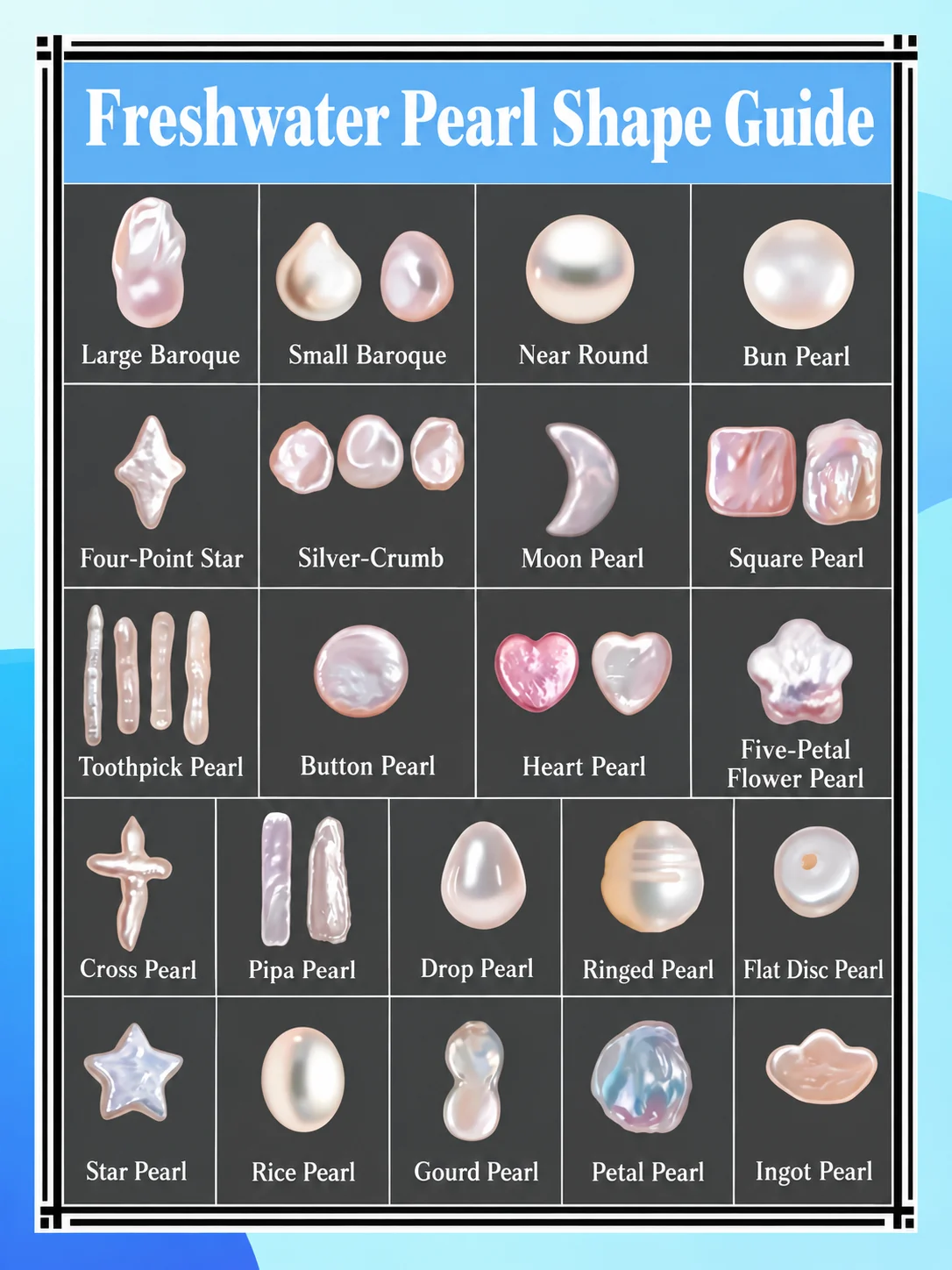
Because there was no large round bead controlling the final form, these pearls frequently developed as baroque, oval, flat, elongated, stick-like, or otherwise irregular shapes. This is why many people now mentally associate the word “Biwa” with long, uneven freshwater pearls.
However, that historical association should not be turned into a rigid definition. CIBJO’s current definition allows the term Biwa cultured pearl to include beaded or non-beaded cultured pearls produced in Lake Biwa. In other words, geography defines the term more reliably than shape or nucleation style.
For a closer explanation of pearls formed without a bead nucleus, see our guide to freshwater non-nucleated cultured pearls. Modern freshwater farming also includes bead-nucleated methods, which are covered in our guide to nucleated freshwater pearls.
What Do Biwa Pearls Look Like?
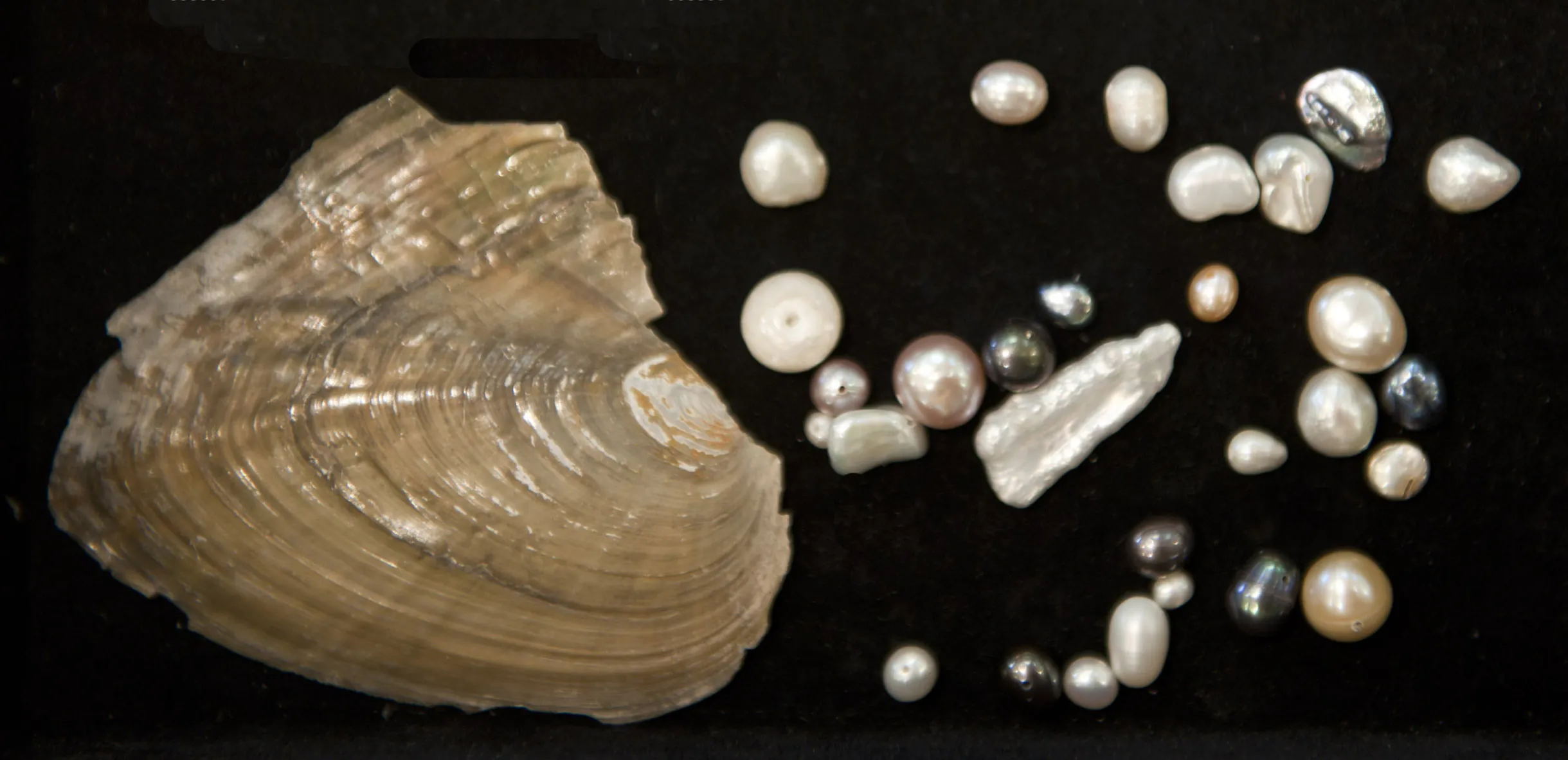
There is no single shape or color that proves a pearl came from Lake Biwa. Historically, however, Biwa production became especially well known for visual variety. Pearls could appear white, cream, pink, lavender, orange, brownish, or other subtle freshwater tones, while shapes ranged from rounded forms to highly expressive baroque forms.
Some historic Lake Biwa producers even experimented with unusual shapes such as crosses, sticks, triangles, and other freeform pearls. These forms contributed to the strong artistic identity of Japanese freshwater pearls in the twentieth century.
Still, appearance must be interpreted carefully. Modern freshwater pearls from China can also be white, pink, lavender, peach, baroque, oval, elongated, or near-round. Advances in Chinese freshwater cultivation have made visual overlap even greater.
Practical rule: an elongated freshwater pearl can be described as elongated, stick-shaped, baroque, or “Biwa-style” if that wording is being used only to describe appearance, but the pearl should not be represented as genuinely from Lake Biwa unless its origin is supported.
Biwa Pearls vs. Freshwater Pearls: What Is the Difference?
| Point | Biwa Cultured Pearls | Freshwater Cultured Pearls in General |
|---|---|---|
| Basic category | A specific freshwater cultured pearl origin | The broad category of cultured pearls grown in freshwater |
| Geographic meaning | Lake Biwa, Japan | Can come from China, Japan, or other freshwater-producing regions |
| Historical production | Major influence on twentieth-century freshwater pearl culture | Includes many production traditions and modern farming systems |
| Typical historical forms | Often non-beaded and baroque, oval, flat, or elongated | Can be round, near-round, oval, button, drop, baroque, and more |
| Can shape prove origin? | No | No |
| Correct use of “Biwa” | For pearls genuinely produced in Lake Biwa | Should not be used generically for unrelated freshwater pearls |
The simplest way to remember the distinction is this: freshwater pearl is the category; Biwa is a historically important geographic origin within that category.
Why Did “Biwa Pearl” Become a Generic Trade Term?
Lake Biwa pearls became internationally successful enough that the name “Biwa” acquired a meaning larger than its place of origin. For a period, buyers and sellers sometimes used the word as a convenient label for tissue-cultured freshwater pearls generally, particularly irregular or elongated ones.
That usage persisted even as Chinese freshwater pearl production expanded and eventually came to dominate the market. The result was a naming problem: pearls that had never been grown in Japan could still be advertised as “Biwa.”
Modern nomenclature is clearer. Geographic pearl names should not be used in a way that falsely suggests origin. For buyers, this means a listing that says only “Biwa pearls” deserves a follow-up question: Does the seller mean genuine Lake Biwa origin, or merely a Biwa-like shape?
What Happened to the Lake Biwa Pearl Industry?
Lake Biwa’s freshwater pearl industry expanded strongly after World War II and reached its high point during the twentieth century. Production later declined sharply. Historical and modern sources point to several overlapping pressures rather than one single cause.
- Declining stocks and poor survival of the traditional pearl-producing mussels reduced reliable production.
- Water-quality changes and broader ecosystem pressures affected the conditions needed for healthy mussels.
- Chinese freshwater pearl production expanded rapidly and created intense competition in volume and price.
- Changes in the lake environment made long cultivation cycles increasingly difficult.
It would be inaccurate, however, to say that Lake Biwa pearl culture simply disappeared. Production today is far smaller than during its historic peak, but Shiga Prefecture and local producers continue efforts to maintain and revive freshwater pearl cultivation. This makes genuine contemporary Lake Biwa pearls a small regional product rather than a mass-market source.
For broader geographic context, see our guide to global pearl-producing regions.
Are Genuine Biwa Pearls Rare Today?
Compared with modern Chinese freshwater pearls, genuine Lake Biwa material is produced on a very limited scale. Older Japanese strands with credible provenance can also be scarce in the vintage and estate market.
But rarity claims should be handled carefully. A seller calling a strand “rare Biwa pearls” has not proven origin simply by showing irregular shapes or an old-fashioned appearance. Vintage age, Japanese-style clasps, baroque shapes, or soft pastel colors may provide context, but none of those features alone establishes that the pearls were cultured in Lake Biwa.
For higher-value purchases, documentation, seller provenance, original invoices, estate history, or qualified gemological examination may all be more useful than visual assumptions. Origin can be difficult to establish from appearance alone.
Can You Identify Biwa Pearls Just by Looking at Them?
Usually not with confidence. Historic Biwa pearls can have recognizable character, especially in old strands of irregular non-beaded freshwater pearls, but similar appearances can be produced elsewhere.
This is an important difference between describing appearance and establishing origin. A jeweler may reasonably observe that a pearl is elongated, baroque, strongly nacreous, or similar in style to classic Japanese freshwater material. Those observations do not, by themselves, prove that the pearl came from Lake Biwa.
If a geographic origin materially affects price or collectability, ask for evidence supporting the origin claim rather than relying on shape. Our broader pearl classification guide explains why pearl names should distinguish type, origin, and production method instead of mixing them together.
What Is the Relationship Between Biwa Pearls and Modern Chinese Freshwater Pearls?
The relationship is historical and technical, but the two should not be treated as the same product. Lake Biwa was an important early center of freshwater pearl culture, especially for non-beaded cultured pearls. China later developed freshwater pearl farming on a far larger scale and became the dominant modern producer.
Early Chinese freshwater pearls were often strongly baroque, which made them easy for some traders to compare with Japanese Biwa material. Over time, however, farming methods, mussel selection, grafting, and bead-nucleation techniques advanced dramatically. Modern Chinese freshwater pearls can now range from small tissue-cultured pearls to large bead-nucleated pearls with very round shapes and strong luster.
So it is more accurate to view Biwa pearls as part of the history and development of freshwater pearl culture, not as a synonym for everything the freshwater industry produces today.
What Should Buyers Check When They See “Biwa Pearls” for Sale?
Use the term as an origin claim first, not a shape claim. A simple four-question check is usually enough:
- Is the seller claiming actual Lake Biwa origin? If not, the product may simply be Biwa-style.
- What supports the origin? Ask about provenance, documentation, supplier records, or the history of the strand.
- Is the item vintage or contemporary? Both can exist, but the context and likely supply are very different.
- Is the price based on beauty, provenance, or both? Luster, surface, matching, color, and condition still matter even when origin is historically interesting.
This approach helps separate a useful historical name from vague marketing language. The word “Biwa” can add real provenance and cultural significance when used correctly, but it should not replace normal evaluation of pearl quality.
The Most Important Point to Remember
Biwa pearls are best understood as Lake Biwa freshwater cultured pearls with an outsized place in the history of modern pearl cultivation. Classic Biwa production became famous for non-beaded pearls, expressive baroque shapes, varied natural colors, and thick nacre, but none of those visual features alone defines the name.
If you encounter an elongated freshwater pearl made in China today, it may resemble a historical Biwa pearl and may even be marketed as “Biwa-style,” but it is not a genuine Biwa cultured pearl merely because of its shape. In careful pearl terminology, origin matters.
FAQ
Are Biwa pearls real pearls?
Yes. Genuine Biwa cultured pearls are real cultured freshwater pearls produced by freshwater mussels. “Cultured” means humans initiate the pearl-growing process; it does not mean the pearl is imitation.
Are all Biwa pearls baroque or stick-shaped?
No. Classic Lake Biwa production is strongly associated with irregular, oval, flat, and elongated forms, but shape does not define the term. Biwa is primarily a geographic origin designation.
Can Chinese freshwater pearls be called Biwa pearls?
Not when “Biwa” is being used as a claim of geographic origin. Chinese pearls may resemble traditional Biwa pearls and are sometimes described informally as Biwa-style, but they were not cultured in Lake Biwa.
Are Biwa pearls the same as keshi pearls?
No. The terms describe different things. “Biwa” refers to geographic origin, while “keshi” is a separate pearl-industry term connected to how certain pearls form. A pearl should not be called Biwa simply because it is non-beaded or irregular.
Does Lake Biwa still produce pearls?
Yes, but on a much smaller scale than during the industry’s twentieth-century peak. Local producers and public programs in Shiga Prefecture continue efforts to maintain and revive freshwater pearl cultivation around the lake.