What Pearls Are Best for Work and Commuting? Choosing Size, Design, and Style
For most workdays, the easiest pearls to wear are moderate in size, simple in design, and secure enough to stay out of your way during a commute. A 6–8 mm pearl stud is a reliable starting point for earrings, while a single 7–10 mm pendant or a restrained 6–8 mm strand can work well if you prefer necklaces. These are not rules, however. The best choice depends on your workplace, personal style, clothing, and how much visual presence you want the pearls to have.
Quick Guide: The Most Practical Pearl Styles for Work
| Work Situation | Easy Starting Choice | Why It Works |
|---|---|---|
| Conservative or formal office | 5–7 mm pearl studs or a delicate single-pearl pendant | Low visual volume and easy to pair with structured clothing |
| Typical professional office | 6–8 mm studs, 7–10 mm pendant, or 6–8 mm strand | Noticeable enough to look polished without becoming the focal point |
| Client meetings or business events | 7–9 mm studs or a well-matched classic strand | Adds a little more presence while remaining traditional |
| Business-casual workplace | Small drops, pearl huggies, studs, or a modern pendant | Allows more personality without becoming difficult to wear |
| Creative or fashion-oriented workplace | Baroque pearls, darker pearls, asymmetrical designs, or larger single pearls | More distinctive designs can become part of the outfit rather than merely an accent |
The important distinction is that “work appropriate” does not automatically mean “smallest possible pearl.” A clean 8 mm stud can look quieter than a complicated 5 mm pearl earring surrounded by crystals, chains, or decorative metalwork. Size matters, but design and movement matter too.
For Commuting, Start with Practicality Before Pearl Type
When choosing pearls for work, many buyers begin by asking whether Akoya or freshwater pearls are better. For a daily commuter, a more useful first question is: Will this piece interfere with anything I do between leaving home and sitting at my desk?
Think about headphones, scarves, coat collars, lanyards, shoulder bags, helmets, frequent phone calls, and crowded public transport. Jewelry that looks effortless in a product photograph may become irritating if it repeatedly catches on clothing or presses against an over-ear headset.
That is why pearl studs are such an effective commuting design. They have little movement, stay close to the ear, and do not easily become tangled. A single pearl pendant is similarly practical because it can sit relatively flat against the chest.
Long pearl drops, multi-layer necklaces, dangling chains, and loose bracelets can still be worn to work, but they demand more attention. If your commute involves changing jackets, carrying bags, or moving through crowded spaces, simpler construction usually means fewer things to adjust.
What Pearl Earring Size Is Best for Work?
For most people, 6–8 mm is the easiest workwear range to begin with. It gives a pearl enough surface area for its luster to be visible while remaining relatively understated.
5–6 mm: Very Subtle
Pearls around 5–6 mm create a delicate appearance. They can work especially well if you prefer minimal jewelry, have multiple ear piercings, work in a conservative environment, or frequently wear over-ear headphones.
The trade-off is visibility. At normal conversation distance, a very small pearl becomes more of a light-catching accent than a central part of the outfit.
6–8 mm: The Most Versatile Range
This is a useful middle ground for daily office wear. A 6–7 mm pearl tends to stay understated, while a 7–8 mm pearl has noticeably more presence without automatically looking formal.
If you want one pair of pearl studs to move between a blouse, knitwear, blazer, dress, and weekend clothing, this range is difficult to go wrong with.
8–9 mm: More Presence, Still Easy to Wear
An 8–9 mm pearl looks distinctly like a pearl rather than a tiny accent. It can be a good choice for client-facing roles, business dinners, presentations, or simply for someone whose personal style favors more visible jewelry.
Do not assume that 8 mm is automatically “too large for the office.” The setting matters. A plain 8 mm stud can still look restrained because there is no additional movement or decoration.
10 mm and Above: Deliberate Rather Than Neutral
Once studs move into larger sizes, they begin to take up more visual space on the earlobe. That can look excellent, but the pearl becomes an intentional styling feature rather than a nearly invisible finishing touch.
Large pearls can therefore work perfectly well in offices with flexible dress codes, senior client-facing settings, or creative industries. They are simply less universal as an automatic everyday choice.
Studs, Drops, Pendants, or Strands: Which Design Works Best?
Pearl Stud Earrings: The Lowest-Fuss Option
If practicality is the priority, studs usually win. They work with hair up or down, do not compete with most necklines, and can be worn with almost any level of office formality.
For commuting, pay attention not only to pearl diameter but also to the profile of the setting and the security of the earring back. A beautifully proportioned pearl is not very convenient if the backing constantly loosens or if an oversized setting presses against a headset.
Small Pearl Drops: More Movement and Personality
A short drop can make pearls feel less traditional while still working with professional clothing. The key distinction is length. A pearl hanging slightly below the earlobe behaves very differently from a long swinging earring.
Small drops are particularly useful when you want visible movement around the face without moving into statement-jewelry territory.
Single-Pearl Pendants: Easy with Modern Workwear
A single pearl on a simple chain is one of the easiest alternatives to pearl studs. It works particularly well with V-necks, open collars, knit tops, simple dresses, and minimal tailoring.
A 7–10 mm pearl generally gives a pendant enough presence to be recognized without requiring the visual weight of a full pearl strand. Larger sizes can work too when the necklace is meant to be the main accessory.
Classic Pearl Strands: More Polished and More Visible
A strand creates a stronger pearl impression because many pearls are visible at once. For regular office wear, a relatively restrained 6–8 mm strand is easier to combine with work clothes than a very large strand.
However, the clothing matters as much as the millimeter measurement. A pearl strand over a plain crew-neck knit can look contemporary and simple, while the same necklace combined with several other traditional accessories may read much more formally.
Akoya or Freshwater Pearls for Work?
There is no pearl type that is inherently the “office pearl.” For workwear, the individual pearl's size, luster, color, shape, setting, and design usually matter more than the category name alone.
Akoya Pearls
Akoya pearls are a natural fit for traditional professional jewelry because round white pearls with crisp luster are strongly associated with the classic pearl look. Their commonly available moderate sizes also work conveniently for studs and refined strands.
Choose Akoya when you particularly value a bright, sharply reflective appearance, roundness, and a traditional white-pearl aesthetic.
Freshwater Pearls
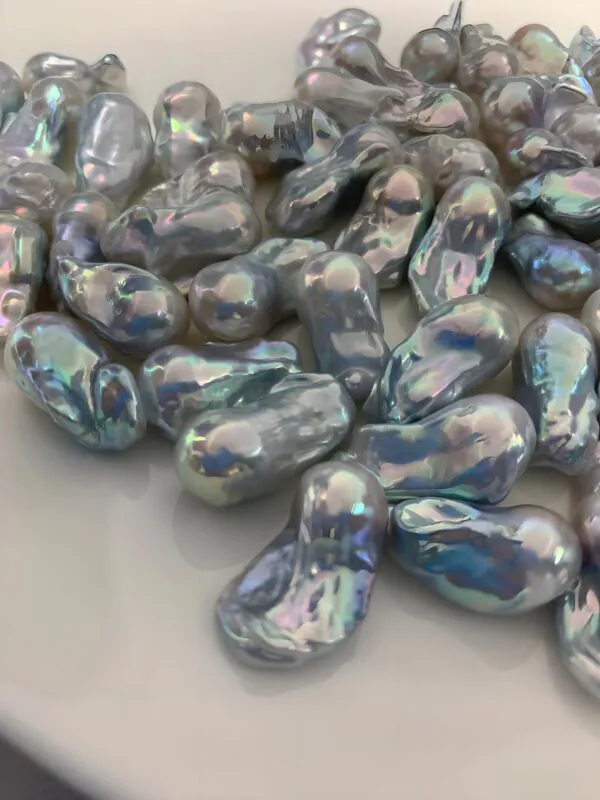
Freshwater cultured pearls offer a much broader design vocabulary. You can find classic round white pearls, softer near-round shapes, natural pastel colors, small pearls, large bead-nucleated pearls, and irregular baroque forms.
That range makes freshwater pearls especially useful when you want everyday work jewelry that is less traditional or when you want to compare several sizes and designs at different budgets.
Tahitian Pearls
Tahitian cultured pearls naturally occupy darker gray, silver, greenish, brownish, and related color ranges and generally create more visual contrast than a small white pearl. They can look particularly effective with black, charcoal, navy, gray, and other restrained workwear palettes.
Because Tahitian pearls commonly begin at larger sizes than classic small Akoya pearls, they tend to feel more intentional. That does not make them inappropriate for work—it simply makes them less invisible.
South Sea Pearls
South Sea pearls are generally associated with larger scale and a soft, satiny glow. A simple South Sea stud or pendant can still be extremely clean in design, but its size often gives it stronger presence.
Choose South Sea pearls for work when you deliberately want that presence rather than because you think a more expensive pearl type is automatically more professional.
If you are comparing pearl categories more broadly, our pearl classification guide explains how different pearl types fit together.
For Work, Luster Often Matters More Than Going Larger
When choosing between two similarly priced options, it can be tempting to buy the larger pearl simply because the millimeter number looks better on paper. For work jewelry, that is not always the best trade-off.
A smaller pearl with lively reflections can remain visible in ordinary indoor lighting, while a larger but dull pearl may appear flat. Luster is also one of the major factors used when evaluating pearl quality, alongside size, shape, color, surface quality, nacre quality, and matching.
For a pair of studs, matching also deserves attention. Two pearls do not need to be laboratory-identical, but visibly different color, luster, size, or shape can become distracting because the earrings frame the face symmetrically.
For more detail on separating size from overall quality, see our guide to evaluating pearl value.
What Pearl Colors Work Best with Professional Clothing?
White and cream are the easiest starting points because they create clear contrast against dark clothing and sit comfortably with many neutral office palettes. But they are not your only professional options.
- White: crisp, neutral, and easy with navy, black, gray, blue, and white shirts.
- Cream: slightly warmer and often comfortable with beige, camel, brown, ivory, and warm-toned metals.
- Pink, peach, and lavender: softer options that can make a simple design feel less traditional.
- Gray and dark Tahitian tones: effective when you want a modern, lower-contrast alternative to bright white.
- Golden tones: visually warmer and often more noticeable, especially when coordinated with warm neutral clothing or yellow-gold settings.
Color should therefore be chosen with your wardrobe rather than from a rule about what a professional pearl is “supposed” to look like.
Match the Pearls to Your Workplace, Not an Imaginary Universal Dress Code
One reason office-jewelry advice becomes confusing is that “the office” can mean completely different environments.
A lawyer meeting conservative corporate clients, a software engineer in a casual workplace, a hotel manager, an architect, a fashion buyer, and a creative director may all have very different acceptable levels of jewelry visibility.
For Conservative Workplaces
Start with simple studs, a small pendant, or a restrained strand. Keep movement and decorative metalwork limited. If you are unsure, a 5–7 mm or 6–8 mm stud gives you considerable flexibility.
For Business-Casual Offices
You have much more room to use small baroque pearls, short drops, pearl huggies, contemporary metal settings, or slightly larger studs. A classic pearl does not have to be styled classically.
For Creative Workplaces
Shape and color can become part of the design language. Baroque freshwater pearls, darker Tahitian colors, asymmetry, mixed metals, and larger single pearls can all work while still looking deliberate and polished.
The useful question is not simply, “Is this pearl professional?” It is: Does the scale and design make sense with the clothing, workplace, and amount of attention I want the jewelry to receive?
A Commuter's Checklist Before Buying Pearl Jewelry
- Think about headphones. If you wear over-ear headphones for hours, very large studs or prominent settings may press against the ear.
- Check the backing or clasp. Daily commuting gives jewelry more opportunities to loosen, snag, or disappear than occasional event wear.
- Consider coat and scarf season. Long drops and delicate chains can catch while clothing is repeatedly added and removed.
- Think about your work surface. Pearl bracelets and rings receive more direct contact with desks, keyboards, doors, and objects than earrings and pendants.
- Verify the metal. If your ears or skin are sensitive to particular metals, ask what the posts, backs, chain, and setting are actually made from rather than judging only by color.
- Choose something you can repeat. Work jewelry earns its value through wear. A versatile piece you reach for three times a week can be more useful than an impressive design that feels inconvenient every morning.
Daily Pearl Care Matters More When You Commute
Pearls are relatively soft compared with many gemstones, so daily jewelry should not simply be dropped into a handbag beside keys, chargers, coins, or other hard objects.
Perfume, hair products, cosmetics, and perspiration can also affect pearl surfaces over time. A sensible routine is to finish applying cosmetics and fragrance before putting on your pearls, then wipe them gently with a clean, soft cloth after wearing them.
If you commute with a jewelry pouch, keep pearls separated from harder jewelry rather than allowing different pieces to rub together. More detailed maintenance guidance is available in our pearl care guide.
Four Easy Starting Choices
If you do not want to analyze every possible combination, use these as practical starting points:
- The safest all-rounder: round or near-round white 6–8 mm pearl studs.
- For someone who rarely wears earrings: a single 7–10 mm pearl pendant on a simple chain.
- For a more traditional professional look: a well-matched 6–8 mm pearl strand.
- For a more modern workplace: a clean baroque pearl, short pearl drop, dark Tahitian pearl, or contemporary pearl-and-metal design in a controlled scale.
To compare low-profile options by silhouette rather than pearl type alone, you can browse Margaret Jewelry's pearl earrings and pearl pendants. If you prefer a traditional strand, compare the actual millimeter sizes in the pearl necklace collection before deciding.
The Best Work Pearl Is Usually the One You Stop Thinking About
For most commuters, the ideal pearl is not necessarily the smallest, most expensive, or most traditional. It is the piece that looks intentional with your work clothes, survives the realities of the commute, and stays comfortable enough that you do not spend the day adjusting it.
Start around 6–8 mm if you want versatile pearl studs, 7–10 mm if you prefer a simple pendant, or 6–8 mm for a restrained classic strand. Then move smaller, larger, darker, more irregular, or more decorative according to your workplace and personal style. Use size as a way to control visual presence—not as a rule for what you are allowed to wear.
FAQ
Are 8 mm pearl earrings too large for work?
No. An 8 mm pearl is clearly visible but can still look understated in a simple stud setting. Whether it feels large depends on the wearer, the setting, hairstyle, clothing, and workplace rather than the millimeter measurement alone.
What pearl earring size is safest for a conservative office?
Around 5–7 mm is a useful starting range when you specifically want a subtle look. If you prefer slightly more presence, simple 7–8 mm studs can still work well in many professional environments.
Are freshwater or Akoya pearls better for work?
Neither is automatically better. Akoya pearls are a natural choice for a classic round white look with crisp luster, while freshwater pearls offer broader choices in shape, color, size, design, and price. Compare the individual jewelry rather than choosing only by pearl type.
Can I wear a pearl necklace to work every day?
Yes, provided the design suits your routine and the pearls receive reasonable care. A single pendant is particularly easy for daily wear, while a classic strand creates a stronger visual statement. Keep pearls away from unnecessary abrasion and wipe them gently after wearing.
What pearls are easiest to wear with headphones?
Small, low-profile studs are generally the easiest starting point, especially around 5–7 mm. However, headphone shape and earring placement vary, so comfort depends on whether the ear cup presses against the pearl or backing.