What Are Nacre and the Nacre Layer? How Are They Related?
Nacre is the material; the nacre layer is the way that material is deposited and built up in a pearl. Nacre, also called mother-of-pearl, is a layered biomineral produced by certain mollusks. In a nacreous pearl, repeated deposits of nacre form the pearl's visible outer structure. When people talk about a pearl's "nacre layer" or "nacre thickness," they are usually referring to how much nacre surrounds an internal nucleus, especially in bead-nucleated cultured pearls.
Nacre vs. Nacre Layer: The Quick Answer
| Term | What It Means | How It Is Used When Discussing Pearls |
|---|---|---|
| Nacre | The actual layered material produced by a mollusk | Describes the substance that makes up the nacreous portion of a pearl |
| Nacre layer | A physical accumulation of nacre over another structure | Often refers to nacre deposited around a bead nucleus in a cultured pearl |
| Nacre thickness | The thickness of that accumulated nacre | Most directly useful when evaluating bead-cultured pearls |
| Nacre quality | A broader assessment of nacre condition and structure | Not necessarily the same thing as measuring thickness in millimeters |
This distinction matters because the terms are often used interchangeably in jewelry descriptions even though they do not mean exactly the same thing.
What Is Nacre?
Nacre is a natural composite material secreted by certain mollusks. It is the familiar luminous material seen on the inner surfaces of many pearl-producing shells and is also the material that forms nacreous pearls.
At the microscopic level, nacre consists mainly of closely arranged calcium carbonate crystals, commonly in the form of aragonite, combined with a much smaller amount of organic material. The mineral platelets and organic components are organized into an extremely fine layered structure rather than forming one solid, homogeneous mineral mass. CIBJO describes nacre in nacreous pearls as microscopic aragonite platelets bound by an organic network, while GIA describes nacreous pearl surfaces as layered structures composed principally of calcium carbonate and organic material.
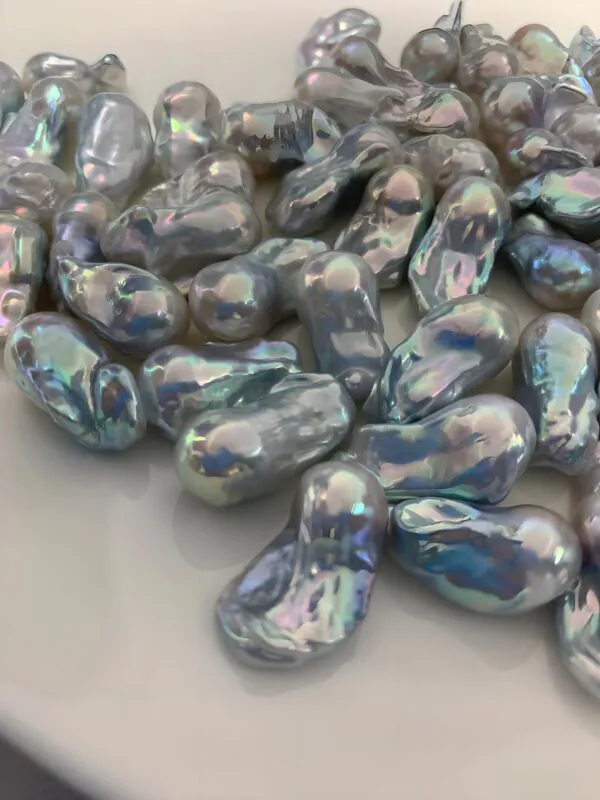
This microscopic organization is important because a pearl's characteristic appearance is not produced by surface polish alone. Light interacts with the surface and underlying nacre structure, contributing to the depth, glow, overtone, and other optical effects associated with nacreous pearls.
If you want to understand the formation process more broadly, see our guide to how pearls form and our overview of the physical and chemical properties of pearls.
What Does “Nacre Layer” Mean?
The nacre layer is not a different material from nacre. It simply describes nacre as a physical layer or series of layers.
In shell anatomy, the term can refer to the nacreous inner layer of a mollusk shell. In pearl discussions, however, “nacre layer” usually has a more practical meaning: the nacre that has accumulated around the inner part of a pearl during its growth.
This is particularly easy to visualize in a bead-nucleated cultured pearl. A pearl farmer introduces a bead nucleus together with mantle tissue. A pearl sac develops, and the mollusk deposits nacre around the bead. As deposition continues, the nacreous portion surrounding the nucleus becomes thicker.
CIBJO describes the surfaces of nacreous cultured pearls as nacre deposited in concentric layers within the cultured pearl sac.
So a simple way to remember the relationship is:
Nacre = what the material is.
Nacre layer = where and how that material has accumulated.
Is a Pearl Made Entirely of Nacre?
Not always. This is one of the most important details missing from many simplified explanations of nacre.
Bead-nucleated cultured pearls
Akoya, Tahitian, and South Sea cultured pearls are generally bead-nucleated. They contain an internal bead surrounded by nacre deposited by the mollusk. In these pearls, talking about the thickness of the nacre surrounding the bead makes clear physical sense.
Tissue-nucleated freshwater cultured pearls
Many traditional freshwater cultured pearls are produced without a large spherical bead nucleus. Instead, mantle tissue initiates pearl formation. These pearls can consist almost entirely of nacreous material rather than having a large bead surrounded by a relatively thin external coating. GIA notes this distinction while also pointing out that bead-cultured freshwater pearls have become increasingly common in the modern market.
That means asking, “How thick is the nacre?” does not have exactly the same practical meaning for every cultured pearl.
| Pearl Structure | Typical Internal Structure | How Useful Is “Nacre Thickness”? |
|---|---|---|
| Bead-nucleated | Bead nucleus surrounded by deposited nacre | Highly relevant |
| Tissue-nucleated freshwater | Often largely nacre without a large spherical bead | Less useful as a simple coating measurement |
| Bead-nucleated freshwater | Bead nucleus plus surrounding pearl material | Relevant again |
For more detail on these structures, compare non-bead-nucleated freshwater pearls with nucleated freshwater pearls.
Why Does the Nacre Layer Matter?
Nacre matters for more than simply making a pearl “real.” Its structure and condition are connected with several aspects of a nacreous pearl's appearance and durability.
1. Nacre contributes to a pearl's optical appearance
A nacreous pearl's characteristic glow comes from the way light interacts with its complex surface and subsurface structure. GIA defines pearl luster in terms of light reflected from the surface and underlying nacre layers, so luster and nacre are related rather than completely independent characteristics.
However, this does not mean that nacre thickness and luster are the same thing. Luster is something we evaluate visually through the strength and sharpness of reflections. Nacre thickness describes physical construction. A thickness measurement alone does not tell you everything about how beautiful a pearl will look.
2. Very thin nacre can affect durability
In a bead-cultured pearl, inadequate nacre coverage can make the underlying nucleus more apparent and may reduce the pearl's ability to withstand normal wear. This is why GIA treats nacre as one of its pearl value factors and specifically considers nacre when evaluating cultured pearl durability.
3. Nacre is more than a thickness number
A useful modern distinction is between nacre thickness and nacre quality or condition. GIA notes that nacre condition is not the same as a numerical measurement of nacre thickness. In 2025, GIA expanded its nacre classification approach to describe nacre continuity and quality more fully rather than relying only on a simple acceptable/unacceptable distinction.
In other words, “thicker” is useful information in the right context, but it should not become a shortcut for judging every aspect of pearl quality.
Does Thicker Nacre Always Mean a Better Pearl?
No. For bead-nucleated cultured pearls, sufficient nacre thickness is important, but pearl quality is multidimensional.
Consider two pearls with adequate nacre. One might show very strong, sharp reflections and a clean surface, while the other may have softer luster or more noticeable surface characteristics. Nacre alone does not erase those differences.
GIA's pearl classification system therefore considers seven factors rather than relying on nacre alone: size, shape, color, luster, surface, nacre, and matching when applicable.
A better practical rule is:
For bead-cultured pearls, the nacre should first be sufficient and well formed. After that, evaluate the pearl's actual luster, surface, shape, color, and overall appearance rather than treating thickness as a standalone quality grade.
Can You See the Nacre Layer with the Naked Eye?
You can sometimes see signs associated with poor or unusually thin nacre, but you usually cannot measure nacre thickness accurately just by looking at a finished pearl.
GIA notes that a bead nucleus showing through the nacre or a dull, chalky appearance can indicate thin nacre. These observations are warning signs rather than precise measurements.
Professional laboratories can investigate internal pearl structure using techniques such as X-radiography and, when necessary, more advanced imaging. X-rays can reveal whether a pearl contains a bead nucleus and show important aspects of its internal growth structure.
This is why photographs alone should not be used to make precise claims such as “0.8 mm nacre” or “1.0 mm nacre.” Lighting can help you evaluate visible appearance, but it does not provide a reliable physical cross-section of the pearl.
Readers interested in laboratory and practical examination can continue with our pearl identification guide.
Are All Pearls Nacreous?
No. Another useful distinction is that pearl and nacreous pearl are not identical categories.
Many familiar commercial pearls—including Akoya, South Sea, Tahitian, and most freshwater cultured pearls—are nacreous. Their characteristic surface structure is formed from layered nacre.
But some other pearls are classified as non-nacreous. GIA, for example, distinguishes nacreous pearls from pearls such as conch and melo pearls, which have different internal and surface structures and do not possess classic lustrous nacre.
So the statement “all pearls are made of nacre” is an oversimplification. It works for many of the pearls commonly encountered in jewelry stores, but it is not technically correct for every pearl-producing mollusk.
How Should You Interpret “Thick Nacre” in a Pearl Description?
If a seller describes a pearl as having “thick nacre,” first ask what type of pearl is being discussed.
- For Akoya, Tahitian, South Sea, and other bead-cultured pearls: nacre thickness can be an important part of understanding construction and durability.
- For traditional tissue-nucleated freshwater pearls: the pearl may already consist largely of nacre, so simply advertising “thick nacre” provides less useful differentiation.
- For bead-nucleated freshwater pearls: nacre thickness becomes relevant again because an internal bead is present.
Also separate the nacre claim from other quality claims. “Thick nacre,” “high luster,” “clean surface,” and “round shape” describe different characteristics. They may influence one another, but they are not interchangeable.
That distinction is especially useful when comparing pearls online, where multiple quality terms are sometimes compressed into a single phrase such as “thick nacre, high quality.” A more meaningful description explains the pearl type and then evaluates visible quality factors separately.
The Simplest Way to Remember the Difference
Think of nacre and the nacre layer as material versus structure.
- Nacre is the layered biomineral material produced by the mollusk.
- A nacre layer is an accumulation of that material in a particular place.
- Nacre thickness describes how thick that accumulation is, especially around the nucleus of a bead-cultured pearl.
- Nacre quality is broader than thickness alone and may include how well the nacre has formed and its condition.
Once these ideas are separated, pearl terminology becomes much easier to understand: nacre tells you what the pearl material is, while the nacre layer tells you something about how that material has been built up.
FAQ
Is nacre the same as mother-of-pearl?
Yes, nacre is commonly called mother-of-pearl. The term is frequently used for the nacreous inner surface of mollusk shells, while the same type of layered material also forms nacreous pearls.
Is nacre the same as the nacre layer?
Not exactly. Nacre is the material itself. A nacre layer is a physical layer or accumulation of nacre. In bead-cultured pearls, the term usually refers to the nacre deposited around the bead nucleus.
Does thicker nacre always produce better luster?
No. Adequate nacre is important, particularly in bead-cultured pearls, but nacre thickness and luster are different characteristics. Luster depends on how light interacts with the pearl's surface and underlying structure, so thickness alone cannot determine the final visual quality.
Do freshwater pearls have thick nacre?
It depends on how the pearl was cultured. Many traditional tissue-nucleated freshwater pearls consist largely of nacre rather than a large bead with a nacre coating. Modern bead-nucleated freshwater pearls contain a bead, so nacre thickness around that nucleus becomes a more directly relevant measurement.
Can nacre thickness be measured from a photograph?
No reliable millimeter measurement can normally be made from an ordinary product photograph. Visual clues may sometimes suggest thin nacre, but examining internal structure or obtaining precise measurements may require gemological testing.
References
- Gemological Institute of America (GIA), pearl education and GIA 7 Pearl Value Factors materials.
- Gemological Institute of America, updated nacre classification guidance and pearl laboratory research.
- CIBJO Pearl Commission, Pearl Book and Guide for Classifying Natural Pearls and Cultured Pearls.
- Peer-reviewed research on nacre formation, biomineralization, and microscopic nacre structure.