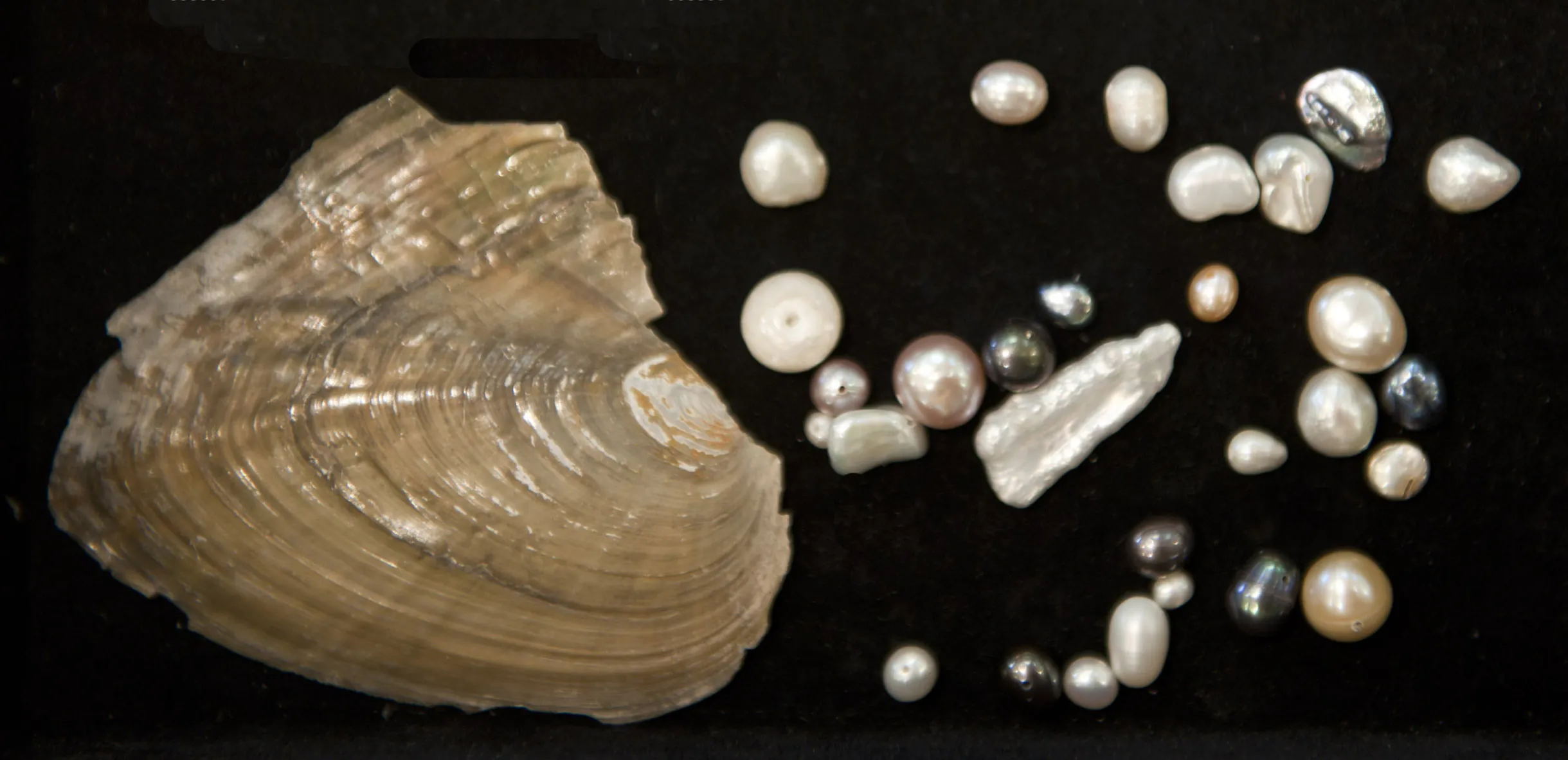
Yes, in general it is harder to control the final shape of a non-nucleated—or more precisely, non-beaded—cultured pearl. The main reason is simple: there is no rigid round bead inside the pearl to provide a ready-made spherical foundation. Instead, the pearl develops around a pearl sac formed after mantle tissue is implanted, so the final shape depends more heavily on how that sac develops and how nacre is deposited over time.
That does not mean non-beaded pearls are uncontrollable, nor does it mean they must be baroque. Skilled tissue preparation, implantation technique, host selection, and cultivation can greatly improve shape. Very round tissue-nucleated freshwater pearls do exist. They are simply harder to produce consistently than pearls grown around a well-positioned round bead.
First, What Does “Non-Nucleated” Actually Mean?
The phrase can be confusing. In pearl-industry usage, “non-nucleated cultured pearl” is commonly used for a non-beaded cultured pearl. CIBJO’s Pearl Blue Book defines the term in this trade sense. In many traditional freshwater cultured pearls, a small piece of donor mantle tissue is implanted into a host mussel, but no hard spherical bead is inserted.
So “non-nucleated” does not mean the pearl formed naturally without human intervention. These are still cultured pearls. A clearer technical description is often tissue-nucleated or non-bead cultured.
If you want the broader background, see our guide to freshwater non-nucleated pearls and our introduction to how pearls form.
Why Does a Round Bead Make Shape Easier to Control?
A round bead does not magically force a pearl to become perfect, but it gives the developing pearl a strong geometric starting point.
In bead-nucleated culture, the pearl sac forms around a bead that is already close to the desired size and shape. If the bead remains well positioned and nacre grows relatively evenly around it, the finished pearl has a much better chance of remaining round or near-round.
GIA notes that modern bead-cultured freshwater pearls can achieve larger sizes and rounder, more symmetrical shapes than traditional tissue-nucleated freshwater pearls. This is one of the practical reasons bead nucleation has become important in modern freshwater pearl production.
With a non-beaded pearl, there is no hard spherical core to preserve that geometry. The shape has to emerge through biological growth itself.
What Determines the Shape When There Is No Bead?
Without a round nucleus, several small biological and cultivation differences can have a larger influence on the result.
1. The shape of the developing pearl sac matters more
The implanted mantle tissue helps form a pearl sac, and that sac secretes the material that builds the pearl. If the early sac is not close to spherical, the pearl may begin growing in an oval, button, elongated, or irregular form. Once that geometry is established, later nacre growth does not necessarily correct it.
2. Small asymmetries can become more visible over time
A bead-nucleated pearl begins with a stable solid core. A tissue-nucleated pearl does not. If growth is slightly faster in one direction, or if the pearl sac develops unevenly, the difference can become increasingly visible as more nacre is deposited.
This helps explain why traditional tissue-nucleated freshwater production is associated with such a broad spectrum of shapes: round, near-round, oval, button, drop, potato-like, and fully baroque.
3. The host mollusk and implantation technique also matter
Shape is not determined by “no bead” alone. Historical GIA research on Chinese freshwater cultured pearls found that improved tissue-insertion techniques and changes in mussel selection were being used to produce larger, better-shaped tissue-nucleated pearls. In other words, farmers can influence the odds even when they cannot dictate the exact geometry of every pearl.
This is the key distinction: shape control is probabilistic, not absolute.
Does This Mean Non-Nucleated Pearls Cannot Be Round?
No. This is one of the most important misconceptions to avoid.
GIA research has documented very round freshwater cultured pearls grown by mantle-tissue nucleation without a bead. In one major study involving X-radiographic examination of approximately 41,000 Chinese freshwater cultured pearls from many farms, the samples examined showed evidence of mantle-tissue nucleation rather than bead nucleation. The same research described improved techniques aimed at producing larger and better-shaped pearls.
So a round pearl does not automatically prove that a bead is inside it.
The more accurate statement is this:
Round non-beaded pearls are possible, but producing them in high percentages and with close matching is generally more difficult.
That distinction matters when comparing pearl lots. A single round tissue-nucleated pearl may be beautiful, but creating an entire necklace with consistently round, well-matched pearls requires much more sorting.
Does a Bead Guarantee a Round Pearl?
No. The opposite oversimplification is also wrong.
A round bead improves the starting geometry, but the finished pearl is still a biological product. Nacre may grow unevenly. The bead and pearl sac may not remain ideally positioned. Surface growth can become irregular. Some bead-cultured pearls therefore finish as near-round, drop, circled, semi-baroque, or baroque shapes.
GIA’s work on Chinese freshwater pearl culture has documented bead-cultured production that yielded substantial quantities of baroque pearls as well as smaller quantities of round and near-round pearls. A bead improves the farmer’s ability to target a shape; it does not eliminate biological variation.
If you want to compare the two cultivation approaches more directly, see our guide to freshwater nucleated pearls.
Non-Beaded vs. Bead-Nucleated Pearls: Shape Control at a Glance
| Factor | Non-Beaded / Tissue-Nucleated | Bead-Nucleated |
|---|---|---|
| Starting geometry | No rigid spherical core | Usually starts with a pre-shaped bead |
| Roundness control | More dependent on pearl-sac development and nacre growth | Usually easier to target round or near-round shapes |
| Shape variation | Often broader | Usually more predictable, but still variable |
| Can it produce round pearls? | Yes | Yes |
| Can it produce baroque pearls? | Yes | Yes |
| Typical internal structure | Often predominantly nacre in traditional freshwater production | Nacre grows around a substantial bead nucleus |
Why Are Round Non-Nucleated Pearls More Selective?
When a cultivation method naturally produces a wider distribution of shapes, the roundest pearls represent a smaller selected portion of the harvest. That is why fine round tissue-nucleated freshwater pearls can be much more selective than an ordinary mixed lot.
Selection becomes even stricter when pearls must also match in:
- diameter,
- bodycolor and overtone,
- luster,
- surface quality, and
- degree of roundness.
This does not mean a round non-beaded pearl is automatically more valuable than every bead-nucleated pearl. Pearl value is never determined by shape alone. Luster, surface, size, color, nacre quality, and matching still matter. For a fuller explanation of the shape factor itself, see our pearl shape guide.
How Much Shape Control Do Pearl Farmers Really Have?
It is useful to think of pearl cultivation as managing probabilities rather than manufacturing identical spheres.
A farmer can influence the process through tissue preparation, insertion technique, selection of healthy host mollusks, cultivation conditions, and timing. Better methods can shift the harvest toward more desirable shapes. What the farmer cannot do is control every microscopic layer of biological mineral deposition after implantation.
This is why two pearls from the same general production method can still look very different. Culturing technique establishes the conditions for growth; the mollusk completes the biological process.
What Does This Mean for Buyers?
If your priority is a very uniform round strand, do not shop by the words “freshwater” or “non-nucleated” alone. Look at the actual shape grade and the matching of the finished strand. A well-selected tissue-nucleated strand can be impressively round, while a lower-grade bead-nucleated lot may still contain many off-round pearls.
If you prefer more organic forms, the broader natural shape variation of non-beaded freshwater pearls can be an advantage rather than a defect. Baroque, oval, button, and other shapes can create designs that look less standardized and more individual.
The practical question is therefore not simply, “Which method is better?” It is: Which cultivation method and sorting standard produce the shape you actually want?
So, Is the Shape Harder to Control?
Yes—generally. Without a pre-shaped bead nucleus, the final form of a tissue-nucleated pearl depends more strongly on pearl-sac formation and biological nacre deposition. That makes perfectly round results less predictable and increases the range of possible shapes.
But “harder to control” should not be confused with “impossible to control.” Modern cultivation has shown that non-beaded freshwater pearls can be very round. The difference is that achieving roundness consistently requires more precise cultivation and more selective sorting.
A bead gives the farmer a geometric head start. A non-beaded pearl asks the biological process to create that geometry largely on its own.
Frequently Asked Questions
Are non-nucleated pearls always irregular?
No. Tissue-nucleated, non-beaded freshwater pearls can be round or near-round. They simply tend to show a wider range of shapes than pearls grown around a round bead.
Does “non-nucleated” mean the pearl is natural?
No. In trade terminology, “non-nucleated” commonly refers to non-beaded cultured pearls. Mantle tissue is still deliberately implanted, so these are cultured pearls rather than natural pearls.
Are all freshwater pearls non-beaded?
No. Traditional freshwater cultured pearls are commonly tissue-nucleated, but bead-nucleated freshwater pearls are now well established in the market.
Are bead-nucleated pearls always perfectly round?
No. A round bead makes roundness easier to target, but biological growth can still produce near-round, circled, semi-baroque, or baroque results.
Why can round tissue-nucleated pearls be harder to match?
Because the harvest usually contains a broader distribution of shapes. To make a closely matched round strand, pearls must be selected not only for roundness but also for size, color, luster, surface, and overall appearance.
References
- CIBJO Pearl Blue Book 2024 — pearl terminology, including “non-nucleated cultured pearl.”
- GIA: Freshwater Pearls vs. Saltwater Pearls — tissue-nucleated and bead-nucleated freshwater culturing methods and shape tendencies.
- GIA Gems & Gemology: Characteristics of Nuclei in Chinese Freshwater Cultured Pearls — research on tissue nucleation and improved shape in Chinese freshwater cultured pearls.
- GIA Gems & Gemology: Continuity and Change in Chinese Freshwater Pearl Culture — historical development of tissue implantation and bead-nucleated freshwater techniques.