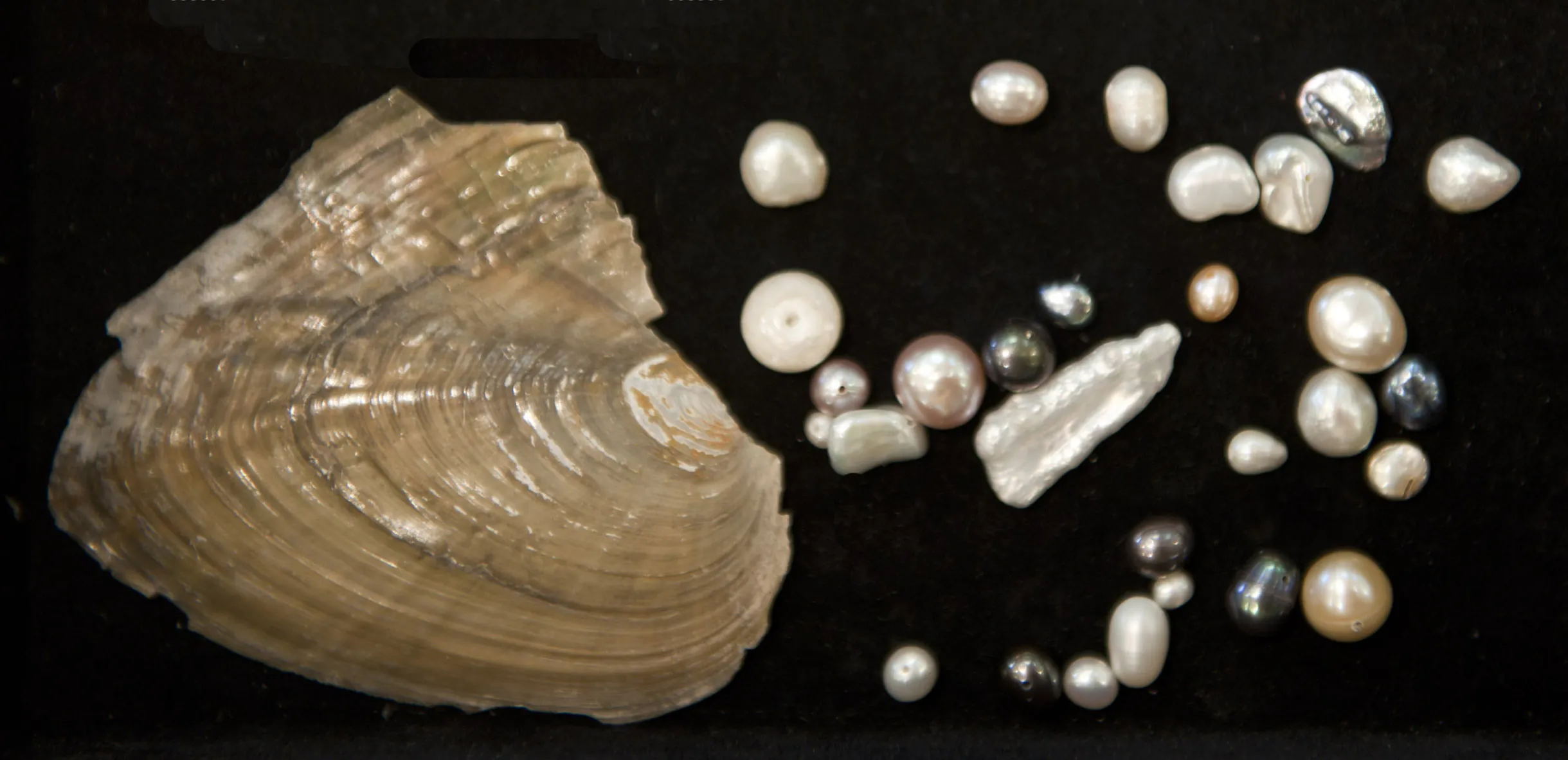
Chinese freshwater pearls can be very good—sometimes exceptionally good—but “Chinese” is an origin, not a quality grade. China produces the majority of the world’s freshwater cultured pearls, so its output covers a huge spectrum: inexpensive commercial pearls, attractive everyday jewelry pearls, unusual baroque material, and highly selected round pearls with strong luster and clean surfaces.
The useful question is therefore not “Are Chinese freshwater pearls good?” but “How good is this particular pearl or strand?” That is best answered by looking at luster, surface quality, shape, color, size, nacre, and matching rather than relying on country of origin or a seller’s grade label.
The Short Answer: Quality Ranges from Basic to Fine
Freshwater pearls from China are not one uniform product. Two strands from the same country can look completely different. One may be visibly off-round, lightly lustrous, and loosely matched; another may be bright, round to the eye, smooth, and carefully matched.
This wide range is partly a consequence of scale. The Gemological Institute of America (GIA) notes that freshwater pearls are cultivated primarily in China and that modern farming has produced pearls that are larger, rounder, and more lustrous than earlier generations. Because freshwater mussels can also produce multiple pearls, the category remains widely available and comparatively accessible in price.
That accessibility should not be confused with low quality. A pearl can be affordable because it comes from a high-volume production system while still having excellent visual qualities.
Why Chinese Freshwater Pearls Still Have a “Cheap Pearl” Reputation
Older freshwater pearl material was often strongly off-round, ringed, or baroque, and enormous quantities entered the market at low prices. That history still shapes how some buyers think about the category.
But freshwater culturing has changed substantially. Better farming, selection, and bead-nucleation techniques have expanded what Chinese freshwater pearls can look like. In 2026, GIA specifically highlighted small bead-nucleated freshwater pearls from China that can show near-round to round shapes, bright white bodycolor, and excellent luster—features that may visually overlap with Akoya pearls.
This does not mean that every modern freshwater pearl is fine quality. It means the old shortcut—“freshwater equals low-end”—is no longer useful.
What Actually Determines Whether a Chinese Freshwater Pearl Is Good?
A practical way to judge freshwater pearl quality is to use the same core visual factors applied to other pearl types. GIA’s pearl quality framework considers seven factors: size, shape, color, luster, surface, nacre, and matching. For a deeper explanation of how these interact, see our pearl grading guide.
1. Luster
Luster is one of the fastest ways to separate an ordinary pearl from a fine one. Look at how clearly the surface reflects light. A weak pearl may appear dull or chalky. A strong pearl shows bright reflections and a sense of depth.
Freshwater luster can range from soft and satiny to surprisingly sharp and reflective. Do not assume that freshwater pearls must have a muted glow.
2. Surface Quality
Natural growth marks are normal, but the number, size, location, and visibility of those marks matter. A few small features may have little effect on beauty, while deep pits, heavy wrinkling, or distracting blemishes can lower quality significantly.
3. Shape
Chinese freshwater pearls are available in round, near-round, oval, button, drop, baroque, and many irregular forms. Roundness can add value when round pearls are the goal, but a baroque pearl should not be judged as defective merely because it is not spherical. The more useful question is whether the shape is attractive and appropriate for the intended design.
4. Color
Freshwater pearls can appear white, cream, pink, peach, lavender, purple, and other tones. Judge color by evenness, attractiveness, overtone, and how it works with the jewelry design. If color treatment matters to you, ask the seller directly whether the color is natural or treated rather than trying to decide from photographs alone.
5. Matching
For a necklace, bracelet, or pair of earrings, matching can be just as important as the beauty of an individual pearl. Compare size, shape, bodycolor, overtone, luster, and surface quality across the whole piece. A strand of individually attractive pearls can still look mediocre if the matching is inconsistent.
6. Size and Nacre Structure
Larger pearls are not automatically better. Size matters because larger, fine-quality pearls are generally harder to produce, but luster and surface quality should not be sacrificed simply to gain millimeters.
It is also useful to know how the pearl was cultured. Traditional tissue-nucleated freshwater pearls are often composed almost entirely of nacre, while many newer round freshwater pearls are bead-nucleated. The phrase “freshwater pearl” therefore does not describe one single internal structure.
How High Can the Quality Go?
Quite high. Modern Chinese freshwater pearls can be rounder, larger, cleaner, and more lustrous than the freshwater pearls many buyers remember from older jewelry.
GIA’s 2026 discussion of so-called “freshwater Akoya” pearls is especially useful here. It explains that some bead-nucleated Chinese freshwater pearls can look remarkably similar to saltwater Akoya pearls because the round bead gives nacre a more symmetrical foundation. These pearls may combine bright white color, round shapes, and strong luster.
However, visual similarity does not make them Akoya pearls. Akoya pearls are a saltwater cultured pearl produced by Pinctada fucata, while the Akoya-like freshwater pearls remain freshwater cultured pearls. For the terminology issue, see our guide to what “Freshwater AK” means in the market.
The important takeaway is not that freshwater pearls have “become Akoya.” It is that the quality ceiling of freshwater pearls is much higher than a simple low-end stereotype suggests.
Chinese Freshwater Pearls vs. Akoya: Which Looks Better?
There is no universal winner because the answer depends on the actual pearls being compared. A fine freshwater strand can look better than a weak Akoya strand. At the high end, however, Akoya pearls are especially known for very consistent roundness and crisp, mirror-like luster.
| Factor | Chinese Freshwater Pearls | Akoya Pearls |
|---|---|---|
| Luster | Ranges from soft/satiny to bright and reflective; fine modern material can be very lustrous | Especially known for sharp, mirror-like luster at high quality |
| Shape | Very broad range from baroque to round; bead-nucleated material can be highly round | Roundness and consistency are major strengths |
| Color range | Broad palette including white, pink, peach, lavender, and purple tones | Best known for white to cream colors with characteristic overtones |
| Typical price position | Generally more accessible, with a very wide quality and price range | Generally more expensive at comparable size and quality |
| Best reason to choose | Value, variety, larger design freedom, and a wide range of natural-looking forms | Classic round appearance, fine matching, and crisp traditional luster |
So if your priority is the classic perfectly round white strand with very sharp reflections, Akoya may justify its premium. If your priority is strong visual quality at a more accessible price—or you prefer unusual colors and shapes—well-selected Chinese freshwater pearls can be an excellent choice.
Why Are Chinese Freshwater Pearls Often Less Expensive?
Price is influenced by more than beauty. Production volume, the number of pearls a mollusk can produce, farming scale, sorting yield, size rarity, and market positioning all affect cost. Freshwater pearl farming in China operates at much greater volume than most saltwater pearl sectors, which helps make the category more accessible.
This is why origin and price should not be used as a shortcut for quality. A lower-priced pearl can still have excellent luster and an attractive surface, while a more expensive pearl can still disappoint if its quality factors are weak.
For a broader explanation of this distinction, read why pearl origin matters.
Do “AAA” or “AAAA” Labels Prove Quality?
No. Letter grades are widely used in the pearl trade, but there is no single universal AAA or AAAA system that every seller follows. One supplier’s “AAA” can differ noticeably from another supplier’s “AAA.”
That means the grade name should be treated as a seller’s shorthand, not as a substitute for inspecting the pearl itself. Ask what the grade actually means in terms of luster, surface cleanliness, shape tolerance, and matching.
When comparing pearls from different sellers, use observable characteristics rather than assuming identical letters mean identical quality.
How to Buy Chinese Freshwater Pearls More Confidently
A simple buying process is more reliable than chasing a grade label:
- Check luster first. Look for bright, clear reflections rather than only judging whiteness.
- Inspect the surface at normal viewing distance and close up. Minor marks are normal; decide whether they distract from the overall appearance.
- Confirm the shape you are actually paying for. “Round,” “near-round,” and “oval” should not be treated as interchangeable.
- Judge matching across the whole strand or pair. This matters especially for necklaces and earrings.
- Ask whether the pearl is tissue-nucleated or bead-nucleated when that distinction matters.
- Ask about treatment disclosure. In particular, do not assume an unusual color is natural merely because it looks convincing.
- Compare actual photos or video under neutral light. Heavy editing can hide differences in luster, surface texture, and color.
- For higher-value purchases, prioritize clear identity and documentation. GIA notes that visual inspection alone may not always distinguish certain bead-nucleated freshwater pearls from Akoya pearls.
If you are new to pearls, our pearl buying guide gives a broader framework for comparing pearl types and quality. For designers and businesses comparing loose pearls or strands, browse our wholesale pearl selection and compare actual specifications rather than relying on grade names alone.
So, Are Chinese Freshwater Pearls Worth Buying?
Yes—if the individual pearls meet the quality level you want.
Chinese freshwater pearls are best understood as a broad category rather than a fixed quality tier. At the lower end, they can be inexpensive and visibly commercial. At the upper end, they can be round, clean, strongly lustrous, well matched, and visually impressive enough to challenge old assumptions about what freshwater pearls should look like.
The most reliable buying rule is simple: judge the pearl, not the passport. Origin helps explain the pearl’s production context, but luster, surface, shape, color, nacre, size, and matching determine how good the pearl actually is.
Frequently Asked Questions
Are Chinese freshwater pearls real pearls?
Yes. Chinese freshwater cultured pearls are real pearls produced by living freshwater mollusks. “Cultured” describes human-assisted pearl farming; it does not mean imitation.
Are Chinese freshwater pearls lower quality than Akoya pearls?
Not automatically. The two are different pearl types with different typical characteristics. Fine freshwater pearls can be extremely attractive, while high-quality Akoya pearls are especially prized for roundness, matching, and crisp mirror-like luster. The actual quality of the individual pearl matters more than a simple country-based ranking.
Can Chinese freshwater pearls look like Akoya pearls?
Yes. Some modern bead-nucleated freshwater pearls from China can be round, white, and highly lustrous enough to resemble Akoya pearls. They are still freshwater pearls, however, and should be sold as such.
What is the most important quality factor when choosing freshwater pearls?
Luster is a strong place to start because it has a major effect on how lively and attractive a pearl looks. After luster, check surface quality, shape, color, and matching together rather than judging any single factor in isolation.