Can Men Wear Pearls? How to Choose Size, Color, and Style
Yes. Men can wear pearls, and there is no special pearl category that a man has to choose from. What changes the look is not gender but proportion, color, shape, necklace length, and the way the pearls are combined with clothing and metal jewelry. A 5–6 mm strand can feel subtle and minimal; an 8–10 mm strand is much more visible; a single dark pearl on a chain creates a completely different impression from a full strand of round white pearls.
If you are buying your first piece, the most useful question is not “Which pearls are masculine?” but “How noticeable do I want the pearls to be?” Once you answer that, size, color, shape, and style become much easier to choose.
Quick Guide: Choosing Pearls for Men
| Choice | More Understated | More Noticeable |
|---|---|---|
| Full pearl strand | About 4–6 mm | About 8–10 mm or larger |
| Versatile first strand | About 6–8 mm is a practical middle range for many styles | |
| Single pearl pendant | About 8–10 mm | About 10–14 mm or larger |
| Color | Gray, silver, cream, muted tones | Bright white, strong gold, high-contrast or multicolor pearls |
| Shape | Round or near-round for a clean look | Baroque or mixed shapes for a more design-forward look |
| Styling | One pearl piece by itself | Layered with chains, pendants, or other textures |
These are style ranges, not rules. The same pearl diameter can look very different depending on necklace length, body frame, clothing, pearl color, and whether the piece contains one pearl or dozens of them.
Can Men Wear White Pearls, or Should They Choose Darker Colors?
Men do not need to avoid white pearls. White is simply the most familiar pearl color, so a full strand of bright white round pearls creates a more recognizable “classic pearl necklace” effect. Whether that feels elegant, fashion-forward, formal, or too traditional depends on the rest of the outfit.
Dark or muted pearls are often easier for someone who wants a lower-contrast first piece, but they are not automatically more suitable for men. Think about color as a styling tool:
- White pearls: crisp, bright, and high contrast against black, navy, denim, or dark knitwear. They make the pearl look intentional and visible.
- Cream or ivory pearls: softer than bright white and easy to combine with beige, brown, olive, linen, and warm neutrals.
- Gray, silver, and dark pearls: create a quieter tonal effect with black, charcoal, navy, and metal jewelry. Naturally dark Tahitian pearls are one option, although dark freshwater pearls can also be color-treated, so pearl type and color origin should be checked separately.
- Golden pearls: warmer and more luxurious in appearance, especially with yellow gold, brown, cream, forest green, or other warm clothing colors.
- Pink, peach, lavender, or multicolor pearls: more expressive rather than inherently feminine. They work especially well when the rest of the outfit is simple and neutral.
There is also no universal rule that pearl color must match skin tone. Skin tone can affect contrast, but your usual wardrobe is often the more practical guide. If you mostly wear black, white pearls create a strong focal point while gray pearls blend more quietly. If you wear warm earth tones, cream or golden pearls may integrate more naturally.
What Pearl Size Should a Man Wear?
There is no single best pearl size for men. The right diameter depends mainly on how many pearls are in the piece and how strong you want the visual effect to be.
For a Full Pearl Necklace
When dozens of pearls form a complete strand, every millimeter matters because the size is repeated around the entire neck.
| Pearl Diameter | Typical Visual Effect in a Full Strand | Good Starting Point For |
|---|---|---|
| 4–6 mm | Fine, light, and relatively subtle | Layering, minimalist outfits, people who already wear thin chains |
| 6–8 mm | Balanced and clearly visible without dominating the neckline | A versatile first pearl strand |
| 8–10 mm | Bold, substantial, and immediately noticeable | Statement styling, tailoring, fashion-focused looks |
| 10 mm+ | Strong visual weight and a more dramatic silhouette | Intentional statement pieces rather than subtle everyday jewelry |
Body size can change how these ranges look, but it should not become a rigid rule. A larger frame may visually absorb a delicate 4–5 mm strand more easily, while the same strand may look more prominent on a smaller frame. The solution is to compare the necklace to the wearer, not to assume that every man needs larger pearls.
For a Single Pearl Pendant
A single pearl can usually be larger than the pearls in a full strand without feeling overwhelming. An 8–10 mm pearl makes a restrained focal point; 10–12 mm becomes more obvious; 12–14 mm and larger sizes can work as a deliberate centerpiece. Because only one pearl is carrying the visual weight, pendant sizing should not be judged by the same scale as a full strand.
For Pearl Studs
If you are choosing pearl earrings, approximately 5–7 mm often reads as compact and easy to wear, while 7–9 mm becomes more visible. Larger studs can create a stronger fashion statement. Again, the useful question is visibility rather than gender.
Round or Baroque Pearls: Which Style Works Better?
Shape changes the character of pearl jewelry almost as much as color.
- Round pearls create the cleanest, most polished look. They work well with tailoring, simple knitwear, monochrome outfits, and jewelry that uses precise geometric lines.
- Near-round or slightly irregular pearls soften the formality of a classic strand. They can feel more relaxed while still looking coordinated.
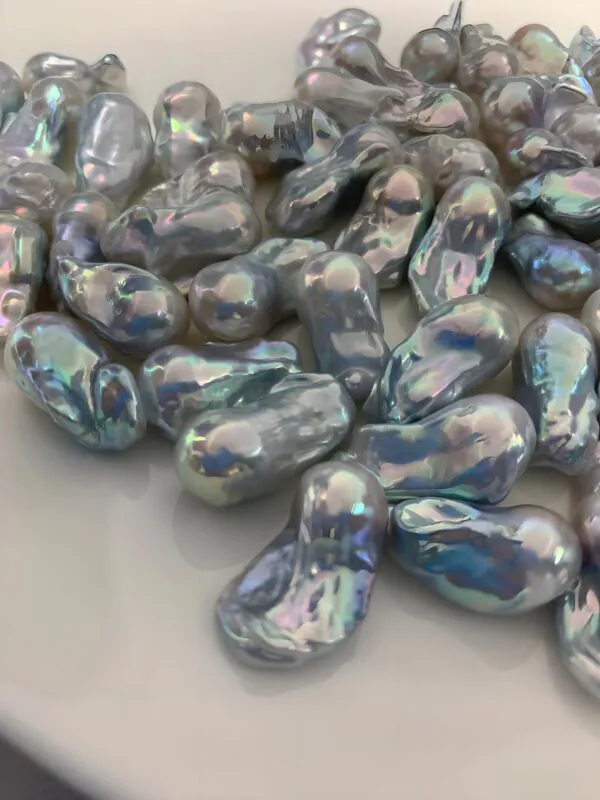
- Baroque pearls have obvious organic irregularity. They often suit casual, artistic, streetwear, or mixed-material designs because the uneven surfaces make the piece feel less uniform and more textural.
- Mixed shapes create the strongest design-led effect and work well when the jewelry is intended to look individual rather than traditional.
Do not confuse shape with quality. A baroque pearl is not automatically a lower-quality version of a round pearl. Shape is only one part of evaluation. Luster, surface quality, color, nacre, size, and matching also matter, which is why it helps to understand the broader framework for evaluating pearl value.
Which Pearl Jewelry Style Is Easiest for Men to Start With?
The easiest starting point is usually the format that already resembles jewelry you wear. Someone who wears chains every day may find a pearl pendant or mixed pearl-and-metal necklace easier than a full strand. Someone who already wears bracelets or earrings may not need to start with a necklace at all.
1. Full Pearl Strand
A complete strand gives pearls the largest visual role. A 6–8 mm strand worn near the collarbone is a versatile starting point, while larger pearls or brighter white color make the necklace more dominant. Round strands look cleaner; baroque strands feel more relaxed and textural.
2. Single Pearl Pendant
A pendant keeps the pearl as one focal element rather than surrounding the neckline with pearls. It is easy to combine with a T-shirt, open shirt, knit, or jacket and can use a larger individual pearl without creating the visual weight of a large full strand.
3. Pearls Mixed with a Metal Chain
A half-pearl, half-chain design or a strand layered with a gold or silver chain creates contrast between soft luster and hard metal. This is useful when you want pearls to feel connected to an existing jewelry wardrobe rather than like a completely separate category.
4. Pearl Bracelet
A bracelet is less visually dominant than a necklace and works well with a watch, cuff, or simple chain bracelet. Smaller pearls create a lighter effect, while baroque or darker pearls increase texture without necessarily increasing brightness.
5. Pearl Earring
A single pearl stud is one of the smallest ways to introduce pearls. It can remain minimal at a smaller size or become an intentional focal point when the pearl is larger, darker, baroque, or combined with metal.
How Long Should a Men's Pearl Necklace Be?
Necklace length should be chosen by where you want the pearls to sit, not by assuming one inch measurement works for every man. Neck circumference, shoulder width, shirt collar, and pendant size can all change the result.
A practical method is to measure a chain you already like and use that as your reference:
- At or close to the collarbone: clean and visible with crewnecks, open collars, tanks, and simple T-shirts.
- Slightly below the collarbone: more relaxed and often easier for layering with another chain.
- Upper-chest pendant length: gives a single pearl or pendant more breathing room and works well with open shirts, knits, and jackets.
If you layer pearls with a metal chain, avoid placing both necklaces at exactly the same height. A small difference in length usually keeps each material visible and reduces tangling. Also compare visual weight: a very heavy chain can overpower a fine 4–5 mm pearl strand, while a slimmer chain tends to sit more comfortably beside it.
How to Match Pearls with Different Outfits
| Outfit | Pearl Direction | Why It Works |
|---|---|---|
| Plain T-shirt or tank | 6–8 mm strand, pendant, or pearl-and-chain mix | Simple clothing gives the jewelry a clear visual role |
| Open linen or casual shirt | Short strand, pendant, cream or baroque pearls | The relaxed fabric balances pearl luster |
| Black knit or turtleneck | White pearls for contrast or dark pearls for a tonal look | Color contrast can be controlled very precisely |
| Suit or blazer | Round or near-round strand, single pearl, brooch, or stud | Clean shapes complement structured tailoring |
| Denim or streetwear | Baroque pearls, mixed metal, layered necklaces | Organic pearl texture contrasts with casual materials |
You do not need to make the rest of the outfit “match” the formality of pearls. In fact, one reason pearls work well in modern menswear is contrast: a refined pearl strand with a plain T-shirt, or an irregular pearl pendant with a structured jacket, can feel more contemporary than trying to build an entirely formal outfit around the jewelry.
Do Larger Pearls Automatically Look Better on Men?
No. Larger pearls are more visible, but visibility is not the same as suitability or quality. A smaller strand with strong luster and good matching can look far more intentional than a larger strand chosen only for diameter.
As a practical buying rule, decide your visual scale first and then compare quality within that size range. If your budget forces a choice between noticeably larger pearls and better luster, a slightly smaller pearl with stronger luster is often the more satisfying piece because luster is what gives pearls their characteristic brightness and depth.
If you are unfamiliar with pearl categories, the pearl classification guide can help you separate pearl type, shape, and cultivation method before comparing styles. Different pearl types naturally occupy different size and color ranges, so two necklaces with the same diameter do not necessarily represent the same material or value.
A Simple Six-Step Way to Choose Your First Pearl Piece
- Choose the level of visibility. Do you want the pearls to be a small detail, a clear accessory, or the focal point?
- Choose the jewelry format. Full strand, pendant, bracelet, earring, or pearl-and-chain design.
- Choose the size for that format. Do not use full-strand sizing rules for a single pearl pendant.
- Choose color by contrast. Bright white creates contrast; gray and dark colors can be quieter; gold and pastels add stronger color personality.
- Choose shape by mood. Round is polished, near-round is relaxed, and baroque is more organic and design-forward.
- Then judge pearl quality. Compare luster, surface, matching, and overall workmanship rather than choosing only by size.
If you want to compare how different proportions look in finished pieces, browse the pearl necklace collection and focus first on diameter, necklace length, shape, and how much visual contrast each design creates.
The Most Useful Rule: Choose the Look, Not a Gender Label
Men can wear white pearls, dark pearls, small pearls, large pearls, round strands, baroque pendants, bracelets, earrings, or layered pearl-and-metal designs. None of those choices belongs exclusively to one gender.
The more useful way to choose is to decide what you want the jewelry to do. For a subtle look, reduce diameter, contrast, and the number of pearl elements. For a balanced everyday look, a medium-size strand or single pendant is usually easy to integrate. For a statement, increase pearl size, brightness, irregularity, layering, or color contrast. Once you think in those terms, choosing men's pearl jewelry becomes much more practical.
FAQ
Can men wear white pearl necklaces?
Yes. White pearls are not limited to women's jewelry. They create more contrast and a more recognizable classic pearl look than many darker colors, so the result depends mainly on pearl size, necklace length, clothing, and how prominent you want the necklace to be.
What pearl size is best for a men's necklace?
There is no single best size. For a full strand, about 6–8 mm is a practical middle range for many first-time wearers. Smaller pearls are more subtle, while 8–10 mm and larger pearls make a stronger statement. A single pendant can usually use a larger pearl than a full strand.
Are black pearls better for men?
Not necessarily. Dark gray, silver, and Tahitian colors can create a lower-contrast or more tonal look, but white, cream, gold, and pastel pearls can work equally well. Color should be chosen according to the desired effect and wardrobe rather than gender.
Are baroque pearls good for men's jewelry?
Yes. Baroque pearls have irregular organic shapes that can make a necklace, pendant, bracelet, or earring feel more relaxed and design-focused. They are especially useful when you want texture rather than the uniform appearance of a perfectly matched round strand.
Can men layer pearls with gold or silver chains?
Yes. Pearls and metal chains can work well together because the surfaces contrast. Choose slightly different necklace lengths so both pieces remain visible, and keep the chain's visual weight in proportion to the pearl size.