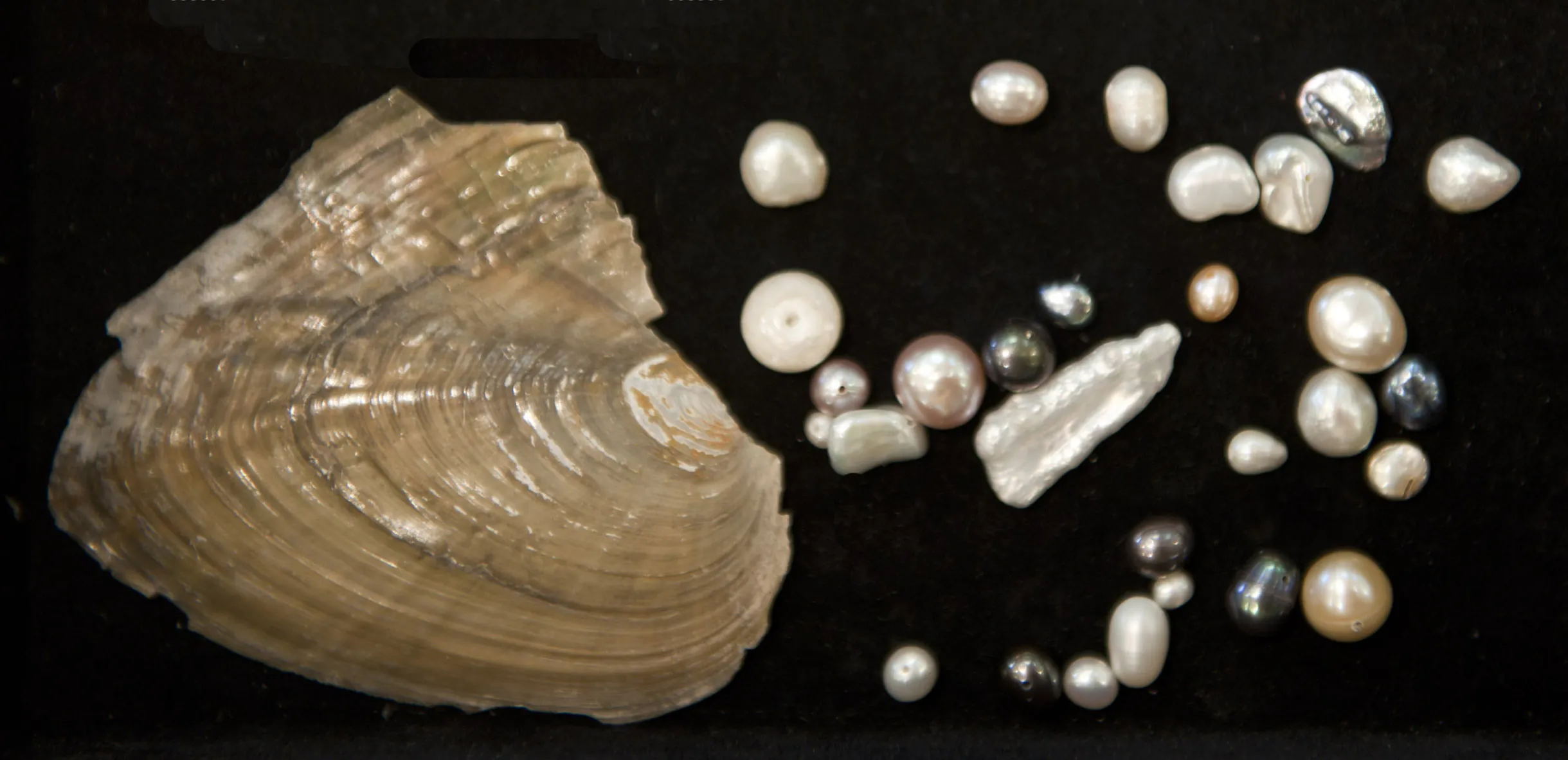
No—not as a category. Chinese freshwater pearls cover an unusually wide range, from inexpensive commercial material to carefully selected pearls with strong luster, clean surfaces, round shapes, large sizes, and excellent matching. Calling all of them “low-end” confuses three different ideas: low price, low position in the value chain, and low pearl quality.
Those three things can overlap, but they are not the same. China became the world’s dominant freshwater pearl producer through enormous production scale, efficient supply chains, and a historically volume-driven market. That made many freshwater pearls affordable and helped create a “cheap pearl” reputation. At the same time, modern Chinese farms also produce much finer material than the stereotype suggests.
The Short Answer: “Chinese Freshwater” Is an Origin and Pearl Category, Not a Quality Grade
A pearl does not become low quality simply because it was cultured in China, and it does not become high quality simply because it comes from a more prestigious pearl-producing region. Geographic origin helps explain the production environment, mollusk species, cultivation methods, and supply chain. It does not replace evaluation of the pearl itself.
The Gemological Institute of America (GIA) evaluates pearl quality through characteristics such as size, shape, color, luster, surface, nacre, and matching. These factors can vary dramatically within the same pearl type and the same country of origin.
If you want a detailed guide to judging those characteristics one by one, see our guide to Chinese freshwater pearl quality. This article focuses on a different question: why the entire category is sometimes perceived as low-end, and when that label is misleading.
Why Did Chinese Freshwater Pearls Get a Low-End Reputation?
The reputation did not appear from nowhere. It grew out of the way the industry developed.
For decades, China’s freshwater pearl sector competed successfully through scale. Large volumes of inexpensive pearls entered global jewelry markets, including strongly off-round, ringed, wrinkled, and lightly lustrous material. These pearls made genuine cultured pearls available at prices that would have been difficult to achieve with many saltwater pearl types.
That accessibility was commercially important, but it also shaped consumer perception. Many people first encountered freshwater pearls as inexpensive bead-shop strands, fashion jewelry, or visibly irregular pearls. The category became mentally linked with “budget,” while round white Akoya pearls and large South Sea pearls retained a stronger luxury association.
China’s position as the dominant freshwater producer reinforced the effect. When one country supplies both enormous quantities of entry-level material and much of the better material, buyers may remember the low-cost majority more readily than the small percentage selected into fine grades.
What Does “Low-End Lock-In” Mean in China’s Pearl Industry?
This is where the word low-end needs careful interpretation.
A 2026 GIA research article on China’s freshwater pearl industry describes a longstanding problem of “low-end lock-in” in the global value chain. In that context, GIA is not saying that every Chinese freshwater pearl is physically low quality. The discussion is about where value is created and retained across the industry.
Historically, a large share of Chinese production has been concentrated in cultivation, bulk processing, and unbranded export. Higher-value activities—such as global branding, luxury positioning, design, retail markup, and control of premium consumer channels—can capture far more value than simply producing large volumes of raw or semi-processed pearls.
That distinction is essential:
| What “low-end” might mean | What it actually describes | Does it prove the pearl is low quality? |
|---|---|---|
| Low retail price | The item is inexpensive relative to alternatives | No |
| Low value-chain position | The producer captures less value from branding, design, retail, or distribution | No |
| Low market prestige | The category is perceived as less exclusive or luxurious | No |
| Low pearl quality | Weak luster, poor surface, unattractive shape, weak matching, or other quality problems | Yes—this is an actual quality judgment |
In other words, an industry can occupy a lower-value position in global commerce while still producing individual pearls of excellent visual quality.
Have Chinese Freshwater Pearls Actually Improved?
Yes. Modern cultivation has expanded what freshwater pearls can look like.
One of the clearest recent examples is the rise of small bead-nucleated freshwater cultured pearls from China. In January 2026, GIA highlighted pearls that can show near-round to round shapes, bright white bodycolor, and excellent luster. Their appearance can overlap so closely with Akoya pearls that sellers sometimes use terms such as “freshwater Akoya” or “Chinese Akoya.” GIA cautions that these names are misleading because the pearls remain freshwater cultured pearls, not true Akoya pearls.
The important point is not that freshwater pearls have somehow become Akoya pearls. It is that cultivation technology has raised the visual ceiling of the freshwater category. Roundness, luster, color control, bead nucleation, breeding, farm management, and sorting have all become more sophisticated.
China’s freshwater sector is also not limited to small white pearls. Modern production includes tissue-nucleated pearls, large bead-nucleated pearls, baroque material, naturally colored pink, peach, and lavender pearls, and increasingly specialized products designed for different jewelry markets.
If you want to understand where this production takes place and why Zhuji is so important to the trade, see where freshwater pearls are mainly produced.
Why Can a Good Chinese Freshwater Pearl Still Be Cheaper Than an Akoya Pearl?
Because price is not a pure quality score.
GIA notes that saltwater Akoya cultured pearls are generally more expensive than freshwater cultured pearls of similar size and quality, partly because Akoya pearls are rarer and have higher culturing costs. Freshwater production economics are different. Freshwater mussels can support production systems with higher pearl output, and China has a highly developed network for farming, sorting, drilling, matching, jewelry manufacturing, and wholesale distribution.
That scale lowers the cost of bringing many freshwater pearls to market. It also creates enormous sorting depth: millions of pearls can be divided into commercial, mid-range, and fine selections.
So a lower price can reflect greater supply and production efficiency rather than a defect in the pearl. Of course, very low prices can also indicate lower quality. The point is that price alone does not tell you which explanation applies.
Can Chinese Freshwater Pearls Be Fine or Premium Quality?
Yes, although “premium” should describe the actual pearl rather than act as a vague marketing label.
Fine freshwater pearls can combine strong, sharp luster with relatively clean surfaces, attractive color, desirable shape, and careful matching. Large round or near-round pearls that maintain these qualities are much harder to assemble into a consistent strand than ordinary commercial material.
High-end selection also creates a yield problem. A farm may harvest a large quantity of pearls, but only a small proportion may meet strict requirements for roundness, luster, surface cleanliness, color consistency, and matching. Producing one excellent pearl is easier than producing enough closely matched excellent pearls for a necklace.
This is why a fine freshwater strand can cost many times more than an ordinary freshwater strand even though both are described by the same broad origin and pearl type.
What Separates Commercial Freshwater Pearls from Fine Ones?
The difference is visible in the pearl, not in the country name.
| Factor | More commercial material | Finer material |
|---|---|---|
| Luster | Soft, hazy, dull, or chalky reflections | Bright, sharp reflections with strong visual depth |
| Surface | More obvious pits, wrinkles, spots, or uneven areas | Cleaner overall appearance with fewer distracting features |
| Shape | Greater irregularity when roundness is the intended standard | More consistent round, near-round, or deliberately selected symmetrical shapes |
| Matching | Noticeable differences across a pair or strand | Closer agreement in size, color, shape, luster, and surface appearance |
| Color | May be uneven, muddy, or selected mainly for low price | Attractive, deliberate color with good consistency or well-designed variation |
| Overall selection | Large-volume material with wider tolerances | Smaller selected proportion meeting tighter visual standards |
These are the same kinds of observations used when judging other cultured pearls. GIA’s broader pearl framework considers size, shape, color, luster, surface, nacre, and matching. For a full explanation, see our pearl grading guide.
Does “Freshwater” Automatically Mean Less Luxurious?
It often means less expensive on average, but that is not the same as less beautiful or less suitable for fine jewelry.
Akoya, Tahitian, and South Sea pearls have strong category identities. Their mollusks, production regions, typical sizes, colors, rarity, and market histories have helped establish luxury associations. Freshwater pearls developed differently: enormous volume and broad price accessibility became central to the category.
That market history affects prestige. But prestige is partly cultural and commercial, while visual quality is something you can inspect. A highly lustrous, clean, well-matched freshwater strand does not become dull simply because another pearl type carries stronger luxury branding.
At the same time, buyers should not reverse the stereotype and assume every expensive freshwater pearl is automatically exceptional. The same discipline applies in both directions: judge the actual pearls, the disclosure, the matching, and the seller’s evidence.
How Should You Evaluate a Chinese Freshwater Pearl Before Buying?
Instead of asking whether Chinese freshwater pearls are “low-end,” ask questions that reveal what you are actually buying:
- How strong is the luster? Look for bright, clear reflections rather than judging only whiteness.
- How clean is the surface? Minor growth features are normal, but heavy wrinkling, deep pits, or distracting marks affect quality.
- What shape is being promised? Round, near-round, oval, button, and baroque should not be treated as interchangeable.
- How well are the pearls matched? For pairs and strands, compare size, shape, color, luster, and surface across the whole piece.
- Is the pearl tissue-nucleated or bead-nucleated? Modern Chinese freshwater pearls can be produced using different cultivation structures.
- Has the color been treated? Ask directly when color origin matters.
- Are the seller’s grades defined? “AAA,” “AAAA,” “top grade,” and similar labels are not useful unless the seller explains the standard behind them.
- Can you see neutral-light photos or video? Heavy editing can hide surface texture, weaken realistic color comparison, and exaggerate luster.
For a broader buying framework, see our pearl buying guide. If you are sourcing pearls for jewelry making, our wholesale pearl selection includes freshwater and saltwater materials across different shapes, sizes, and quality levels.
So, Are Chinese Freshwater Pearls Low-End?
Some are. The category is not.
China produces enough freshwater pearls to supply many different market levels. Entry-level commercial pearls are a real and important part of that output, which is why the category gained its inexpensive reputation. But the same industry also produces round, clean, strongly lustrous, well-matched pearls that do not fit the old “cheap freshwater pearl” stereotype.
The most useful distinction is simple: market position describes the business around the pearl; quality describes the pearl itself.
When you separate those ideas, the apparent contradiction disappears. Chinese freshwater pearls can be affordable without being poor, mass-produced without all being identical, and produced by an industry with lower value-chain capture while still reaching very high visual quality at the top end.
Origin is context—not a grade. If geographic reputation is influencing your buying decision, our guide to why pearl origin matters explains where origin is genuinely useful and where it becomes an unreliable shortcut.
Frequently Asked Questions
Are Chinese freshwater pearls real pearls?
Yes. Chinese freshwater cultured pearls are real pearls formed by living freshwater mollusks after human-assisted cultivation. “Cultured” does not mean imitation.
Why are Chinese freshwater pearls often inexpensive?
China has very large-scale freshwater pearl production and an efficient supply chain. Freshwater production can also yield more pearls than many saltwater systems. Greater supply and production efficiency help keep average prices accessible, although fine selected pearls can cost much more.
Can Chinese freshwater pearls be high quality?
Yes. High-quality examples can show strong luster, clean surfaces, attractive round or symmetrical shapes, desirable color, and excellent matching. Modern bead-nucleated freshwater pearls can also reach levels of roundness and luster that challenge older assumptions about the category.
Are Chinese freshwater pearls lower quality than Akoya pearls?
Not automatically. They are different pearl categories with different production economics and typical characteristics. Fine Akoya pearls are especially known for crisp luster, roundness, and matching, but a fine freshwater pearl can be much more attractive than a weak Akoya pearl. Compare the individual pearls rather than ranking only by type.
Are “Freshwater Akoya” pearls actually Akoya pearls?
No. GIA has specifically cautioned that terms such as “freshwater Akoya” can be misleading. These are freshwater cultured pearls that may resemble Akoya pearls, often because they are bead-nucleated, but true Akoya pearls are saltwater cultured pearls from the Akoya pearl oyster.
References and Further Reading
- GIA, “Policy-Driven Sustainability in China’s Freshwater Pearl Culturing Industry” (2026)
- GIA, “Freshwater Akoyas - A Trending Misnomer for Certain Freshwater Pearls” (2026)
- GIA, “Pearl Quality Factors”
- GIA, “Freshwater Pearls vs. Saltwater Pearls: Understanding the Difference”
- CIBJO, “Guide for Classifying Natural Pearls and Cultured Pearls”