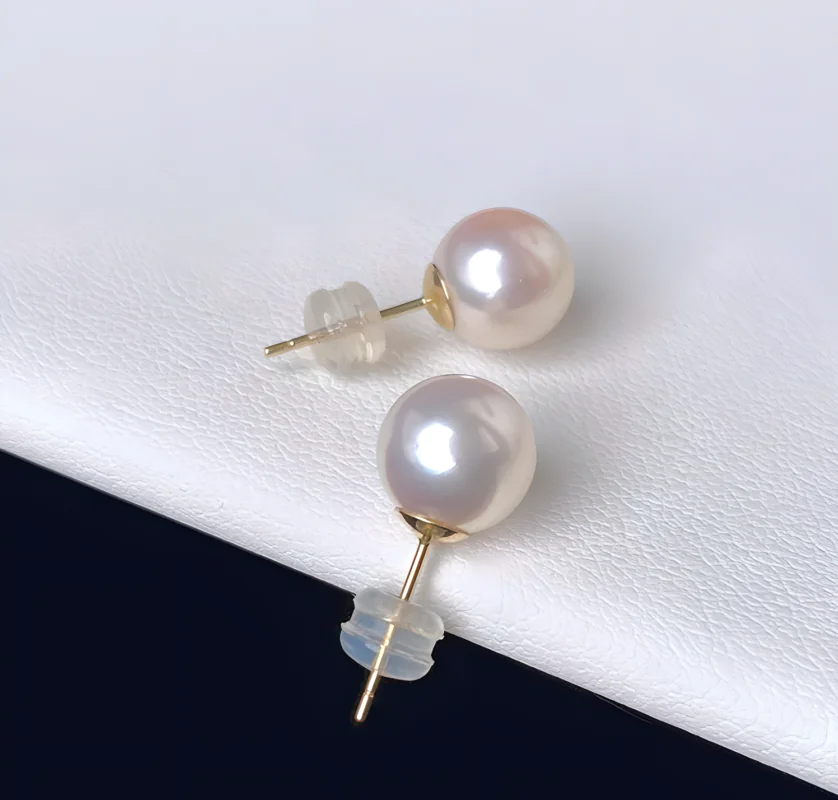
Akoya Tennyo Pearls in Grading Certificates: What the Designation Really Means
When the word Tennyo appears beside an Akoya pearl necklace, pair, or loose pearl, the most useful question is not simply “Is Tennyo the highest grade?” It is “Which laboratory issued the report, what exactly does that laboratory mean by Tennyo, and what does the certificate actually document?”
In the best-known Japanese grading context, Aurora Tennyo is a special appellation used by the Pearl Science Laboratory (PSL) for white Akoya pearls that qualify within its Aurora Hanadama quality framework and show exceptionally strong luster. It is therefore better understood as a certificate-specific quality designation than as a universal pearl grade.
Quick answer: what does Tennyo mean on an Akoya certificate?
Within the Pearl Science Laboratory system, Aurora Tennyo (オーロラ天女) is used for white Akoya pearls that are already within the laboratory's Aurora Hanadama category but stand out especially for teri—the Japanese term commonly used for the strength and quality of pearl luster.
PSL's current certificate system assigns Aurora Tennyo its own dedicated report type and places particular emphasis on luster analysis and the Aurora interference-color image.
This distinction matters because “Tennyo” does not function like a universal A, AA, AAA, or diamond-style grade that every laboratory applies in the same way. Pearl grading systems are not fully standardized across the industry. The designation only becomes meaningful when it is connected to the issuing laboratory and the criteria documented on that report.
Start with the certificate issuer, not the grade word
One of the most common mistakes in high-grade Akoya shopping is treating a familiar word as though it has one global definition.
Hanadama, for example, is a historic Japanese trade term associated with very high-quality Akoya pearls, but different laboratories may define or report it under their own systems.
PSL defines its own Aurora Hanadama standard, while GIA uses its 7 Pearl Value Factors—size, shape, color, luster, surface, nacre, and matching—and can include a Hanadama comment on qualifying Akoya cultured pearls under GIA's own criteria.
The same broad trade vocabulary can therefore appear in more than one reporting environment without the underlying systems being identical.
That is why a careful reader should interpret a pearl report in this order:
- Who issued the report?
- What report or certificate type is it?
- What special appellation or quality terminology appears?
- What measurable or observed quality information is recorded?
- Does the physical item being offered correspond to that report?
This approach is much more reliable than comparing words such as “Hanadama,” “Tennyo,” “AAA,” and “gem grade” as though they belonged to one universal grading ladder.
Where Aurora Tennyo sits within the PSL certificate system
PSL issues several report types for different purposes. The distinction between identification and quality designation is especially important.
A document can confirm that an item is pearl without awarding it a top-quality appellation.
| PSL report context | What it is used for | What the buyer should understand |
|---|---|---|
| FA / FC identification reports | Pearl identification without a top-quality grade | Useful for identification, but not equivalent to an Aurora Hanadama or Tennyo designation |
| SS-type report | PSL's highest-quality series, including Aurora Hanadama | Evaluates a broader set of quality conditions; nacre thickness forms part of the report process |
| SP-type report | Dedicated Aurora Tennyo report | Includes teri measurement analysis and an Aurora interference-color image, with exceptional luster as the focus |
PSL notes that the current SP certificate corresponds to the older P type, while the current SS certificate replaced the older S type. This is useful when comparing newer documents with older inventory or certificate photographs published online.
The practical lesson is simple:
A Tennyo claim should be tied to the appropriate PSL report, not merely written in a seller's product title.
What must an Akoya pearl satisfy before Tennyo becomes relevant?
PSL's published Aurora Hanadama definition provides the baseline.
For its white Akoya category, Aurora Hanadama applies to pearls of 6 mm or larger, with nacre thickness of at least 0.4 mm.
PSL allows shape within its stated range up to semi-round, checks surface condition according to its own standard, and gives particular importance to luster—including both brightness and interference color.
This is an important correction to a common oversimplification.
Retail descriptions sometimes imply that every certified Hanadama or Tennyo pearl must be absolutely flawless and perfectly round. That is too absolute.
A laboratory designation is based on the laboratory's stated acceptance criteria, not on idealized marketing language.
The key Tennyo difference: exceptional luster, not simply “better at everything”
The most useful way to understand Tennyo is that it places an additional spotlight on luster performance.
PSL's own explanation describes Aurora Tennyo as a special appellation for pearls within Aurora Hanadama whose teri is particularly outstanding.
In PSL's published technical explanation of Tennyo, two features are highlighted:
- a measured brightness-distribution value reaching at least 90% of the instrument's maximum reference value; and
- vivid reflected interference-color patterns showing at least three colors across the red-to-green range.
These published conditions help explain why Tennyo reports devote special attention to luster measurement and the Aurora image.
For a buyer, this creates a much better mental model than simply saying:
Tennyo is one grade above Hanadama.
A more precise interpretation is:
Aurora Hanadama establishes the high-quality white Akoya context; Aurora Tennyo identifies a subset distinguished especially by unusually strong luster performance under PSL's system.
This also explains why two pearls can both be beautiful high-grade Akoya pearls while looking different in person.
Luster intensity, reflection sharpness, overtone, body color, matching, size, and surface character all affect the visual result.
Aurora Tennyo vs Aurora Hanadama
| Point | Aurora Hanadama | Aurora Tennyo |
|---|---|---|
| Pearl context | High-quality white Akoya under PSL criteria | A selection within the Aurora Hanadama context |
| Main emphasis | Overall high-quality requirements, with luster strongly emphasized | Particularly exceptional teri / luster performance |
| Nacre | PSL specifies at least 0.4 mm for Aurora Hanadama | Still satisfies the underlying Hanadama context; Tennyo does not simply mean “the thickest nacre” |
| Surface and shape | Must fall within PSL's accepted quality range | Remain within the qualified context, while Tennyo's defining extra emphasis is luster |
| Certificate context | PSL highest-quality series | Dedicated Tennyo report emphasizing teri testing and Aurora imagery |
| Best shorthand | Top-quality white Akoya category within PSL's system | Especially high-luster selection within that category |
What a Tennyo certificate does not automatically mean
A grading certificate is most useful when it reduces ambiguity.
It becomes less useful when buyers read additional promises into a designation that the report does not actually make.
It does not mean “the highest grade of every pearl in the world”
Tennyo belongs to a particular laboratory framework for Akoya pearls.
Tahitian, South Sea, freshwater, and other pearls are evaluated under different terminology and may be submitted to different laboratories or grading systems.
Calling Tennyo “the highest pearl grade in the world” removes the laboratory and pearl-type context that gives the designation its actual meaning.
It does not mean the surface must be literally flawless
High-quality pearls can still have minor natural surface characteristics.
The relevant question is whether the surface falls within the laboratory's accepted range and how those characteristics affect appearance.
“Certified Tennyo” and “absolutely flawless under every viewing condition” are not interchangeable statements.
It does not mean the pearl has the thickest possible nacre
Nacre is an important quality factor, but the extra distinction of Tennyo is luster.
A Tennyo report should not be interpreted as a statement that no other pearl can have thicker nacre.
This distinction matters when comparing two expensive Akoya strands. One may have exceptional luster performance while another has different strengths in nacre, size, matching, color, or overall appearance.
It does not tell you that a larger pearl is automatically better
Size affects rarity and market value, but it is a separate factor.
A smaller Tennyo pearl can show stronger luster than a larger Akoya pearl while the larger pearl may still command a higher price for other reasons.
Certificate designation and pearl size should therefore be read separately.
It does not replace treatment or color remarks
Do not infer every treatment or color-status detail from the Tennyo name alone.
If a report contains specific remarks about natural color, processing, or other identification findings, those remarks should be read separately.
It does not make seller-created AAA systems equivalent
Vendor grades such as AAA, AAAA, “gem grade,” “top quality,” or “top 1%” may be useful for organizing one seller's inventory.
They should not, however, be treated as automatic translations of a PSL appellation unless the seller clearly explains the relationship and provides the corresponding laboratory documentation.
How to read a Tennyo certificate before buying
Instead of asking only whether a strand “has a certificate,” use the certificate as a structured checklist.
1. Confirm the issuing laboratory
If the product is sold specifically as Aurora Tennyo, check that the designation is tied to a Pearl Science Laboratory report rather than merely to a generic appraisal card.
The word on the sales page is not the same thing as the designation on the laboratory document.
2. Check the report type and special appellation
Look for the Tennyo designation in the actual report context.
Older and newer PSL certificate formats may differ, so report type and layout should be interpreted with that history in mind.
3. Match the item description and size
The pearl type, item form, and measurements recorded on the report should correspond to what is being sold.
This is especially important when certificates are shown separately from the product photographs.
4. Read the nacre information
Tennyo's special emphasis is luster, but nacre remains part of the underlying high-quality Akoya context.
Do not ignore nacre simply because the report contains the Tennyo name.
5. Look at the teri analysis and Aurora image
These are central to understanding why the pearls qualified for the Tennyo designation.
They provide more useful information than treating “Tennyo” as a decorative luxury label.
6. Read surface, shape, body-color, and remarks fields
Do not reduce the whole report to one word at the top.
A certificate contains several pieces of information that together describe the item examined.
7. Compare the certificate with the actual pearls
A certificate supports the identity and evaluated quality of the submitted item.
It does not make photographs, consistent lighting, matching, and direct visual inspection irrelevant.
This becomes especially important with expensive Akoya strands because pearls that pass the same certificate threshold can still present different visual personalities.
Does Tennyo certification determine the pearl's value?
No single certificate word determines market value by itself.
Certification can provide useful independent evidence that an item met a laboratory's criteria at the time of examination, but buyers still compare multiple factors.
GIA's framework is useful here because it separates pearl quality into seven value factors:
- size
- shape
- color
- luster
- surface
- nacre
- matching
A Tennyo designation gives unusually strong information about one of the most visually important factors—luster—inside a high-quality Akoya context.
Price, however, can still vary with pearl size, matching quality, overtone preferences, strand length, jewelry construction, brand, retail channel, and the overall visual character of the pearls.
That is also why two Tennyo-certified strands need not look identical or sell at identical prices.
A certification threshold creates a qualified group; it does not erase variation within that group.
Tennyo certificates are most useful when comparing similar high-end Akoya pearls
Imagine that you are comparing three 8–8.5 mm Japanese Akoya necklaces.
One carries no third-party grading report.
One has an Aurora Hanadama certificate.
One has an Aurora Tennyo certificate.
The wrong approach is:
uncertified < Hanadama < Tennyo, therefore the third strand must automatically be the best purchase.
The more useful approach is:
- establish what each laboratory report actually confirms;
- compare size and matching;
- compare visible luster and reflection sharpness;
- compare overtone and body color;
- inspect surface character;
- consider nacre information;
- then compare price.
The Tennyo certificate gives you meaningful additional evidence about exceptionally strong luster under PSL's system.
It does not make all of the other questions disappear.
Who benefits most from Tennyo certification?
Tennyo certification is most useful when the buyer specifically values high-luster Japanese Akoya pearls and wants laboratory documentation that goes beyond a seller's internal grade.
It can be particularly helpful when:
- comparing expensive Akoya strands remotely;
- the buyer cannot inspect several candidates side by side;
- a collector wants a recognized PSL quality designation attached to the item;
- different sellers use incompatible AAA-style grading systems;
- luster is one of the buyer's highest priorities.
It may be less important for someone whose priority is simply finding the most attractive pearl within a fixed budget.
An excellent non-Tennyo strand—or even a non-certified strand from a trustworthy source—can still be visually compelling.
The certificate is evidence and context. It should not replace the actual appearance of the pearls or the buyer's priorities.
The most useful way to think about Tennyo
For Akoya pearls, “Tennyo” is most informative when read as part of a grading-certificate system, not as a free-floating luxury word.
Pearl Science Laboratory uses Aurora Tennyo for white Akoya pearls within its Aurora Hanadama framework that show especially outstanding luster, supported by dedicated teri analysis and Aurora interference-color evaluation.
So when comparing certificates, do not stop at the label.
Identify the laboratory, understand the report type, read the measurable and observed quality information, and then compare those findings with the physical pearls.
That approach tells you far more than simply asking whether Tennyo is “higher” than Hanadama.
FAQ
Is Tennyo higher than Hanadama?
Within the Pearl Science Laboratory system, Aurora Tennyo is selected from the Aurora Hanadama quality context and is distinguished especially by stronger luster performance. Calling it “higher” is acceptable as shorthand, but “especially high-luster Aurora Hanadama” is more precise.
Does Tennyo mean an Akoya pearl is flawless?
No. Tennyo indicates that the pearl or pearl item met PSL's relevant quality criteria and its additional luster-focused requirements. It should not be translated into an absolute promise of a perfectly flawless surface.
Is Tennyo a universal Akoya grade?
No. Tennyo is associated specifically with Pearl Science Laboratory's grading and certification terminology. Other laboratories use their own classification systems and should be interpreted according to their own published criteria.
What should I check on a Tennyo certificate?
Check the issuing laboratory, report type, Tennyo special appellation, pearl type and size, nacre information, teri analysis, Aurora image, surface and shape information, body color, and any remarks that apply to the submitted item.
Can two Tennyo-certified strands still differ in quality or price?
Yes. Certification establishes that both met the relevant criteria, but they can still differ in size, matching, overtone, exact luster character, surface appearance, jewelry construction, and other factors that influence preference and price.