Akoya Pearl Size Range and the Rarity of Larger Sizes
Akoya cultured pearls can occur across a surprisingly broad size range, but the pearls most people encounter in jewelry occupy a much narrower band. Published gemological observations have documented bead-cultured Akoya pearls from roughly 2 mm to around 11 mm, while the typical commercial range is closer to 6–9 mm. Once Akoya pearls move beyond about 9 mm, availability generally falls quickly, and fine-quality pearls of 10 mm or more are especially uncommon.
This distinction matters because statements such as “Akoya pearls are 2–10 mm” and “Akoya pearls are usually 6–9 mm” can both be reasonable. One describes the broader possible range; the other describes what buyers are much more likely to encounter in normal jewelry. For background on the pearl type itself, see our guide to Akoya pearls.
What Is the Typical Akoya Pearl Size Range?
In everyday jewelry, approximately 6–9 mm is the most useful range to think about. Smaller Akoya pearls certainly exist, including very small “baby” sizes, while pearls around 9–10 mm occupy the large end of normal commercial production. Sizes exceeding 10 mm can occur, but they should not be treated as routine.
| Akoya Size | General Appearance | Typical Market Context |
|---|---|---|
| About 2–5 mm | Very small and delicate | Specialty or “baby” Akoya sizes; less typical for a classic full strand |
| 5–6 mm | Small and refined | Used for delicate jewelry and smaller-scale designs |
| 6–7 mm | Classic-small | Common commercial Akoya size |
| 7–8 mm | Classic and balanced | One of the central size ranges for traditional Akoya jewelry |
| 8–9 mm | More substantial | Upper mainstream range; often positioned as a more premium size |
| 9–10 mm | Distinctly large for Akoya | Increasingly scarce, particularly in high quality |
| 10 mm+ | Very large for the pearl type | Uncommon; fine round pearls and well-matched strands become much harder to assemble |
Important: these are practical market descriptions, not universal grading categories. Harvests, producing regions, cultivation methods, and individual sellers can divide size ranges differently.
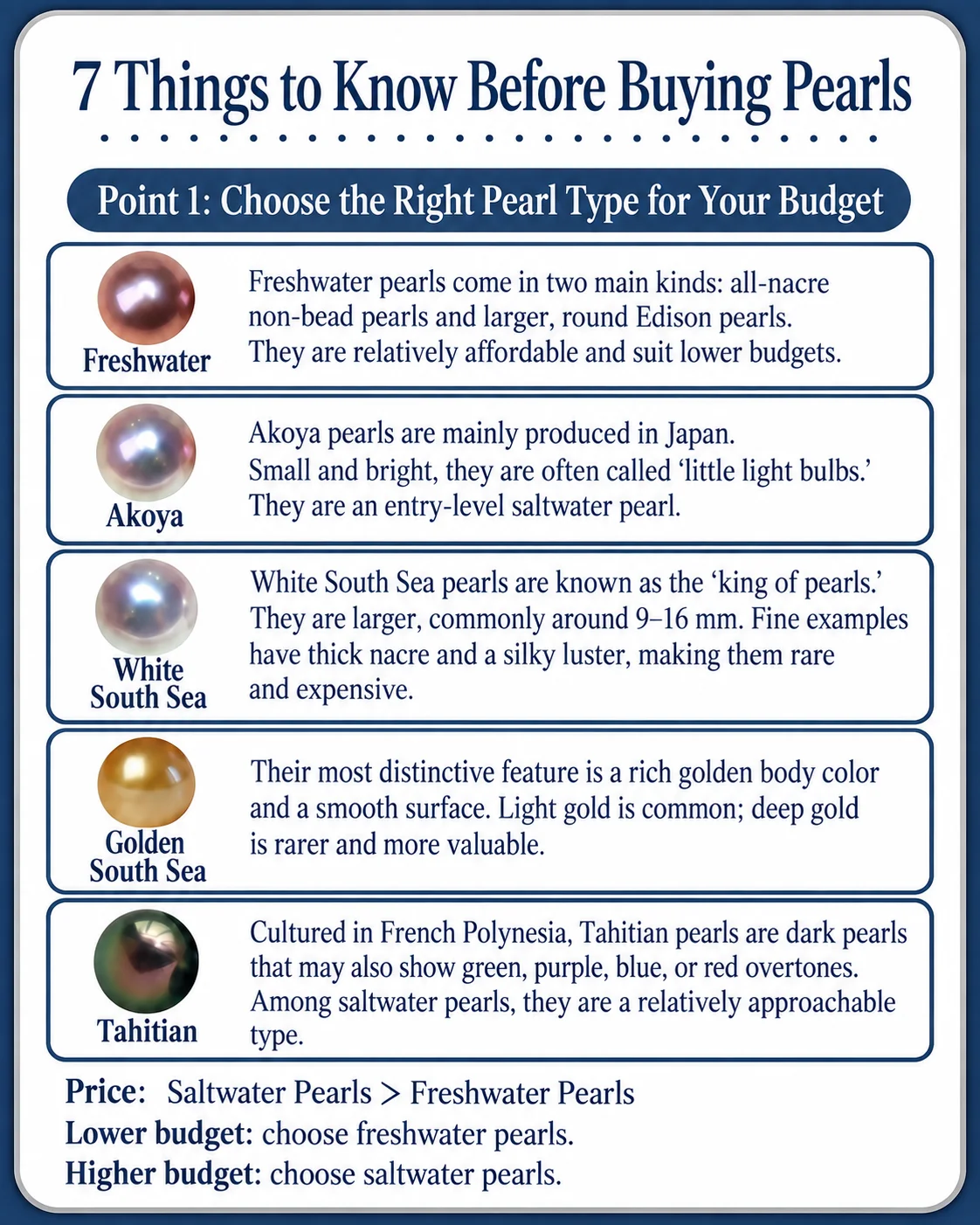
Why Do Some Sources Say Akoya Pearls Reach Only 10 mm?
A simple “maximum size” can be misleading. Many retail guides use about 10 mm as the practical upper end because pearls larger than this are uncommon enough that most buyers will rarely see them. That does not mean an Akoya pearl becomes biologically impossible at exactly 10.0 mm.
GIA has documented bead-cultured Akoya pearls reaching approximately 11 mm. The better way to describe the range is therefore to distinguish between what has been observed and what is normally available. Around 10 mm represents the extreme end of ordinary Akoya jewelry far better than it represents an absolute physical limit.
This is useful when comparing seller descriptions. A 10.2 mm Akoya pearl should not automatically be dismissed because someone has stated that “Akoya stops at 10 mm.” At the same time, unusually large size claims deserve more scrutiny precisely because such pearls are outside the center of normal production.
Why Do Larger Akoya Pearls Become Rarer?
The rarity is partly biological. Akoya pearl oysters are much smaller than the mollusks used to produce South Sea cultured pearls, so there is less physical capacity for producing very large bead-cultured pearls. Final pearl diameter is determined by both the bead nucleus and the nacre deposited around it, but a producer cannot simply continue increasing nucleus size without considering the health and limitations of the oyster.
Several filters also work against large pearls reaching the fine-jewelry market at top quality.
- The oyster must successfully accept the nucleation. A larger target pearl does not eliminate the biological risks of rejection, mortality, or unsuccessful growth.
- The pearl still has to develop acceptable nacre. Large diameter alone does not prove that the nacre is thick, even, attractive, or durable.
- Shape still matters. A very large pearl that becomes noticeably off-round does not satisfy a buyer looking for a classic round Akoya.
- Surface and luster still matter. As the target becomes “large, round, clean, and highly lustrous,” the usable portion of the harvest becomes progressively narrower.
- Matching multiplies the difficulty. Finding one attractive large pearl is easier than finding dozens with closely similar size, color, overtone, luster, shape, and surface quality.
This last point is particularly important. The rarity of a single 9.5 mm pearl and the rarity of a well-matched 9.5 mm necklace are not the same thing. A strand requires many pearls to pass several quality filters simultaneously, so high-quality matched strands become scarce much faster than individual loose pearls.
Why Does a Difference of Only 0.5 or 1 mm Matter?
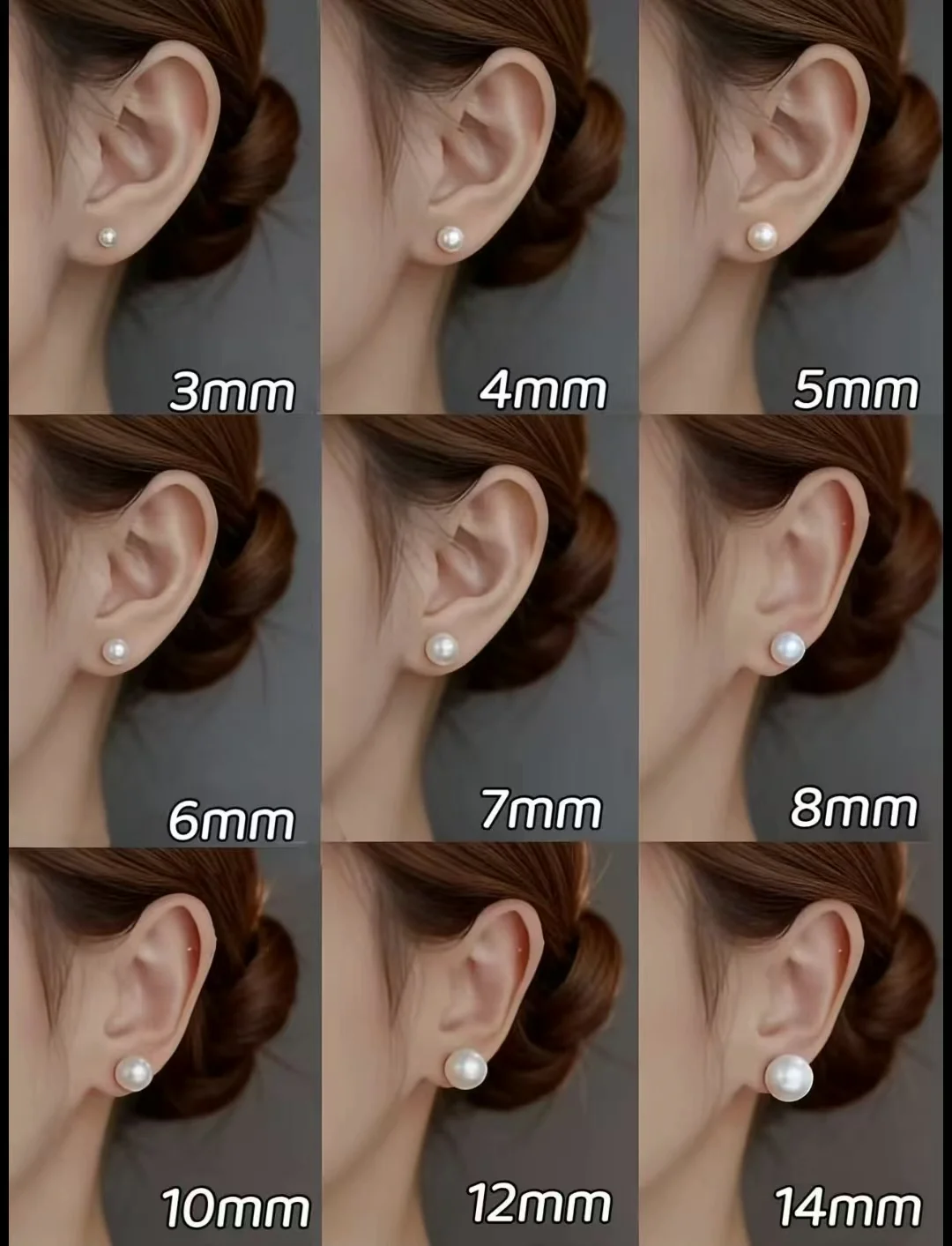
Pearl sizes are small enough that a difference of one millimeter can sound insignificant on paper. On the ear or neckline, however, the change can be quite noticeable. Pearl diameter affects the visible width in every direction, so moving from 7 mm to 8 mm or from 8 mm to 9 mm produces more visual presence than the number alone may suggest.
This is one reason Akoya pearls are commonly sold in relatively narrow size bands such as 7.0–7.5 mm, 7.5–8.0 mm, or 8.0–8.5 mm. A strand described as 7.5–8.0 mm should be understood as a matched size range rather than as a claim that every individual pearl measures exactly the same diameter.
The visual effect also becomes more pronounced toward the larger end of the Akoya range. Going from 9 mm to 10 mm does not merely change a specification on a product page; it can shift a necklace from a traditional Akoya appearance toward a much more substantial look.
When Does Akoya Size Start to Become Truly Scarce?
There is no universal line at which a pearl suddenly becomes “rare,” because harvest volume and quality vary. A practical way to think about the market is that scarcity becomes increasingly important above roughly 8–9 mm and much more obvious as Akoya approaches or exceeds 10 mm.
The critical phrase is at comparable quality. Large diameter is relatively easy to advertise because it can be measured. What is harder to find is a large Akoya pearl that simultaneously has strong luster, an attractive surface, good shape, suitable nacre, desirable color, and—when multiple pearls are involved—good matching.
Therefore, “10 mm Akoya” and “fine-quality 10 mm Akoya” should not be treated as equivalent market categories.
Does a Larger Akoya Pearl Automatically Have Higher Value?
No. Size is one pearl value factor, not the entire quality grade. When two Akoya pearls are comparable in luster, surface, shape, nacre, color, and other relevant factors, the larger pearl will generally be rarer and more valuable. But real pearls are rarely identical in every other respect.
An 8 mm Akoya with exceptionally sharp luster and a clean surface can be more desirable than a dull or heavily blemished 10 mm pearl. Likewise, an unusually large pearl with poor nacre quality does not become a superior pearl simply because its diameter is impressive.
This is why size should be considered together with the other characteristics covered in our guide to evaluating pearl value. For Akoya in particular, the combination of strong luster, roundness, surface quality, nacre, and matching often matters more to the finished appearance than chasing the largest possible millimeter measurement.
Why Large Akoya and Large South Sea Pearls Should Not Be Compared the Same Way
Pearl size only makes sense within the context of pearl type. A 10 mm Akoya is large for Akoya, but a 10 mm South Sea pearl sits near the small end of the South Sea category. The mollusks are different sizes and have different production characteristics, so rarity cannot be judged from diameter alone.
This also explains why “larger pearls are rarer” should be interpreted as larger pearls of the same type, with other quality factors held reasonably similar. A buyer should not conclude that a 10 mm pearl is inherently rarer than every 8 mm pearl without first knowing what kind of pearl is being compared.
How Should You Evaluate an Unusually Large Akoya Size Claim?
An unusual size is not proof that a pearl is mislabeled, but it is a reasonable reason to ask more questions. If a seller describes pearls well above the normal Akoya market range, especially in a high-value purchase, verify the pearl type rather than relying only on the product name.
- Confirm the actual measurement. Check whether the number refers to diameter, a size range, or the longest dimension of an off-round pearl.
- Confirm that the pearl is being represented as Akoya cultured pearl. Large white pearls can also belong to other pearl categories.
- Look beyond size. Examine luster, surface, shape, nacre appearance, color, and matching.
- For important purchases, consider independent documentation. An appropriate gemological report can provide stronger identification than a seller's size label alone.
Our pearl identification guide explains why no single visual feature—including unusually large or small size—should be used as a stand-alone authenticity or pearl-type test.
Choosing an Akoya Size in Practice
For most buyers, the best size is not necessarily the rarest size. It is the size that creates the desired visual presence while leaving enough budget to prioritize luster and overall quality.
- About 6–7 mm: delicate, traditional, and visually light.
- About 7–8 mm: a classic Akoya scale that works across many jewelry styles.
- About 8–9 mm: noticeably more presence while remaining recognizably within the mainstream Akoya look.
- About 9–10 mm: large for Akoya and increasingly dependent on limited higher-size production.
- Above 10 mm: an unusual Akoya size where quality, identification, matching, and provenance deserve especially careful attention.
If the choice is between a slightly smaller pearl with excellent luster and a larger pearl with visibly weaker quality, choosing the smaller pearl is often the better aesthetic decision. Size creates presence; luster is what makes that presence look alive.
FAQ
What is the most common size range for Akoya pearls?
Akoya cultured pearls can span a wider range, but approximately 6–9 mm represents the typical size range encountered in much of the jewelry market. Sizes around 7–8 mm are especially associated with the classic Akoya look.
Are 9 mm Akoya pearls rare?
They are not impossibly rare, but they sit toward the larger end of normal Akoya production. Fine 9 mm pearls become noticeably scarcer when strong luster, clean surfaces, round shape, good nacre, and close matching are all required.
Are 10 mm Akoya pearls rare?
Yes, 10 mm is very large for Akoya and availability is much lower than in mainstream 6–9 mm sizes. High-quality matched 10 mm pearls are considerably more difficult to source than individual pearls that merely reach that diameter.
Can Akoya pearls be larger than 10 mm?
Yes. Gemological observations have documented Akoya cultured pearls around 11 mm, so 10 mm should not be treated as an absolute biological cutoff. Pearls above 10 mm are simply outside the normal center of the Akoya market and are uncommon.
Is a bigger Akoya pearl always better?
No. Size is only one value factor. Luster, surface, shape, color, nacre quality, and matching can make a smaller Akoya pearl more attractive and potentially more desirable than a larger pearl of weaker overall quality.
What to Remember
The broad Akoya size range is wider than the range most jewelry shoppers actually encounter. Roughly 6–9 mm covers much of the typical market, 9–10 mm represents increasingly large and scarce Akoya, and pearls above 10 mm are uncommon rather than impossible. Most importantly, the rarity of large Akoya pearls increases dramatically when size must be combined with excellent luster, good surface quality, roundness, suitable nacre, and close matching. Size matters—but the finest large Akoya pearls are rare because they have to be large and good.
Selected References
- Gemological Institute of America (GIA), Very Small Akoya Cultured Pearls, Gems & Gemology, Spring 2018.
- Gemological Institute of America (GIA), Different Pearl Types Explained: Akoya, South Sea, Tahitian & Freshwater Pearls.
- Gemological Institute of America (GIA), Pearl Quality Factors.