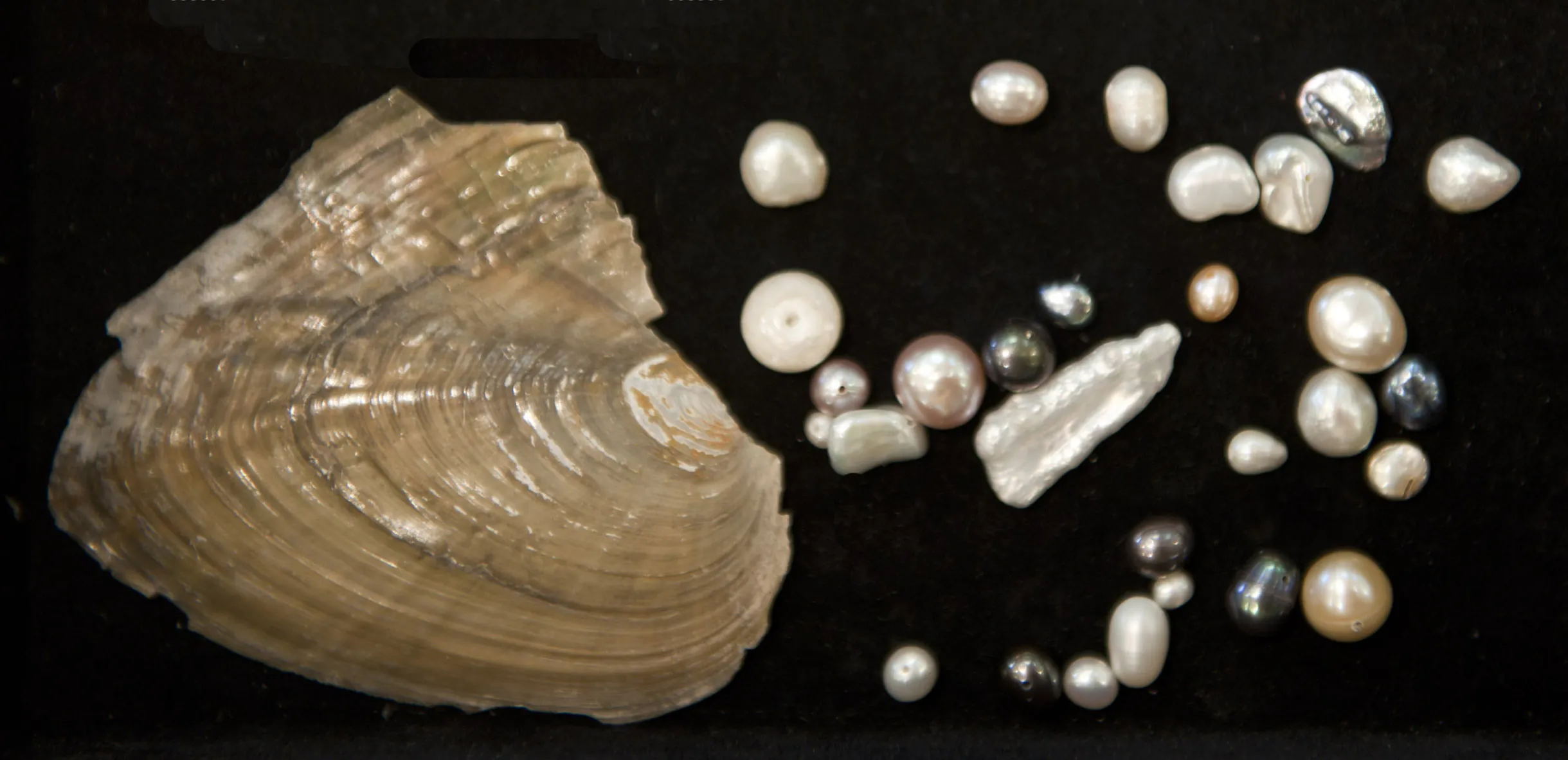
Abalone pearls are famous for shapes that can look more like horns, teeth, drops, hooks, or small sculptures than classic round pearls. The main reason is not that abalone nacre somehow “cannot grow round.” It is that natural abalone pearls usually grow under very different physical conditions from modern bead-cultured pearls.
Their shape is strongly influenced by where the pearl forms inside the abalone, the shape of the surrounding anatomy, whether it touches the shell, and whether a round bead nucleus is present. In many natural examples, those conditions favor irregular or elongated growth rather than a sphere.
The Short Answer: Abalone Pearls Follow Their Growth Environment
Abalone belong to the genus Haliotis, a group of marine gastropods rather than the bivalve pearl oysters that produce Akoya, Tahitian, and South Sea cultured pearls. Natural abalone pearls can form in different parts of the animal, and their eventual outline often reflects the space in which they grew.
GIA has documented natural abalone pearls in strongly baroque forms, including elongated “horn” and “tooth” shapes, and notes that their shapes are determined by where they form within the mollusk and may mirror the form of the gonad.
1. Growth Location Has a Major Effect on Shape
A pearl does not grow in empty space. It develops inside living tissue or, in some cases, next to the inner shell surface. The surrounding space can influence the direction in which nacre is deposited.
This is especially important with abalone. Instead of producing one standardized shape, natural abalone pearls may develop in different anatomical locations. When a pearl grows in a long or constrained area, its form can become elongated. When it develops in a less regular pocket of tissue, the result may be strongly baroque.
That helps explain why two natural abalone pearls from the same general species can look completely different. One may be compact and rounded, while another may resemble a horn, tooth, fish head, or other free-form object.
2. The Abalone’s Anatomy Can Be Reflected in the Pearl
Some of the most characteristic abalone pearls are long, curved, or tapering. These shapes are not random in the same sense as a damaged object being distorted after formation. In documented natural specimens, the pearl can grow in a way that reflects the form of surrounding body structures.
GIA specifically notes that the shape of natural Haliotis pearls can mirror the mollusk’s gonad. This is one reason horn-like and tooth-like forms appear so often in descriptions of natural abalone pearls.
In other words, the pearl is not necessarily “trying to become round and failing.” Its layers are simply building within a biological space that may itself be elongated or asymmetric.
3. Natural Abalone Pearls Usually Do Not Have a Round Bead Controlling the Shape
Many familiar saltwater cultured pearls begin with a carefully selected spherical bead nucleus. The mollusk coats that bead with nacre, so the pearl already has a round foundation. This does not guarantee a perfectly round pearl, but it gives the growing pearl a strong geometric starting point.
Natural abalone pearls do not begin with a pearl farmer inserting a round bead. Their internal starting structures can be irregular, and the growing pearl is more exposed to the influence of tissue position and available space.
This is an important distinction: the absence of a spherical bead does not make roundness impossible. It simply removes one of the strongest shape-control tools used in modern pearl culture.
If you want to compare how pearl forms are described more broadly, see our Pearl Shape Guide.
4. Contact With the Shell Can Create Blister-Like Forms
Not every unusual abalone formation is a free whole pearl. Abalone can also produce shell blisters or blister pearls associated with the inner shell surface.
GIA describes natural shell blisters forming when foreign material becomes trapped between the shell interior and the mantle. The mollusk deposits nacre over the object, and the growth becomes integrated with the shell. Because the nacre follows the underlying object and shell surface, the result is naturally domed, asymmetric, or otherwise non-spherical.
This matters because people sometimes explain all abalone pearls as “blisters attached to the shell.” That is too broad. Natural whole abalone pearls also exist, including loose horn-shaped and baroque specimens. Shell-attached growth is one route to unusual shape, not the only one.
What Actually Controls an Abalone Pearl’s Shape?
| Factor | How It Can Affect Shape |
|---|---|
| Growth location | The pearl develops within a particular anatomical space rather than in unrestricted space. |
| Surrounding anatomy | Elongated or asymmetric body structures can encourage horn-like, tooth-like, or irregular forms. |
| Initial nucleus or internal structure | Natural pearls do not have a deliberately inserted round bead guiding the outer shape. |
| Contact with the shell | Shell-attached growth can create domed, flat-backed, or strongly asymmetric blister forms. |
| Culturing method | Specialized bead-nucleation can produce much rounder abalone cultured pearls than typical natural examples. |
Are Abalone Pearls Always Irregular?
No. Irregular shape is typical, especially in natural abalone pearls, but it is not an absolute biological rule.
This distinction has become even clearer as abalone pearl culturing methods have developed. A 2025 CIBJO Pearl Special Report described a Japanese cultivation method using repeated bead insertion into a pearl sac in the mantle. The reported result was near-round to almost spherical cultured abalone pearls.
That is useful evidence because it shows that abalone can produce rounder pearls when the growth process is deliberately controlled. The dramatic shapes of natural abalone pearls therefore make more sense as a consequence of growth conditions and anatomy, not as proof that abalone nacre is inherently incapable of forming a sphere.
Is an Unusual Shape a Defect?
Not automatically. With a classic Akoya strand, buyers may pay a premium for high roundness and close matching. Abalone pearls belong to a different visual category.
For natural abalone pearls, an unusual silhouette can be part of the appeal. The more useful questions are whether the shape is visually interesting, whether the nacre and surface are attractive and structurally sound, and how well the form works in jewelry or as a collector specimen.
“Baroque” describes irregular shape; it does not by itself mean poor quality. You can read more about that distinction in our guide to baroque pearls.
Why Do Many Abalone Pearls Look So Sculptural?
The unusual shape becomes even more noticeable because abalone nacre is highly iridescent. Strong blue, green, violet, gold, and other shifting colors can run across ridges, curves, hollows, and uneven surfaces.
As a result, the pearl’s outline and color work together. A ridge catches light differently from a hollow; a tapering horn may show several colors along its length. This can make a natural abalone pearl feel more like a miniature organic sculpture than a conventional round pearl.
For a broader introduction to this pearl type, including color, origin, rarity, and natural versus cultured examples, see Abalone Pearls: Origins, Colors, Shapes, and Rarity.
FAQ
Why are abalone pearls often horn-shaped?
Many natural abalone pearls form in anatomical locations whose shape influences the growing pearl. GIA notes that abalone pearl shapes may mirror the form of the gonad, helping explain the characteristic horn-like or tooth-like outlines.
Can an abalone pearl be perfectly round?
Yes, but round natural examples are uncommon. Specialized cultured abalone methods using bead nuclei have produced near-round and almost spherical pearls, showing that roundness is possible under controlled growth conditions.
Are all abalone pearls attached to the shell?
No. Abalone can produce shell blisters and blister pearls, but natural whole pearls can also form loose within the mollusk. Loose abalone pearls are often baroque, elongated, horn-like, or tooth-like.
Does an irregular abalone pearl shape mean low quality?
No. Irregularity is characteristic of many natural abalone pearls. Shape should be judged together with luster, color, surface condition, structural integrity, size, rarity, and overall visual appeal.
Final Takeaway
Abalone pearls have unusual shapes because their growth is strongly shaped by biology. Natural pearls may develop in constrained or elongated parts of the mollusk, reflect surrounding anatomy, lack a deliberately round bead nucleus, or grow against the shell surface. Those conditions make baroque, horn-like, tooth-like, and sculptural forms much more common than perfect spheres.
The key idea is simple: an abalone pearl’s shape records where and how it grew. Its irregularity is often not an accident to be corrected, but part of the gem’s natural identity.