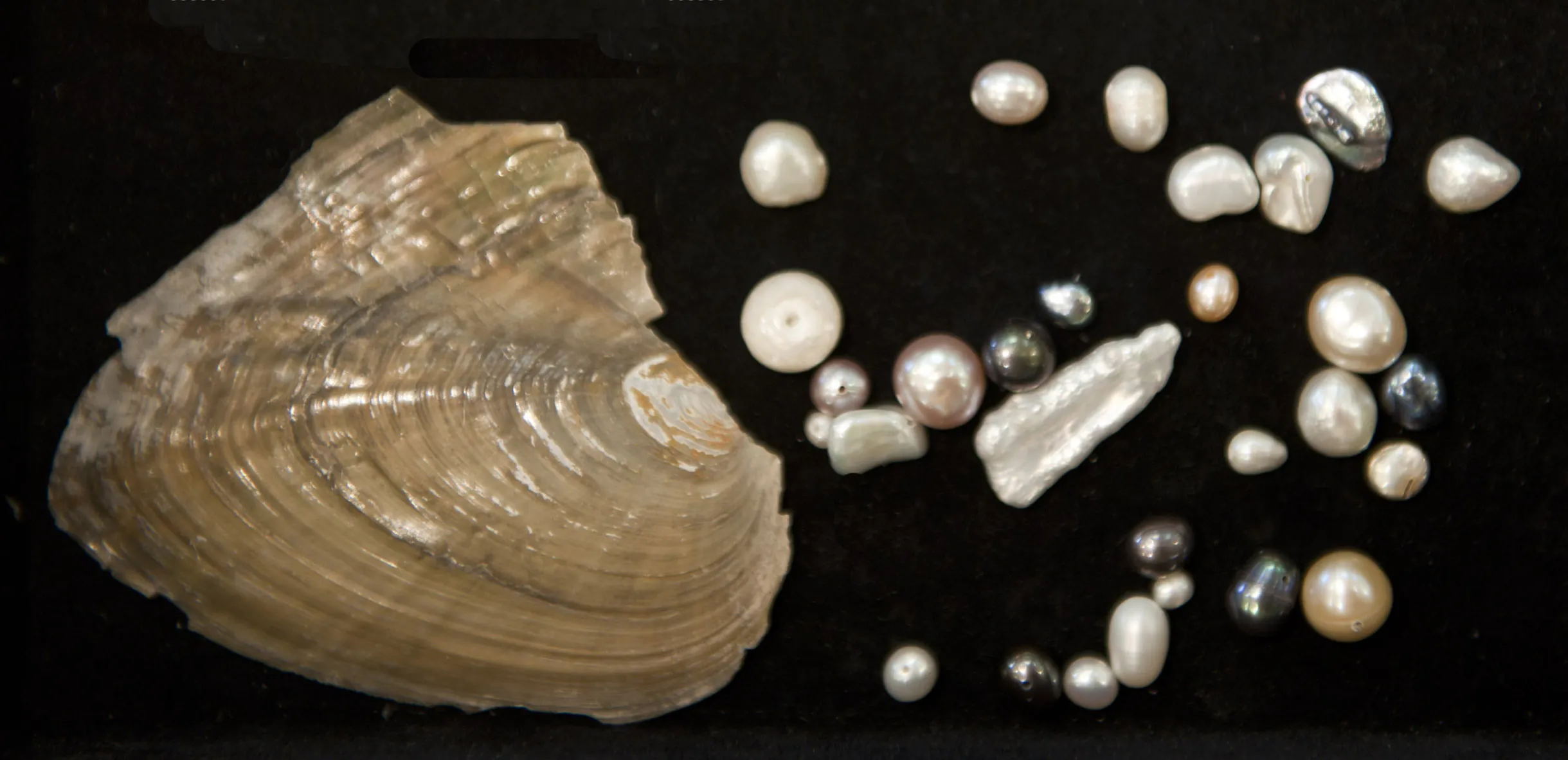
Saltwater pearls are usually rounder not because seawater itself makes pearls spherical, but because of how most saltwater cultured pearls are produced. Akoya, Tahitian, and South Sea pearls are generally bead-nucleated: a technician inserts a round shell bead together with a small piece of mantle tissue into the oyster. The oyster then deposits nacre around that already-round center.
That spherical bead gives the developing pearl a strong geometric starting point. Traditional freshwater cultured pearls, by contrast, have often been tissue-nucleated without a round bead, so their shape is controlled more by the pearl sac and the way nacre develops around soft tissue. The result is a much wider range of oval, button, potato, drop, near-round, and baroque forms.
The important distinction, then, is not simply saltwater versus freshwater. It is largely bead nucleation versus tissue nucleation.
The Main Reason: Saltwater Pearls Usually Grow Around a Round Bead
Most familiar saltwater cultured pearl types—including Akoya pearls, Tahitian pearls, and South Sea pearls—are produced by bead nucleation. A spherical bead, usually made from nacreous shell, is inserted into the pearl oyster along with donor mantle tissue.
Once a pearl sac forms around the implant, the oyster lays down nacre over the bead. Because the center is already spherical, the pearl has a built-in template that encourages a round or near-round final form.
Gemological research from GIA describes shell-bead nuclei used in bead-cultured pearls as typically spherical. GIA also notes that Akoya bead-cultured pearls are commonly round. This does not mean the oyster simply “copies” the bead perfectly, but the bead greatly narrows the range of possible shapes compared with a pearl that begins without a hard spherical core.
Why Traditional Freshwater Pearls Show More Shape Variation
Traditional Chinese freshwater cultured pearls have commonly been produced by inserting a small piece of mantle tissue into the mussel without adding a bead nucleus. You can read more about this process in our guide to freshwater non-nucleated pearls.
In this method, there is no rigid sphere in the center telling the pearl sac what shape to follow. The tissue develops into a pearl sac, and nacre accumulates around the resulting structure. Small differences in the sac, tissue placement, healing response, and growth can therefore have a larger effect on the final outline.
This is why traditional freshwater production has historically yielded such a broad spectrum of shapes. Perfectly round pearls can still occur, but achieving a highly spherical result without a round bead is more difficult and less predictable.
Does the Round Bead Guarantee a Round Pearl?
No. A round nucleus improves shape control, but it does not guarantee a perfectly round pearl.
A pearl is a biological product, not a molded coating made by a machine. After nucleation, many variables can influence the finished shape: how the pearl sac develops, the position and stability of the nucleus, the mollusk's biological response, and whether nacre is deposited evenly around the surface.
That is why saltwater harvests still contain near-round, button, drop, circled, semi-baroque, and baroque pearls. Even with a spherical nucleus, nature can change the final geometry.
GIA treats shape as one of the major pearl value factors and notes that round is the most difficult cultured pearl shape to produce. In other words, bead nucleation makes roundness more achievable—it does not make it automatic.
Modern Freshwater Pearls Show That Water Type Is Not the Whole Story
One of the clearest ways to understand the issue is to look at modern bead-nucleated freshwater pearls.
Freshwater farmers now also use spherical bead nuclei for some pearl types. Bead-nucleated freshwater pearls, including many Edison-type pearls and newer small round freshwater pearls, can be remarkably spherical.
In 2026, GIA highlighted small Chinese bead-nucleated freshwater pearls that can look very similar to saltwater Akoya pearls. The reason is instructive: once freshwater cultivation uses a round shell bead in a process more similar to Akoya culture, the resulting pearls can also become round or near-round with much greater consistency.
This is strong evidence that the old rule—“saltwater pearls are round, freshwater pearls are irregular”—is too simplistic for today's market.
Saltwater vs. Freshwater Roundness at a Glance
| Pearl type | Typical nucleation method | What it means for shape |
|---|---|---|
| Akoya | Round bead + mantle tissue | Strong tendency toward round and near-round shapes, although other shapes occur |
| Tahitian | Round bead + mantle tissue | Round and near-round pearls are produced, but drops, circles, and baroques are also common market shapes |
| South Sea | Round bead + mantle tissue | Roundness can be excellent, but many symmetrical and baroque shapes also occur |
| Traditional freshwater | Mantle tissue without a bead | Greater natural variation; round pearls are possible but harder to control |
| Modern bead-nucleated freshwater | Round bead + mantle tissue | Can produce highly round or near-round pearls, sometimes visually approaching saltwater types |
So if you are comparing pearl shapes, it is more useful to ask how the pearl was cultured than to rely only on whether it came from fresh or salt water.
Why Akoya Pearls Are Especially Associated With Roundness
Among saltwater pearls, Akoya pearls have the strongest public association with the classic round white pearl necklace. Their culture method is built around a spherical bead nucleus, and roundness has long been an important selection criterion for matched Akoya strands.
This is also why an exceptionally uniform Akoya necklace can look so precise: the pearls are not only individually round, but also carefully sorted for size, color, luster, surface quality, and matching.
If shape is your main concern, our pearl shape guide explains the differences between round, near-round, oval, button, drop, and baroque pearls in more detail.
Is a Rounder Pearl Automatically a Better Pearl?
No. Roundness is important, but it is only one part of pearl quality.
A pearl can be perfectly round yet have weak luster, obvious surface blemishes, poor nacre quality, or unattractive matching. Conversely, a beautifully lustrous drop or baroque pearl can be highly desirable because its shape is attractive and distinctive.
GIA evaluates pearls using multiple value factors, including shape, size, color, luster, surface, nacre, and matching. When other factors are comparable, a truly round pearl is generally rarer and therefore more valuable. But shape should never be judged in isolation.
For a broader quality comparison, see our pearl grading guide.
What This Means When You Buy Pearls
If you are shopping for a very round strand or pair of earrings, do not assume that the word “saltwater” alone guarantees better shape. Instead, compare pearls within the same category and look at the actual roundness, luster, surface, and matching.
Likewise, do not dismiss freshwater pearls as inherently irregular. Modern bead-nucleated freshwater pearls can be extremely round, while some saltwater pearls are intentionally sold in drop, circled, or baroque forms.
A useful rule is:
Saltwater pearls are usually rounder because most are cultured around round bead nuclei—but roundness comes from the cultivation method and successful biological growth, not from salt water itself.
Frequently Asked Questions
Are all saltwater pearls round?
No. Saltwater cultured pearls can be round, near-round, button, drop, circled, semi-baroque, or baroque. A round bead nucleus encourages a spherical shape but does not guarantee one.
Can freshwater pearls be perfectly round?
Yes. Some tissue-nucleated freshwater pearls can grow very round, and modern bead-nucleated freshwater pearls can achieve particularly strong roundness. Perfectly spherical examples are still selected more strictly than ordinary off-round material.
Does salt water itself make pearls rounder?
No. The main reason is the culture technique. Saltwater pearl farming commonly uses spherical bead nuclei, whereas traditional freshwater pearl farming often used mantle tissue without a bead.
Are round pearls more valuable than baroque pearls?
When other quality factors are equal, round pearls are generally rarer and more valuable. But a high-quality baroque pearl with excellent luster, color, and surface character can still be highly desirable.
Why are Akoya pearls so round?
Akoya pearls are bead-cultured around a spherical shell nucleus, which provides a round foundation for nacre growth. Careful sorting after harvest also means the roundest pearls are selected for classic matched strands and earrings.
References and Further Reading
- Gemological Institute of America (GIA), Saltwater Bead Cultured Pearl with Laminated Nucleus.
- Gemological Institute of America (GIA), Freshwater Akoyas — A Trending Misnomer for Certain Freshwater Pearls, 2026.
- Gemological Institute of America (GIA), Pearl Quality Factors.
- Gemological Institute of America (GIA), Very Small Akoya Cultured Pearls.