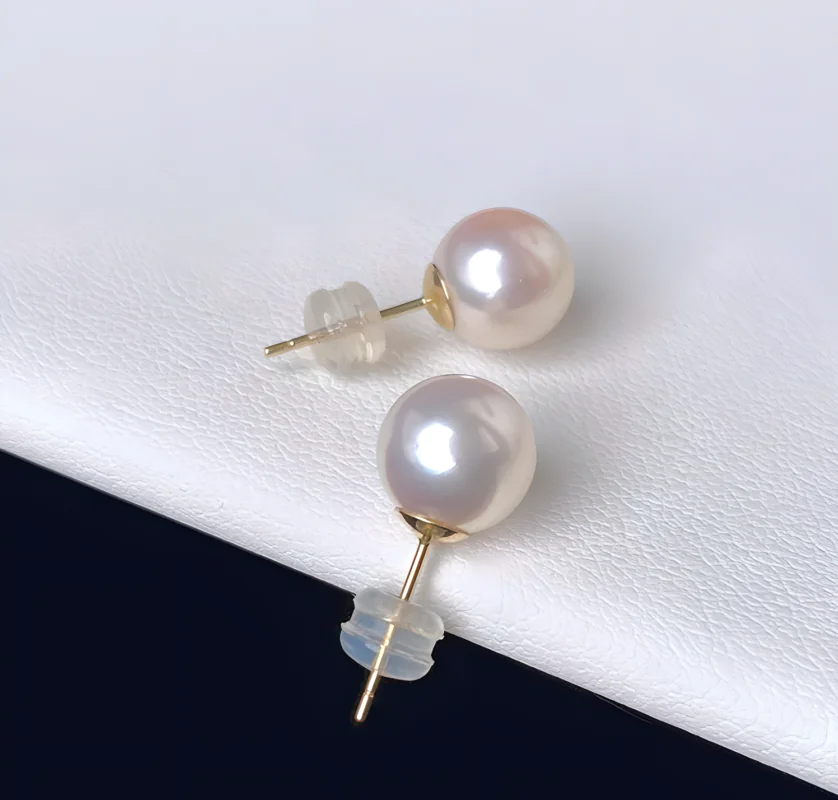
What Are Irradiated Pearls?
An irradiated pearl is a real pearl whose appearance has been intentionally altered by exposing it to controlled radiation, usually to create a darker gray, silver, blue-gray, or similarly cool-toned color. Irradiation is a pearl treatment, not a method of making imitation pearls. The important distinction for buyers is therefore not “real or fake,” but “natural color or treated color.”
The treatment is especially associated with gray and blue-gray cultured pearls, but the way irradiation changes a pearl depends on its structure. In bead-cultured Akoya pearls, the bead nucleus can darken and influence the color seen through the nacre. In many freshwater pearls, irradiation can affect the pearl material itself more directly. Understanding that difference makes the treatment much easier to recognize and explain.
What Does Irradiation Actually Do to a Pearl?
Pearl irradiation uses controlled radiation to change the optical appearance of materials inside the pearl. It does not work by painting the surface or soaking the pearl in a colored liquid. Instead, radiation can alter color-producing components within shell material or nacre, creating a darker internal appearance.
Gemological research has long noted that freshwater shell material contains more manganese than typical saltwater pearl-oyster nacre. GIA has reported that irradiation can alter manganese-related components in freshwater shell and pearl material and produce darker colors. This matters because many bead-cultured saltwater pearls, including Akoya pearls, contain a bead nucleus made from freshwater mussel shell.
In Bead-Cultured Akoya Pearls
Akoya cultured pearls normally contain a round shell bead covered by a layer of nacre. During irradiation, the freshwater-shell bead nucleus may become significantly darker while the saltwater nacre around it is much less affected. Because nacre is partly translucent, the darker nucleus changes how the finished pearl looks from the outside.
The result can be a pearl with a gray, silver-gray, blue-gray, or greenish-gray appearance. The color may look surprisingly natural because the effect is coming from beneath the nacre rather than simply sitting on the surface.
In Freshwater Cultured Pearls
Freshwater cultured pearls often have no large shell bead nucleus, especially traditional tissue-nucleated varieties. In these pearls, the nacre itself can respond more strongly to irradiation. The result may be gray, dark gray, metallic, or other unusually cool-toned colors.
This is why the simple explanation “irradiation only darkens the nucleus” is incomplete. It describes many irradiated Akoya pearls well, but it does not describe every irradiated pearl.
What Colors Can Irradiated Pearls Have?
Irradiation is most commonly discussed in connection with darker pearl colors. Depending on pearl type, treatment conditions, original material, and any additional treatments, irradiated pearls may show:
- light to dark gray;
- silver-gray;
- blue-gray;
- greenish-gray;
- charcoal or dark metallic tones.
Color alone is not enough to prove irradiation. Natural-color pearls can also occur in gray, blue, silver, green, and dark tones. Conversely, treated pearls can sometimes look subtle enough to overlap visually with natural-color material.
For a broader overview of how pearl colors may be altered after harvest, see our guide to pearl color enhancement treatments.
Are Irradiated Pearls the Same as Dyed Pearls?
No. Irradiation and dyeing are both color treatments, but they change pearls in different ways.
| Factor | Irradiated Pearls | Dyed Pearls |
|---|---|---|
| How color is changed | Radiation alters material within the pearl or its bead nucleus | Dye is introduced onto or into the pearl material |
| Typical location of the effect | May be concentrated in the bead nucleus in Akoya pearls or within nacre in freshwater pearls | Often affects the nacre or surface and may concentrate around drill holes or surface features |
| Common visual result | Gray, silver, blue-gray, greenish-gray, or darker tones | Can produce a much wider range of colors |
| Can visual inspection prove the treatment? | No; visual clues may suggest irradiation, but laboratory testing can be needed | No; some dyes are obvious, while others require magnification or laboratory testing |
| Should the treatment be disclosed? | Yes | Yes |
A pearl can also receive more than one treatment. In a 2024 Gems & Gemology laboratory note, GIA documented Akoya samples showing evidence of darkened irradiated bead nuclei and, in some specimens, additional dye treatment. Buyers should therefore not assume that one treatment automatically rules out another.
Are Irradiated Pearls Real Pearls?
Yes. Irradiation does not turn a cultured pearl into an imitation pearl. If a genuine cultured pearl is irradiated, it remains a cultured pearl; its color has simply been treated.
This distinction is important when reading product descriptions. Terms such as natural-color pearl, irradiated cultured pearl, dyed cultured pearl, and imitation pearl describe different things. A treated pearl can still have genuine nacre, real luster, natural surface characteristics, and the same cultured origin it had before treatment.
What changes is how the pearl should be represented in the market. Treatment information matters because natural-color rarity can influence desirability and value.
How Can You Tell If a Pearl Has Been Irradiated?
There is no single reliable home test that identifies every irradiated pearl. The most useful clues depend on pearl type, and even experienced visual inspection has limits.
1. Look at the Bead Nucleus in Drilled Akoya Pearls
In irradiated bead-cultured Akoya pearls, a darkened bead nucleus may sometimes be visible through the drill hole. This can be a useful clue because an untreated white Akoya pearl normally has a light-colored shell bead inside.
However, a dark-looking drill hole is not proof by itself. Natural organic material, local color concentrations, dirt, dye, or shadows can also make the drilling area appear dark. The correct rule is: a dark nucleus can support an irradiation diagnosis, but a dark-looking hole alone should not be treated as a verdict.
2. Compare Surface Color with Internal Appearance
When a pearl is examined with transmitted light or when its internal structure is visible, an irradiated Akoya may reveal a darker core beneath comparatively unaffected nacre. In freshwater pearls, the color response can involve the nacre more directly, so the appearance may be different.
3. Do Not Rely on Color Matching Alone
A very uniform gray or blue-gray strand may make a buyer suspect treatment, but good matching is not laboratory evidence. Natural pearls can be carefully matched, while treated pearls can still show variation. Color uniformity is a market clue, not a definitive identification method.
4. Use Laboratory Testing When the Color Origin Affects Value
When a seller is asking a significant premium for rare natural color, professional identification becomes much more important. Gemological laboratories can combine microscopy, X-ray methods, fluorescence behavior, spectroscopy, and other testing to evaluate pearl structure and color origin.
If you are learning how different observations fit together, our pearl identification guide provides a broader framework for separating origin, structure, and treatment questions.
Are Irradiated Pearls Safe to Wear?
For consumers, the important point is that “irradiated” does not automatically mean “radioactive.” Different irradiation technologies behave differently.
Gamma-ray treatment, historically used for pearl color modification, does not normally make the treated material radioactive. The U.S. Nuclear Regulatory Commission makes the same distinction for irradiated gem materials generally: gamma treatment does not activate the stone, while reactor-based neutron irradiation or some accelerator treatments can create temporary induced radioactivity. Regulated distribution therefore requires suitable holding periods, testing, and release limits when activation is possible.
In practical terms, consumers should buy treated pearls through reputable, compliant supply channels rather than trying to judge radiation safety from appearance. The treatment disclosure question is usually much more relevant to a jewelry buyer than radiation exposure from a properly released finished pearl.
Is Irradiation Permanent?
Irradiation-induced pearl color is generally regarded as relatively stable under normal jewelry use, especially because the color change is not simply a removable surface coating. That does not make an irradiated pearl indestructible, however. Pearls remain organic-inorganic composite gems with nacre that can be damaged by acids, strong chemicals, excessive heat, abrasion, and poor storage.
Care for an irradiated pearl as you would other fine pearls: avoid harsh cleaners, perfumes directly on the surface, prolonged heat, and abrasive contact. Treatment does not eliminate the normal care requirements of nacre.
Does Irradiation Affect Pearl Value?
It can. A rare natural-color pearl may command a premium over a visually similar treated-color pearl because natural color is part of what creates its scarcity. Irradiation can make attractive gray or blue-gray colors available more consistently and often at a more accessible price.
That does not mean every irradiated pearl is low quality. Luster, nacre quality, surface condition, shape, size, matching, craftsmanship, and overall beauty still matter. A well-matched strand of irradiated Akoya pearls can be visually impressive, while a natural-color strand can still be poorly matched or low in luster.
The better buying principle is to separate two questions:
- Is the pearl attractive and well made?
- Has its color origin been described honestly?
Treatment should influence description and value expectations, but it should not replace normal pearl-quality evaluation.
Should Irradiation Be Disclosed When Pearls Are Sold?
Yes. The CIBJO Pearl Book classifies irradiation as a treatment requiring specific declaration for cultured pearls. In other words, a seller should not present an irradiated gray cultured pearl as though its color were naturally produced.
This is especially important when color origin is part of the price story. If a product is marketed as rare natural gray, natural blue, or another unusual natural color, buyers should be able to ask whether the color has been treated and receive a clear answer.
Irradiation is only one step that may occur after pearl harvest. For context on where sorting, cleaning, bleaching, drilling, matching, and other operations fit into production, see the pearl processing workflow.
What Should Buyers Ask Before Purchasing Gray or Blue-Gray Pearls?
If treatment matters to your purchase, a short set of questions is more useful than trying to identify everything by eye:
- Is the color natural or treated?
- If treated, was irradiation used?
- Were any additional color treatments, such as dyeing or coating, also used?
- If the pearl is sold at a premium for natural color, is there a laboratory report supporting that claim?
- Is the seller pricing the pearl based on its actual treatment status rather than the appearance alone?
These questions shift the buying decision away from guessing and toward disclosure, documentation, and visible quality.
FAQ
Are irradiated pearls fake?
No. A genuine cultured pearl remains a genuine cultured pearl after irradiation. Irradiation changes its appearance, usually its color, but does not make it an imitation pearl.
Are all gray or blue Akoya pearls irradiated?
No. Akoya pearls can occur in natural gray, blue, and silver-toned colors. Irradiation is one way to create or deepen similar colors, so appearance alone is not enough to determine origin.
Can you identify an irradiated pearl from a dark drill hole?
Not reliably. A darkened bead nucleus visible through the drill hole can be an important clue in Akoya pearls, but organic material, dye, shadows, or local color concentrations can produce a similar visual impression.
Are irradiated pearls radioactive?
Not simply because they have been irradiated. Gamma irradiation does not normally make gem material radioactive. Some reactor or accelerator treatments can create temporary induced radioactivity, which is why regulated distribution systems require appropriate testing and release limits before affected material reaches consumers.
Is irradiation the same as dyeing?
No. Dyeing introduces colorants into or onto the pearl, while irradiation changes the optical appearance of material already present in the pearl or bead nucleus. A pearl can also receive both treatments.
The Key Point to Remember
Irradiated pearls are treated real pearls, not imitation pearls. The treatment is most useful to understand as a color-origin issue: in Akoya pearls it may darken the shell bead nucleus beneath the nacre, while in freshwater pearls it can affect pearl material more directly. Visual clues can suggest irradiation, but they are not always conclusive.
For buyers, the most important combination is simple: accurate treatment disclosure, appropriate pricing, and normal pearl-quality evaluation. A beautiful irradiated pearl can still be a good jewelry choice when it is represented honestly.