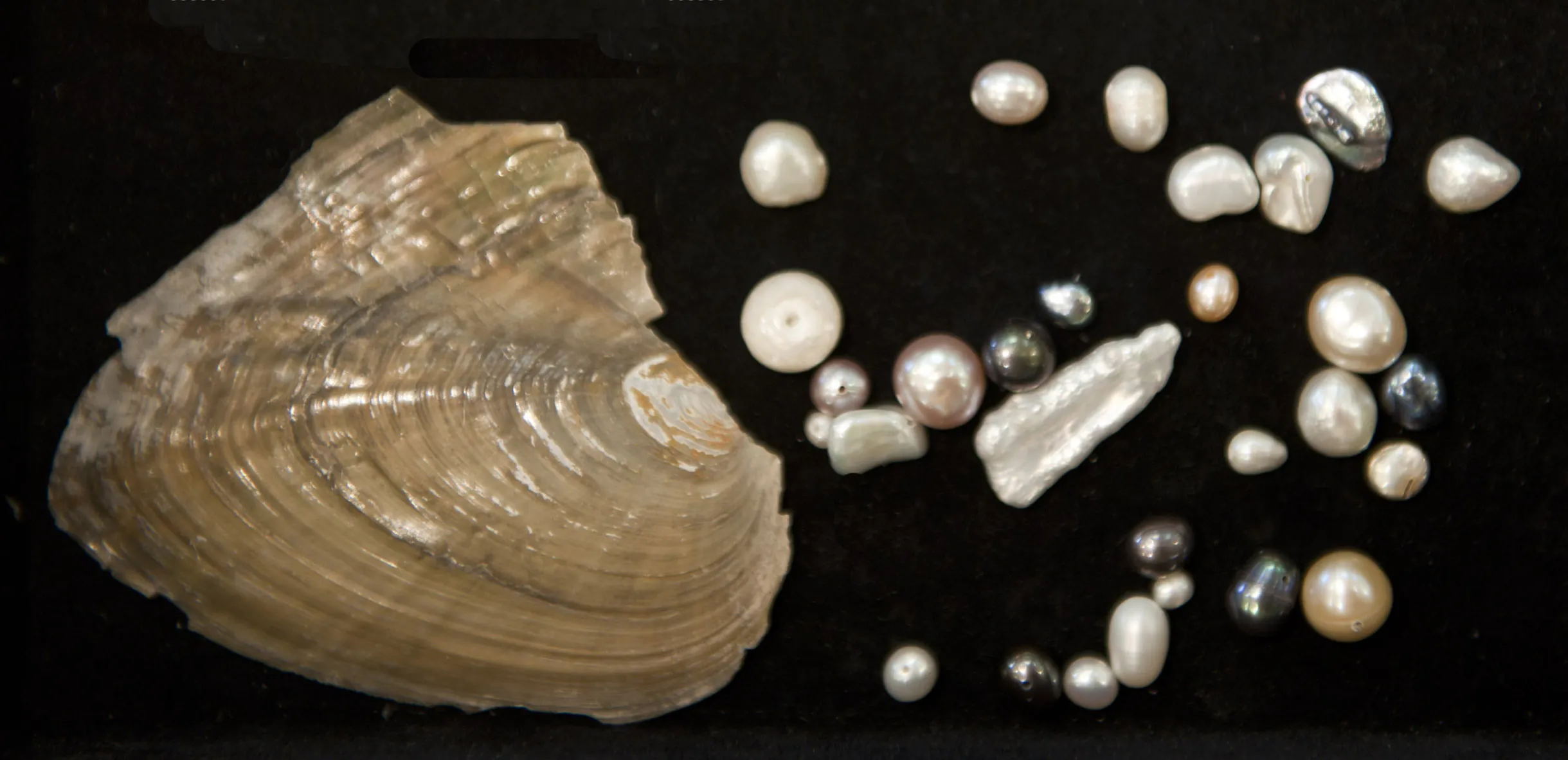
Button pearls are pearls with a rounded, usually symmetrical face and a noticeably flattened profile. From the front, a good button pearl may look almost round; from the side, it looks more like a dome or a slightly compressed sphere than a full ball.
The most important point is that button describes shape, not pearl type or quality. A button pearl is not automatically freshwater, low-grade, imitation, or inferior to a round pearl. It is simply a different geometry—and in some jewelry designs, that geometry is especially useful.
Quick Answer: What Is a Button Pearl?
| Feature | Button Pearl |
|---|---|
| Basic shape | Rounded and symmetrical, but flattened in profile |
| Front view | Often circular or close to circular |
| Side view | Low dome, high dome, or compressed rounded profile |
| Common jewelry uses | Stud earrings, rings, pendants, some strands and bracelets |
| Does the shape identify pearl origin? | No |
| Does button shape mean poor quality? | No; shape is only one quality and value factor |
The World Jewellery Confederation (CIBJO) defines a button or bouton-shaped pearl as a symmetrical domed shape with or without a flattish bottom. GIA also recognizes button as a standard pearl-shape category. In practical terms, the side profile matters more than whether the pearl looks round in a single face-up photograph.
What Does a Button Pearl Actually Look Like?
A classic button pearl combines two visual ideas:
- it is fairly symmetrical around its center, and
- it is shorter in height than it is in width.
Imagine a sphere that has been gently compressed from top to bottom. Some button pearls have a low, broad dome. Others rise much higher and can look almost round until you inspect them from the side.
This is why a face-up image alone can be misleading. A button pearl may present a nearly perfect circular outline when viewed straight on. Rotate it ninety degrees, however, and the flattened profile becomes obvious.
There is also no single universal height-to-width percentage that every pearl seller uses to separate a button from every neighboring shape. Industry references define the general form, but commercial labels can still overlap around the boundaries. When the distinction matters, photographs from more than one angle and actual dimensions are more useful than the word on a product label.
For a broader comparison of round, near-round, oval, drop, button, ringed, and baroque shapes, see our pearl shape guide.
Button Is a Shape, Not a Type of Pearl
This distinction prevents one of the most common misunderstandings around button pearls.
Words such as freshwater, Akoya, Tahitian, and South Sea refer to pearl categories associated with particular mollusks, environments, and cultivation traditions. Button describes what the pearl looks like.
Button shapes can occur in different pearl categories. You will often encounter them among freshwater cultured pearls because freshwater production offers a particularly wide range of shapes, but the shape itself does not prove that a pearl is freshwater.
Likewise, looking at a button profile alone cannot tell you whether a pearl is natural or cultured, bead-nucleated or non-bead-nucleated, treated or untreated, or high or low in overall quality.
If you want to understand why freshwater pearls show such a broad range of forms, our guide to freshwater non-nucleated pearls provides useful background.
Button Pearl vs. Round, Near-Round, Coin, Baroque, and Mabé Pearls
Button pearls are easiest to understand by comparing them with nearby shapes and products.
| Term | Typical appearance | Main difference from a button pearl |
|---|---|---|
| Round | Approximately spherical from multiple directions | A button pearl is visibly flatter in profile |
| Near-round | Almost spherical with relatively minor deviation | A button usually has more deliberate-looking flattening rather than a small off-round variation |
| Coin | Very flat, disc-like or coin-like | A button normally retains more dome and three-dimensional volume |
| Baroque | Irregular or free-form | A button is generally symmetrical rather than randomly irregular |
| Mabé | Domed assembled cultured blister product with a backed underside | A conventional button pearl is a whole pearl shape rather than an assembled shell blister product |
Button vs. round
This is the most important comparison. A round pearl keeps a nearly spherical form as you rotate it. A button pearl may look round from the front but reveals compression from the side.
That difference can matter greatly in a strand, where the side profile is repeatedly visible, but very little in a stud earring, where the back of the pearl sits against the ear.
Button vs. near-round
Near-round pearls show relatively small departures from a sphere. Button pearls are more distinctly flattened. There is still a transition zone between a very high button and a noticeably flattened near-round pearl, so inspecting the actual profile is more reliable than arguing over borderline wording.
Button vs. coin
Coin pearls are flatter and more disc-like. A button pearl keeps enough dome that it still reads visually as a rounded pearl rather than a flat disc. The difference is often easiest to see from the side.
Button vs. baroque
Button does not mean “slightly bad round.” A good button pearl has its own symmetry. Baroque pearls, by contrast, are valued for irregular, individual outlines. Both are legitimate shapes rather than defects by definition.
Button vs. mabé
The visual similarity can be confusing because both may present a domed face with a flatter back. But a mabé is an assembled cultured blister product: a purpose-grown blister is cut from the shell, processed, filled, and backed. A whole button pearl is not the same product simply because its silhouette is domed. See our guide to mabé pearls for the formation and construction differences in more detail.
How Do Button Pearls Form?
There is no single cultivation event that explains every button pearl. Pearl shape develops as the pearl grows within the mollusk, and the final outline can be influenced by the geometry and position of the pearl sac, available space, the pearl's movement or orientation during growth, and the particular cultivation method involved.
The useful conclusion for a buyer is simpler: a button shape is a growth form, not automatically a damage feature.
A pearl can be deliberately attractive, well-lustered, and structurally sound while being clearly flattened. The fact that it is not spherical does not mean that nacre failed to form properly.
At the same time, shape alone should not be used to reconstruct a pearl's exact cultivation history. Two pearls with similar button profiles can have different internal structures and come from different pearl-producing environments.
Are Button Pearls Lower Quality Than Round Pearls?
No. Button is a shape category, not a complete quality grade.
Pearl quality and value are judged through several characteristics, including luster, surface condition, shape, color, size, nacre quality, and—when multiple pearls are used together—matching. A button pearl with strong luster, a clean surface, attractive color, and excellent matching can be a much more desirable pearl than a dull or heavily blemished round pearl.
Round pearls often command a premium when all other factors are comparable because true roundness is difficult to achieve. That does not mean paying for roundness is always the best decision. If the pearl will be mounted with its flatter side hidden, a button pearl can deliver a very similar face-up look while using a shape better suited to the design.
When comparing quality, judge the shape separately from the other factors in our pearl grading guide.
What Jewelry Are Button Pearls Best For?
1. Stud earrings
Stud earrings are one of the most natural uses for button pearls. The flatter side can sit closer to the earlobe, while the rounded face remains fully visible from the front.
This can be particularly useful as pearl diameter increases. A full round pearl projects farther from the ear, while a button profile can create a lower, more compact presentation.
For a finished-jewelry comparison, you can browse our pearl earrings category.
2. Rings
A button pearl can also work well in a ring because the flatter profile gives a jeweler a practical surface to position against a mounting. The lower profile may reduce how far the pearl projects compared with a full sphere of similar face-up diameter.
That does not remove the need for protection. Pearls remain relatively soft organic gems, and rings receive more knocks and abrasion than earrings or pendants.
3. Pendants
In a pendant, a button pearl can give the appearance of a rounded pearl from the front while keeping the setting relatively close to the wearer's body. This works especially well in designs intended to emphasize the face of the pearl rather than its full three-dimensional silhouette.
4. Necklaces and bracelets
Button pearls can be strung, but they create a different rhythm from a classic round strand. Depending on the drilling direction and degree of flattening, the strand may look compact, slightly stacked, or intentionally textured.
For a formal strand where spherical continuity is the goal, round or near-round pearls are usually the more obvious choice. For contemporary designs, button pearls can create an attractive repeating shape at a lower roundness premium.
How to Choose Button Pearls
If you are buying button pearls online or selecting loose pearls for jewelry making, do not judge them from a single front-facing image. Use the following checks.
Check the side profile
This is the most important step. Ask whether the pearl has a low dome, a high dome, or an uneven base. Two pearls can have nearly identical face-up diameters but very different heights.
Ask for width × height measurements
A single size such as “8 mm” can hide the information that matters most for a button. An 8 mm-wide pearl that is 7 mm high looks very different from one that is 4.5 mm high.
Look for front-view symmetry
A button pearl can be flattened and still be beautifully symmetrical. If the intended design depends on a clean round-looking face, check whether the outline remains balanced from the front.
Judge luster independently
A neat shape should not distract you from weak reflections. Look for brightness, sharpness, and visual depth appropriate to the pearl type.
Inspect surface condition
Flattening is part of shape. Pits, cracks, abrasions, peeling, or heavy wrinkles are separate surface questions. Do not confuse a normal button profile with a blemish.
For pairs, compare height as well as diameter
This matters especially for stud earrings. Two pearls can look like a matched pair from the front yet project noticeably differently from the ear if one is much deeper than the other.
Check drilling or setting orientation
For loose pearls, make sure the drill direction suits the intended design. A button pearl drilled through the wrong axis may not sit or hang the way you expect.
Jewelry makers sourcing components can also compare available wholesale loose pearls by actual shape, dimensions, drilling, luster, and matching rather than relying on the shape name alone.
What Do “Button Round,” “Half-Round,” and Similar Trade Names Mean?
Pearl terminology is not perfectly standardized in retail and supplier listings. You may encounter descriptions such as button round, half-round, flat round, or regional trade terms that overlap with button-shaped pearls.
These labels can be useful shorthand, but they should not replace visual inspection. A seller's “high button” may look close to another seller's “near-round,” while a “flat round” pearl may approach coin shape.
For practical buying, ask four questions:
- What does the pearl look like from the front?
- What does it look like from the side?
- What are its width and height?
- How consistent is the shape across the pair or strand?
Those answers are usually more useful than trying to force every pearl into a perfectly rigid vocabulary.
Are Button Pearls a Good Value?
They can be, particularly when the design hides the flatter side.
If two pearls have similar face-up diameter, color, luster, and surface quality, the more perfectly round pearl may cost more because of its shape rarity. In a stud earring, however, much of that additional three-dimensional roundness is not visible once the pearl is worn.
This does not mean button pearls are always inexpensive, or that every button is a bargain. Large size, exceptional luster, rare color, clean surface, unusual origin, and excellent matching can all raise value. The point is simply that you should pay for the characteristics that matter in the finished jewelry.
The Most Useful Way to Think About Button Pearls
A button pearl is best understood as a deliberately useful pearl shape: rounded from the viewing face, flatter through its depth, and generally symmetrical.
That combination explains why it works so well in jewelry that presents one main face to the viewer. For stud earrings and many rings or pendants, the flatter profile can be an advantage rather than a compromise.
When buying, do not ask only, “Is it button-shaped?” Ask how high the dome is, whether the front is symmetrical, how strong the luster is, what the surface looks like, how well a pair matches, and whether the drilling or setting suits the design.
Once those factors are separated, button pearls become easy to evaluate: they are not failed round pearls. They are a distinct shape with their own practical strengths.
FAQ
Are button pearls real pearls?
They can be. Button describes shape, so genuine natural or cultured pearls can be button-shaped. Imitation pearls can also be manufactured in a similar shape, which means shape alone cannot prove authenticity.
Are button pearls always freshwater pearls?
No. Button shapes are commonly seen among freshwater cultured pearls, but the term itself does not identify origin. Different pearl categories can occur in button-like shapes.
Are button pearls the same as coin pearls?
No. Coin pearls are generally much flatter and more disc-like. Button pearls normally retain a stronger dome and more three-dimensional volume.
Are button pearls the same as mabé pearls?
No. A mabé is an assembled cultured blister product made from material grown against the shell and then processed and backed. A button pearl is a whole pearl whose shape is rounded and flattened.
Are button pearls good for stud earrings?
Yes. Stud earrings are one of their best applications because the flatter side can sit close to the ear while the rounded face remains visible.
Do button pearls cost less than round pearls?
Often they can, when pearl type, size, luster, surface quality, color, and other factors are comparable, because perfect roundness typically carries a premium. But shape is only one value factor, so an exceptional button pearl can still be valuable.