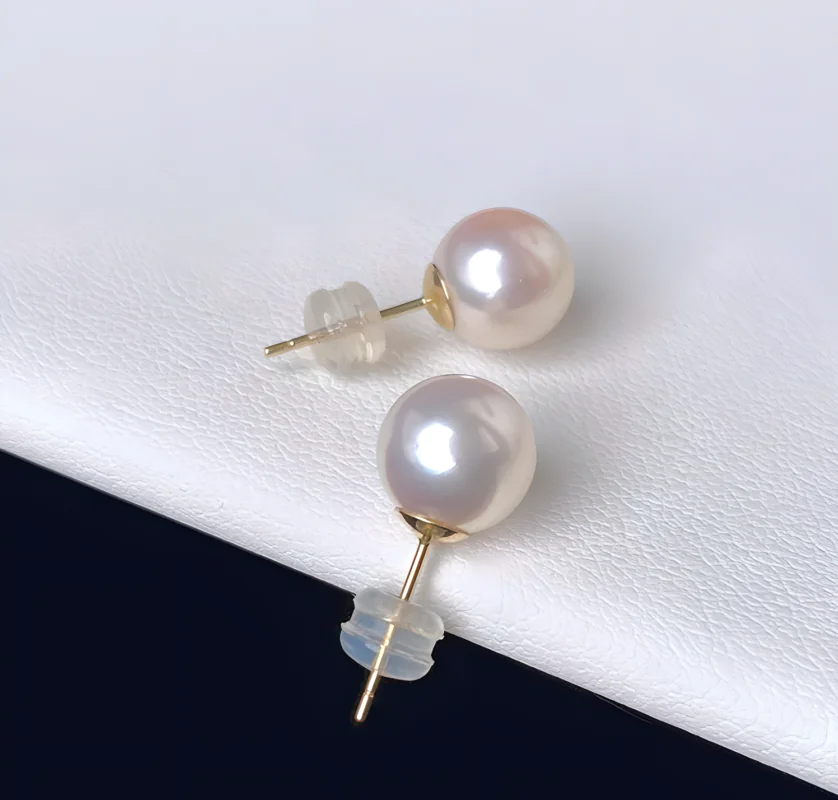
Pearl color is not one single layer. To describe it accurately, separate bodycolor, overtone, and orient. These three effects can overlap, but they are not interchangeable and they should not be confused with luster.
Quick answer: what makes up pearl color?
- Bodycolor: the main overall color of the pearl.
- Overtone: a secondary color that appears over the bodycolor.
- Orient: a shifting, iridescent play of multiple colors created by optical effects in the nacre.
A pearl does not need to show all three strongly. Some pearls have a clear bodycolor and little overtone; others show a distinct rose, green, or silver overtone; orient may be subtle or absent.
1. Bodycolor: the main color you see first
Bodycolor is the dominant color of the pearl when viewed under neutral light. Common examples include white, cream, pink, peach, lavender, silver, gray, green, golden, and darker Tahitian tones.
Bodycolor should be interpreted in the context of pearl type. White Akoya, golden South Sea, naturally dark Tahitian, and lavender freshwater pearls belong to different biological and market categories.
2. Overtone: a secondary color over the bodycolor
Overtone is a translucent secondary hue seen over the main bodycolor. A white pearl may show rose or silver overtone; a dark Tahitian pearl may show green, blue, aubergine, or peacock-like secondary colors.
Overtone does not need to be strong to matter. A subtle cool or warm cast can change how a pearl looks next to skin, metal, and neighboring pearls in a strand.
For matched jewelry, overtone consistency can matter almost as much as bodycolor because two nominally “white” pearls may look mismatched if one is strongly rose and the other strongly silver.
3. Orient: multicolor iridescence
Orient is a moving, rainbow-like effect that can show several colors as the pearl is rotated. It is not simply one secondary hue.
Orient is often easiest to see on pearls where the nacre structure and surface allow complex interference colors to become visible. It may appear as flashes of pink, green, blue, or other colors that shift with angle.
Orient is not the same as luster
Luster describes the quality and sharpness of reflected light. Orient describes iridescent color effects. A pearl can have strong luster but limited orient, or visible orient with a softer reflection style.
How to evaluate pearl color step by step
Step 1: Identify the pearl type first
Do not rank colors without knowing the category. A dark Tahitian pearl and a dyed dark freshwater pearl may look superficially similar while representing different products.
Step 2: Use consistent neutral lighting
Warm indoor bulbs can make cream and gold look stronger; cool light can exaggerate silver or blue. Compare pearls under the same neutral light and avoid heavily color-graded photos.
Step 3: Identify bodycolor first
Ask what the pearl looks like overall before chasing subtle secondary tones.
Step 4: Rotate the pearl and look for a secondary color
If one additional hue remains visible over the bodycolor, that is usually described as overtone.
Step 5: Look for multicolor iridescence
If several colors shift with the viewing angle, you may be seeing orient rather than a single overtone.
Step 6: Compare similar pearls side by side
Subtle color differences are easier to see in comparison than in isolation.
Step 7: For strands and pairs, evaluate matching
Color matching includes bodycolor, overtone, and overall visual harmony. Perfectly identical color is not always necessary, especially in intentionally multicolor designs, but the variation should look deliberate.
How pearl type changes expected color
Freshwater pearls
Freshwater cultured pearls can naturally appear white, cream, peach, pink, lavender, and related tones. They can also be dyed or otherwise treated to create colors outside the natural range.
Akoya pearls
Akoya pearls are commonly white to cream with rose, silver, or other subtle overtones. Color descriptions such as “pink” may refer to overtone or toning rather than a naturally pink bodycolor, so terminology matters.
Tahitian pearls
Tahitian pearls are naturally dark but are not simply “black.” Gray, charcoal, green, blue, aubergine, and multicolor overtone combinations are common.
South Sea pearls
White South Sea pearls range through white, silver, and cream tendencies. Golden South Sea pearls can range from pale champagne to deeper gold.
Does pearl color affect value?
Yes, but not through a universal “best color” hierarchy. Value depends on rarity within the pearl type, saturation, evenness, market preference, treatment status, and how the color interacts with luster and surface quality.
A rare or highly desirable color can add value, but poor luster will still weaken the pearl's appearance.
Is more overtone always better?
No. Overtone is partly preference. Some buyers want a neutral white pearl; others prefer obvious rose, silver, green, or peacock effects. The most important issue is whether the color is attractive, appropriately described, and well matched for the intended piece.
Why pearl color can look different in photos
White balance, exposure, background color, camera processing, surrounding clothing, and display calibration can all shift color. A pearl photographed on black velvet may look different from the same pearl photographed on skin or a white background.
For an important purchase, ask for neutral-light photos or video and, when possible, comparison against another known pearl color.
Natural color versus treated color
A treated pearl can still be genuine and attractive. The question is disclosure. Dyeing, irradiation, coating, toning, and other processes can modify appearance. If natural color materially affects price, documentation or laboratory testing may be appropriate.
FAQ
What is the difference between pearl bodycolor and overtone?
Bodycolor is the main overall color; overtone is a secondary hue visible over it.
What is orient in pearls?
Orient is a shifting, multicolor iridescent effect. It is different from one stable overtone and different from luster.
Does a white pearl with pink overtone count as a pink pearl?
Usually it is more accurate to describe it as a white pearl with pink or rose overtone, unless pink is truly the dominant bodycolor.
Is peacock a bodycolor?
“Peacock” is commonly used for a multicolor Tahitian appearance involving green and other overtone effects rather than one simple standardized bodycolor.
Can photos accurately show pearl color?
They can help, but lighting and camera processing can shift subtle hues. Neutral-light comparison video is often more reliable.