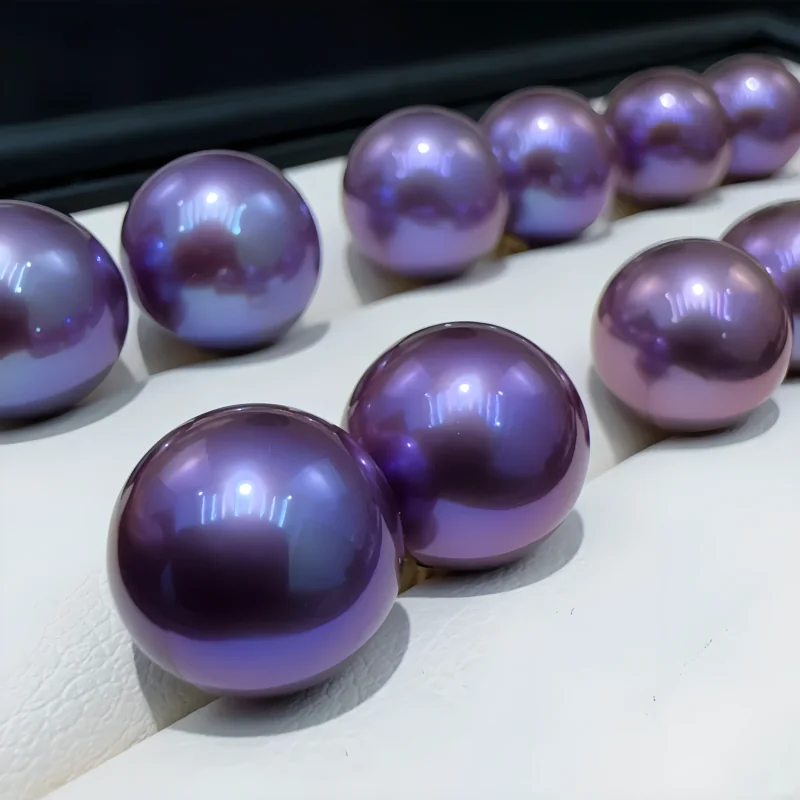
Quick answer: because a batch is not a quality grade. Pearls harvested at the same time, from the same farm, or even from a similar group of mollusks can still differ in luster, surface quality, shape, size, color, nacre quality, and overall visual appeal. After harvest, those differences are sorted into smaller quality groups, and the scarcer combinations usually receive higher prices.
This is one of the most useful things to understand about pearl pricing. Two pearls can share the same pearl type, the same nominal size, and the same harvest period but still belong to very different value levels. The price difference is not necessarily a contradiction. It is often the result of sorting a naturally variable harvest.
“Same batch” does not mean “same pearl”
In pearl farming and trading, the word batch can be used fairly loosely. It may refer to pearls collected during the same harvest, pearls from the same farm or production group, or a commercial lot assembled before detailed grading.
None of those meanings guarantees uniform quality.
Pearls are organic gems formed inside living mollusks. Even when the farming method and cultivation period are similar, the individual results are not identical. GIA notes that pearls occur in many shapes and colors and that the condition of the growing environment is closely connected with mollusk health and pearl quality. In other words, cultivation creates a population of outcomes, not copies of one standardized object.
That is why a freshly harvested lot can contain pearls that look exceptional, average, commercially useful, or unsuitable for fine jewelry—all in the same general batch.
What usually separates the higher-priced pearls from the lower-priced ones?
For a comparable group of pearls, the main differences are usually the same characteristics used in professional pearl evaluation. The GIA 7 Pearl Value Factors are size, shape, color, luster, surface, nacre, and matching for multi-pearl pieces.
Within one batch, several of these factors can vary at the same time.
1. Luster can separate pearls very quickly
Place two similar pearls next to each other under the same light and the first difference you may notice is the reflection. One pearl may show bright, sharp reflections and strong visual depth. Another may look softer, hazier, or flatter.
GIA describes luster as one of the most important pearl value factors, and within the same pearl type, stronger luster generally supports higher value when other factors are comparable.
This is also why photographs can sometimes make two price levels look closer than they really are. Exposure, lighting, distance, and image processing can reduce the apparent difference. Side-by-side comparison under controlled light is much more revealing. Our pearl luster guide explains what to look for in reflection sharpness and consistency.
2. Surface quality varies from pearl to pearl
One pearl may have only a few small marks. Another from the same harvest may show pits, wrinkles, growth lines, depressions, or more prominent irregularities.
Not every surface mark has the same effect. A tiny feature near a drill hole may matter much less than a deep or highly visible mark on the front of a pendant pearl. Severity, location, number, and how much the feature affects beauty or durability all matter.
This means two pearls can be similar in size and color while still falling into different price levels because one has a much cleaner usable face.
3. Shape and roundness are not uniform within a harvest
A batch may contain round, near-round, oval, button, drop, circled, and baroque results, depending on the pearl type and cultivation method.
When pearls are being sold specifically as round pearls, small differences in roundness can matter. Truly round pearls are harder to produce consistently, so a pearl that remains round from multiple viewing angles may be separated from one that looks round from the front but shows noticeable deviation when rotated.
For intentionally baroque or other non-round categories, however, “less round” does not automatically mean “worse.” The relevant question becomes whether the form is attractive, useful for the intended design, and consistent with the category. For a broader explanation, see our pearl shape guide.
4. Size differences can exist even inside one labeled range
A commercial lot may be described as 7–8 mm, 8–9 mm, or another size range rather than one exact diameter. Pearls near the upper and lower edges of that range are not necessarily equally scarce.
More importantly, size does not work alone. A larger pearl with weak luster and a heavily marked surface may be worth less than a slightly smaller pearl with much stronger visual quality.
This is why comparing pearls only by millimeter size can be misleading. The meaningful comparison is usually same type + similar size + similar shape category, followed by quality differences.
5. Color and overtone can create different demand within the same batch
Pearls from one production group can show noticeable color variation. White pearls may lean cream, silver, or rosé. Tahitian pearls can vary through gray, green, peacock, aubergine, and other tones. Freshwater pearls may also show different bodycolors and overtones.
Color is not a universal ladder from “bad” to “good.” Some colors are simply rarer within a specific pearl type, and some are more desirable in a particular market or design. When an attractive color also appears with strong luster, good shape, and a clean surface, that combination becomes harder to find.
Sorting is what turns one harvest into several price levels
After harvest and basic processing, pearls are sorted into progressively more comparable groups. A simplified workflow might look like this:
- separate by pearl type and general product category;
- sort by size range;
- separate major shape groups;
- compare luster and surface quality;
- refine by color, overtone, nacre appearance, and other relevant traits;
- match suitable pearls into pairs, strands, or production lots.
The exact sequence varies by supplier and pearl type, but the principle is the same: the original batch becomes multiple smaller groups because the pearls are not equally rare or equally suitable for the same use.
At MJ Pearls, our commercial A–AAAA ranges are seller sorting ranges rather than laboratory grades. We primarily compare comparable pearls by luster, surface, and shape, while also considering factors such as size, pearl type, color, nacre, and matching. The full method is explained in our pearl grading guide.
Why can the price gap become large even when the visual difference seems small?
The key is scarcity of combinations.
Suppose a batch contains many pearls of the right size. Fewer may also have strong luster. Fewer still may combine strong luster with a clean surface. Add a round shape and a desirable color, and the number of pearls meeting every condition becomes smaller again.
This means value is not always distributed in a smooth, linear way. The very top portion of a batch can become disproportionately scarce because several desirable characteristics must occur in the same pearl.
A small visible improvement can therefore represent a much larger reduction in available supply. That is one reason premium pearls may cost considerably more than the next quality level even when both look attractive.
Matching can raise the price again
A single high-quality pearl is one thing. Finding two that work as an earring pair—or dozens that work together as a strand—is another.
GIA treats matching as a separate value factor for multi-pearl jewelry. Pearls in a matched piece may need to harmonize in size, shape, color, luster, surface appearance, and overall character. GIA also shows pearl traders sorting pearls into matching groups, which reflects an important trade reality: matching is additional selection work, not merely stringing together pearls of the same diameter.
That is why two loose pearls from the same batch might have one price individually, while a closely matched pair can command more. A highly consistent necklace can require searching through a much larger pool of pearls to find enough compatible pieces.
Does a lower-priced pearl from the same batch mean it is poor quality?
No. It usually means the pearl fits a different quality or rarity level.
A pearl with a few visible natural marks may still have beautiful luster. A near-round pearl may be ideal for a design that does not require perfect roundness. A softer-color pearl may be less scarce but more suitable for a particular jewelry style. Lower price can reflect wider tolerances rather than an unusable pearl.
This matters especially for designers and wholesale buyers. Paying for the highest grade is not always necessary if the design hides part of the surface, deliberately uses organic shapes, or prioritizes color and luster over perfect roundness. The better question is whether the pearl quality matches the intended product.
How should you compare pearls from the same batch?
Do not start with the price tag. Start by making the comparison fair.
- Compare like with like: same pearl type, similar size, and the same general shape category.
- Use the same lighting: luster and color can look very different under different light.
- Rotate the pearls: a clean front view can hide marks or shape variation on another side.
- Check luster before chasing perfection: strong reflections often have a larger visual effect than one or two minor surface marks.
- Ask what the grade actually means: A, AA, AAA, and similar labels are not universally standardized across every seller.
- For pairs or strands, judge the group: matching quality can matter as much as the quality of an individual pearl.
If you want a broader framework for how these characteristics interact, our pearl value evaluation guide explains why no single factor determines value on its own.
For wholesale buyers, the batch is only the starting point
When buying pearls for jewelry production, a batch description such as “8–9 mm white freshwater pearls” is not enough to define the final price. You still need to know the expected luster, surface tolerance, shape tolerance, color consistency, drilling, and matching requirements.
Tighter specifications require more selective sorting. Broader tolerances leave more of the original batch usable. That difference directly affects how much material can satisfy the order.
For designers, jewelers, and workshops sourcing materials, our wholesale pearl collection is organized around practical attributes such as pearl type, form, shape, size, color, luster, and drilling so that these trade-offs are easier to compare.
The main idea: a batch is a mixed outcome, not a fixed value
Pearls from the same batch can have different prices because harvesting groups pearls by production history, while pricing separates them by quality, rarity, and suitability.
The same harvest can produce pearls with different luster, surfaces, shapes, sizes, colors, and nacre characteristics. Sorting then reveals which combinations are common and which are scarce. Matching for pairs and strands can narrow the usable selection even further.
So when two pearls from the same batch carry different prices, the useful question is not “Why aren't they priced the same?” It is: which characteristics became scarcer after the batch was sorted?
FAQ
Can two pearls from the same oyster farm have very different values?
Yes. Sharing the same farm or harvest period does not make pearls identical. Individual pearls can differ in luster, surface, shape, size, color, and nacre quality, so they may be sorted into different value levels.
Are pearls from the same batch always graded the same way?
No. A batch is often divided into several grades or commercial quality ranges after harvest. The exact grading system also varies by seller, so grade labels should be interpreted together with the seller's stated criteria.
Why can a small quality difference cause a large price difference?
Because top-quality characteristics must occur together. Pearls that combine strong luster, clean surfaces, desirable shape, appropriate size, and attractive color are less common than pearls that meet only some of those conditions. The premium reflects that scarcity.
Is the most expensive pearl in a batch always the largest?
No. Larger size can increase value when other factors are comparable, but a smaller pearl with much better luster, surface, shape, or matching potential can be worth more than a larger lower-quality pearl.
Do matched pairs and strands cost more than similar loose pearls?
They can. Matching requires finding pearls that work together in size, shape, color, luster, surface appearance, and overall character. The tighter the match, the smaller the usable selection may become.