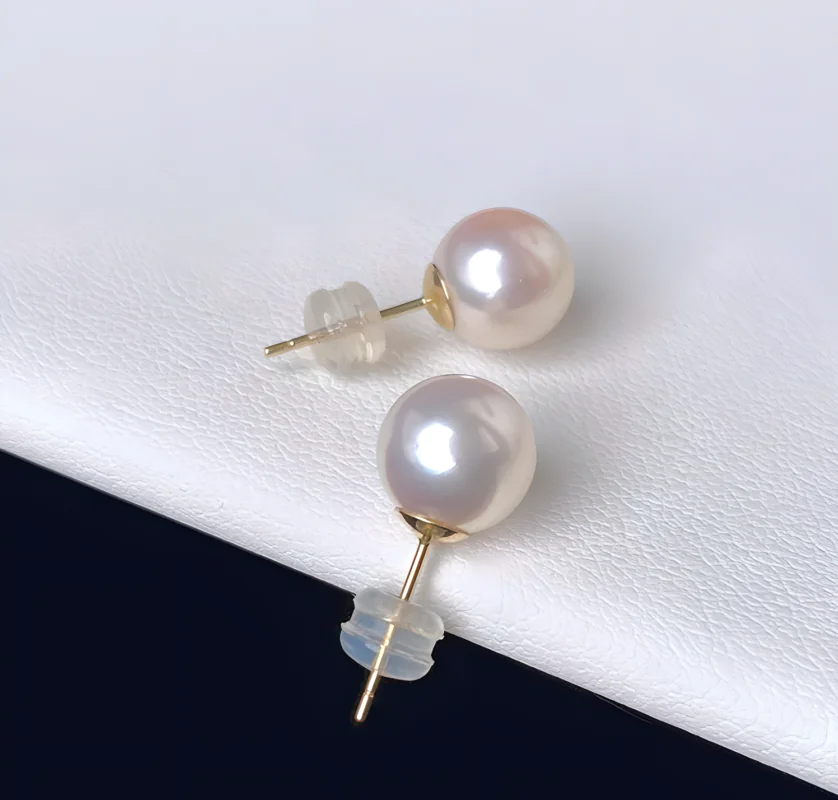
What Is Pearl Bleaching? Why Are Pearls Bleached?
Pearl bleaching is a controlled post-harvest treatment used to reduce unwanted color, stains, and uneven pigmentation in pearls. Hydrogen peroxide is one of the best-known bleaching agents used in pearl processing. The goal is usually not to create an artificial fantasy color, but to make light-colored pearls appear cleaner, brighter, and more uniform.
Bleaching is especially familiar in the processing of white and light-colored cultured pearls, including many Akoya and freshwater pearls. It is common enough that seeing a bleached pearl does not mean the pearl is fake or automatically low quality. What matters is understanding what the treatment changes, what it cannot change, and whether it has been carried out without damaging the nacre.
What Does Pearl Bleaching Actually Do?
A newly harvested pearl does not always have the clean, evenly colored appearance seen in a finished necklace. During pearl formation, organic matter, pigments, cellular material, and other substances can become incorporated into or beneath the nacre. These may contribute to cream, yellowish, grayish, brownish, or locally darker areas.
Bleaching uses chemical and sometimes physical conditions to reduce some of these color-causing substances. In practical terms, it can:
- lighten unwanted yellow, cream, brown, or gray discoloration;
- reduce the visibility of certain organic stains or pigment concentrations;
- make the body color of a group of pearls more consistent;
- produce a cleaner white or light appearance; and
- make pearls easier to match into visually consistent strands, pairs, or jewelry sets.
The CIBJO Pearl Book defines bleaching broadly as removing or changing color through chemical or physical agents or light. It also specifically notes that Akoya cultured pearls are commonly bleached to reduce blemishes between the nucleus and nacre, alter the nacre color, or produce a more uniform white appearance.
Why Are Pearls Bleached?
The easiest way to understand pearl bleaching is to separate appearance problems from actual pearl quality factors.
| Reason for Bleaching | What the Treatment Is Intended to Improve |
|---|---|
| Uneven body color | Makes a group of pearls appear more consistent |
| Yellowish or brownish coloration | Reduces unwanted warm or dark tones |
| Organic stains or pigmentation | Reduces visible discoloration associated with organic material |
| Strand matching | Makes it easier to assemble pearls with similar color |
| Market preference for cleaner white pearls | Produces a brighter and more commercially consistent appearance |
Bleaching therefore has a practical production purpose. A necklace containing dozens of pearls requires much tighter visual matching than a single loose pearl. Reducing unnecessary color variation can make matching significantly easier.
However, bleaching does not turn an ordinary pearl into a top-quality pearl. It cannot make an off-round pearl perfectly round, create thicker nacre, remove a deep pit, repair a crack, or generate excellent luster where the nacre structure itself does not support it.
How Are Pearls Bleached?
Modern pearl bleaching is generally a controlled industrial process rather than a simple soak in household bleach. Hydrogen peroxide is widely associated with pearl bleaching because it can oxidize certain color-causing organic substances without being used as a dye.
The exact procedure varies between pearl types, processing facilities, starting material, and the desired result. Important variables can include solution concentration, temperature, pH, treatment time, light exposure, and the condition of the pearl itself.
This is one reason there is no useful universal “pearl bleaching recipe.” A treatment suitable for one batch may be unnecessarily aggressive for another. Experienced processors aim to achieve the required color improvement while preserving the nacre surface and luster.
Bleaching also sits inside a larger post-harvest pearl processing workflow. Pearls may be sorted and cleaned before treatment and later undergo additional matching, polishing, or other finishing steps depending on their intended use.
Pearl Bleaching Is Not the Same as Cleaning, Brightening, or Dyeing
One of the most useful distinctions for pearl buyers is that several processes can make a pearl look cleaner or brighter, but they do not work in the same way.
| Process | Main Purpose | Basic Principle |
|---|---|---|
| Cleaning | Remove surface residue or contamination | Removes material from the surface without intentionally changing pearl color |
| Bleaching | Reduce unwanted pigmentation or discoloration | Removes or alters color-causing substances |
| Optical brightening | Make pearls appear visually whiter or brighter | Uses brightening agents that affect how light is perceived |
| Dyeing | Add or substantially alter color | Introduces coloring substances into or onto the pearl |
| Luster enhancement | Improve perceived luster | Uses separate chemical or finishing techniques to affect surface or optical appearance |
CIBJO specifically distinguishes ordinary cleaning from bleaching. GIA research also separates bleaching from optical brightening: bleaching makes a pearl whiter primarily by reducing discoloration, while optical brightening introduces substances that change the pearl's optical response.
Likewise, bleaching should not simply be called dyeing. Dyeing adds or introduces color; bleaching generally removes or reduces unwanted color. Readers who want the broader treatment picture can continue with the guide to pearl color enhancement treatments.
Are All White Pearls Bleached?
No single statement safely describes every pearl on the market. Bleaching is extremely common in commercial pearl processing, particularly with white and light-colored Akoya pearls and many freshwater cultured pearls, but treatment histories can vary by pearl type, producer, quality level, and target market.
It is therefore better to say that bleaching is a routine and widely encountered treatment rather than to assume that every white pearl has followed exactly the same processing sequence.
Other pearl types may be handled differently because their natural body color is itself an important part of their identity and value. Dark Tahitian colors and the white, silver, or golden colors associated with South Sea pearls, for example, create a different processing objective from whitening a commercial strand of light-colored pearls.
Does Bleaching Mean a Pearl Is Fake?
No. A bleached cultured pearl is still a cultured pearl, and a bleached natural pearl is still a natural pearl. Bleaching changes appearance after formation; it does not replace the pearl with an imitation material.
This distinction matters because “treated” and “fake” describe two completely different issues. An imitation pearl is an artificial product made to resemble a pearl. A treated pearl actually formed in a mollusk and was subsequently altered after harvest.
The same principle applies to other pearl treatments. Treatment history may influence description, care, value, or buyer preference, but it does not by itself determine whether the underlying pearl is genuine.
Does Bleaching Improve Pearl Quality?
Bleaching can improve one aspect of appearance, particularly color cleanliness and uniformity, but overall pearl quality depends on much more than color.
Important pearl quality factors still include:
- luster;
- surface condition;
- shape;
- nacre quality and, where relevant, nacre thickness;
- body color and overtone;
- size; and
- matching in a multi-pearl piece.
A pearl with weak nacre structure does not become a fine pearl simply because it becomes whiter. Conversely, the fact that a beautiful commercial pearl has undergone routine bleaching does not automatically make it inferior.
This is why treatment should be understood as one part of the pearl's history rather than used as a substitute for evaluating the pearl itself.
Can Bleaching Damage Pearls?
It can if the treatment is excessive or poorly controlled.
Pearl nacre is a delicate biogenic material made largely from calcium carbonate crystals combined with an organic matrix. Its appearance depends on an extremely fine layered structure. Aggressive chemical exposure, excessive heat, or an unsuitable treatment schedule can disturb that structure.
The Japan Pearl Promotion Society notes that excessive bleaching can contribute to problems such as mottling, cracking, or surface roughening. GIA also warns that excessive bleaching during initial processing can make some pearls more fragile.
The key distinction is therefore not simply bleached versus unbleached. It is also well-controlled treatment versus excessive treatment.
A properly processed pearl should still display a healthy surface and attractive luster. A chalky, heavily worn, rough, cracked, or unusually dull appearance can have many possible causes and should not be diagnosed as over-bleaching from appearance alone.
For more background on why chemical exposure matters, see the guide to the physical and chemical properties of pearls.
Can You Tell Whether a Pearl Has Been Bleached?
Usually not with confidence from ordinary visual inspection alone.
A clean white appearance is not proof of bleaching, just as cream or yellow coloration is not proof that a pearl is untreated. GIA has noted that bleaching used as a single treatment can be difficult to identify conclusively in many cases.
Gemological laboratories have more tools available than a consumer with a loupe. Depending on the question, laboratories may use ultraviolet observation, fluorescence spectroscopy, chemical analysis, microscopy, or other advanced techniques to investigate pearl treatments. Recent laboratory work has also shown that optically brightened pearls may behave differently under fluorescence testing from pearls that have only been bleached.
For consumers, the practical lesson is not to rely on a home test. Ask for accurate treatment information when it matters, and use a qualified gemological laboratory when a high-value pearl requires a more formal determination. The broader pearl identification guide explains why treatment identification often requires several observations rather than one visual clue.
Do Sellers Have to Disclose Pearl Bleaching?
Treatment disclosure should not be reduced to a universal yes-or-no rule because standards and legal requirements differ between markets.
Under the CIBJO Pearl Book 2024, cultured pearls bleached to produce a uniform white appearance fall into a category requiring general treatment information. CIBJO specifically distinguishes this from ordinary cleaning and provides a disclosure method for commercial documentation.
In the United States, the Federal Trade Commission's Jewelry Guides take a materiality-based approach to pearl treatments. Disclosure is called for when a treatment is not permanent, creates special care requirements, or significantly affects the product's value.
For merchants operating internationally, the safest professional habit is to understand the rules and standards that apply in the market where the pearls are being sold instead of assuming that one country's convention applies everywhere.
Do Bleached Pearls Need Special Care?
Normal pearl care is appropriate for bleached pearls, and gentle treatment is sensible for pearls regardless of their processing history.
Avoid harsh chemicals, excessive heat, steam cleaning, ultrasonic cleaning, abrasive materials, and prolonged contact with cosmetics or perfume. After wearing pearl jewelry, wiping it gently with a clean, soft cloth helps remove perspiration and surface residue.
Bleaching itself does not mean a pearl is automatically fragile. However, because excessive processing can weaken some pearls, there is little benefit in exposing pearl jewelry to unnecessary chemical or mechanical stress. The detailed pearl care guide covers appropriate everyday cleaning and storage.
What Should You Remember About Pearl Bleaching?
Pearl bleaching is best understood as a color-correction treatment used after harvest. It is commonly performed with controlled oxidizing agents such as hydrogen peroxide to reduce unwanted stains, pigments, and uneven coloration and to create a cleaner, more uniform appearance.
Its importance is easy to misunderstand. Bleaching does not make a pearl fake, does not automatically mean poor quality, and does not create excellent luster or nacre where those qualities were absent. At the same time, it is a real treatment rather than ordinary cleaning, and excessive bleaching can damage pearl material.
For a buyer, the useful question is therefore not simply, “Has this pearl been bleached?” A better set of questions is: What treatment was used, why was it used, was it performed appropriately, how does the finished pearl actually look, and has the treatment been represented accurately?