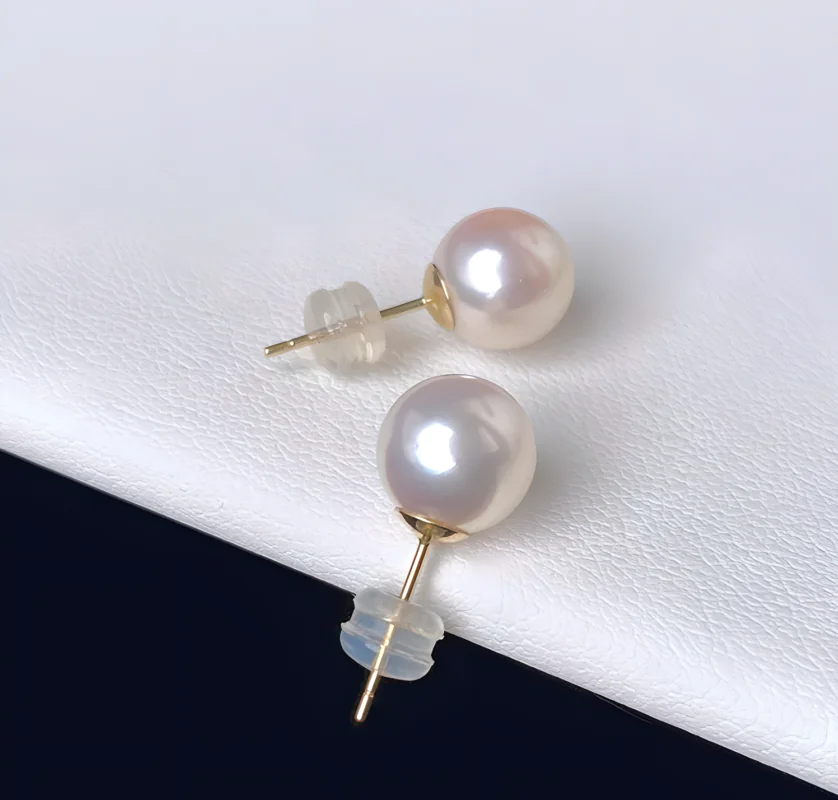
What Does “Non-Toned” Mean for Pearls?
“Non-toned” usually means that a pearl has not received a final tinting or color-adjustment treatment. The term is especially important with Akoya cultured pearls, where subtle pink or reddish toning has traditionally been used to adjust their appearance. However, non-toned does not automatically mean untreated, unbleached, or exactly the same color as when the pearl was harvested.
That distinction matters because several different post-harvest processes can be used on pearls, and a seller may be describing only one of them when using the words “non-toned.”
The Quick Answer: What Is a Non-Toned Pearl?
In the Akoya pearl trade, a non-toned pearl generally refers to a pearl that has not undergone the final pink or reddish color adjustment commonly called toning, tinting, pinking, or Choshoku.
Japan's pearl terminology also uses the word Muchoshoku for Akoya pearls that have not received this final Choshoku color adjustment. Importantly, such pearls may already have undergone other post-harvest treatments, particularly bleaching and sometimes other preparatory or luster-related processes.
So the simplest rule to remember is:
Non-toned describes the absence of toning. It does not necessarily describe the pearl's entire treatment history.
What Is Pearl Toning?
Toning is a subtle color treatment rather than a dramatic recoloring of a pearl. CIBJO, the World Jewellery Confederation, defines tinting as a treatment that causes a subtle change in a pearl's color or appearance and notes that it is often associated with bleaching. Its treatment terminology describes tinted pearls as receiving a light application of a light-colored dye, usually pink.
The Japanese pearl industry uses the term Choshoku for a closely related process. The Pearl Standard 2025 describes Choshoku as adjusting the color tone of bleached Akoya cultured pearls with reddish dye. The objective is a slight modification of color rather than transforming the pearl into a completely different color.
This is why pearl toning should not simply be treated as another word for strong dyeing. Both involve color modification, but the intended degree of change is different. For a broader explanation of these processes, see our guide to pearl color enhancement treatments.
Does Non-Toned Mean Untreated?
No. This is the most important misconception to avoid.
A non-toned Akoya pearl may still have been bleached. It may also have undergone processes intended to prepare, clean, brighten, or improve the appearance of the pearl before the point at which toning would normally occur.
The Japan Pearl Standard specifically explains that Muchoshoku indicates the absence of the final Choshoku color adjustment rather than the absence of all treatment. In its terminology, Muchoshoku Akoya pearls may have undergone Maeshori and bleaching while receiving no Choshoku or dyeing afterward.
CIBJO terminology makes the distinction even clearer. Its pearl trade code NT is reserved for pearls that have not been treated. That is a much broader statement than saying that a pearl is merely non-toned.
| Term | What It Usually Means | Can It Still Be Bleached? |
|---|---|---|
| Non-toned / Muchoshoku | No final toning or Choshoku color adjustment | Yes |
| Toned / Tinted | A subtle color adjustment has been made | Often |
| Dyed | Color has been altered using dye | Possibly |
| Untreated | No treatment has been applied | No |
Does Non-Toned Mean “Natural Color”?
Not necessarily, and this is where marketing language can become confusing.
If an Akoya pearl has been bleached but not toned, its final appearance is not simply identical to the pearl as it came from the oyster. Bleaching itself can alter or stabilize aspects of color by removing organic matter and pigments. Calling every non-toned pearl “completely natural color” can therefore imply more than the term actually guarantees.
The Japan Pearl Standard makes this point directly in its discussion of Muchoshoku pearls. It cautions against describing their color as simply the same as when harvested and also regards expressions such as “natural white” as potentially misleading in this context.
This does not make non-toned pearls somehow less genuine. They are still real cultured pearls. It simply means that cultivation origin and post-harvest treatment history are two separate questions.
What Colors Can Non-Toned Akoya Pearls Have?
Non-toned should not be interpreted as one specific color.
Akoya pearls without the final reddish color adjustment can show different appearances depending on the individual pearls and the processing they received beforehand. The Japanese Pearl Standard itself recognizes descriptions such as white Muchoshoku Akoya, blue Muchoshoku Akoya, and yellow Muchoshoku Akoya.
Therefore, a non-toned Akoya pearl does not have to look cream-colored or yellow, nor does a bright-looking white Akoya pearl automatically prove that toning was used.
Pearl color is also more complicated than a single body-color label. Luster, overtone, orient, nacre structure, surrounding light, and nearby colors can all influence what the eye sees. Our Akoya pearl guide explains the characteristics of this pearl type in more detail.
Non-Toned vs. Toned vs. Dyed Pearls
The difference becomes easier to understand if you think about the degree and purpose of color alteration.
Non-toned pearls
The final toning step has not been applied. With Akoya pearls, this commonly refers to the absence of Choshoku or pinking. Other processing may still have occurred.
Toned or tinted pearls
A subtle adjustment has been made to the pearl's appearance. With Akoya pearls, this has traditionally involved a light reddish or pinkish adjustment rather than creating an obviously artificial new body color.
Dyed pearls
Dyeing is a broader color-alteration treatment. It can be used to produce colors substantially different from the pearl's previous appearance. Both Japanese pearl standards and CIBJO terminology distinguish dyeing from the lighter color modification described as Choshoku or tinting.
Understanding where these steps fit into the wider production sequence is easier when viewed alongside the complete pearl processing workflow.
Are Non-Toned Pearls Better?
Not automatically. “Non-toned” is a treatment description, not a pearl quality grade.
A beautiful non-toned pearl may have exceptional luster, clean surfaces, attractive color, good nacre, and excellent matching. Another non-toned pearl may be much less impressive. The same is true of toned pearls.
The Pearl Standard 2025 specifically warns against assuming that Muchoshoku pearls are inherently superior simply because Choshoku was not applied. If the underlying quality factors are equivalent, the presence or absence of this final color adjustment does not by itself determine overall pearl quality.
When comparing pearls, evaluate factors such as:
- Luster: How bright, sharp, and reflective does the pearl appear?
- Surface quality: How visible are blemishes, pits, wrinkles, or other surface characteristics?
- Nacre: Is the nacre appropriate for the pearl type and visually healthy?
- Shape: Is the pearl round, near-round, baroque, or another desired shape?
- Color: Is the actual appearance attractive for the intended jewelry?
- Matching: For pairs and strands, how consistently do the pearls work together?
- Treatment disclosure: Do you understand what processes have actually been applied?
The treatment label is one piece of information within that larger quality picture.
Are Non-Toned Pearls Rarer or More Valuable?
There is no reliable rule that every non-toned pearl is rarer, more valuable, or more desirable than every toned pearl.
Specific collectors, brands, or market segments may prefer certain non-toned Akoya pearls, and an especially attractive lot can command a premium. But that premium reflects the desirability of the actual pearls and the market around them—not a universal rule that the words “non-toned” automatically increase value.
Size, luster, nacre quality, surface, shape, color, matching, provenance, and market demand can all have a greater effect on price than this single treatment descriptor.
Can You Tell Whether a Pearl Is Non-Toned Just by Looking?
Usually, you should not rely on appearance alone to reconstruct a pearl's treatment history.
Toning can be intentionally subtle. At the same time, naturally occurring color effects, bleaching, lighting conditions, photography, surrounding objects, and individual nacre characteristics can all influence how pink, silver, cream, blue, or white a pearl appears.
A pearl that looks slightly pink is therefore not automatically toned, and a pearl without an obvious pink overtone is not automatically non-toned.
For ordinary purchases, clear supplier disclosure is often more useful than trying to diagnose treatments from photographs. For valuable pearls where treatment status materially affects a buying decision, an independent gemological laboratory may be appropriate.
What Should You Ask When Buying “Non-Toned” Pearls?
The best approach is to replace one vague question with several specific ones.
- Has the pearl been toned, tinted, pinked, or given Choshoku treatment?
- Has it been bleached?
- Has it received Maeshori or another luster-enhancement treatment?
- Has the color been modified by dyeing, chemical coloration, irradiation, or optical brightening?
- When you say “non-toned,” do you mean Muchoshoku, or do you mean completely untreated?
- Can the treatment description be provided in writing?
These questions are far more informative than asking only whether a pearl is “natural color.” They separate the individual processing stages and reduce the chance that buyer and seller are using the same words with different meanings.
Why the Term Matters Most with Akoya Pearls
Although tinting can be discussed more broadly in pearl treatment terminology, “non-toned” is particularly significant in the Akoya market because subtle reddish color adjustment has a long history in Japanese Akoya processing.
The Japanese industry therefore has unusually specific terminology surrounding this stage. Choshoku describes the subtle final color adjustment, while Muchoshoku describes pearls that do not receive that adjustment.
This makes “non-toned Akoya” a useful description—as long as it is not expanded into claims the term itself cannot support.
Standards Behind the Terminology
The distinction used in this article is consistent with major pearl-industry references. The Japan Pearl Promotion Society's Pearl Standard 2025 describes Choshoku, Muchoshoku, bleaching, dyeing, and related processing separately. CIBJO's Pearl Book 2024 likewise distinguishes tinting from dyeing and defines tinting as a subtle color or appearance change, often associated with bleaching.
Gemological Institute of America resources also emphasize that pearls can undergo multiple post-harvest processes and color treatments, reinforcing why treatment descriptions should be interpreted precisely rather than reduced to a simple “natural versus artificial” distinction.
FAQ
Does non-toned mean a pearl is untreated?
No. Non-toned generally means that the toning or tinting step was not used. An Akoya pearl described as non-toned may still have undergone bleaching, Maeshori, or other processing.
Does non-toned mean unbleached?
No. In Japanese Akoya terminology, Muchoshoku pearls can be bleached while receiving no subsequent Choshoku color adjustment.
Are non-toned Akoya pearls always yellow or cream?
No. Non-toned Akoya pearls can display different colors. Japanese terminology recognizes white, blue, and yellow Muchoshoku Akoya pearls, among other individual variations.
Are non-toned pearls automatically more valuable?
No. The absence of toning is not a quality grade. Luster, nacre, surface quality, size, shape, color, matching, and market demand still determine the desirability and value of a pearl.
Is non-toned the same as natural color?
Not necessarily. If a pearl has undergone bleaching or another appearance-altering process, “non-toned” only confirms the absence of the toning step. It does not prove that the pearl looks exactly as it did when harvested.
How can I know whether pearls have been toned?
Do not rely only on color or photographs. Ask the seller for a clear treatment history and preferably written disclosure. For higher-value material, a reputable gemological laboratory may provide additional treatment analysis.
The Bottom Line
A non-toned pearl is best understood as a pearl that has not received a toning or tinting treatment—not automatically as a completely untreated pearl. With Akoya pearls in particular, non-toned or Muchoshoku material may still have undergone bleaching and other post-harvest processing.
Instead of treating “non-toned” as a quality grade or a synonym for “natural,” use it as one precise piece of treatment information. Then evaluate the pearl itself: its luster, surface, nacre, color, shape, matching, and documented processing history.