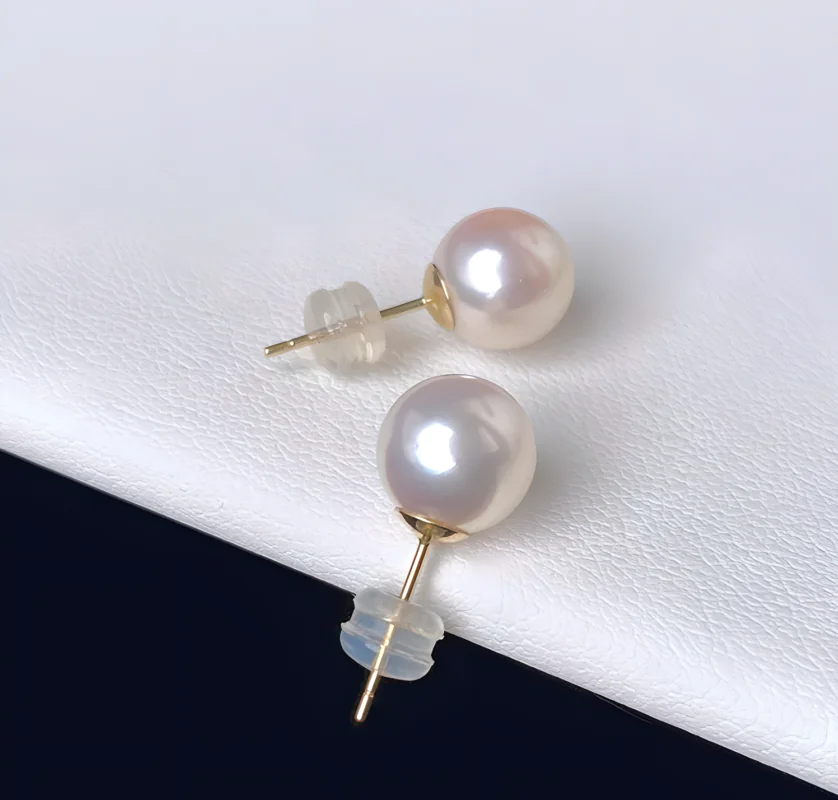
Pearl luster is the quality of light returned from the pearl's surface and nacre. It is often the first characteristic people notice and one of the strongest visual quality factors. A fine pearl does not simply look bright: reflections appear sharp, lively, and dimensional rather than flat or chalky.
Terms such as “strong luster,” “high luster,” “very high luster,” and “mirror-like luster” are common in the trade, but not all sellers use those words in exactly the same way. The safest approach is to judge the pearl itself and understand what the description is trying to communicate.
What does pearl luster actually measure?
Luster is influenced by how light interacts with the pearl's nacre layers and surface. When nacre has developed well and the surface is suitable, reflections can look crisp and energetic. When luster is weaker, the reflection becomes softer, blurred, or milky.
Do not reduce luster to simple brightness. A pearl can look bright because the lighting is intense or the photograph is overexposed while still having relatively weak reflection definition.
Are “strong,” “high,” and “mirror-like” standard grades?
Not universally. Some laboratories and trade systems use defined luster scales, but ordinary seller language is much less standardized. One supplier's “strong luster” may overlap another supplier's “high luster.” “Mirror-like” usually describes very crisp reflections, especially in fine Akoya or high-luster freshwater pearls, but it is a descriptive term rather than a global legal grade.
The practical lesson is simple: read the term, then verify the visual evidence.
How to evaluate pearl luster step by step
1. Compare pearls under the same light
Do not compare one pearl photographed in a light box with another photographed in dim room light. Use the same light source, background, camera distance, and exposure whenever possible.
2. Look at reflection sharpness, not only the white highlight
A strong point light can create a white dot on almost any glossy object. Instead, look at the edges of reflected windows, phone screens, dark clothing, or other recognizable shapes. Sharper edges generally indicate stronger luster.
3. Use a dark-and-light reference
A pearl becomes easier to judge when both light and dark areas are reflected. Stronger luster creates clearer contrast between them; weak luster tends to blur them together.
4. Hold comparison pearls at the same distance
Reflection size and sharpness change with distance. If you are comparing loose pearls or samples, keep them in the same position relative to the light and viewer.
5. Rotate the pearl
One attractive highlight is not enough. Rotate the pearl and see whether the luster remains lively around the body. This also helps separate a consistently lustrous pearl from one photographed at its best angle.
6. Compare like with like
Compare similar pearl types and sizes when possible. Different pearl categories can have different typical optical character, so forcing every fine pearl to look identical is misleading.
What does “mirror-like luster” look like?
A mirror-like pearl shows relatively crisp reflected shapes, strong contrast, and a lively transition between bright and dark areas. In the finest examples, you may be able to recognize the outline of the photographer, a window, or surrounding objects rather than seeing only a vague glow.
This does not mean the pearl should literally behave like a glass mirror. Pearls have layered nacre optics, bodycolor, overtone, and surface features that create a more complex appearance.
Why brightness alone can be misleading
Photography can exaggerate brightness through exposure, sharpening, contrast, or a small intense light source. A seller photo can therefore make a low-luster pearl look “shiny.”
When buying online, ask for video under neutral light, movement, and side-by-side comparison with similar pearls. Reflection sharpness that survives rotation is more informative than one bright still image.
Luster is not the same as surface quality
A pearl can have excellent luster and still show pits, growth marks, or other blemishes. Another pearl can have a very clean surface but only moderate luster. These are separate grading factors.
If budget is limited, many buyers prefer a pearl with strong luster and a few minor low-visibility marks over a cleaner pearl that looks dull.
Luster is not the same as overtone or orient
Luster describes light return and reflection quality. Overtone is a secondary color seen over the bodycolor. Orient is a multicolor iridescent effect that may appear on some pearls. A pearl can have strong luster with little visible orient, or noticeable orient with a different style of luster.
Different pearl types can show different luster character
Akoya pearls
Fine Akoya pearls are often associated with crisp, sharp, “mirror-like” reflections. This is one reason luster is such a central part of Akoya evaluation.
South Sea pearls
South Sea pearls can show excellent luster with a softer, more satiny visual character. Judging them only by whether they mimic Akoya sharpness can be misleading.
Tahitian pearls
Tahitian pearls combine luster with naturally dark bodycolors and colorful overtones. Strong luster helps those colors look vivid and dimensional.
Freshwater pearls
Freshwater pearls span an extremely wide range. Fine modern examples can be very sharp and metallic, while lower grades may be much softer.
Do AAA and AAAA tell you the luster grade?
Not by themselves. Seller grades often combine several factors such as luster, surface, shape, and matching. Because the letters are not universally standardized, you should ask what luster level the grade actually requires.
Does strong luster mean thick nacre?
Not automatically. Luster and nacre quality are related, but a visual impression does not provide an exact nacre-thickness measurement. Pearl type, cultivation structure, surface condition, and processing also matter.
How much does luster affect pearl value?
Within the same pearl type, size, shape, and general market category, stronger luster usually increases desirability and value because the difference is immediately visible. But price still depends on the full combination of surface quality, nacre, shape, size, color, matching, rarity, and jewelry construction.
A practical luster test for buyers
- Clean the pearls gently if surface residue is present.
- Place two similar pearls under the same neutral light.
- Compare the sharpness of reflected light and dark shapes.
- Rotate both pearls.
- Judge whether the stronger reflection remains consistent.
- Repeat with another sample if the difference is subtle.
FAQ
What is the difference between strong luster and high luster?
Usually they are seller descriptions of the same underlying quality—how strong and sharp the pearl's reflections appear—but the exact thresholds are not universally standardized.
Is mirror-like luster always the best?
It is highly desirable in many pearl categories, especially Akoya, but different pearl types can show different fine luster character. A South Sea pearl can be excellent without looking identical to an Akoya pearl.
Can a pearl be very shiny but still have poor luster?
Yes. Intense lighting or photography can create bright highlights. Judge reflection definition and depth, not brightness alone.
Can a blemished pearl have excellent luster?
Yes. Luster and surface cleanliness are separate grading factors.