Choose a pearl choker when you want the pearls to frame the neck and collarbone, stay close to the face, and become part of the neckline itself. Choose a long pearl necklace when you want more vertical movement, more distance from the face, easier wear over clothing, and more options for doubling, wrapping, or layering.
The choice is not really “short people wear this, tall people wear that,” and it is not a question of which length is more elegant. A choker and a long strand do different jobs. One concentrates attention near the neckline; the other extends the jewelry into the outfit.
If you are comparing several exact lengths rather than these two broad effects, use our pearl necklace length guide. Here, the goal is simpler: decide which of the two extremes fits the way you actually dress and wear jewelry.
Quick Answer: Pearl Choker or Long Pearl Necklace?
| Decision factor | Pearl choker | Long pearl necklace |
|---|---|---|
| Visual focus | Neck, collarbone, face | Chest, clothing, overall vertical line |
| Fit sensitivity | High; a small length difference can change comfort | Lower around the neck, although the final drop still matters |
| Best wardrobe clue | You often wear open necklines or want pearls visible above a neckline | You often wear crew necks, knits, shirts, jackets, or high-neck clothing |
| Movement | Compact and controlled | More swing and drape |
| Layering role | Usually the shortest layer | Can form the lower layer or, if long enough, be doubled |
| Styling flexibility | Strong single look; less variable in placement | Often more ways to wear, especially at opera and rope lengths |
| Buying consideration | Fewer pearls than a comparable long strand | More pearls are required at the same pearl size and quality |
If you already know which column sounds more like your wardrobe, your answer may be clear. If not, the sections below show what each choice changes in practice.
First, Define What “Choker” and “Long” Mean
A pearl choker is commonly around 14–16 inches (36–41 cm), although sellers do not always use necklace-length names in exactly the same way. The important part is the position: it sits close to the base of the neck rather than dropping well below the collarbone.
“Long pearl necklace” is less precise. In this article, it means a strand that clearly leaves the neckline area and becomes part of the torso styling—roughly 24 inches (61 cm) and longer, with the strongest contrast appearing at opera and rope lengths. A 20–24 inch matinee strand may behave as useful middle ground rather than as a truly dramatic long necklace.
Always compare the actual measurement in inches or centimeters, not just the style name printed on a product page.
Choose a Pearl Choker When You Want the Necklace to Frame the Neckline
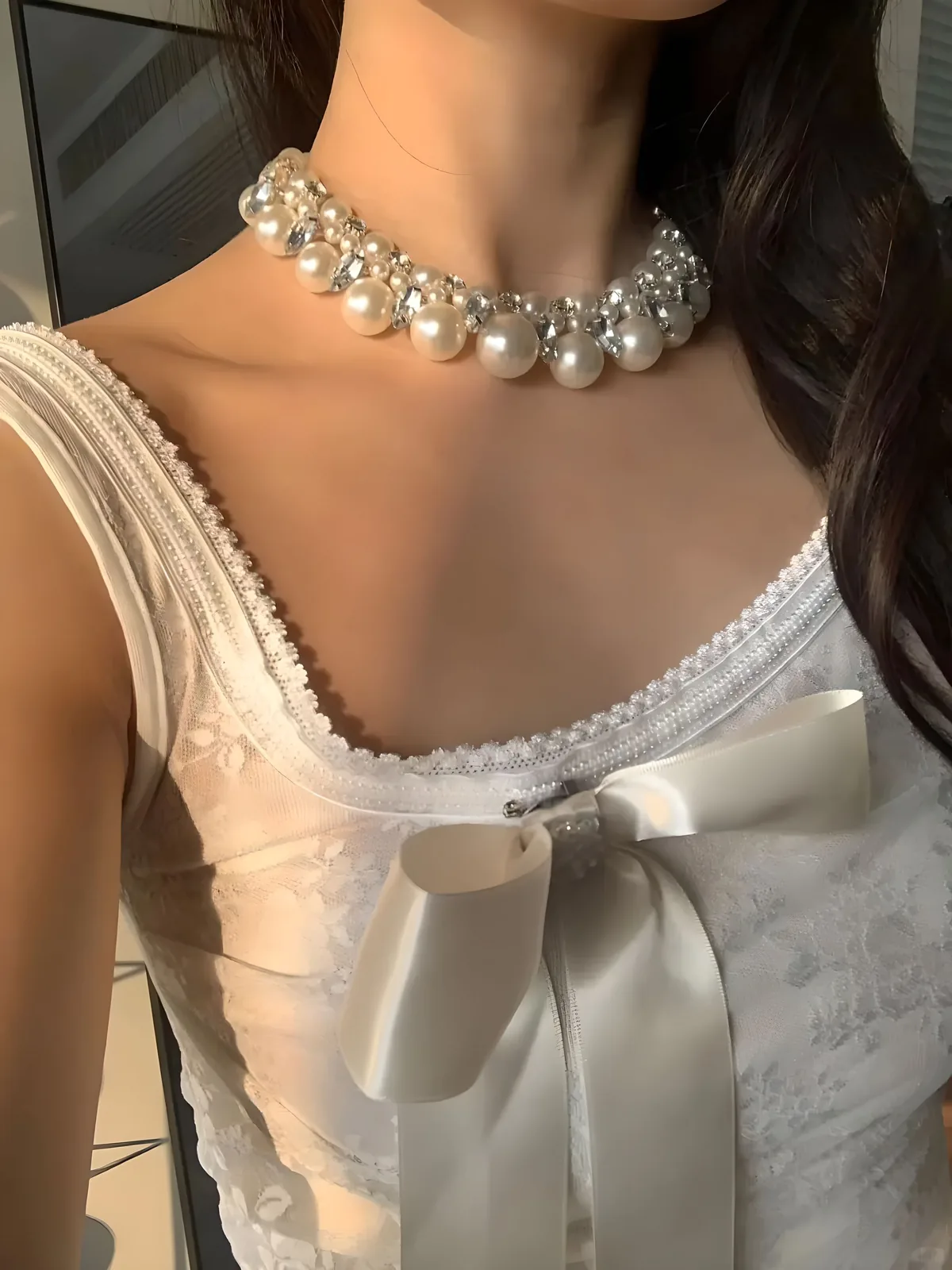
A choker is not simply a shorter version of the same necklace. Moving the strand upward changes its visual role. The pearls become a border around the neck and collarbone rather than a line that travels down the outfit.
You want the pearls close to the face
Because a choker sits high, its color, luster, and pearl size stay close to the face. This can make even a relatively simple strand feel intentional and visible without requiring a large pendant or a long drop.
This is especially useful when your clothing leaves open space around the neck—strapless, off-shoulder, square, scoop, or wide open collars. The necklace can occupy that space without competing with a lower seam or button line.
You like a compact, defined look
A short strand moves less across the torso and keeps the jewelry composition concentrated. If your style is minimal, graphic, or neckline-focused, that compactness may be exactly what you want.
It can also work with a crew neck if the pearls sit clearly above the fabric edge. The useful rule is not “chokers only work with low necklines.” It is make the placement look deliberate rather than accidental.
You want a strong first layer
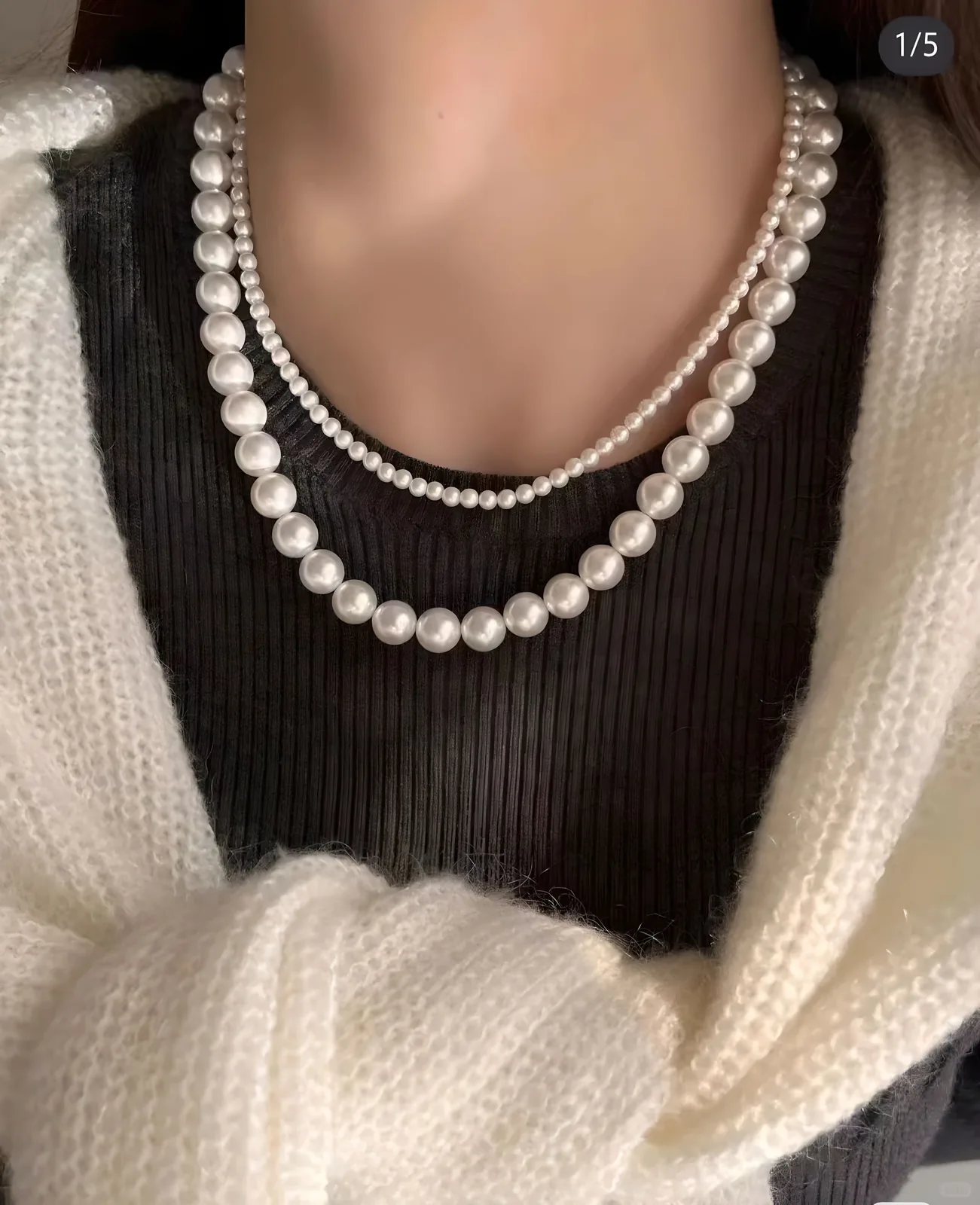
If you like layered necklaces, a pearl choker can act as the highest anchor. A longer chain, pendant, or second pearl strand can then fall below it with clear separation.
The spacing matters more than the number of necklaces. Two strands that land almost on top of each other can look crowded, while a short pearl strand and a clearly longer second layer usually read as an intentional composition.
You are comfortable measuring the fit carefully
This is the main practical disadvantage of a choker: fit is less forgiving. A difference of an inch can move a short necklace from relaxed to close-fitting, and pearl diameter can make a chunky strand feel more substantial than a delicate one at the same measured length.
If you are buying online, test the exact circumference with a soft tape, ribbon, or string before ordering. Do not rely on a generic “choker” label.
Choose a Long Pearl Necklace When You Want the Jewelry to Become Part of the Outfit
A long strand shifts the emphasis downward. Instead of outlining the neck, it creates a line across the chest or torso. That difference makes long pearls particularly useful with clothing that leaves little bare neckline space.
You wear high necklines, knits, shirts, or jackets often
Long pearls can sit visibly over a turtleneck, crew-neck knit, blouse, dress, or simple top without disappearing into the collar area. They also have enough visual distance from lapels and shirt collars to read as a deliberate layer rather than a necklace trapped at the clothing edge.
This does not mean a long strand is “for winter” or a choker is “for summer.” It simply means covered necklines often give a long strand more uninterrupted space.
You want more movement
Long strands move as you walk and sit. That movement can make pearls feel less static and can soften very structured clothing. If you prefer jewelry that interacts with the whole outfit rather than staying fixed near the face, this is a meaningful difference.
Movement is also something to test for comfort. A very long strand may swing against a desk, bag, buttons, or belt. If you work with your hands or move around a lot, consider where the lowest point of the necklace lands.
You want one necklace that can create several looks
Opera and rope-length pearl strands often offer more styling options than a fixed choker. Depending on the total length, clasp, strand construction, and your neck circumference, a long strand may be worn:
- as one long line;
- doubled into two shorter rows;
- combined with a shorter necklace for layered spacing;
- or, with a suitable design, styled with a loose knot.
Not every long necklace will convert neatly into every style, so check the actual length before buying. A strand that looks dramatic when worn long may become surprisingly compact when doubled.
You want more room for fit variation
A long strand is usually less sensitive to neck circumference because it does not depend on a close fit around the neck. The exact drop still changes from one wearer to another, especially around the bust and torso, but small measurement differences are less likely to determine whether the necklace feels physically tight.
The Biggest Difference Is Visual Direction, Not “Body Type”
Many necklace guides turn length into body-shape rules: short necklaces for one build, long necklaces for another. Those formulas are too rigid to be very useful.
A better way to think about the choice is visual direction.
- A choker creates a horizontal frame close to the neck and collarbone.
- A long necklace creates a longer vertical path through the outfit.
Neither effect is automatically more flattering. The useful question is which line you want to emphasize. Some people love the deliberate framing of a choker. Others prefer the openness and movement of a long strand.
Height, shoulder width, neck length, and torso proportions can change where a necklace lands, but they do not create a list of lengths you are or are not “allowed” to wear. Test the actual placement on your body instead of trying to fit yourself into a rule.
Pearl Size Changes the Choice More Than Many Buyers Expect
A 15-inch necklace made with 5–6 mm pearls and a 15-inch necklace made with 11–12 mm pearls do not create the same visual effect. Larger pearls take up more visual space around the neck and can make a choker feel bolder and more substantial.
The same issue becomes more important in a long necklace. A long strand contains many more pearls than a short strand of comparable diameter, so increasing pearl size can change both the visual weight and the price of the piece.
GIA treats size as one of the major pearl value factors and evaluates matching for multi-pearl jewelry such as strands. When other factors are equal, larger pearls are generally rarer and more valuable, and a well-matched long strand requires consistency across more pearls.
If you are choosing pearl diameter and necklace length at the same time, separate those decisions. First decide where you want the necklace to sit. Then use our pearl size guide to decide how visually strong you want the pearls themselves to be.
Budget: A Long Strand Uses More Pearls
This sounds obvious, but it matters when comparing two necklaces of similar pearl type, size, shape, luster, and matching quality: a long strand simply requires more pearls.
That means your budget may create a real tradeoff. For the same total spend, you may prefer:
- a shorter necklace with larger pearls;
- a shorter necklace with tighter matching or stronger luster;
- a longer necklace with smaller pearls;
- or a long strand in a pearl type or shape that gives you the look you want at a more comfortable price.
There is no universal rule that the shorter necklace is “better quality.” Length and pearl quality are separate decisions. Use observable pearl characteristics rather than assuming price comes from length alone. Our broader pearl buying guide explains the quality factors to compare before purchasing.
Use the Three-Outfit Test Before You Buy
If you are still undecided, do not start with your height or age. Start with your wardrobe.
- Choose three tops or dresses you wear often. Ideally include one open neckline, one everyday crew or shirt, and one higher or more structured neckline.
- Use ribbon or string to mark a choker position. Stand in front of a mirror and check whether you like the attention concentrated near your face and collarbone.
- Use a longer piece of string to mark a 24–36 inch drop. Check where it crosses buttons, lapels, seams, the bust, or a belt.
- Sit down as well as stand. A long necklace that looks perfect standing may land on a desk or catch on clothing when seated.
- Choose the length that works with two of the three outfits. That is usually more useful than choosing the one that looks best with a single ideal dress.
This small test turns an abstract style question into a practical wardrobe decision.
When a Choker Is the Better Buy
A pearl choker is usually the stronger choice if most of these statements sound like you:
- You want the pearls to stay close to your face.
- You wear open collars, scoop necks, strapless styles, or clean crew necks often.
- You prefer a compact, defined jewelry look.
- You want a short anchor for layering.
- You are happy to measure your fit carefully.
- You would rather spend your budget on pearl size or quality than on additional strand length.
When a Long Pearl Necklace Is the Better Buy
A long pearl necklace is usually the stronger choice if most of these statements sound like you:
- You wear high necks, shirts, knits, dresses, or jackets that provide a clean background for pearls.
- You like jewelry with movement and a lower focal point.
- You want one strand that may be worn long or restyled in layers.
- You do not want the fit to depend on a close neck measurement.
- You like the look of pearls as part of the whole outfit rather than mainly around the face.
- You are comfortable with the additional pearl count—and possible additional cost—of a longer strand.
What If You Like Both?
Then the answer may not be to choose one extreme.
A 17–19 inch princess-length strand sits between the two ideas. It is lower and less fit-sensitive than a choker, but it still keeps the pearls close enough to the face for everyday wear. For many buyers, that middle position is easier to combine with a broad wardrobe.
Another option is to buy a genuinely long strand that can be doubled, provided the total length and construction make that practical. That gives you both a long look and a shorter layered look from one necklace.
A Practical Buying Checklist
Before you choose between a choker and a long pearl necklace, check these points:
- Actual length: confirm inches or centimeters rather than relying on the style name.
- Neckline position: make sure the pearls sit clearly above, inside, or below the clothing edge.
- Fit: chokers need especially careful measurement.
- Pearl diameter: large pearls make any strand visually stronger.
- Matching and luster: do not let length distract you from pearl quality.
- Clasp and extender: an adjustable design can make a short necklace more forgiving.
- Convertible use: if you want to double a long strand, verify that the total length actually allows it.
- Your real wardrobe: test the necklace position against clothes you already wear.
When you are ready to compare finished pieces, browse the MJ Pearls pearl necklace collection and evaluate the stated length, pearl size, and construction together rather than treating any one of them as the whole decision.
Frequently Asked Questions
Is a pearl choker more formal than a long pearl necklace?
Not necessarily. Formality depends on the pearl size, matching, clasp, number of strands, clothing, and overall design. A simple pearl choker can look minimal and modern, while a long matched strand can look dramatic or formal. Length alone does not determine the dress code.
Are long pearl necklaces outdated?
No. A long strand can be worn as a single line, layered, doubled, or paired with simple contemporary clothing. Whether it feels classic, vintage, minimal, or modern depends more on styling than on the fact that it is long.
Can I wear a pearl choker if I have a short or wide neck?
Yes, if you like the effect and the necklace is comfortable. There is no universal neck-shape rule that makes chokers inappropriate. Measure the exact fit and judge the placement on your own body rather than relying on a body-type chart.
What counts as a long pearl necklace?
There is no single universal cutoff. For this comparison, roughly 24 inches and longer functions as a long necklace, while opera and rope lengths create the clearest contrast with a choker. Always check the actual measurement because seller terminology varies.
Can an opera pearl necklace be worn as a choker?
Sometimes. A sufficiently long opera or rope strand may be doubled into a shorter two-row necklace, but the final fit depends on the total length, pearl diameter, clasp, construction, and your neck circumference. Test the doubled circumference before assuming it will fit like a choker.
Final Takeaway
Choose a pearl choker for concentration; choose a long pearl necklace for extension.
A choker keeps the pearls close to the face, makes the neckline part of the design, and works best when you are willing to get the fit right. A long strand moves the visual focus into the outfit, works easily over more covered clothing, and often gives you more ways to restyle the same necklace.
If neither description clearly sounds like you, the answer may be in the middle: a princess-length strand or a convertible long necklace can give you more everyday flexibility.
The best choice is not the length a body-type chart says you should wear. It is the necklace that lands where you want it to land, works with the clothes you actually own, and gives you the visual effect you want to repeat.