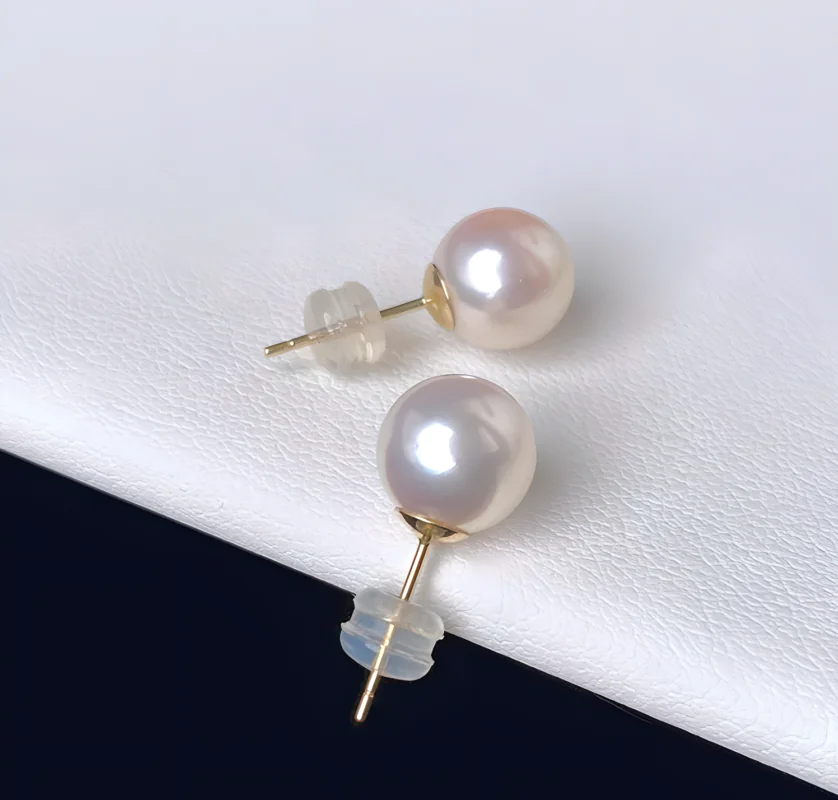
The Limits of Visual Inspection for Irradiated Pearls
Visual inspection can give useful clues that a pearl may have been irradiated, but in many cases it cannot prove the treatment. A dark bead nucleus, unusual gray or blue-gray color, color differences around a drill hole, or an unnatural-looking surface may justify suspicion. None of these observations should automatically be treated as a final identification.
This distinction matters because natural-color and treated-color pearls can overlap surprisingly closely in appearance. It matters even more with modern Akoya and freshwater cultured pearls, where different internal structures respond to irradiation differently. The practical rule is simple: use visual inspection to decide what deserves further investigation, not to create certainty that the evidence cannot support.
Visual Inspection Is a Screening Tool, Not a Laboratory Conclusion
When people ask how to identify an irradiated pearl, they often expect one visible feature that separates treated pearls from untreated ones. In reality, pearl treatment identification rarely works that neatly.
Visual examination is useful because treatment can sometimes leave recognizable patterns. Under magnification, a jeweler may notice a dark internal bead, unusual color concentration, a difference between the nacre and the drill-hole area, or a patchy distribution that does not look typical of the pearl being examined.
The problem is that a visible clue can have three very different meanings:
- it may be strongly consistent with irradiation;
- it may be caused by irradiation but not be unique to irradiation;
- it may simply look suspicious without actually revealing the color origin.
Confusing those three levels is where visual inspection becomes unreliable.
| Visual Observation | What It May Suggest | Why It Is Not Enough by Itself |
|---|---|---|
| Dark bead visible through a drill hole | Irradiation of a freshwater-shell bead nucleus in a bead-cultured pearl | The viewing area is small, and the exact source of a dark-looking area may not always be clear visually |
| Gray or blue-gray bodycolor | A color commonly associated with irradiated Akoya pearls | Natural-color Akoya pearls can also occur in gray, silver, and blue-gray tones |
| Color concentrated around the drill hole | Possible color treatment | Concentration may indicate dyeing rather than irradiation alone |
| Patchy or unusual surface color | Possible treatment or combination treatment | It does not identify which process caused the appearance |
| Very uniform dark strand | A reason to question color origin | Careful matching can also produce visually consistent untreated strands |
The goal, therefore, is not to stop looking. It is to understand what looking can and cannot establish.
Why Irradiated Akoya Pearls Can Sometimes Show a Dark Nucleus
Akoya cultured pearls provide one of the most useful examples of how irradiation can create an internal visual clue.
A typical bead-cultured Akoya pearl contains a round shell bead surrounded by saltwater-grown nacre. The bead is commonly made from freshwater mussel shell. Freshwater shell material contains substantially more manganese than typical saltwater pearl-oyster nacre, and irradiation can darken manganese-related material in the bead.
The result is important: the freshwater-shell nucleus may become darker while the surrounding Akoya nacre changes much less. Because nacre is partly translucent, the darker material underneath can influence the pearl's face-up appearance and create gray, silver-gray, blue-gray, or greenish-gray colors.
This explains why examining the drill hole has long been taught as a practical way to screen some irradiated Akoya pearls. If a clearly darkened bead can be seen beneath relatively light nacre, irradiation becomes a reasonable possibility.
But the word possibility is essential.
Why a Dark Drill Hole Is Not a Universal Irradiation Test
The popular shortcut “dark drill hole equals irradiated pearl” takes a useful observation and pushes it too far.
A drill hole gives the observer only a narrow view into a complicated structure. Lighting angle, shadows, the condition of the drilling channel, surface material, internal organic features, and additional treatments can all influence what appears dark through that opening. More importantly, not every visible dark region necessarily represents the bead nucleus itself.
There is another problem: pearls can receive more than one treatment.
In a 2024 Gems & Gemology laboratory investigation of reportedly irradiated Akoya pearls, GIA examined samples with a variety of gray, bluish, and greenish colors. Some showed obvious color concentrations near their drill holes or unnatural patchy surface coloration together with darkened bead nuclei. Other lighter-colored samples showed a darkened bead nucleus without obvious drill-hole color concentration.
Further examination also indicated that some specimens had received dye treatment in addition to irradiation.
That finding demonstrates two important limitations of visual inspection:
- Visible color concentration is not required for an irradiated pearl to be present.
- Visible color concentration may reflect an additional treatment rather than irradiation itself.
In other words, the presence of a clue can be ambiguous, while the absence of the clue does not necessarily clear the pearl.
Face-Up Color Is Even Less Conclusive
Judging irradiation from the face-up color of a pearl is generally more difficult than examining its internal structure.
Gray, silver, greenish-gray, and blue-gray colors may immediately make a buyer think of irradiated Akoya pearls because those colors are commonly produced by the treatment. But naturally colored Akoya pearls can occupy part of the same visual range.
This creates a basic identification problem: a treatment does not have to produce an obviously artificial-looking color.
A well-treated pearl may still show attractive luster, overtone, depth, and subtle variation. Irradiation can work through material beneath the nacre rather than leaving obvious pigment on the surface, so an irradiated pearl may look much more natural than many buyers expect.
Likewise, natural-color pearls do not have to look irregular, pale, or obviously different from treated material.
Color should therefore be interpreted in context:
- What type of pearl is being examined?
- Is the color plausible for that pearl type?
- What does the drill-hole area show?
- Does the nacre look different from the internal bead?
- Are there signs that dyeing or another treatment may also be present?
- Is the pearl being sold at a premium specifically because its color is claimed to be natural?
These questions are more useful than asking whether a particular shade simply “looks irradiated.”
The Problem Changes with Freshwater Cultured Pearls
The dark-nucleus explanation works particularly well for many bead-cultured Akoya pearls, but it should not be applied to every pearl.
Traditional tissue-nucleated freshwater cultured pearls do not contain the large round shell bead found in an Akoya pearl. Irradiation can affect their pearl material more directly, producing darker gray, metallic, or other modified colors without giving the observer the same bead-versus-nacre contrast.
Modern bead-cultured freshwater pearls add another layer of complexity because they do contain nuclei and can have different structures from older tissue-nucleated freshwater products.
This is one reason identification rules should begin with pearl structure rather than color alone. Before deciding what a visual clue means, you need to know what kind of pearl could reasonably produce that clue.
GIA's study of Chinese freshwater “Edison” pearls illustrates the point. Researchers used a combination of microscopic observation, fluorescence examination, fluorescence spectroscopy, Raman spectroscopy, and trace-element analysis to investigate color origin and optical brightening. Treatment identification was based on multiple observations rather than one face-up characteristic.
For a broader explanation of the different ways pearl color can be modified, see our guide to pearl color enhancement treatments.
Useful Visual Clues Still Matter
Saying that visual inspection has limits does not mean it is useless. It remains an important first step, especially for dealers, jewelers, designers, and buyers who regularly handle groups of pearls.
The following observations can justify closer investigation:
A visibly darkened bead nucleus
In a drilled bead-cultured Akoya pearl, a clearly dark bead beneath comparatively unaffected nacre is one of the more meaningful visual clues associated with irradiation.
A difference between nacre color and drill-hole color
If the material visible inside the drilling channel looks substantially different from the surrounding nacre, inspect further. The difference may help reveal internal darkening or an additional color treatment.
Color concentration around drilling or surface features
Concentrated color can be evidence that the pearl's appearance has been modified, although it may point more strongly toward dyeing than irradiation by itself.
Unusual patchy coloration
Patchy or locally concentrated dark areas deserve attention, particularly if they do not fit the expected appearance of the pearl type.
A color that conflicts with the seller's description
A visual clue becomes more important when it conflicts with a commercial claim. A pearl being sold simply as an attractive treated gray pearl creates a different identification problem from a pearl being sold at a substantial premium as rare natural-color material.
The right use of these signs is to increase or decrease suspicion. They should not be converted into absolute rules.
Why Magnification Does Not Completely Solve the Problem
A loupe or microscope improves visual inspection, but magnification does not automatically turn an ambiguous feature into a diagnostic one.
Magnification can reveal:
- the edge of a bead nucleus;
- color concentration around a drill hole;
- patchy surface coloration;
- pigment collecting in surface features;
- differences between the outer nacre and the interior.
What magnification cannot do is provide information that is not expressed visibly. If two pearls have overlapping outward appearances, making the image larger does not necessarily reveal why their colors formed.
This distinction is useful far beyond irradiation. Our broader pearl identification guide follows the same principle: external observation is excellent for screening many features, while questions about internal structure, treatment, and color origin may require instrumental evidence.
What Laboratory Testing Adds That the Eye Cannot
A gemological laboratory is not simply “looking more carefully.” It can collect types of evidence that are not available to ordinary visual inspection.
X-ray microradiography
X-ray imaging helps reveal internal pearl structure. It can show the relationship between nacre, bead nuclei, growth structures, cavities, and other internal features that may be hidden from normal view.
Elemental analysis
Techniques such as energy-dispersive X-ray fluorescence can help characterize chemical composition and support conclusions about freshwater versus saltwater origin. In treatment investigations, elemental information may also help researchers evaluate whether certain foreign treatment agents are present.
Fluorescence-based testing
GIA research has investigated fluorescence spectroscopy as a rapid, nondestructive way to screen colored pearls for possible treatment. In one study, naturally colored samples produced stronger ultraviolet-region fluorescence than the treated samples examined. The researchers presented the method as a useful screening approach rather than a reason to abandon other testing.
Raman and optical spectroscopy
Raman, photoluminescence, and UV-Vis-NIR spectroscopy can provide additional information about pearl material and color origin. GIA uses these techniques as part of a broader analytical workflow when evaluating whether pearl color is natural or modified.
The important lesson is not that one laboratory instrument replaces the human eye. It is that difficult pearl identification is usually strongest when multiple independent observations point toward the same conclusion.
There Is No Single “Best Home Test” for Irradiation
Flashlights, transmitted light, drill-hole inspection, magnification, color comparison, and strand matching can all provide useful observations. None should be promoted as a universal home test capable of confirming irradiation.
A home or shop-floor inspection can reasonably answer questions such as:
- Does anything about this pearl make treatment worth investigating?
- Can I see a dark bead beneath lighter nacre?
- Does the color appear concentrated around the drill hole?
- Does the seller's description match what I can observe?
- Is the price high enough that color origin materially affects the transaction?
It generally cannot answer the more demanding question:
Can I scientifically prove that this color was produced by irradiation?
That is a different level of identification.
A Practical Decision Framework for Buyers and Dealers
The amount of testing needed should depend on what is at stake.
| Situation | Reasonable Approach |
|---|---|
| Inexpensive pearl openly sold as treated color | Focus on accurate disclosure, quality, condition, and price rather than demanding laboratory confirmation for every piece |
| Pearl sold at a premium as natural gray or natural blue | Ask for stronger evidence of natural color origin and consider a reputable laboratory report |
| Wholesale lot with uncertain treatment history | Combine visual screening, supplier disclosure, sample comparison, and laboratory spot checks when commercially justified |
| Estate or secondhand jewelry with no documentation | Describe visual observations cautiously and avoid converting an educated guess into a definitive treatment claim |
| Pearl showing both dark internal material and surface color concentration | Consider the possibility of more than one treatment rather than forcing all observations into a single explanation |
This framework is more useful than trying to memorize a checklist of supposedly definitive visual signs.
Treatment Disclosure Matters More Than Winning a Visual Guess
Irradiated pearls are still real pearls. The issue is not whether irradiation makes a pearl fake; it is whether its color origin has been represented accurately.
The CIBJO Pearl Book recognizes irradiation as a pearl treatment and requires treatment disclosure in trade descriptions when applicable. That distinction matters because natural-color rarity may contribute substantially to how a pearl is marketed and valued.
A beautiful irradiated Akoya pearl may still have excellent luster, good nacre, clean surface quality, attractive matching, and strong jewelry value. Treatment status and quality are separate questions.
The problem begins when treated color is sold as though it were naturally produced.
For buyers, this leads to a better question than “Can I catch an irradiated pearl by looking at it?” Ask instead:
Is the pearl being described and priced according to what is actually known about its color?
FAQ
Can you identify an irradiated pearl just by looking at it?
Sometimes visual features can create strong suspicion, particularly in bead-cultured Akoya pearls with visibly darkened nuclei. In many cases, however, appearance alone cannot conclusively establish irradiation.
Does a dark drill hole prove that an Akoya pearl was irradiated?
No. A clearly darkened shell bead can be an important clue, but a dark-looking drill-hole area is not automatically proof. The observer needs to distinguish the bead itself from other dark material or color effects, and additional treatment may also be present.
Can irradiated Akoya pearls look naturally gray?
Yes. Irradiation can produce gray, silver-gray, blue-gray, and greenish-gray appearances that overlap with naturally colored Akoya pearls. Face-up color alone is therefore unreliable for determining color origin.
Does the absence of color concentration around a drill hole rule out irradiation?
No. GIA has documented reportedly irradiated Akoya samples in which some lighter-colored pearls contained a darkened bead nucleus without obvious color concentration around the drill hole.
Can a pearl be both irradiated and dyed?
Yes. More than one treatment may be applied to the same pearl. GIA has examined Akoya samples showing evidence consistent with irradiated bead nuclei together with additional dye treatment.
What is the most reliable way to determine whether pearl color is treated?
For difficult or high-value cases, a reputable gemological laboratory can combine microscopy, X-ray examination, spectroscopy, fluorescence behavior, and elemental analysis. The conclusion is usually stronger when several independent forms of evidence agree.
Selected Technical References
- Gemological Institute of America, Irradiated and Dyed Akoya Pearls, Gems & Gemology, Spring 2024 Lab Notes.
- Tsung-Han Tsai and Chunhui Zhou, Fluorescence Spectroscopy for Colored Pearl Treatment Screening, Gems & Gemology, Spring 2020.
- Chunhui Zhou et al., Detection of Color Treatment and Optical Brightening in Chinese Freshwater “Edison” Pearls, Gems & Gemology, Summer 2021.
- Gemological Institute of America, How GIA Analyzes Pearls from Start to Finish.
- CIBJO Pearl Commission, The Pearl Book, treatment and disclosure provisions.
The Key Point to Remember
Visual inspection remains valuable because it can reveal clues, inconsistencies, and reasons to investigate a pearl more carefully. Its weakness appears when those clues are mistaken for proof.
For irradiated pearls, especially gray and blue-gray Akoya, a darkened bead nucleus can be significant. But surface color can overlap with natural material, drill-hole features can be ambiguous, freshwater pearls may respond differently from Akoya pearls, and multiple treatments can occur in the same pearl.
The most defensible approach is therefore a hierarchy of evidence: observe first, interpret cautiously, verify when the commercial claim requires it. That makes visual inspection more useful—not less—because it is being used for the job it can actually perform.