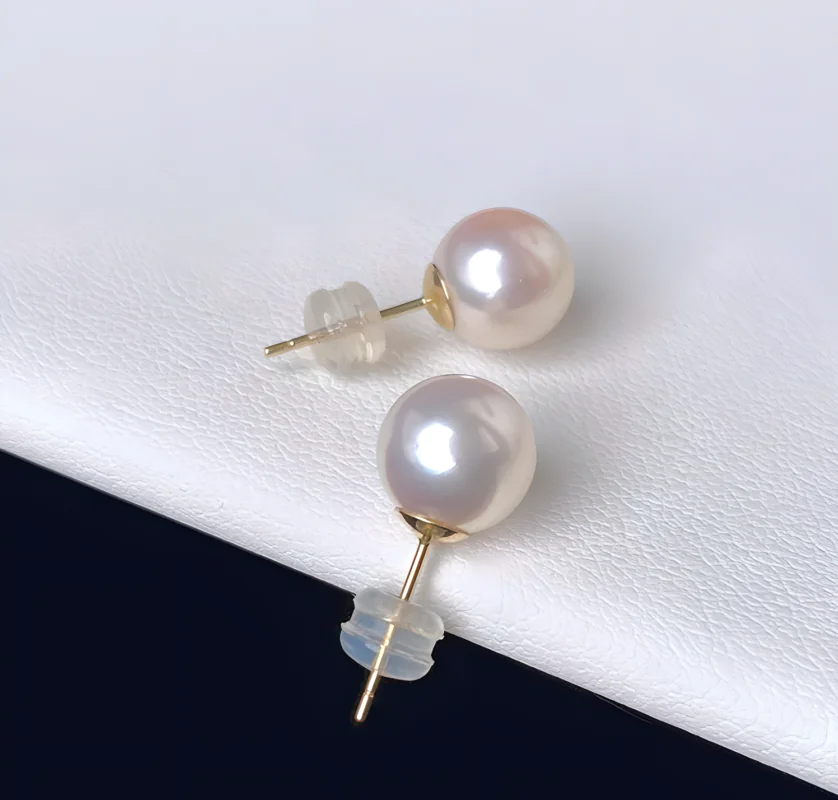
How to Evaluate Nacre Quality: How It Affects Pearl Durability
Nacre quality affects both how a pearl looks and how well it is likely to hold up over time. But evaluating nacre is not as simple as asking whether it is “thick.” For bead-cultured pearls, thickness is important, while the continuity and condition of the nacre also matter. A pearl can have attractive color and shape yet still be less desirable if its nacre is thin, damaged, cracked, or structurally uneven.
For a buyer, the practical goal is not to measure nacre with the naked eye. It is to recognize visual warning signs, understand which pearl types need to be judged differently, and know when an apparent surface issue may indicate a genuine durability concern.
What Is Nacre?
Nacre is the material deposited by a pearl-producing mollusk as a pearl grows. It is made from microscopic calcium-carbonate structures combined with an organic matrix and arranged in many layers. These layers are responsible for much of the optical character associated with pearls, including their glow, reflections, and in some pearls, orient.
In a bead-cultured pearl, nacre grows around an inserted bead nucleus. In many traditional tissue-nucleated freshwater cultured pearls, there is no large shell bead in the center, so the finished pearl is composed almost entirely of nacre.
This difference matters. When evaluating a bead-cultured Akoya, Tahitian, South Sea, or bead-nucleated freshwater pearl, the thickness of the nacre coating over the nucleus is an important concern. Applying exactly the same “nacre thickness over a bead” logic to a tissue-nucleated freshwater pearl would be misleading.
If you want to understand why these structures differ, start with the pearl formation process and the separate guides to traditional non-bead freshwater cultured pearls and bead-nucleated freshwater pearls.
Nacre Quality Is More Than Nacre Thickness
One of the most useful distinctions for buyers is that nacre thickness and nacre quality are related, but they are not identical concepts.
Historically, consumer explanations often reduced nacre evaluation to a simple formula: thicker nacre is better and thin nacre is worse. Thickness remains important, particularly in bead-cultured pearls, but professional evaluation has become more nuanced.
In 2025, GIA expanded its nacre classification from the previous Acceptable/Unacceptable approach to five ranges: Excellent, Very Good, Good, Fair, and Poor. The updated approach considers visible structural and textural features related to nacre continuity, while also taking thickness and the condition of the nacre into account.
This distinction is important because a pearl may have sufficient nacre thickness yet still show disrupted layering, subsurface cracks, damage, or other structural features. Conversely, a pearl should not automatically be called poor simply because it has one harmless surface irregularity.
| Nacre factor | What it means | Why it matters |
|---|---|---|
| Thickness | How much nacre covers the nucleus in a bead-cultured pearl | Very thin nacre can reduce luster and make the underlying bead more vulnerable to becoming visible as the pearl wears |
| Continuity | How consistently the nacre has formed without significant structural disruptions | Major disruptions or subsurface cracking may affect appearance and, in some cases, durability |
| Condition | The present state of the nacre, including wear or damage | Peeling, chipping, cracking, or severe abrasion can indicate an already-compromised surface |
How Nacre Quality Affects Pearl Durability
The durability concern is easiest to understand with a bead-cultured pearl. The bead nucleus forms most of the interior, while the nacre forms the visible outer shell. If that shell is excessively thin or becomes damaged, there is less material between normal wear and the nucleus beneath it.
Over time, vulnerable nacre may show wear, chipping, peeling, or areas where the nucleus becomes easier to see. The area around a drill hole deserves particular attention because the edge of the nacre is exposed and the pearl may also experience friction from stringing materials, knots, pins, or jewelry components.
However, nacre thickness should not be confused with hardness. Even a pearl with excellent nacre is still relatively soft compared with many gemstones and metals. Better nacre does not make a pearl scratch-proof or immune to chemicals, heat, dehydration, or abrasion.
That is why pearl durability has two parts: the quality of the pearl when you buy it and the way it is treated afterward. Strong nacre gives the pearl a better structural starting point, while appropriate handling helps preserve it. The pearl care guide explains how cleaning, storage, cosmetics, heat, and friction can affect pearls during wear.
What Does Good Nacre Look Like?
You cannot reliably determine an exact nacre thickness just by looking at a pearl. You can, however, use several visual clues to screen for obviously weak or damaged nacre.
1. Look at the quality of the reflection
Good nacre and good luster are closely related. Under soft white light, a high-luster pearl usually shows bright, relatively sharp reflections rather than a flat, chalky glow.
Rotate the pearl rather than judging it from one stationary angle. Good reflections should remain lively as the pearl moves. A very dull or chalky appearance on a bead-cultured pearl can be a warning sign, particularly when combined with other evidence of thin nacre.
Luster alone is not a measurement of nacre thickness, though. Pearl type, surface texture, nacre structure, and other factors also affect the way reflections appear. Treat luster as an important clue, not as proof.
2. Check whether the nucleus appears to show through
In a bead-cultured pearl with very thin nacre, the underlying nucleus can sometimes influence the surface appearance. You may notice a chalky quality, uneven translucency, or visual evidence of the bead beneath the outer layer.
This is more concerning than a simple pinpoint or minor growth mark because it suggests that the visible nacre coating itself may be insufficient.
3. Inspect for peeling, flaking, or missing nacre
Peeling nacre is different from a harmless surface blemish. If layers appear to be lifting, separating, flaking, or already missing, the issue is structural rather than merely cosmetic.
Similarly, a chip that exposes a different-looking material underneath deserves more attention than a shallow natural pit. Once material has already been lost, the pearl's current condition has been compromised even if the rest of its surface remains attractive.
4. Look for cracks and subsurface lines
Some pearls display cracks or fissures within or immediately below the nacre. Under strong directional lighting, these may appear as lines beneath the surface rather than as ordinary scratches sitting on top of it.
Not every line means that a pearl is about to fail. Growth features can be complex, and visual inspection alone cannot always determine their depth. But obvious open cracks or extensive subsurface cracking deserve more caution because some internal disruptions can create durability concerns.
5. Separate texture from actual damage
A pearl can have ridges, shallow depressions, wrinkles, hammer-like texture, or irregular growth patterns without actively peeling apart. These features may affect the apparent smoothness of the nacre and can soften or distort reflected light, but their significance varies.
This is one reason surface quality and nacre quality should not be treated as the same thing. A small pit may primarily affect appearance. A subsurface crack or area of separating nacre may have a much stronger durability implication.
A Practical Five-Step Nacre Inspection
When comparing pearls in person, this simple sequence is more useful than trying to assign your own laboratory-style nacre grade.
- Identify the pearl type first. Determine whether you are evaluating a bead-cultured pearl or a predominantly nacreous tissue-nucleated freshwater pearl. The construction changes what “thin nacre” means.
- Use neutral, diffused light. Rotate the pearl and look at the brightness and sharpness of its reflections. Avoid judging only under highly flattering jewelry-store spotlights.
- Look for thin-nacre warning signs. On bead-cultured pearls, pay attention to chalkiness, obvious bead show-through, or unusually weak and shallow-looking reflections.
- Inspect structural weak points. Check the surface and, where visible, the drill-hole area for cracks, chips, peeling, missing nacre, or significant abrasion.
- Compare like with like. Compare Akoya with similar Akoya pearls, South Sea with South Sea, and so on. Different pearl varieties naturally produce different optical appearances and nacre structures.
For an expensive pearl where nacre thickness, internal structure, origin, or condition materially affects the purchase decision, visual inspection should be treated as screening rather than definitive measurement. Appropriate gemological examination can provide information that cannot be established reliably from photographs or naked-eye inspection alone.
Nacre Quality vs. Luster: Do Not Treat Them as the Same Grade
A common shortcut is to say that a lustrous pearl automatically has excellent nacre. The relationship is real, but the conclusion is too strong.
Luster describes the quality of light reflected from and within the pearl. Nacre quality describes characteristics of the nacre itself. Strong, well-formed nacre often supports attractive luster, while very thin or disrupted nacre can weaken it. But they remain separate factors when evaluating pearl quality.
The practical rule is therefore:
- Strong luster is a positive nacre clue, not proof of perfect nacre.
- Dullness on a bead-cultured pearl can be a warning sign, but should be considered with other observations.
- Visible peeling, chips, missing nacre, or serious cracks deserve more attention than luster alone.
For the broader relationship between nacre, luster, surface, shape, size, color, and matching, see the guide to evaluating pearl value.
Freshwater Pearls Need a Different Nacre Conversation
This is where many simplified pearl guides become inaccurate.
Traditional tissue-nucleated freshwater cultured pearls do not contain the large central shell bead found in typical Akoya, Tahitian, or South Sea bead-cultured pearls. They are often composed almost entirely of nacre. For these pearls, asking how thick the “nacre coating over the bead” is does not make much sense because there may be no large bead to coat.
At the same time, buyers should not assume that every modern freshwater pearl is beadless. Bead-nucleated freshwater cultured pearls are increasingly common, particularly among larger and highly round products. Those pearls do have a nucleus surrounded by nacre, so nacre thickness becomes relevant again.
The correct approach is therefore to understand the cultivation structure before drawing conclusions from generic statements such as “freshwater pearls have thick nacre.” Pearl technology has evolved, and the market now contains multiple freshwater culturing methods.
Does Better Nacre Mean a Pearl Will Last Forever?
No. Good nacre improves the pearl's ability to retain its appearance and reduces some structural concerns associated with excessively thin or damaged nacre, but it cannot eliminate normal pearl vulnerabilities.
Pearls can still be scratched by harder jewelry materials, abraded by repeated friction, damaged by excessive heat, or affected by chemicals and acids. A thick-nacre pearl that is handled carelessly can deteriorate, while a well-cared-for pearl with sound nacre can remain attractive for many years.
If durability is your priority, consider nacre quality together with the pearl's current surface condition, the jewelry design, how often the piece will be worn, and how exposed the pearl will be to impact or friction. A pearl ring, for example, usually experiences more contact than a pendant.
For more background on why pearls behave differently from harder gemstones, see the physical and chemical properties of pearls.
What Matters Most When Evaluating Nacre?
The most useful rule is to stop treating nacre as a single thickness number. For bead-cultured pearls, adequate thickness is important, but the continuity and present condition of the nacre also matter. Look for healthy reflections and an intact surface, then give extra attention to chalkiness, visible nucleus show-through, peeling, missing nacre, and cracks.
Also identify the pearl's construction before judging it. Tissue-nucleated freshwater pearls and bead-cultured pearls cannot always be evaluated with exactly the same nacre framework.
For everyday buying, visual inspection can help you reject obvious problems. For high-value pearls or cases where an exact determination matters, professional gemological evaluation is more reliable than trying to infer nacre thickness or internal structure from appearance alone.
FAQ
Is thicker nacre always better?
Adequate thickness is especially important for bead-cultured pearls, but thickness alone does not define nacre quality. Continuity, structural features, existing damage, and overall condition also matter. A sufficiently thick nacre layer can still contain cracks or other disruptions.
Can you tell nacre thickness by looking at a pearl?
You can recognize some warning signs of excessively thin nacre, such as a dull or chalky appearance and possible nucleus show-through in bead-cultured pearls. However, naked-eye inspection cannot reliably provide an exact nacre-thickness measurement.
Does high luster mean a pearl has good nacre?
High luster is generally a positive sign because luster and nacre quality are closely related. It should still be considered alongside surface condition, nacre continuity, pearl type, and any evidence of cracking, peeling, or damage.
Do freshwater pearls have thicker nacre than saltwater pearls?
Many traditional tissue-nucleated freshwater cultured pearls are composed almost entirely of nacre because they do not contain a large bead nucleus. However, modern bead-nucleated freshwater pearls are also common, so the answer depends on how the particular pearl was cultured.
What nacre problems are most concerning for durability?
Very thin nacre in a bead-cultured pearl, obvious peeling or missing nacre, significant chips, open cracks, and serious subsurface cracking deserve more attention than minor shallow growth marks that affect appearance only.