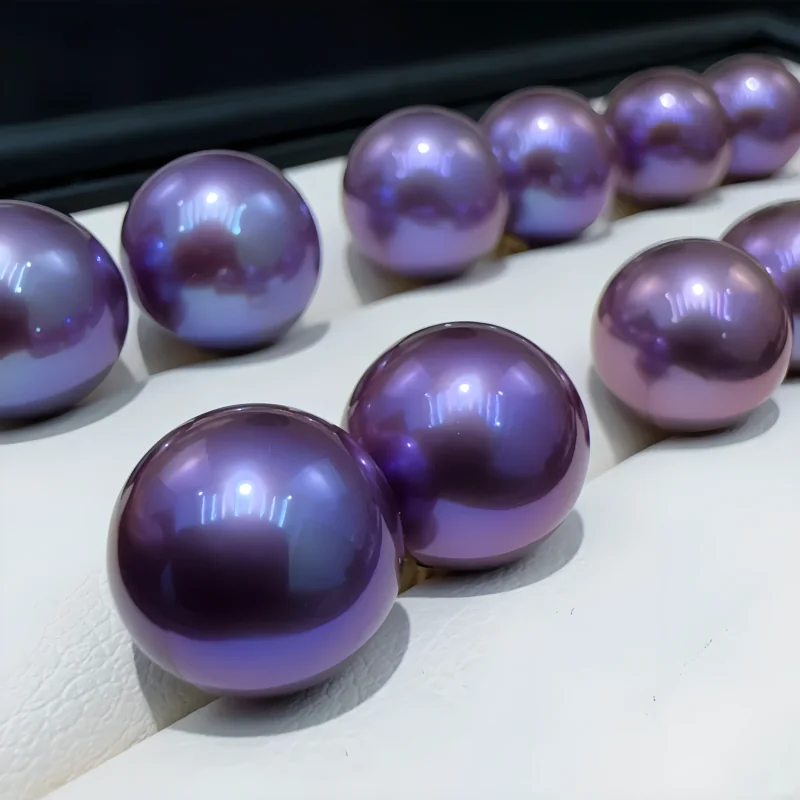
Drilling does not automatically make a pearl less valuable. For most cultured pearls intended for necklaces, bracelets, earrings, pendants, or rings, drilling is a normal part of jewelry preparation. A clean, correctly positioned hole may have little negative effect on the pearl’s commercial value because the pearl is being prepared for the use it was selected for.
What can reduce value is poor, excessive, or inappropriate drilling: chipped nacre, cracking, an oversized hole, a crooked drilling axis, a second abandoned hole, or a hole that forces the pearl to display its weaker side. The context also matters. An ordinary cultured pearl prepared for a strand should not be evaluated in the same way as a rare natural pearl being preserved as a loose gem.
The most important distinction is therefore not simply drilled versus undrilled. It is what kind of pearl is being evaluated, why it was drilled, how well the work was done, and whether the drilling changed characteristics that buyers actually value.
If you first want the practical reason pearls are drilled, see our guide to why pearls are drilled. Here, the question is narrower: does that hole change what the pearl is worth?
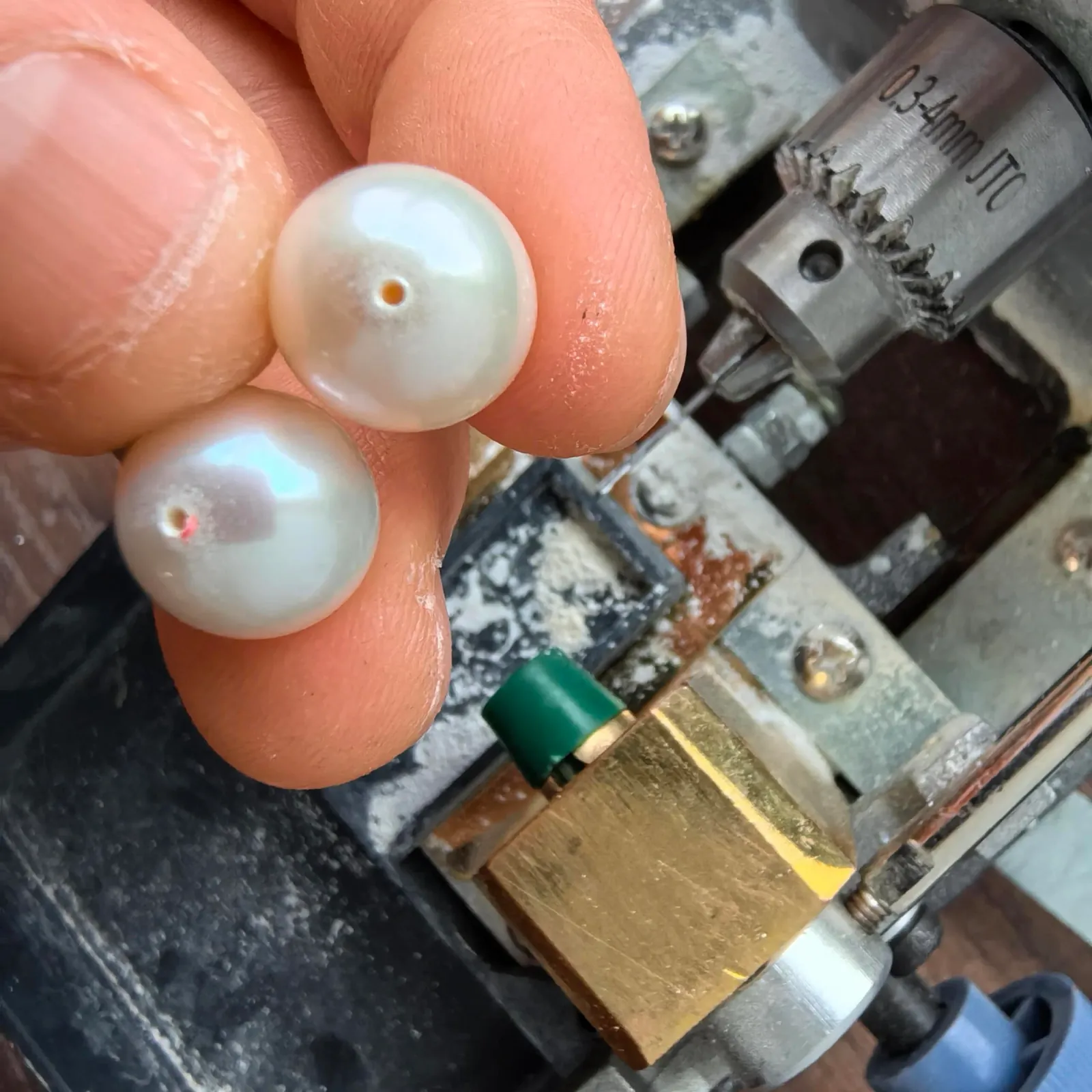
Quick answer: when does drilling matter to value?
| Situation | Typical effect on value | Why |
|---|---|---|
| Well-drilled cultured pearl for a necklace or bracelet | Usually little or no negative effect from drilling alone | Through-drilling is normal preparation for stringing. |
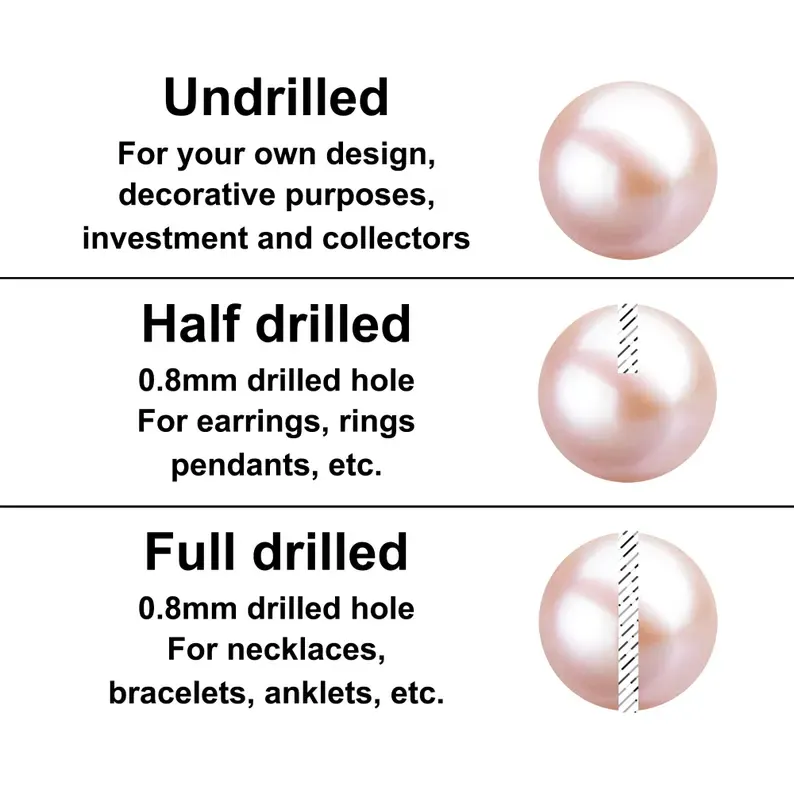
| Well-executed half-drilled cultured pearl for a stud, ring, or pendant | Usually little or no negative effect from drilling alone | The partial hole is part of the intended setting system. |
| Undrilled cultured pearl | Not automatically more valuable | It preserves design flexibility, but quality still depends on the pearl itself. |
| Chipped, cracked, crooked, or badly enlarged drill hole | Can reduce value | Workmanship may damage appearance, durability, matching, or usability. |
| Rare natural pearl | Drill status can matter more | Weight, condition, preservation, and disclosure may all be relevant. |
| Re-drilled, plugged, or unusually worked pearl | Requires closer evaluation | The alteration may affect condition, weight, identification, or future setting options. |
Drilling is not one of GIA’s seven pearl value factors—but it can affect them
GIA evaluates pearl quality through seven value factors: size, shape, color, luster, surface quality, nacre quality, and matching. “Drilled” and “undrilled” are not separate grades in that framework.
That is an important starting point. A pearl does not become lower grade merely because it has been prepared for jewelry. A highly lustrous, clean, well-shaped cultured pearl does not lose those qualities simply because a precise hole has been made through it.
Drilling can still affect value indirectly. A chipped opening changes the surface condition. A crack can become a durability concern. A badly placed hole can make an oval, drop, button, or baroque pearl hang at the wrong angle. In a strand, inconsistent drilling can disturb alignment and matching. In other words, the hole matters when it changes one of the things the market actually cares about.
For a broader explanation of those underlying quality factors, see our Pearl Grading Guide and our guide to evaluating pearl value.
The biggest distinction: cultured pearls and natural pearls should not be treated the same
For ordinary cultured pearls, value is usually discussed primarily through millimeter size and visible quality rather than the pearl’s weight. That is one reason normal jewelry drilling is commonly accepted as part of production.
Natural pearls can be different. In a 2024 update from the CIBJO Pearl Commission, the organization stated that drilling of natural pearls should be described in transactions. CIBJO specifically noted that drilling can reduce a natural pearl’s weight, which can be linked to its value, and that buyers should be informed about drill-hole condition such as plugged, narrow, or wide holes. The same update contrasted this with cultured pearls, whose value is generally linked to size rather than weight.
This does not mean every drilled natural pearl has low value. Important natural pearl jewelry routinely contains drilled or half-drilled pearls. Major auction houses also describe natural pearls as undrilled, half-drilled, partially drilled, or drilled in their catalogues. The point is that, for rare natural pearls, drilling status becomes part of the condition and provenance picture rather than being treated as an invisible manufacturing detail.
So the practical rule is:
For common cultured jewelry pearls, ask whether the drilling is appropriate and well executed. For rare natural pearls, also ask exactly what drilling has been done and whether it has been disclosed and documented.
1. Chipped or cracked drill holes can lower value
The most obvious value problem is visible damage around the opening. A clean drill hole should have a controlled edge. If nacre has broken away, flaked, cracked, or fractured around the entry or exit, the pearl now has a workmanship defect that did not exist before drilling.
This matters for both appearance and durability. GIA notes that pearl surface characteristics such as chips and cracks can reduce value, especially when they are severe enough to threaten durability. GIA also points out that minor characteristics located near a drill hole or mounting may matter less visually because they can be less noticeable in the finished piece.
That creates a useful distinction: a drill hole can hide a minor pre-existing blemish without improving the pearl’s original quality, but drilling damage that creates a new chip or crack is a separate negative condition.
The area around the opening deserves extra attention because the edge of the nacre is exposed there. Our guide to nacre quality and pearl durability explains why damaged, thin, or disrupted nacre can be more vulnerable around drill holes.
2. Hole placement can change how valuable the pearl is for a specific design
Pearls are not visually identical from every direction. Even a round pearl may have one side with stronger luster, fewer surface marks, or a more attractive overtone. Shape makes orientation even more important for drops, buttons, ovals, circled pearls, and baroque pearls.
A well-positioned hole allows the finished jewelry to show the pearl’s best face. A poorly positioned hole can do the opposite: the cleanest side may rotate away from the viewer, a drop may hang off-axis, or a baroque pearl may appear visually unbalanced.
This is why an off-center hole can reduce commercial usefulness even when it has not visibly cracked the nacre. The pearl may still be beautiful, but fewer designs can use it successfully without reworking the hole or accepting an awkward orientation.
For custom production, drilling direction should therefore be decided together with the intended setting, pin, thread, or cord. Our Drilling & Pearl Preparation page lists the specifications worth confirming before a pearl is prepared.
3. An oversized hole can remove more material than the design needs
Hole size should match the intended construction. A strand needs enough clearance for its thread or wire. A half-drilled pearl needs a hole compatible with its post or peg. Making the opening much larger than necessary removes extra material and can leave less support around the hole.
For most cultured pearls, there is no universal rule saying that a particular hole diameter causes a fixed percentage loss in value. Such a rule would be misleading because pearl size, nacre condition, construction, and final use all vary.
The safer valuation principle is qualitative: the more unnecessary material that is removed, and the more the alteration limits secure use or creates visible damage, the more likely it is to hurt value.
With natural pearls, oversized or widened holes deserve even closer attention because drilling can also affect weight. CIBJO’s recommendation to disclose the condition of natural-pearl drill holes reflects this additional concern.
4. Re-drilling or a second hole can reduce flexibility and raise condition questions
A misplaced first hole cannot truly be “undone.” A pearl can sometimes be re-drilled, enlarged, plugged, capped, or oriented so that earlier work is hidden, but these solutions do not restore the pearl to an undrilled state.
A second hole may make a pearl harder to use in a different design. It can also create additional exposed edges where nacre must remain intact. For a routine low-cost cultured pearl, the practical consequence may be small. For a high-value loose pearl, unusual alteration deserves more scrutiny.
This is one reason undrilled pearls are useful in custom jewelry: they preserve the jeweler’s ability to choose the final axis, depth, and hole size after the design has been decided. That flexibility has value, but it should not be confused with a universal “undrilled premium.”
5. Drilling can matter to gemological identification in unusual high-value cases
There is another, more specialized reason drill status can matter: a hole passes through internal structure.
GIA has documented difficult non-bead cultured pearl cases in which drilling removed or intersected small internal features that were useful for identification. In those cases, determining natural versus cultured origin became more challenging and required careful X-ray orientation or advanced imaging.
This is not a reason for ordinary pearl buyers to fear normal jewelry drilling. Most cultured pearls are bought and sold with no such identification problem. But it shows why a rare pearl should not be altered casually before laboratory work is complete. For an important natural-pearl candidate, preserving the pearl’s existing condition can help protect both physical material and diagnostic information.
Are undrilled pearls always worth more?
No. Undrilled describes preparation, not quality.
An undrilled pearl can have weak luster, a heavily marked surface, poor shape, thin or disrupted nacre, or an undesirable color. A drilled pearl can have exceptional luster, excellent surface quality, attractive shape, and fine matching. The presence of a hole does not reverse those differences.
Undrilled pearls are especially useful when:
- the final jewelry design has not yet been chosen;
- the pearl has one particularly attractive face that should determine orientation;
- the hole diameter or depth must match a custom finding;
- the pearl is unusual, rare, or valuable enough that unnecessary alteration should be avoided; or
- a collector wants the pearl preserved in its current state.
For a maker who already knows that a pearl will become part of a strand, a properly full-drilled pearl may actually be more useful than an undrilled one. For a pair of stud earrings, accurately half-drilled matched pearls may be exactly the preparation required.
The relevant question is not “Which is better, drilled or undrilled?” It is “Which preparation preserves the quality and usefulness of this particular pearl for its intended market?”
Can drilling ever make a pearl look more valuable?
It can improve presentation, but that is not the same as increasing the pearl’s underlying quality.
GIA notes that a minor surface characteristic has less effect on appearance and value when it is positioned near a drill hole or mounting where it becomes less noticeable. Pearl processors and jewelers can therefore choose an orientation that places a small blemish close to the hole, under a cap, or toward a less visible side.
This is legitimate jewelry planning when it is simply choosing the best orientation for a naturally imperfect pearl. It does not mean the blemish disappeared, and it should not justify misrepresenting the pearl as having a cleaner original surface than it actually does.
A similar principle applies to matching. Good drilling can help a strand sit evenly and present a consistent face. That can improve the finished jewelry’s appearance even though drilling did not change the pearl’s luster, color, or nacre quality.
How to inspect drill-hole quality before buying
If you are buying loose drilled pearls, strands, or custom-ready pairs, the drill hole is worth checking under magnification or in sharp close-up photographs.
| Check | What you want to see | Why it matters |
|---|---|---|
| Hole edge | Clean opening without obvious chips, flaking, or cracks | Reduces visible workmanship defects and structural concerns. |
| Alignment | Hole follows the intended axis of the pearl | Helps strands sit evenly and shaped pearls face correctly. |
| Diameter | Appropriate for the intended thread, wire, peg, or pin | Avoids unnecessary material removal or an insecure fit. |
| Entry and exit | No severe breakout on a fully drilled pearl | The exit side can reveal poor drilling control. |
| Extra holes | No unexplained abandoned or duplicate drilling | Extra work may limit future use or raise condition questions. |
| Visible face | The drilled orientation presents the pearl attractively | Orientation affects the beauty of the finished jewelry. |
| Rare natural pearl documentation | Drill status and condition described clearly | Weight, condition, and identification can be more important in this market. |
What should different buyers prioritize?
If you are buying finished pearl jewelry
Do not reject a necklace, bracelet, pair of studs, or pendant simply because the pearls are drilled. They normally have to be. Focus on the overall pearl quality, how cleanly the piece is made, whether the pearls sit correctly, and whether there is visible cracking or chipping around the holes.
If you are a jewelry maker or designer
Decide the drilling specification before preparation whenever possible. Hole diameter, depth, axis, intended face, and the finding or stringing material should work together. If the design is not fixed, undrilled pearls preserve more options.
For makers sourcing pearls by strand, pair, or loose piece, our wholesale pearl selection and pearl services cover sourcing, matching, drilling, and production inquiries.
If you are buying a rare natural or collectible pearl
Preservation and documentation become more important. Confirm whether the pearl is undrilled, half-drilled, fully drilled, widened, plugged, or otherwise worked. If natural origin or high value depends on laboratory identification, testing before further alteration is the safer order.
Does drilling happen before or after pearl grading?
There is no single universal sequence for every pearl operation. Pearls may be sorted several times, drilled at different stages depending on their intended use, and then re-sorted or matched for final products.
This matters because drilling status can itself become part of commercial sorting. A lot intended for necklaces may be prepared differently from matched pairs for earrings or undrilled loose pearls for custom jewelry.
For the broader sequence from harvest to jewelry preparation, see our post-harvest pearl processing workflow.
FAQ
Do drilled pearls have less value?
Not automatically. For most cultured pearls used in jewelry, drilling is normal preparation. Value is more likely to fall when the drilling creates chips, cracks, poor alignment, an oversized opening, or other damage that affects appearance, durability, or usability.
Are undrilled pearls always more valuable?
No. Undrilled pearls preserve design flexibility, but “undrilled” is not a quality grade. Luster, surface, shape, size, color, nacre quality, rarity, and matching still matter more to the pearl’s overall quality and market desirability.
Does drilling damage pearl nacre?
Drilling necessarily removes a small amount of material, but careful drilling is a normal jewelry-making process. The concern is poor execution: chipped nacre, cracks, flaking, excessive enlargement, or a badly aligned hole can create a real condition problem.
Does the size of a pearl drill hole affect value?
It can. A hole should be large enough for the intended thread, wire, peg, or post but not unnecessarily large. An oversized hole can remove extra material, weaken the area around the opening, limit compatible settings, and—especially for natural pearls—affect weight.
Does drilling affect natural pearl value more than cultured pearl value?
It can. CIBJO specifically recommends disclosure of drilling in natural-pearl transactions because drilling can change weight and condition, both of which may matter to value. For ordinary cultured pearls, drilling is generally treated as normal jewelry preparation when it is properly executed.
Can a drill hole hide a pearl blemish?
Yes, a jeweler can sometimes orient a pearl so a minor surface mark sits near a drill hole or under a mounting and becomes less visible. That can improve presentation, but it does not erase the pearl’s original surface characteristic or change its underlying nacre quality.
The key takeaway
Drilling affects pearl value only when the drilling changes something that matters. For most cultured jewelry pearls, a clean and appropriate hole is simply part of making the pearl usable. It does not automatically turn a fine pearl into a lower-value pearl.
Value becomes more sensitive when the hole is chipped, cracked, crooked, oversized, repeated, or badly oriented; when the pearl loses useful design options; or when the pearl is a rare natural specimen whose weight, preservation, and documented condition matter more strongly.
So when comparing two pearls, do not ask only whether one is drilled and the other is not. Ask a better set of questions: Is the pearl itself high quality? Was the drilling done well? Does it suit the intended jewelry? And, if the pearl is rare or natural, has the alteration been fully documented?
References and further reading
- GIA — Pearl Quality Factors — GIA’s seven-factor framework for size, shape, color, luster, surface, nacre, and matching.
- GIA — Pearls Forever Fashionable — discussion of surface characteristics, drill-hole location, durability, and value.
- CIBJO — Pearl Commission 2024 update — disclosure guidance for drilling of natural pearls and the distinction between weight-based natural-pearl considerations and size-based cultured-pearl value.
- CIBJO — Guide for Classifying Natural Pearls and Cultured Pearls — industry terminology and classification context.
- GIA Gems & Gemology — Fine Linear Structures in Non-Bead Cultured Pearls — examples showing how drilling can intersect or remove diagnostic internal structures.
- Christie’s — Natural Pearl and Diamond Earrings — auction example explicitly describing two natural saltwater pearls as half drilled.
- Christie’s — Pair of Natural Pearl, Jade and Diamond Brooches — auction example explicitly documenting undrilled natural saltwater pearls.