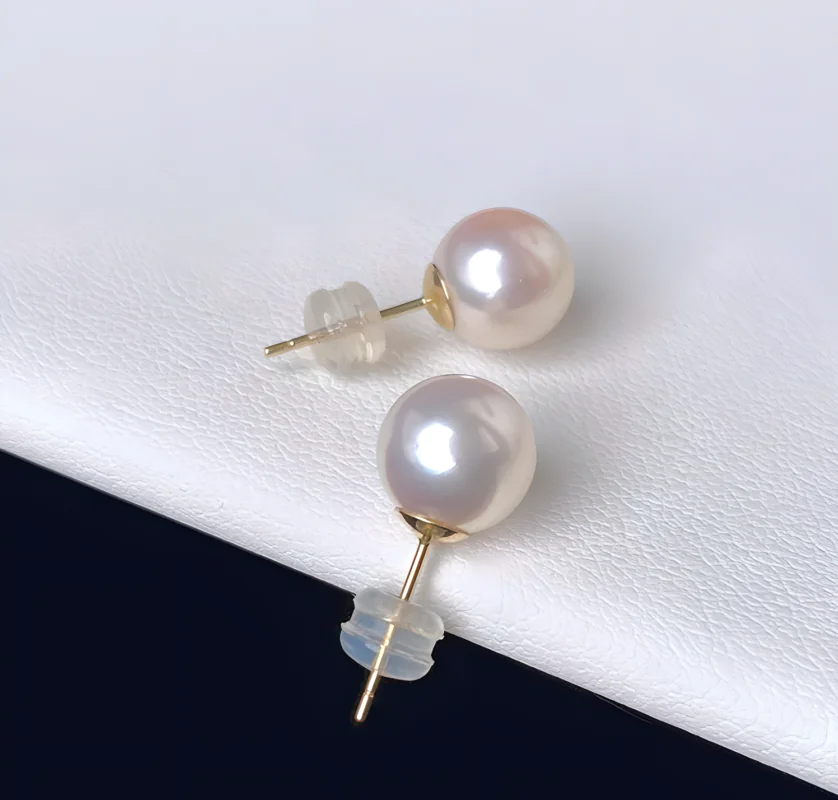
Yes—many white and light-colored Akoya cultured pearls are routinely bleached after harvest. Bleaching is used to reduce organic stains, unwanted yellowish or uneven coloration, and other pigments that can develop during pearl formation. In traditional Japanese Akoya processing, it is often one step in a longer sequence that may also include drilling, maeshori-type pretreatment, and optional color adjustment.
But the useful answer is not “all Akoya pearls are bleached.” Akoya pearls naturally occur in a wider range of colors than the classic bright-white strand suggests, and some natural-color Akoya—especially blue, gray, cream, or other unusual material—may be sold with different processing histories. The safest rule is therefore: bleaching is very common in commercial white Akoya, but treatment status should be confirmed rather than guessed from appearance or a marketing name.
It is also important to separate three different ideas: bleaching does not make a cultured pearl fake, bleaching is not the same as dyeing, and “no color adjustment” does not necessarily mean “completely untreated.”
Quick Answer: What Does “Bleached Akoya” Actually Mean?
| Term | What it usually means | What it does not automatically mean |
|---|---|---|
| Bleached Akoya | A bleaching agent was used to remove or reduce unwanted color, staining, or pigments | Fake pearl, imitation pearl, or poor quality |
| Maeshori | A Japanese umbrella term for pretreatment or luster-enhancement processes; methods can vary | Exactly the same process as bleaching |
| Choshoku | A subtle post-bleaching color adjustment, traditionally used to restore or add a reddish/rose tone | Full-color dyeing that turns the pearl into an obviously different color |
| Muchoshoku | No final choshoku color-adjustment step | Untreated, unbleached, or exactly as harvested |
| Natural-color Akoya | The visible bodycolor is presented as naturally produced by the oyster | Proof that no other post-harvest process was used |
This distinction matters because Akoya treatment vocabulary is often simplified in retail listings. A buyer may see phrases such as “natural white,” “untinted,” “uncolored,” or “Muchoshoku” and assume all of them mean no treatment of any kind. They do not necessarily mean the same thing.
Why Are Akoya Pearls Bleached?
Akoya pearls do not all leave the oyster as evenly matched, bright white spheres. During cultivation, organic material, pigments, and staining can affect the appearance of the nacre. Freshly harvested pearls may show cream, yellowish, greenish, grayish, or uneven tones even when the underlying pearl has good luster and attractive nacre.
Bleaching is used to reduce some of this unwanted coloration and make light-colored pearls cleaner and easier to match. The Japan Pearl Promotion Society describes bleaching as a treatment that removes oyster secretions, impurity stains, and pigments produced during pearl formation. For Akoya cultured pearls, the process is commonly performed after drilling, allowing a diluted bleaching solution to penetrate into the nacre more effectively.
Historically and in modern gemological literature, hydrogen peroxide is the bleaching agent most often associated with Akoya processing. The exact factory method can vary, but controlled light, temperature, solution strength, pH, and treatment time can all affect the result.
That is why the bright white Akoya look should not automatically be interpreted as the untouched color of the pearl at harvest. It is often the result of cultivation quality plus careful post-harvest preparation.
For the broader biological side of the pearl type, see our Akoya pearl guide.
Is Bleaching the Same as Dyeing?
No. Bleaching and dyeing change color in different directions and for different purposes.
Bleaching removes or reduces unwanted coloration. Dyeing adds color. A white Akoya pearl may be bleached to look cleaner or lighter, while a black, vivid blue, strong gold, or other unusual Akoya color may involve dyeing, irradiation, chemical alteration, or another color-treatment method depending on the product.
| Process | Main purpose | Typical result |
|---|---|---|
| Bleaching | Reduce stains, pigments, or unwanted color | Lighter, cleaner, more even appearance |
| Tinting / choshoku | Make a subtle color adjustment | Often a softer rose or reddish overtone |
| Dyeing | Add or substantially alter color | Can create black, blue, gold, or fashion colors |
| Optical brightening | Increase perceived whiteness or brightness through fluorescence | A brighter-looking white under certain lighting |
| Maeshori-type treatment | Improve or modify luster and appearance before or alongside later processing | Brighter, cleaner-looking surface appearance depending on the method |
If you want the broader treatment framework, our pearl treatments guide separates bleaching, dyeing, irradiation, tinting, coating, luster enhancement, and other processes in more detail.
How Is Akoya Bleaching Done?
There is no single universal recipe used by every Akoya processor, and commercial details can be proprietary. However, authoritative Japanese and gemological sources describe a broadly recognizable approach.
- The pearls are cleaned and prepared. In Japanese processing, maeshori or other preparation may be used before bleaching.
- Akoya pearls are commonly drilled before bleaching. The drill hole can help the solution reach material below the outer surface.
- A controlled bleaching solution is used. Hydrogen peroxide diluted with water, alcohol, or another medium is commonly described in the literature.
- Light and temperature may be controlled. Light can increase the bleaching effect, while concentration, pH, temperature, duration, and light intensity must be balanced carefully.
- The pearl may receive later finishing or color adjustment. Depending on the desired product, this can include choshoku, polishing, matching, or other processing.
The important point is that successful bleaching is not simply “soaking pearls in a strong chemical until they turn white.” Skilled processing aims to improve appearance while preserving the nacre. Overprocessing can do the opposite.
Can Bleaching Damage an Akoya Pearl?
Yes, if the treatment is excessive or poorly controlled. This is one reason bleaching should be understood as a technical process rather than a harmless cosmetic word.
The Japan Pearl Promotion Society warns that immature technique or excessive treatment can cause problems such as nacre cracking, mottling, or surface roughening. Gemological literature likewise notes that processors must balance whitening against the risk of damaging the pearl.
That does not mean a properly bleached Akoya pearl is automatically fragile. Bleaching is widely used in the trade, and many fine Akoya pearls have been processed this way. The more accurate distinction is between controlled treatment and over-treatment.
A pearl's durability and beauty still depend on its original nacre quality, cultivation history, surface condition, treatment quality, drilling, jewelry construction, and later care. Treatment cannot turn fundamentally weak nacre into fundamentally strong nacre.
When comparing finished pearls, continue to judge the ordinary quality factors—especially luster, surface condition, nacre quality, shape, color, and matching. Our pearl grading guide explains how to evaluate those characteristics without reducing quality to one treatment label.
Does Bleaching Make an Akoya Pearl Fake?
No. A bleached Akoya cultured pearl is still a genuine cultured pearl.
“Cultured” describes how the pearl formed: a living mollusk produced nacre after human-assisted nucleation and grafting. “Bleached” describes something that happened after harvest. These are different parts of the product description.
An imitation pearl is different again. It is a man-made bead or object designed to look like a pearl but not produced as a natural or cultured pearl inside a mollusk.
So bleaching does not erase the pearl's biological origin. What changes is the treatment history of its appearance. The commercial question is therefore not whether the pearl is “real,” but whether the treatment has been represented accurately.
What Does “Muchoshoku” Mean? It Does Not Mean Untreated
This is one of the most useful distinctions for Akoya buyers.
In Japanese pearl terminology, choshoku refers to a subtle color-adjustment step used after bleaching, traditionally to restore or introduce a reddish or rose tone. Muchoshoku means that this final color-adjustment step was not performed.
It does not automatically mean the pearl was never bleached.
The Japan Pearl Promotion Society specifically cautions against claims that Muchoshoku pearls are simply “the natural color as harvested.” Its guidance explains that these pearls stop at the bleaching stage without the final choshoku step. In other words, a pearl can be both bleached and Muchoshoku.
This is why labels such as “uncolored,” “untinted,” “natural white,” and “untreated” should not be treated as interchangeable unless the seller explains exactly which processing steps were or were not used.
Are “Natural White Akoya” Pearls Unbleached?
Not necessarily. “Natural white” is a marketing phrase, not a complete treatment history.
A pearl may be sold as “natural white” because it received no pinking or choshoku adjustment, because its final appearance is meant to look naturally white, or because the seller is using the phrase more loosely. None of those possibilities proves that bleaching was absent.
If an untreated claim materially affects the price, ask the seller to define it:
- Was the pearl bleached?
- Was maeshori or another luster-enhancement process used?
- Was optical brightening used?
- Was choshoku, tinting, or dyeing used?
- Is the claim based on supplier documentation, laboratory testing, or only trade description?
These questions are more useful than asking only, “Is this pearl natural white?”
What About Blue, Gray, Cream, or Other Natural-Color Akoya Pearls?
Akoya pearls naturally occur in more than one color family. Cream, yellowish, gray, silver-blue, and other unusual colors can occur without full-color dyeing. Some natural-color Akoya pearls are specifically valued because the producer preserves a color that conventional white-pearl processing might otherwise reduce or modify.
But appearance alone cannot reconstruct the full processing history. A blue or gray Akoya may be naturally colored, treated, or subjected to a combination of processes. Likewise, a white Akoya may be heavily processed, lightly processed, or unusually close to its harvested appearance.
If the color origin is part of what you are paying a premium for, treatment documentation becomes more important. Our guide on how to tell if pearls are real or fake can help with basic identity questions, but treatment origin is a separate issue and may require stronger documentation or gemological testing.
Do Sellers Have to Disclose Akoya Bleaching?
Disclosure depends on the trade standard and jurisdiction, but current international guidance has become more explicit.
CIBJO's current Pearl Book lists bleaching among treatments that require specific treatment information to be declared. This is important because older pearl literature may say that traditional Akoya bleaching was treated as a normal processing step that did not need separate disclosure. That older statement should not be carried forward as though the standard never changed.
In the United States, the FTC Jewelry Guides use a somewhat different framework. Sellers should disclose pearl treatments when they are not permanent, create special care requirements, or have a significant effect on value. The FTC also describes bleaching as a process that lightens and whitens pearls.
For a buyer, the practical rule is simpler than memorizing every standard: if treatment history matters to your buying decision, ask for it explicitly and prefer sellers who answer with specific process names rather than vague phrases such as “enhanced” or “premium processed.”
Why Do Some Older Articles Say Bleaching Does Not Need Disclosure?
Pearl-treatment standards have evolved.
A frequently cited 2007 GIA overview of the cultured-pearl industry described bleaching as part of the traditional Akoya processing sequence and noted that, under the CIBJO rules cited at that time, those traditional steps did not require disclosure. That historical description was accurate for the standard being discussed then.
Current CIBJO guidance is different. Its Pearl Book now places bleaching in the category of treatments requiring specific declaration. CIBJO also highlighted this change publicly in 2024, noting that bleaching is commonplace in Japanese Akoya pearls and should be disclosed through the supply chain.
This is a useful reminder when researching pearls online: an older gemological source can remain technically valuable while its disclosure rules are no longer current.
How Should You Buy Akoya Pearls If Treatment Matters to You?
You do not need to reject a pearl merely because it was bleached. You need to know what you are buying and whether the description matches the price and your priorities.
- Ask what “untreated” means. Does it mean no dye, no choshoku, no bleaching, no optical brightening, no maeshori—or only one of those?
- Separate bleaching from color addition. A bleached white Akoya and a dyed black Akoya are both treated, but they are not equivalent treatments.
- Do not assume Muchoshoku means unbleached. It usually refers specifically to the absence of the final choshoku color adjustment.
- Judge the pearl itself. Strong luster, healthy nacre, surface quality, shape, and matching still matter more than treatment vocabulary alone.
- Request stronger evidence when rarity creates a premium. If you are paying substantially more for an “untreated,” “natural-color,” or unusual-color claim, supplier documentation or a reputable laboratory report may be appropriate.
- For sourcing, ask treatment questions before matching a lot. This is especially useful for designers and wholesale buyers because treatment consistency matters when pearls from different lots will be combined.
If you are sourcing strands or loose material rather than finished jewelry, you can apply the same questions while browsing our wholesale pearls. Treatment history should sit beside size, shape, luster, surface quality, color, nacre, and matching—not replace them.
The Bottom Line
Most commercial white Akoya pearls are likely to have undergone bleaching or related post-harvest processing, but it is too absolute to say that every Akoya pearl is bleached.
Bleaching is used to reduce stains and unwanted pigments and to create a cleaner, more matchable light-colored pearl. It is not the same as dyeing, and it does not make a genuine Akoya cultured pearl fake. At the same time, it is a real treatment, and excessive processing can damage nacre.
The most important vocabulary lesson is this: Muchoshoku does not mean completely untreated, and “natural white” does not by itself prove that bleaching was never used. If treatment status matters, ask which specific processes were used and what evidence supports the claim.
That approach is more useful than dividing Akoya pearls into “processed bad” and “untreated good.” A well-grown, carefully processed pearl can be beautiful and durable. What matters is that the treatment history, quality, and price are understood honestly.
FAQ
Are most white Akoya pearls bleached?
Yes. Bleaching is a very common post-harvest treatment for white and light-colored Akoya cultured pearls. It is used to reduce stains, pigments, yellowish tones, and uneven coloration. However, treatment history can vary, so “most” is safer than claiming every Akoya pearl is bleached.
Does bleaching make Akoya pearls fake?
No. A bleached Akoya pearl is still a genuine cultured pearl produced by a living oyster. Bleaching describes a post-harvest treatment; imitation pearls are man-made products that were not formed as pearls inside a mollusk.
Is bleaching the same as pinking or choshoku?
No. Bleaching removes or reduces unwanted coloration. Choshoku is a separate color-adjustment process traditionally used after bleaching to restore or add a subtle reddish or rose tone.
Does Muchoshoku mean an Akoya pearl is untreated?
No. Muchoshoku generally means the pearl did not receive the final choshoku color-adjustment step. Japanese industry guidance specifically explains that Muchoshoku pearls may still have been bleached.
Can Akoya pearls be naturally blue or gray?
Yes. Akoya pearls can naturally occur in blue, gray, cream, yellowish, and other colors in addition to white. But color appearance alone does not prove treatment history, so valuable natural-color claims may require documentation or laboratory testing.
Can bleaching damage pearls?
Excessive or poorly controlled bleaching can damage nacre, including causing roughness, mottling, or cracking. Proper commercial processing is designed to balance appearance improvement with preservation of the pearl.
Authoritative References
- Japan Pearl Promotion Society — Pearl Standard 2025 / English guidance on maeshori, bleaching, choshoku and Muchoshoku
- GIA Gems & Gemology — Optical Whitening and Brightening of Pearls
- GIA Gems & Gemology — From Single Source to Global Free Market: The Transformation of the Cultured Pearl Industry
- CIBJO — Pearl Book 2024
- CIBJO — Pearl bleaching should be disclosed in transactions
- U.S. Federal Trade Commission — In the Loupe: Advertising Diamonds, Gemstones and Pearls