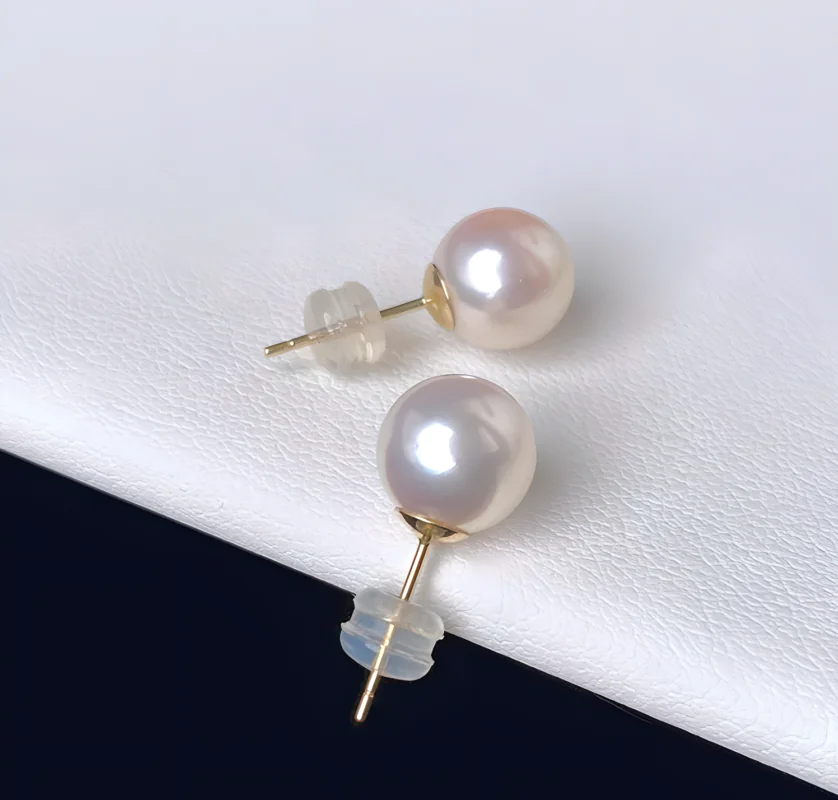
On a Limited Budget, Should You Choose Akoya Pearls or High-Luster Freshwater Pearls?
If your budget is limited, high-luster freshwater pearls are often the better value when your priority is visible beauty for the money. Akoya becomes the stronger choice when you specifically want very crisp reflections, consistently round shapes, tight matching, and the traditional refined Akoya look. The best decision is therefore not simply “saltwater versus freshwater,” but which visible qualities you want your budget to buy.
Quick Answer
Choose high-luster freshwater pearls if you want to maximize size, surface quality, and brightness within a tighter budget. Choose Akoya if sharp mirror-like luster, roundness, and classic matching matter more than size or surface perfection. A fine freshwater pearl can look better than a lower-quality Akoya, so compare the actual pearls rather than assuming pearl type alone determines beauty.
Why This Choice Is Harder Than It Used to Be
The traditional comparison was simple: Akoya pearls were associated with round shapes and sharp luster, while freshwater pearls were more affordable but often less round and more softly lustrous. That distinction still has some truth, but it no longer describes the whole market.
Modern freshwater pearl cultivation has improved substantially. High-quality freshwater pearls can now be very round, bright, and clean. Some newer bead-nucleated freshwater cultured pearls can look so similar to Akoya that visual appearance alone may not reliably identify which environment they came from. GIA has specifically discussed this development and cautioned that terms such as “freshwater Akoya” are misleading: visually Akoya-like freshwater pearls are still freshwater cultured pearls, not Akoya pearls.
This matters for a budget buyer because you are no longer choosing between an obviously premium-looking pearl and an obviously lower-cost-looking pearl. In some price ranges, you may be comparing a modest Akoya with an unusually attractive freshwater pearl.
For background on the pearl type itself, see our Akoya pearl guide. GIA also provides useful explanations of the major cultured pearl types and the modern overlap between certain freshwater and Akoya appearances.
The Most Important Budget Principle: Buy Visible Quality First
When money is limited, paying for a pearl category name can leave less budget for the qualities you actually see. GIA evaluates pearls using seven value factors: size, shape, color, luster, surface, nacre, and matching. For a buyer comparing finished jewelry, several of these factors can be more visually important than pearl type by itself.
Luster deserves particular attention. GIA describes high-luster pearls as having bright, sharp reflections, and notes that luster is one of the most important contributors to pearl beauty. In practical shopping terms, a bright pearl tends to look lively on the ear or neckline, while a duller pearl can look flat even if it belongs to a more expensive pearl category.
This leads to a useful rule:
If choosing Akoya forces you to accept noticeably weaker luster, smaller size, more visible surface issues, or poorer matching than an excellent freshwater alternative, the freshwater option may give you the better-looking piece.
That does not make freshwater “better than Akoya” in general. It means quality should be compared at the level of the actual jewelry you can afford.
Akoya vs High-Luster Freshwater Pearls: What Your Budget Is Buying
| Factor | Akoya Pearls | High-Luster Freshwater Pearls | Budget Implication |
|---|---|---|---|
| Luster | Often known for very sharp, crisp reflections at higher quality levels | Can be extremely bright; top modern material may approach the visual sharpness associated with Akoya | Compare actual reflections rather than the label |
| Roundness | Round and near-round material is central to the classic Akoya market | Round pearls are available, but slight off-roundness may be more common depending on type and price | Freshwater can save money if tiny shape differences do not bother you |
| Size | Commonly seen in classic smaller-to-medium jewelry sizes | Broad size range, including larger options at accessible prices | Freshwater often gives more visual scale per dollar |
| Surface | Cleaner Akoya commands a premium | A limited budget may stretch further toward cleaner freshwater material | Decide whether small blemishes matter more than pearl type |
| Matching | Fine Akoya pairs and strands are valued for tight matching | Good matching is available, but exact uniformity can raise the price | Akoya has a stronger case in classic symmetrical jewelry |
| Overall look | Crisp, refined, traditional, highly uniform | Can range from classic and round to softer, larger, or more individual | Choose the visual language you actually prefer |
When High-Luster Freshwater Pearls Are Usually the Smarter Choice
1. You Want the Brightest Pearl You Can Afford
If the choice is between an average Akoya and a notably brighter freshwater pearl, do not dismiss the freshwater pearl because of its lower-cost category. Strong luster is immediately visible and can dominate your impression of the jewelry.
2. You Want a Larger Pearl Without Sacrificing Too Much Quality
A buyer who wants more presence may find that the same budget reaches a more satisfying size in freshwater pearls. This is especially relevant for pendants, rings, fashion-forward earrings, and single focal pearls, where one larger luminous pearl may create more impact than a smaller pearl chosen mainly for its origin.
3. You Can Accept Slightly Less-Than-Perfect Roundness
Perfect roundness is expensive because it is comparatively scarce. A high-luster freshwater pearl that is visually round when worn but not geometrically perfect can be a very efficient use of budget. From normal viewing distance, a small shape deviation may matter less than dull luster.
4. You Prefer a Clean Surface
Surface quality and luster are separate factors. A limited budget often forces trade-offs. If visible blemishes bother you, you may prefer a cleaner freshwater pearl over an Akoya that offers sharper luster but more noticeable surface characteristics at the same price.
5. You Are Buying Everyday Jewelry Rather Than a Traditional Pearl Strand
For a simple pendant, modern ring, casual bracelet, or design-led earrings, exact historical Akoya styling may not add much to your enjoyment. In these cases, putting more of the budget into the pearl's visible brightness, size, and surface can make sense.
When Akoya Pearls Are Worth Stretching the Budget
1. You Specifically Love Sharp, Mirror-Like Reflection
Fine Akoya luster has a distinctive crispness. Rather than producing only a broad glow, a high-quality Akoya can show sharp highlights and defined reflections. If this optical character is the reason you want pearls in the first place, replacing it with a larger but softer-looking pearl may leave you unsatisfied.
2. You Want the Classic White Round Pearl Look
Akoya is strongly associated with the traditional fine pearl necklace and classic stud earring: white to cream bodycolor, relatively round shapes, smaller refined scale, and careful matching. If that exact visual language matters to you, Akoya is not merely a technical upgrade; it is part of the design itself.
3. Matching Is Central to the Jewelry
Matching becomes especially important in stud earrings and full strands. Two earrings that differ in color or luster can feel more obvious because they are viewed as a pair. A necklace with many pearls also exposes differences in size, tone, shape, and reflection repeatedly across the entire strand.
If your goal is a highly uniform, traditional strand, paying more for better Akoya matching may create a more noticeable improvement than simply buying larger freshwater pearls.
4. The Akoya Identity Itself Matters to You
Sometimes the material category has emotional or gifting value. You may want Japanese Akoya, certified Akoya, or a particular cultured pearl tradition for reasons beyond visible appearance. That is a legitimate preference, but it should be treated as part of what your budget is buying rather than confused with a guarantee that every Akoya will look better than every freshwater pearl.
The Jewelry Type Changes the Answer
| Jewelry | Budget-Friendly Priority | Likely Better Starting Point |
|---|---|---|
| Stud earrings | Luster, pair matching, roundness | Akoya if classic crisp matching is the goal; high-luster freshwater if value matters more |
| Single pearl pendant | Luster, clean front-facing surface, size | Often freshwater for maximum visible quality per dollar |
| Classic full strand | Matching, luster consistency, roundness | Akoya when the traditional uniform look is important |
| Modern necklace or choker | Design, luster, overall proportion | High-luster freshwater can offer excellent value |
| Ring | Focal size, luster, best-facing surface | Freshwater often gives more size flexibility within a limited budget |
Do Not Compare Grade Labels Across Sellers as If They Were Universal
One of the easiest ways to make a poor budget decision is to compare an “AAA freshwater” product from one seller with an “AA+ Akoya” product from another and assume the letters create an objective ranking.
Pearl retail letter grades are not a single universal cross-market standard. Sellers may define their own grade ranges. A more reliable approach is to compare the actual value factors: How sharp is the luster? How visible are the surface marks? How round are the pearls? How well are they matched? What is the size? What treatments or certification are disclosed?
Our guide to evaluating pearl value explains these factors in more detail. GIA's pearl quality factors are also a useful reference because they separate the characteristics instead of reducing a pearl to one retail letter grade.
A Five-Step Decision Rule for a Limited Budget
- Set your maximum budget before choosing the pearl type. This prevents the Akoya label from automatically consuming money that may be more valuable elsewhere.
- Choose the jewelry format. A strand needs matching; a pendant does not. A stud pair rewards symmetry; a fashion ring can tolerate more individuality.
- Prioritize luster first. Eliminate pearls that look dull or chalky unless a softer appearance is intentionally what you want.
- Choose your second priority. For some buyers it is roundness; for others it is size, surface cleanliness, overtone, or matching.
- Only then compare Akoya and freshwater options that meet those priorities. This makes pearl type one part of the decision rather than the entire decision.
If you are comparing pieces from Margaret Jewelry, a useful approach is to ask to see Akoya and high-luster freshwater options of similar size under similar lighting. You can then compare the actual reflections, surface, and matching rather than choosing from category names alone; our finished pearl jewelry collection is a natural place to start.
One Important Modern-Market Warning: “Freshwater Akoya” Is Not Akoya
High-luster freshwater pearls can look impressively Akoya-like, especially when they are small, white, round, and bead-nucleated. That similarity is useful for budget-conscious buyers, but the terminology should remain accurate.
GIA has specifically noted that freshwater pearls marketed as “freshwater Akoya,” “Chinese Akoya,” or similar terms are not Akoya pearls when they were cultured in freshwater mussels. Their appearance may overlap, but pearl type depends on the mollusk and growth environment, not merely on whether the pearl looks like an Akoya.
For a budget buyer, this distinction is simple: enjoy the visual value of a beautiful freshwater pearl, but do not pay an Akoya premium for a misleading name.
So Which Should You Choose?
For most buyers with a genuinely limited budget, high-luster freshwater pearls are the stronger starting point. They usually give you more room to optimize the qualities that are immediately visible: brightness, size, surface, and overall presence.
Choose Akoya when the qualities that make Akoya distinctive are themselves your priority: crisp reflective luster, roundness, refined smaller scale, tight pair or strand matching, and the classic Akoya aesthetic. In that situation, paying more for the pearl type can be rational because you are paying for the look you specifically want.
The mistake is not choosing freshwater or choosing Akoya. The mistake is assuming that origin alone tells you which piece will look better at your budget. Compare the pearls in front of you, decide which quality factors matter for the jewelry you are buying, and let the visible result make the final decision.
FAQ
Can high-luster freshwater pearls be as shiny as Akoya pearls?
Some high-quality modern freshwater pearls can be extremely bright and may visually approach Akoya in certain sizes and qualities. Fine Akoya is still especially known for sharp, mirror-like reflections, so the best comparison is side by side under similar lighting.
Are freshwater pearls fake or less real than Akoya pearls?
No. Both freshwater and Akoya pearls can be genuine cultured pearls. They are produced in different mollusks and environments. “Cultured” describes human-assisted pearl cultivation; it does not mean imitation.
Which is better for pearl stud earrings on a budget?
If you want the most classic round, tightly matched pair with crisp luster, Akoya is worth considering. If your priority is strong luster and attractive size at a lower price, high-luster freshwater studs can offer excellent value.
Should I choose smaller Akoya pearls or larger freshwater pearls?
Choose smaller Akoya if you prefer crisp reflections, roundness, and a refined classic scale. Choose larger freshwater pearls if visual presence matters more and the freshwater pair still has strong luster and acceptable matching.
Does an AAA freshwater pearl automatically beat an AA Akoya pearl?
No. Retail pearl grade labels can vary between sellers, so the letters are not reliable for cross-seller comparison by themselves. Compare luster, surface, shape, size, nacre information where relevant, and matching instead.