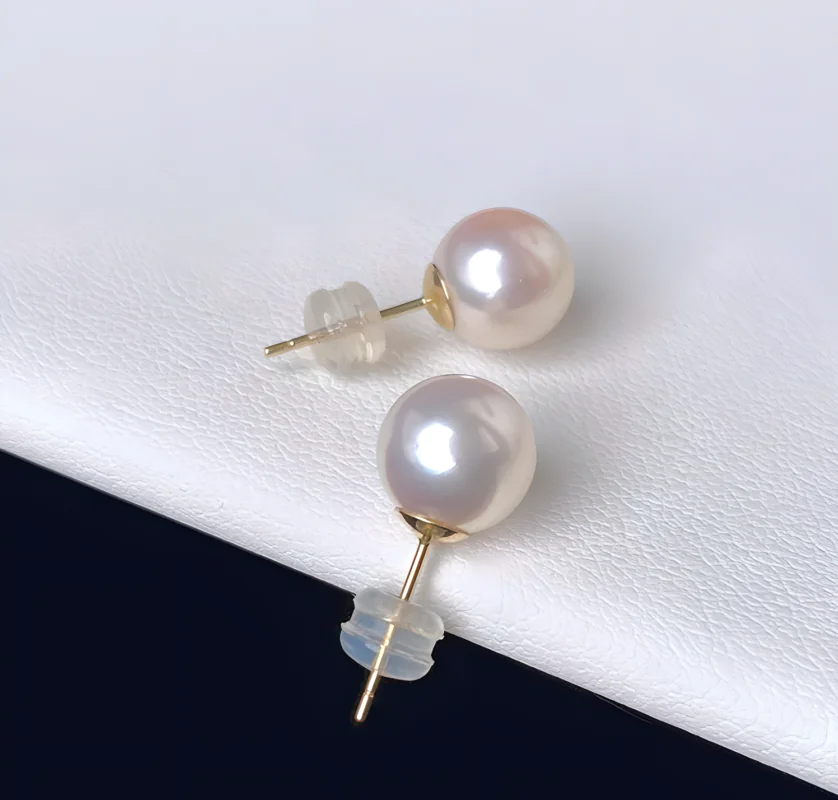
Akoya Hanadama Pearls in the Context of Grading Certificates
Hanadama is best understood as a certificate-dependent quality designation, not as a universal pearl grade that means exactly the same thing everywhere. When an Akoya strand is described as Hanadama, the useful question is not simply “Is it Hanadama?” but “Which laboratory issued the report, what report type is it, and what criteria did that laboratory apply?”
This distinction matters because the historical Japanese term Hanadama is used in the trade for a select range of high-quality Akoya cultured pearls, yet laboratories can define and report that range through different grading systems. A certificate can make the claim much more meaningful, but only if you read the certificate in its own grading context.
Hanadama Is a Trade Term Before It Is a Certificate Term
Hanadama is a historical Japanese trade expression associated with especially fine Akoya pearls. The term is often translated loosely as “flower pearl,” and today it is commonly used in retail descriptions for high-grade white Akoya pearls.
The important limitation is that the word by itself is not a single worldwide grading standard. Japan's Pearl Science Laboratory (PSL), for example, explicitly distinguishes the general trade term from its own defined designation, Aurora Hanadama. PSL notes that the general word Hanadama has long referred to high-quality pearls but does not have one universally fixed definition. Its Aurora Hanadama designation is therefore tied to PSL's own testing and grading system. See the laboratory's official Aurora Hanadama explanation.
GIA takes a different but related approach. Since September 2023, qualifying Akoya cultured pearls on GIA pearl classification reports may receive a comment stating that they fall within the select quality range known in the trade as Hanadama. In other words, GIA recognizes the historical market term but evaluates eligibility through the GIA pearl classification framework.
That is why “Hanadama” should never be read in isolation from the name of the laboratory and the actual report.
What PSL Means by Aurora Hanadama
For PSL, Aurora Hanadama is a defined special designation within its highest-quality series for white-series Akoya pearls. According to PSL's published criteria, Aurora Hanadama applies to white-series Akoya pearls of 6.0 mm or larger, requires a nacre thickness of at least 0.4 mm, permits shapes through the semi-round range, evaluates surface condition under PSL standards, and places particular emphasis on TERI—the combined impression of brilliance and optical interference color.
PSL's SS-type Certificate of Pearl Identification & Grading is used for its highest-quality series, including Aurora Hanadama. PSL states that nacre thickness on this report is measured by X-ray. The laboratory also notes that additional statements, such as natural-color information, can be added when applicable. These details are described in PSL's pearl identification and quality analysis documentation.
This gives Aurora Hanadama a fairly specific meaning inside the PSL system. It does not, however, mean that every Aurora Hanadama strand is visually identical. Natural pearls are not manufactured to one exact optical specification, and a category can contain variation in overtone, surface appearance, matching character, and especially the way luster is perceived in person.
Aurora Tennyo shows why “Hanadama” is not the end of the discussion
PSL also uses the designation Aurora Tennyo for pearls with the highest level of TERI among Aurora Hanadama. That relationship is useful for buyers because it demonstrates an important point: passing the Hanadama threshold does not create a single visual quality level. Within an already high-quality category, luster can still be differentiated.
This is one reason two certified Hanadama strands can both be legitimate yet still look different side by side.
What GIA Means When a Report Includes a Hanadama Comment
GIA does not simply reproduce PSL's Aurora Hanadama specification. Instead, it identifies a Hanadama quality range using its own pearl value-factor system.
GIA states that qualifying cultured Akoya pearls must combine round to near-round shape, white bodycolor with or without overtone, excellent luster, clean to lightly spotted surfaces, strong matching for multi-pearl items, and sufficient nacre quality and thickness. Current GIA educational material describes Hanadama as a select range within high-quality Akoya pearls rather than as a separate pearl species or origin.
GIA evaluates pearls through its 7 Pearl Value Factors: size, shape, color, luster, surface, nacre, and matching. This means a GIA report should be read through those classifications rather than through a seller's separate A/AA/AAA scale.
GIA's nacre terminology changed in 2025
There is another certificate-reading detail that is easy to miss. In May 2025, GIA expanded its nacre classification approach. Older reports may use earlier nacre terminology, while newer classification reports can use the expanded ranges Excellent, Very Good, Good, Fair, and Poor. GIA explains that the newer scale considers the continuity and quality of nacre, including structural and textural features, rather than reducing nacre assessment to one simple thickness number.
For that reason, comparing two GIA pearl reports from different years requires some context. A difference in wording does not automatically mean that one pearl was graded under a stricter or looser overall Hanadama concept; the report format itself may have evolved. See GIA's 2025 nacre classification update.
PSL Aurora Hanadama vs. GIA Hanadama: The Practical Difference
| Point to Check | PSL Aurora Hanadama | GIA Hanadama Comment |
|---|---|---|
| How Hanadama appears | A defined special designation within PSL's grading system | A trade-term comment added when Akoya pearls meet GIA's qualifying range |
| Pearl type/color context | White-series Akoya cultured pearls | White Akoya cultured pearls, with or without overtone |
| Size requirement | PSL specifies 6.0 mm or larger for Aurora Hanadama | Read the actual size on the GIA report; the published Hanadama criteria focus on the combined value factors |
| Nacre | PSL specifies at least 0.4 mm and measures nacre thickness by X-ray on the relevant report | Evaluated within GIA's nacre classification framework; report terminology has evolved |
| Luster | TERI is emphasized, including brilliance and interference color | Excellent luster is required for the Hanadama quality range |
| Higher luster distinction | Aurora Tennyo identifies the highest TERI level among Aurora Hanadama | Read the value-factor classifications and comments shown on the specific report |
The goal of this comparison is not to declare one laboratory “better.” The more useful lesson is that the issuer defines the framework. A PSL Aurora Hanadama certificate and a GIA report carrying a Hanadama comment are both meaningful, but they should not be treated as interchangeable documents with identical tests, terminology, or thresholds.
What a Hanadama Certificate Can Actually Tell You
A strong grading certificate can reduce several kinds of uncertainty. Depending on the laboratory and report type, it can help establish the pearl type, document size and appearance, place luster and surface within a defined quality range, address nacre, evaluate matching, and record other observations relevant to the submitted item.
For a buyer comparing expensive Akoya strands, this is more useful than relying only on seller-created labels such as “AAA+,” “gem grade,” or “top 1%.” Commercial A-to-AAA scales can be useful within one seller's inventory, but they should not automatically be assumed to match another seller's scale. A laboratory report gives you a separate reference point.
If you want the broader framework behind luster, surface, nacre, shape, color, size, and matching, our guide to evaluating pearl value explains why no single label captures the whole visual result.
What a Hanadama Certificate Does Not Automatically Prove
This is where buyers often give the word Hanadama more meaning than the report actually supports.
It does not mean every pearl is flawless
High-grade pearls can still have minor surface characteristics. GIA's Hanadama range allows clean to lightly spotted surfaces, and PSL evaluates surface within its own quality limits. “Hanadama” should therefore be understood as a high-quality range, not a promise of microscopic perfection.
It does not mean every certified strand looks equally beautiful
Certification establishes that an item met a laboratory's criteria at the time of examination. It does not rank every qualifying strand from most beautiful to least beautiful. Two strands can both pass while differing in overtone, reflection character, matching style, or the visual intensity of luster.
When possible, compare actual photographs and video under similar lighting, then inspect the pearls themselves. For Akoya pearls, the crispness and intensity of reflections can change the visual impression dramatically even within a narrow quality range. Our general Akoya pearl guide provides additional context on the type itself.
It does not automatically mean “untreated” or “natural white”
Do not infer treatment status or natural color from the Hanadama word alone. PSL notes that statements such as natural color can be added to its relevant certificates when applicable. GIA also offers different pearl report services with different levels of identification and treatment analysis.
For example, GIA's Cultured Pearl Classification Report is a classification-focused service for known cultured saltwater pearls and is not the same service as its more extensive Pearl Identification & Classification Report. If treatment information matters to you, read the exact report title and the treatment or color-origin wording rather than assuming that the Hanadama comment answers the question.
It does not by itself prove Japanese geographic origin
Hanadama is a quality-related trade designation, not a geographic-origin certificate. Akoya cultured pearls are produced in more than one country, and the Hanadama criteria published by PSL and GIA are framed around pearl type and quality characteristics rather than serving as proof of national origin.
If Japanese origin is a purchasing requirement, ask for separate supply-chain documentation or explicit origin information from the seller. Do not use the word Hanadama alone as a substitute for provenance evidence.
It does not establish market price
A grading report describes characteristics; it does not tell you what you should pay. Price can still vary with diameter, strand length, matching, overtone preference, clasp or mounting, brand, provenance documentation, market availability, and seller margin.
How to Read a Hanadama Certificate Before Buying
- Identify the issuing laboratory. “Certified Hanadama” is incomplete information unless the laboratory is named.
- Read the exact report type. An identification report, identification-and-classification report, and classification-only report may not answer the same questions.
- Confirm the pearl identity. Make sure the document actually describes Akoya cultured pearls and matches the item being sold.
- Find the Hanadama wording. On a PSL document, look for the relevant Aurora Hanadama designation. On a GIA report, look for the Hanadama quality-range comment.
- Read luster and surface separately. Do not let the headline designation replace the underlying quality information.
- Check nacre information. Note whether the report provides a measured thickness, a quality classification, or both.
- Check matching for strands and pairs. Matching is part of the visual quality of multi-pearl jewelry and should not be ignored.
- Look for treatment or color-origin wording if it matters. Never assume that Hanadama automatically means untreated or natural-color.
- Match the document to the physical item. Compare the report number, image, size range, quantity, and other identifying details supplied by the laboratory or seller.
- Finally, judge the pearls themselves. Certification narrows uncertainty; it does not replace visual comparison.
For higher-value purchases, this last step is especially important. A certificate is evidence about a submitted item, not a substitute for seeing how that item actually looks. If authenticity or identity rather than quality is your main concern, see our separate guide to pearl identification.
Why the Certificate Date and Report Format Matter
Laboratory terminology and report formats can change over time. PSL's current documentation, for example, identifies some present certificate types alongside their former names, such as SS type (former S type) and SP type (former P type). GIA introduced its Hanadama report comment in 2023 and later expanded its nacre classification scale in 2025.
So an older legitimate certificate should not be rejected merely because it looks different from a current sample. Instead, identify the issuing laboratory, report date, report type, and the grading language used at that time. If something seems inconsistent, contact the issuing laboratory or use an official report-check service when one is available rather than relying on a seller's explanation alone.
FAQ
Is Hanadama a universal pearl grade?
No. Hanadama is a historical trade term used for a select range of high-quality Akoya pearls. Laboratories such as PSL and GIA apply their own published grading frameworks when they use the term on reports.
Is Aurora Hanadama the same as a GIA Hanadama comment?
No. They refer to a similar high-quality Akoya concept, but they are issued through different laboratory systems. PSL's Aurora Hanadama has PSL-specific criteria, while GIA's Hanadama comment is based on GIA's Pearl Value Factors classification ranges.
Does Hanadama mean the pearls are flawless?
No. High-grade Hanadama pearls can still have minor surface characteristics. The designation indicates that the pearls fall within a high-quality range under the issuing laboratory's criteria; it is not a promise of microscopic perfection.
What is the difference between Aurora Hanadama and Aurora Tennyo?
Within PSL's system, Aurora Tennyo is used for Aurora Hanadama pearls that reach the laboratory's highest TERI level. It is therefore a more specific luster distinction within the Aurora Hanadama category.
Does a Hanadama certificate prove the pearls are from Japan?
Not by the designation alone. Hanadama is primarily a quality-related term. If geographic origin matters, ask for separate provenance or supply-chain documentation rather than assuming that the word Hanadama proves country of origin.
Should I choose a certified Hanadama strand over a non-certified high-grade Akoya strand?
A recognized laboratory certificate can add useful independent evidence and make comparison easier, especially for a high-value purchase. But the final decision should still consider the actual pearls, including luster, overtone, matching, size, condition, and price. A certificate is a strong reference point, not the only value factor.
What to Remember When You See “Hanadama” on a Listing
The most useful interpretation of Hanadama is not “this is automatically the best Akoya pearl.” A better reading is: this item may fall within a defined high-quality Akoya range, and the certificate tells you whose definition is being used.
Start with the laboratory. Then read the report type, pearl identity, Hanadama designation or comment, luster, surface, nacre, matching, and any treatment or color-origin statements. After that, compare the actual pearls. That approach gives the certificate the right amount of authority—enough to reduce uncertainty, but not so much that one word replaces informed judgment.