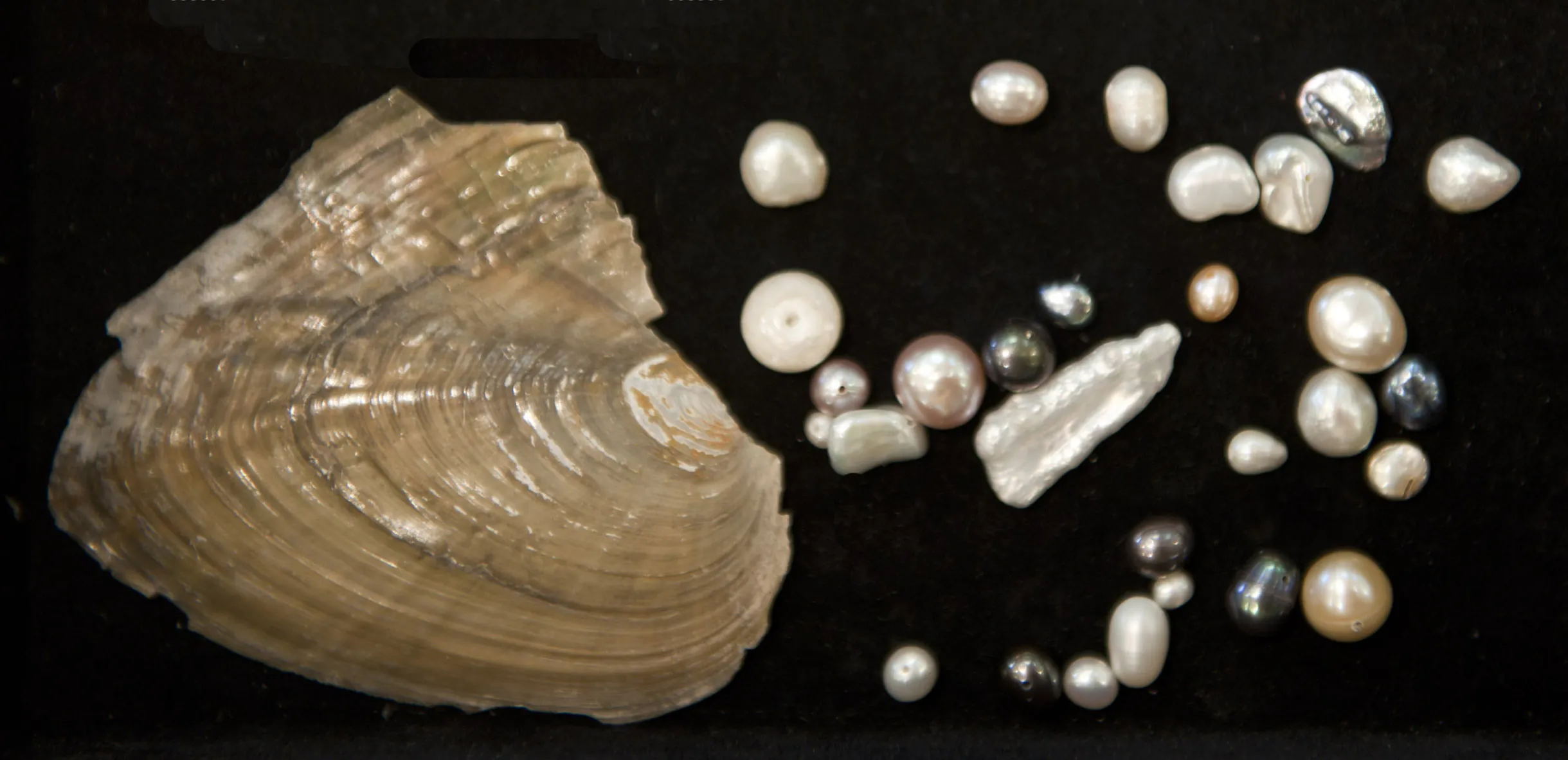
Mabé pearls have a flat back because they are cultured as blisters against the inside of a mollusk’s shell rather than growing as free pearls surrounded by tissue. The nacre forms over the exposed dome and joins the surrounding shell. After harvest, the blister is cut from the shell and, in a typical finished Mabé, the original nucleus is removed, the hollow dome is filled, and a piece of shell is attached as the backing.
So the flat back has two causes: first, the pearl grows attached to the shell instead of becoming a complete sphere; second, the harvested dome is normally finished as an assembled cultured blister with a flat or nearly flat backing. It is not simply a round cultured pearl that has been sliced in half.
The Short Answer: Mabé Pearls Grow Against the Shell
A conventional bead-cultured round pearl develops as a separate body inside a pearl sac. Nacre can be deposited around the bead from all directions, which makes a complete three-dimensional pearl possible.
Mabé production uses a different geometry. A dome-shaped nucleus or form is fixed to, or positioned against, the inner surface of the shell. The mollusk’s mantle deposits nacre over the exposed surface of that form, and the new nacre continues onto the shell around it. The result is a raised nacreous blister attached to the shell, not a loose sphere.
The CIBJO Pearl Book describes a nacreous cultured blister as material formed against the inside of the shell, with nacre growing over the inserted material and continuing onto the shell to create one cohesive structure. This shell-attached growth is the key reason there is no fully nacre-covered underside comparable with a normal round cultured pearl.
For a broader introduction to the category, see our Mabé pearl guide. This article focuses specifically on why the back is flat and how that shape is created.
What Happens During Mabé Cultivation?
The exact materials and methods can vary, but the basic production logic is consistent: the farmer creates a controlled raised form on the shell wall and lets the mollusk cover it.
In a GIA-published study of cultured half-pearls in Pteria penguin, resin half-pearl nuclei were attached to the shell with adhesive. The mollusks were then returned to culture so nacre could build over the exposed nuclei. That is very different from placing a spherical bead inside soft tissue and allowing a pearl sac to form around it.
This difference explains the basic profile:
- Front: the exposed nucleus encourages a raised dome, which becomes covered with nacre.
- Edge: the nacre over the dome merges into nacre deposited on the surrounding shell.
- Back: the blister is physically attached to the shell, so it never develops as an independent rounded underside.
In other words, the flat-backed form is built into the cultivation method from the beginning.
Why the Finished Mabé Is Even Flatter After Harvest
The shell-attached blister is only the first stage. A typical jewelry-ready Mabé is an assembled cultured blister, so post-harvest processing also contributes to the final flat back.
According to the CIBJO definition, a purpose-grown cultured blister can be cut from the shell, the original bead removed, the cavity filled with man-made material, and the piece backed with a layer of shell held in place with adhesive. GIA has documented the same typical Mabé construction: a nacre dome from a cultured shell blister, a removed implanted nucleus, filling material inside the cavity, and a polished shell backing for stability.
This means the finished back is not simply “the part of the pearl that touched the oyster.” The harvested blister is normally processed into a composite structure. The backing closes the hollow dome and gives the piece a practical surface for mounting.
A Mabé Is Not a Round Pearl Cut in Half
This is one of the most useful misconceptions to correct.
A whole round cultured pearl and a Mabé may both show beautiful nacre on the visible face, but their internal structures are different. Cutting a normal round pearl in half would expose its bead, nacre layers, or internal pearl structure. That is not how standard Mabé production works.
| Feature | Whole bead-cultured pearl | Cultured blister before assembly | Finished Mabé |
|---|---|---|---|
| Where it forms | Inside a pearl sac in soft tissue | Against the inner shell | Derived from the shell-attached blister |
| Basic shape | Can develop as a complete sphere or other whole form | Raised dome attached to shell | Domed front with flat or nearly flat back |
| Underside | Part of the complete pearl body | Continuous with / attached to shell | Normally filled and closed with a backing |
| Construction | Whole cultured pearl | Cultured blister | Usually an assembled cultured blister |
This is also why pearl shape labels should not be confused with pearl construction. A button pearl can have a flattened profile while still being a whole pearl. A Mabé has a different formation route. Our Pearl Shape Guide explains the visual shape terms, while Pearl Classification goes further into how different pearl products are categorized.
Is the Flat Back Natural or Man-Made?
The most accurate answer is: both biological growth and human processing contribute to it.
The mollusk biologically produces the nacreous dome. But the farmer determines where the blister grows by placing the nucleus or form against the shell. After harvest, the dome is typically cut out and assembled with filling and a backing.
So it would be incomplete to say that the flat back is purely natural, because the culture and finishing process are deliberately controlled. It would also be wrong to say the pearl face is simply manufactured, because the visible nacre is secreted by the living mollusk during cultivation.
That distinction matters when describing Mabé accurately. CIBJO treats the finished product as an assembled cultured blister, not as an ordinary whole cultured pearl.
Why Does the Flat Back Work So Well in Jewelry?
The flat-backed structure is not merely a side effect of production. It is also useful in jewelry design.
A broad Mabé dome can present a large nacreous face while the backing sits close to the metal setting. That geometry works naturally for jewelry where the reverse side is hidden, such as earrings, pendants, brooches, and many rings. The setting can support the back and frame the dome without needing to accommodate a complete sphere.
This is one reason Mabé jewelry can have a bold, high-profile pearl look without using a similarly wide fully round pearl. If you are comparing finished pieces, browse our pearl jewelry collection with the construction in mind: a domed face does not automatically mean the pearl is spherical underneath.
Does a Flat Back Mean the Pearl Is Fake?
No. A flat back by itself does not mean imitation.
A genuine Mabé contains nacre that was produced by a mollusk during culturing. However, a finished Mabé is normally an assembled product, so accurate disclosure matters. The nacre dome, filling, backing, and adhesive do not make it the same thing as a solid imitation bead—but they also mean it should not be described as though it were a whole free-grown cultured pearl.
At the same time, many craft products sold as “flat-back pearls” are imitation beads made from glass, plastic, resin, or coated materials. The appearance alone therefore does not identify the structure. Check whether the seller specifically describes the item as a Mabé or assembled cultured blister, and ask about the material if the listing is vague.
Blister Pearl vs. Mabé: Why the Terms Can Be Confusing
A cultured blister is the shell-attached nacreous formation produced during cultivation. A finished Mabé, in the narrower gemological sense, is the assembled product made from such a blister after it has been cut out and completed.
Trade usage is not perfectly uniform. CIBJO notes that Mabe originally designates an assembled cultured blister from Pteria penguin, while the term is now often used more broadly for assembled cultured blisters from other bivalves. You may also see “Mabé,” “mabe,” “cultured blister,” and “half-pearl” used more loosely in retail descriptions.
For a buyer, the safest approach is to focus on the structure rather than the label: Did it grow attached to the shell? Was it cut out? Was the nucleus removed? Was the cavity filled and backed? Those questions explain the flat back far better than the name alone.
The Key Point to Remember
Mabé pearls are flat-backed because they follow a completely different growth path from ordinary round cultured pearls.
The pearl farmer starts with a dome against the inner shell. The mollusk covers that dome with nacre, creating a blister that remains attached to the shell. After harvest, the blister is normally cut out, hollowed, filled, and backed. The result is the familiar domed nacreous face plus flat back.
Once you understand that two-stage process—shell-attached growth, then post-harvest assembly—the shape of a Mabé stops looking unusual. It is exactly what the production method is designed to create.
FAQ
Are Mabé pearls just round pearls cut in half?
No. Mabé pearls are cultured as blisters against the inside of a shell. They are not normally made by cutting a complete round cultured pearl in half.
Is the back of a Mabé pearl naturally flat?
The flat-backed form begins during cultivation because the blister grows attached to the shell. After harvest, the blister is typically cut out, the nucleus removed, the cavity filled, and a shell backing attached, which creates the finished flat or nearly flat base.
Are Mabé pearls real pearls?
The visible nacreous dome is produced by a living mollusk during pearl culture. A finished Mabé is generally an assembled cultured blister rather than a whole cultured pearl, so it should be described with that construction in mind.
What is the difference between a blister pearl and a Mabé pearl?
A cultured blister is the nacre-covered formation while it is attached to the shell. In more precise gemological usage, a Mabé is the finished assembled product made from a purpose-grown cultured blister after cutting, filling, and backing.
Are all flat-backed pearls Mabé pearls?
No. Whole button-shaped cultured pearls can look flattened without being Mabé, and many flat-backed craft “pearls” are imitation materials. The construction and material description matter more than the silhouette alone.
Sources & Further Reading
- CIBJO Pearl Book 2024 — definitions for cultured blisters, assembled cultured blisters, and Mabé terminology.
- GIA / Gems & Gemology: Effects of Mollusk Size on Growth and Color of Cultured Half-Pearls from Phuket, Thailand — documents half-pearl nuclei attached to the shell during Mabé cultivation.
- GIA / Gems & Gemology: Assembled Bead Cultured Half-Pearl — describes typical Mabé assembly using a nacre dome, filling material, and shell backing.