How to Evaluate Pearl Matching: What Matters for Necklaces and Earrings?
Pearl matching is the quality of how well two or more pearls work together in one piece of jewelry. For a classic necklace, good matching usually means the pearls create a smooth, consistent visual flow in size, shape, color, luster, and surface appearance. For earrings, the test is more concentrated: the two pearls should look balanced as a pair when viewed face-up and from normal wearing angles. The goal is not always mathematical sameness. It is visual harmony that suits the design.
Quick Answer: What Does Good Pearl Matching Look Like?
The easiest way to judge matching is to stop looking at each pearl as an isolated object and look at the group as a design. Ask: does any pearl stand out for the wrong reason? A sudden change in size, warmth of color, luster, shape, or visible surface quality can interrupt the piece even when every pearl is attractive on its own.
| Factor | Necklace or strand | Earring pair |
|---|---|---|
| Size | Uniform or smoothly graduated according to the design | Two pearls should look balanced at normal viewing distance |
| Shape | Consistent outline or an intentional sequence of shapes | Front profile and side profile should feel like a pair |
| Color | No random warm, cool, dark, or saturated pearl interrupting the strand | Bodycolor and overtone should be visually compatible |
| Luster | Reflection strength should stay reasonably even across the strand | One pearl should not look obviously brighter or duller than the other |
| Surface | Visible surface quality should feel consistent overall | Face-up areas should look comparably clean and balanced |
| Orientation / drilling | Drill direction should support an even layout | Both pearls should face, hang, or sit in comparable orientations |
The GIA Pearl Quality Factors treat matching as one of the seven major pearl value factors when jewelry contains two or more pearls. Unlike size, shape, or luster, matching is not a characteristic of one pearl by itself; it describes the relationship among pearls in a finished group.
Pearl Matching Does Not Always Mean Every Pearl Must Be Identical
This is the most important idea to understand. A perfectly uniform white round strand is one form of good matching, but it is not the only form.
A graduated necklace intentionally changes from smaller pearls near the clasp to larger pearls near the center. A multicolor Tahitian strand may deliberately move through gray, green, blue, and aubergine tones. A baroque necklace may contain different outlines while still maintaining a coherent rhythm. These designs can be very well matched because the variation is controlled, balanced, and intentional rather than random.
GIA makes the same distinction in its buyer guidance: designers may intentionally mix sizes, shapes, and colors, while conventional strands and pairs are generally expected to show close agreement in the relevant quality factors. The useful question is therefore not “Are all the pearls identical?” but “Does the pattern look deliberate and visually continuous?”
Why Matching Is Judged Differently in Necklaces and Earrings
A necklace contains many pearls, so the eye reads it as a sequence. Small differences can disappear if they change gradually, while one abrupt outlier can become surprisingly obvious. Earrings contain only two main pearls, so there is nowhere for a mismatch to hide. The eye immediately compares one side of the face with the other.
For necklaces, continuity matters most
A well-matched strand should look smooth from pearl to pearl. If it is uniform, the pearls should remain visually consistent across the length. If it is graduated, the size progression should feel gradual and symmetrical. If it is multicolor, the color movement should look intentional rather than as if unrelated pearls were assembled together.
For earrings, pair balance matters most
Matched earrings should be judged together, not as two separately acceptable pearls. Even a small difference can become noticeable if one pearl is distinctly warmer, more oval, flatter, brighter, or more blemished on the visible face. At the same time, exact dimensional equality is not the only goal: two pearls with slightly different measurements can still look more balanced than two pearls with identical measurements but different profiles or luster.
1. Size Matching: Compare Visual Diameter, Not Just the Label
Size is usually the first matching factor buyers check because it is easy to measure. But a size range such as 7.0-7.5 mm does not guarantee that two pearls will look identical. A slightly oval pearl, a high button pearl, and a true round pearl can share a similar measured width while appearing different when worn.
For a uniform necklace, compare the strand from end to end and look for sudden jumps. For a graduated strand, look for a smooth progression toward the center and a balanced return on the opposite side.
For earrings, place the pearls side by side in the same orientation. Compare the apparent diameter from the front, then turn them to compare height and profile. Do not rely on one measurement alone.
There is no single millimeter tolerance that defines good matching for every pearl type, size, shape, and jewelry design. A tiny difference that is conspicuous in small round Akoya studs may be visually irrelevant in a large organic baroque pair. Use measurements as a control tool, then make the final judgment with your eyes.
2. Shape Matching: The Side View Often Reveals What the Front View Hides
Shape matching is especially important for round, near-round, button, drop, and pear-shaped earrings. Two pearls can look nearly circular face-up but have noticeably different side profiles. One may be taller, flatter, more pointed, or more asymmetrical.
For drops, align the top and bottom points and compare the taper, shoulder width, length, and symmetry. For buttons, compare both diameter and dome height. For round and near-round pearls, slowly roll the pearls to see whether one develops an obvious flattened or elongated side.
On necklaces, exact shape matching depends on the intended style. A classic round strand should not suddenly contain one pearl that reads visibly oval. A baroque strand, however, may look better when different shapes share a similar scale, surface character, and visual rhythm rather than trying to imitate roundness.
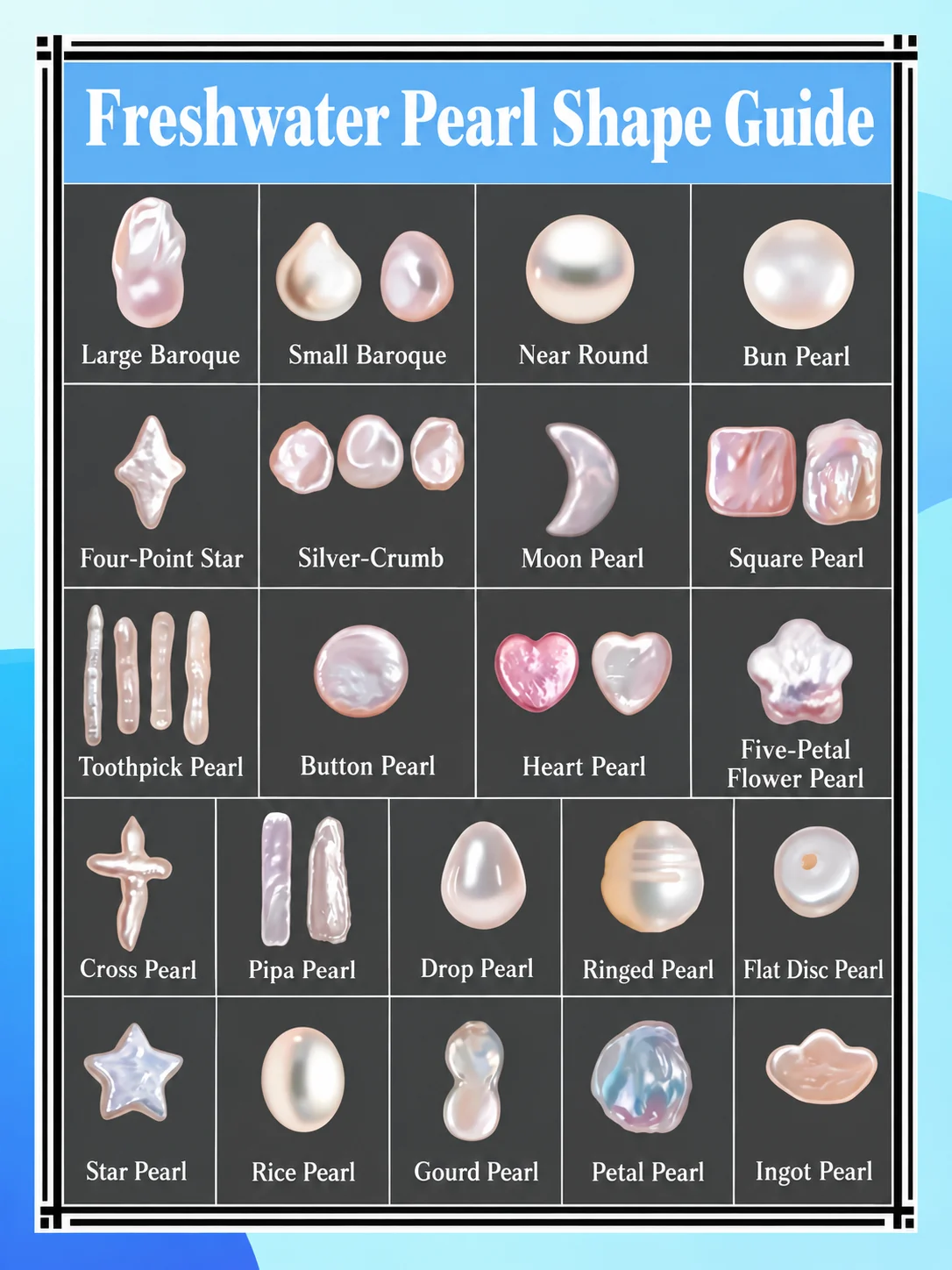
If you are unsure how pearl shape terms differ, the broader pearl classification guide provides useful context before you judge matching.
3. Color Matching: Bodycolor and Overtone Both Matter
Color mismatch is one of the easiest ways for an otherwise fine strand or pair to look uneven. Do not compare only the broad label—“white,” “gold,” “gray,” or “black.” Two white pearls can differ in warmth, brightness, and overtone enough that one looks creamy and the other icy or rosé.
For earrings, compare the two pearls under the same neutral light. First judge the main bodycolor. Then look for secondary pink, green, silver, blue, or other overtone. A pair can have the same bodycolor but still look mismatched if one has a strong overtone and the other has almost none.
For necklaces, scan the strand as a whole before focusing on individual pearls. A single warmer or darker pearl often becomes more obvious when you step back. In a deliberate multicolor strand, the question changes: are the colors arranged in a balanced sequence, and do the pearls still share enough luster, shape, and surface character to feel related?
4. Luster Matching: One Dull Pearl Can Break an Otherwise Good Match
Luster differences can be more distracting than small size differences. If most pearls show crisp, bright reflections but one appears hazy or chalky, the eye tends to find that pearl immediately.
Compare pearls under the same lighting and look at both reflection brightness and reflection sharpness. For earrings, one pearl should not look noticeably livelier than the other. For necklaces, scan from one end to the other and watch for sections where the reflection suddenly becomes weaker or softer.
Do not expect different pearl types to show one identical style of luster. Fine Akoya pearls are often prized for crisp reflections, while high-quality South Sea pearls can have a broader satiny glow. Matching should be judged within the intended pearl type and design. Our guide to Akoya pearls gives more context for the highly reflective look associated with that category.
5. Surface Matching: Judge the Visible Face, Not Only the Total Number of Marks
Pearls are organic gems, so minor spots, pits, ridges, or wrinkles are common. Matching surface quality does not require every pearl to have an identical number of marks. What matters is whether the visible surface condition feels comparable across the piece.
For stud earrings, the fronts and sides seen when worn deserve the closest comparison. A small mark near the back or drilling area may be far less distracting than a deep feature positioned on the face of one pearl. GIA also notes that minor surface characteristics can have less effect when they are positioned where a drill hole or mounting can hide them.
For necklaces, look for obvious changes in cleanliness. A strand that is mostly eye-clean can be visually interrupted by one pearl with a large central blemish, even if the rest of its characteristics match well.
6. Drilling and Orientation: A Good Pearl Can Look Poorly Matched If It Faces the Wrong Way
Matching continues after the pearls have been selected. Drill position and orientation affect how the finished jewelry presents the pearls.
A drilled round strand should hang evenly instead of making individual pearls tilt in inconsistent directions. Drops and baroque pearls need thoughtful orientation so their best faces and axes work together. For earrings, half-drilled pearls should be set so the visible faces, profiles, and any natural surface features appear balanced.
GIA's educational grading material notes centered drilling as part of excellent matching for applicable pieces. That is a useful reminder that matching is partly a sorting skill and partly a jewelry-assembly skill.
How to Evaluate Pearl Necklace Matching Step by Step
A necklace is easiest to judge when you examine both the full layout and the individual transitions between neighboring pearls.
- Lay the strand in a natural curve. A necklace is worn curved, so do not judge it only as a straight line on a tray.
- Step back and look for outliers. Notice any pearl that appears suddenly larger, flatter, warmer, duller, darker, or more blemished.
- Check the center first. The center area receives the most visual attention and should look especially balanced.
- Compare left and right progression. In graduated strands, the two sides should develop in a controlled, roughly balanced way.
- Scan luster from end to end. A section of weaker reflections can make the strand look patchy even if size and color are well matched.
- Rotate or flip the strand. Check whether drill orientation or hidden shape differences cause pearls to sit unevenly.
- Judge the design, not a rigid rule. Uniform, graduated, multicolor, and baroque strands need different kinds of consistency.
How to Evaluate Matching Pearl Earrings Step by Step
Earrings are more demanding because the viewer compares only two pearls. Use the pair as the unit of judgment.
- Place both earrings side by side under the same light. Do not compare separate product photos.
- Align them in the same direction. For drops, align the tips; for buttons, align the dome; for studs, face both pearls forward.
- Compare apparent size. Look first, then check the measurement if needed.
- Compare shape and profile. Turn the pair to the side and check height, taper, flatness, and symmetry.
- Compare bodycolor and overtone. Look for warm-versus-cool or strong-versus-weak secondary color differences.
- Compare luster together. One pearl should not show significantly sharper or brighter reflections.
- Inspect the visible surfaces. Make sure the clean face of one pearl is not paired with the visibly marked face of the other.
- Check the finished orientation. The earrings should sit or hang at comparable angles when worn.
A useful final test is to view the pair from normal conversational distance rather than only at close range. If the mismatch disappears in normal wear, it may be commercially insignificant. If one earring still reads as different immediately, the pair needs improvement.
How to Judge Matching When Buying Pearls Online or Wholesale
Online photography can hide matching problems because separate images may use different exposure, white balance, viewing angles, or backgrounds. Ask for comparison material that keeps the conditions controlled.
- Request the entire earring pair in one frame.
- For strands, request a full-length view as well as a closer pass from one end to the other.
- Ask for neutral, diffused lighting rather than only intense jewelry spotlights.
- Request a short video that rotates the pearls or moves the strand slowly.
- Keep multiple candidate pairs or strands in the same shot when comparing grades.
- For earrings, ask for front and side views.
- For graduated necklaces, confirm the stated size range and inspect whether the progression is visually smooth.
- For baroque or multicolor designs, ask what the supplier is matching intentionally—size, luster, color sequence, shape family, or overall style.
This is especially useful for wholesale selection. A supplier's statement that a lot is “well matched” is more meaningful when you know which visual differences are being controlled and what variation is still allowed.
Does Better Matching Increase Pearl Value?
Generally, yes. When the individual pearls are of comparable quality, a better-matched pair or strand is usually more desirable because assembling it requires enough suitable pearls to select for several characteristics at the same time.
This is particularly noticeable in pieces that demand strong uniformity. Finding one beautiful pearl is easier than finding two closely compatible pearls for earrings, and matching dozens of pearls into a coherent necklace can require much more sorting than selecting pearls individually.
But matching should not be treated as an isolated price formula. A perfectly uniform strand with weak luster is not automatically better than a slightly more varied strand with much stronger overall pearl quality. Size, shape, color, luster, surface, nacre quality, and matching all interact. For the broader framework, see our guide to evaluating pearl value.
Can You Use Grades Such as “Excellent Matching” or “AAA Matching”?
Formal and commercial grading systems need to be separated.
GIA uses a matching scale from Excellent through Poor for multi-pearl items, and its system evaluates matching in relation to the other pearl quality factors. The CIBJO guide for classifying natural and cultured pearls also presents matching as the uniformity of appearance in strands and multiple-pearl groups.
Retail labels such as A, AA, AAA, or AAAA are different. They are not used identically by every seller. If a supplier includes “matching” inside an AAA grade, ask what that means in observable terms: how tight is the size range, how consistent is the luster, what color variation is accepted, and how are surface features handled?
A grading word becomes useful only when you can connect it to a visible standard.
Six Common Mistakes When Judging Pearl Matching
- Checking only the millimeter size. Similar measurements do not guarantee similar shape, profile, color, or luster.
- Judging each pearl separately. Matching is a relationship, so pairs and strands must be viewed together.
- Expecting every strand to be uniform. A graduated, multicolor, or baroque design can be intentionally and beautifully matched.
- Ignoring luster consistency. One dull pearl can stand out more than a small size difference.
- Comparing photographs taken under different conditions. Lighting and camera processing can create false color and luster differences.
- Ignoring orientation after drilling or setting. Pearls that matched loose can look less balanced if their best faces are not aligned in the finished jewelry.
A Practical Pearl Matching Checklist
| Question | What to look for |
|---|---|
| Does the piece look coherent at first glance? | No pearl should become an accidental visual outlier |
| Is the size relationship intentional? | Uniform when intended, or smoothly graduated when designed that way |
| Do the shapes belong together? | Similar profiles or a deliberate, balanced shape pattern |
| Is the color consistent? | Bodycolor and overtone should be compatible or intentionally sequenced |
| Is the luster consistent? | No sudden dull or hazy pearl among much brighter pearls |
| Is visible surface quality balanced? | No single face-up pearl should be disproportionately marked |
| Does the drilling or setting support the match? | Pearls should face and hang in comparable, intentional orientations |
| Does the match still work at normal wearing distance? | The piece should look balanced without requiring microscopic perfection |
FAQ
What does pearl matching mean?
Pearl matching describes how well pearls used together relate in size, shape, color, luster, surface appearance, and overall presentation. It applies to earrings, necklaces, bracelets, and other multi-pearl jewelry rather than to a single pearl by itself.
Do pearl earrings have to be exactly the same size?
No. They should look balanced as a pair, but exact numerical equality is not always necessary. Apparent size also depends on shape and profile, so visual comparison should accompany millimeter measurements.
How can I tell if a pearl necklace is well matched?
View the full strand in a natural curve and look for smooth continuity in size, shape, color, luster, and visible surface quality. A uniform strand should remain consistent, while a graduated or multicolor strand should change in a controlled and intentional way.
Can baroque pearls be well matched?
Yes. Baroque pearls do not need identical outlines. They can be well matched through similar scale, luster, surface character, color family, or a deliberate arrangement of different shapes.
What is more important for matching: size or luster?
It depends on the piece, but luster differences can be highly noticeable because they change how lively each pearl appears. Good matching considers several factors together rather than ranking the piece from size alone.
Does a higher pearl grade guarantee better matching?
Not unless the seller explains how matching is included in that grading system. Retail A-AAA style grades are not universal, so compare the actual pearls and ask what standards the seller uses for size, color, luster, shape, surface, and matching.
Final Takeaway
Good pearl matching is not simply about making every pearl identical. It is about making the piece look intentional. For earrings, concentrate on pair balance: apparent size, shape profile, bodycolor, overtone, luster, visible surface, and orientation. For necklaces, concentrate on continuity: the pearls should move smoothly through the design without accidental jumps in quality or appearance.
If you remember one test, view the pearls together under the same light and ask whether any pearl attracts attention for an unintended reason. That simple question catches many matching problems that measurements and grade labels alone can miss.
Source Notes
The quality framework in this article is aligned with the GIA Pearl Quality Factors, the GIA Pearl Buyer's Guide, and GIA's explanation of how matching is evaluated in multi-pearl jewelry. The discussion of matching as uniformity or intentional visual harmony is also consistent with educational guidance from the CIBJO Pearl Commission.