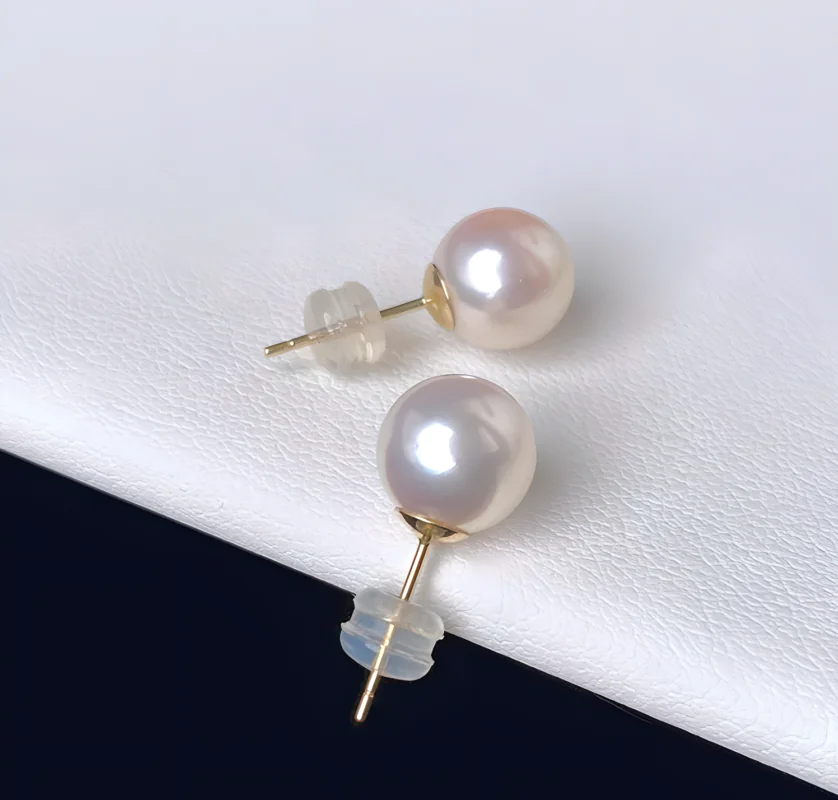
When an Akoya necklace, pair of earrings, or loose pearl is described as Tennyo, the most useful question is not simply, “Is Tennyo the highest grade?” It is: Which laboratory issued the certificate, what does that laboratory mean by Tennyo, and what information on the report supports the designation?
In the grading system of Japan's Pearl Science Laboratory (PSL), Aurora Tennyo is a special designation for white Akoya pearls within its Aurora Hanadama quality context that show especially outstanding teri—the brightness and interference-color character commonly discussed as pearl luster. PSL gives Tennyo its own certificate format and publishes specific luster-related conditions for the designation.
That makes Tennyo meaningful, but also easy to misunderstand. It is better treated as a certificate-specific quality designation than as a universal grade that can be compared directly with every seller's AAA, AAAA, “gem quality,” or another laboratory's terminology.
Quick answer: what does Tennyo mean on an Akoya pearl certificate?
Within the Pearl Science Laboratory system, Aurora Tennyo is not a separate pearl species and not an independent color category. PSL describes it as a special designation for pearls among its Aurora Hanadama category whose teri is particularly outstanding.
PSL's current English certificate guide states that the SP-type Certificate of Pearl Identification & Grading is dedicated to Aurora TEN-NYO. It includes a TERI value analysis and an Aurora image, and PSL describes Aurora TEN-NYO as having the highest level of TERI among Aurora HANADAMA.
This relationship is the key to understanding the term:
Aurora Hanadama establishes the high-quality white Akoya context; Aurora Tennyo identifies an especially high-luster selection within that context.
Why the certificate issuer matters more than the grade word alone
Pearl grading does not operate under one universal A-to-Z system. Sellers may use A, AA, AAA, AAAA, “gem,” or other house grades, while laboratories can publish their own report criteria and terminology. Our pearl grading guide explains why seller grades should always be read within the system that created them.
The same principle applies to special names such as Tennyo. A seller writing “Tennyo quality” in a product title is not equivalent to the actual Aurora Tennyo designation appearing in the proper laboratory-report context.
Before interpreting any premium pearl label, read the claim in this order:
- Identify the issuing laboratory.
- Check the exact report type.
- Read the special appellation shown on that report.
- Review the measured and observed quality information.
- Confirm that the physical pearls being sold correspond to the report.
This approach prevents a common mistake: placing “Tennyo,” “Hanadama,” “AAA,” and “AAAA” on one imaginary universal ladder even though they may come from completely different grading systems.
Where Aurora Tennyo sits within the PSL system
To understand Tennyo, it helps to first understand PSL's Aurora Hanadama category. PSL defines Aurora Hanadama as a special appellation for white Akoya pearls judged to fall within its highest-quality range.
In its published explanation, PSL says Aurora Hanadama applies to white Akoya pearls of 6 mm or larger, uses a minimum nacre thickness of 0.4 mm, permits shape within its stated range up to semi-round, evaluates surface condition according to its own criteria, and places strong emphasis on luster, including both brightness and interference color.
For broader background on the pearl type itself—size, nacre, color, cultivation, and typical Akoya characteristics—see our Akoya pearl guide.
Tennyo begins from that Aurora Hanadama context. It does not replace the underlying quality framework with a completely different one. Instead, it adds a more selective emphasis on exceptional optical performance.
The defining Tennyo difference is exceptional teri
Retail descriptions sometimes simplify Tennyo as “one grade above Hanadama.” That can be useful shorthand, but it hides the most important detail: Tennyo is distinguished especially by luster performance, not by being automatically better in every possible dimension.
PSL's published Tennyo terminology gives two specific conditions:
- a measured brightness-distribution value of at least 90% of the instrument's maximum reference value; and
- a vivid reflected interference-color pattern showing at least three colors across the red-to-green range.
These requirements explain why the dedicated Tennyo report focuses on TERI analysis and includes an Aurora image. The designation is not merely a decorative luxury name; it is connected to PSL's particular method of evaluating the optical behavior that creates strong Akoya luster.
This also clarifies why thicker nacre alone does not create Tennyo. Nacre quality matters, and Aurora Hanadama has its own nacre threshold, but Tennyo's additional distinction is centered on exceptional teri rather than simply the maximum possible nacre thickness.
Aurora Tennyo vs. Aurora Hanadama
| Point | Aurora Hanadama | Aurora Tennyo |
|---|---|---|
| Certificate context | PSL highest-quality white Akoya category | Special selection within the Aurora Hanadama context |
| Main emphasis | Overall high-quality requirements, with luster heavily emphasized | Especially outstanding teri / optical performance |
| Nacre | PSL publishes a minimum 0.4 mm nacre thickness for Aurora Hanadama | Remains within the underlying Hanadama context; Tennyo is not simply “thicker nacre” |
| Shape and surface | Must remain within PSL's accepted quality range | Still evaluated within the qualified context; the additional Tennyo distinction is luster-focused |
| Report type | Part of PSL's highest-quality certification series | Dedicated SP-type report with TERI analysis and Aurora imagery |
| Best shorthand | Top-quality white Akoya under PSL criteria | Especially high-luster Aurora Hanadama under PSL criteria |
So, is Tennyo “higher” than Hanadama? In everyday conversation, that wording is understandable. For precise certificate interpretation, however, it is better to say that Tennyo is a more selective, luster-focused designation within PSL's Aurora Hanadama framework.
Tennyo and GIA Hanadama are not the same certificate language
The certificate context becomes clearer when PSL is compared with another major laboratory.
GIA uses its own pearl-quality framework based on seven value factors: size, shape, color, luster, surface, nacre, and matching. GIA can also add a Hanadama comment to qualifying Akoya cultured pearls that meet its published criteria, including round to near-round shape, white bodycolor, excellent luster, strong nacre quality, clean to lightly spotted surfaces, and strong matching.
That does not make GIA's Hanadama comment identical to PSL's Aurora Hanadama or Aurora Tennyo system. The laboratories use their own report structures, evaluation language, and criteria.
For the buyer, the practical rule is simple: do not translate one laboratory's special designation directly into another laboratory's grading vocabulary. If a report says Tennyo, understand what Tennyo means in the issuing laboratory's system. If a GIA report includes a Hanadama comment, read it according to GIA's stated criteria.
For a broader explanation of why laboratory reports and seller grades should be kept separate, see our pearl grading certificate guide.
How to read a Tennyo certificate before buying
Instead of treating the word Tennyo as the entire certificate, use the document as a checklist.
1. Confirm the laboratory
If an item is sold specifically as Aurora Tennyo, verify that the claim is tied to a Pearl Science Laboratory report rather than to a generic appraisal card, seller certificate, or unrelated laboratory document.
2. Check the certificate type
PSL's current dedicated Tennyo report is the SP type; PSL identifies this as the successor to the older P type. That distinction can be helpful when you are comparing current certificates with older stock or archived product photographs.
3. Match the report to the actual pearls
Check the item form, pearl type, measurements, certificate number, and other identifying information shown on the report. A genuine certificate has little practical value if it belongs to a different strand.
4. Read the nacre information
Tennyo's special emphasis is teri, but nacre remains part of the high-quality Akoya context. Do not ignore nacre simply because the report carries an impressive special appellation.
5. Look at the TERI analysis and Aurora image
These are central to understanding why the pearls received the Tennyo designation. They are more informative than reducing the report to one prestige word.
6. Read the rest of the quality information
Surface, shape, bodycolor, matching, size, and remarks still matter. A pearl certificate describes an evaluated item; it does not turn every pearl within the qualifying range into an identical object.
7. Compare the certificate with real-world appearance
Strong laboratory evidence does not make good product photography, consistent lighting, matching, and visual preference irrelevant. Two certified strands may both qualify while presenting different overtone, reflection character, surface appearance, and overall personality.
What a Tennyo certificate does not automatically prove
A good certificate reduces uncertainty, but problems begin when buyers read additional promises into the designation.
It does not mean “the highest pearl grade in the world”
Tennyo belongs to a specific PSL framework for qualifying white Akoya pearls. Tahitian, South Sea, freshwater, and other pearls use different quality contexts and may be evaluated under different terminology.
It does not mean the surface must be literally flawless
High-grade cultured pearls can retain minor natural surface characteristics. The relevant question is whether the item falls within the laboratory's accepted criteria and how visible those characteristics are in normal viewing.
It does not mean “the thickest nacre possible”
Nacre remains important, but Tennyo's additional distinction is not a competition for maximum nacre thickness. Its defining extra emphasis is unusually strong teri.
It does not make every Tennyo strand identical
Qualified pearls can still differ in size, overtone, precise luster character, surface appearance, matching, and jewelry construction. A certification threshold creates a qualified group; it does not erase variation within that group.
It does not replace origin or treatment information
The word Tennyo is a quality designation, not a complete statement about every other attribute a buyer may care about. If country of origin, natural color, color adjustment, or another treatment-related point matters to you, verify that information separately from the Tennyo name itself.
Does Tennyo certification automatically make a pearl more valuable?
A recognized laboratory designation can support value because it gives independent evidence that the submitted item met defined criteria at the time of examination. It can be especially useful when comparing expensive Akoya pearls remotely or when different sellers use incompatible house grades.
But price still depends on more than the certificate label. Size, matching, color and overtone, strand length, jewelry construction, brand positioning, supply, and the exact visual character of the pearls can all affect market value.
This is why two Tennyo-certified strands do not have to look identical or sell for the same price. If you want a wider framework for understanding those trade-offs, our guide to pearl value evaluation explains the main factors that work together.
For a buyer, Tennyo certification is most useful when luster is a major priority and you want a laboratory-backed way to narrow the field among high-quality Akoya pearls. It should support your judgment, not replace it.
When is a Tennyo certificate especially useful?
It can add the most practical value when:
- you are comparing costly Akoya strands online and cannot inspect them side by side;
- you specifically prioritize sharp, intense Akoya luster;
- you want a recognized PSL designation rather than relying only on a seller's AAA-style grade;
- you are buying a collectible, gift, or heirloom-quality Akoya piece and want stronger documentation;
- you need a clearer basis for comparing several high-grade white Akoya options.
It may matter less when your goal is simply to choose the most attractive pearl jewelry within a fixed budget. An excellent non-Tennyo strand—or a well-selected non-certified strand from a trustworthy source—can still be beautiful.
If you are shopping specifically for finished Akoya pieces, you can also browse our Akoya pearl jewelry after deciding how much importance you want to place on laboratory certification.
A practical rule for comparing Tennyo pearls
Do not ask only, “Does it have Tennyo certification?” Ask:
- Is the certificate actually from PSL?
- Does the report identify the exact pearls being sold?
- What does the report show about TERI, nacre, surface, shape, and size?
- How do the pearls look in consistent, realistic lighting?
- Do you prefer this strand's overtone, matching, and visual character over other qualified options?
- Is the price premium justified by the combination of certificate evidence and the actual pearls?
That framework keeps the certificate in its proper role: evidence, not a substitute for looking at the pearl.
FAQ
Is Tennyo higher than Hanadama?
Within the Pearl Science Laboratory system, Aurora Tennyo is selected from the Aurora Hanadama quality context and is distinguished especially by exceptional teri. Calling it “higher” is understandable shorthand, but “a particularly high-luster selection within Aurora Hanadama” is more precise.
Is Tennyo a universal Akoya grade?
No. Aurora Tennyo is a designation associated with Pearl Science Laboratory's grading system. Other laboratories and sellers use different terminology and criteria.
Does Tennyo mean the pearls are flawless?
No. Tennyo indicates that the submitted item met the relevant PSL requirements, including its exceptional luster conditions. It should not be translated into an absolute promise of a perfectly flawless surface under every viewing condition.
Does Tennyo mean thicker nacre than ordinary Hanadama?
Not necessarily. Aurora Hanadama already has PSL's stated nacre requirement. Tennyo's additional distinction is focused on outstanding teri rather than simply greater nacre thickness.
Can two Tennyo-certified strands still look different?
Yes. Both can meet the required criteria while differing in size, overtone, exact reflection character, surface appearance, matching, and overall visual impression.
What should I verify before paying a Tennyo premium?
Verify the issuing laboratory, certificate type and number, special appellation, item description and size, nacre information, TERI analysis, Aurora image, and other quality fields. Then compare those details with the actual pearls and the seller's photographs.
What to remember
Aurora Tennyo is most useful when it is read as part of a certificate system, not as a free-floating luxury word. Pearl Science Laboratory uses the designation for white Akoya pearls within its Aurora Hanadama context that show especially outstanding teri, supported by dedicated luster analysis and Aurora imagery.
So when you see Tennyo, do not stop at the name. Identify the laboratory, read the report type, understand what was actually evaluated, and then compare that evidence with the physical pearls. That tells you far more than simply asking whether Tennyo is “the highest grade.”