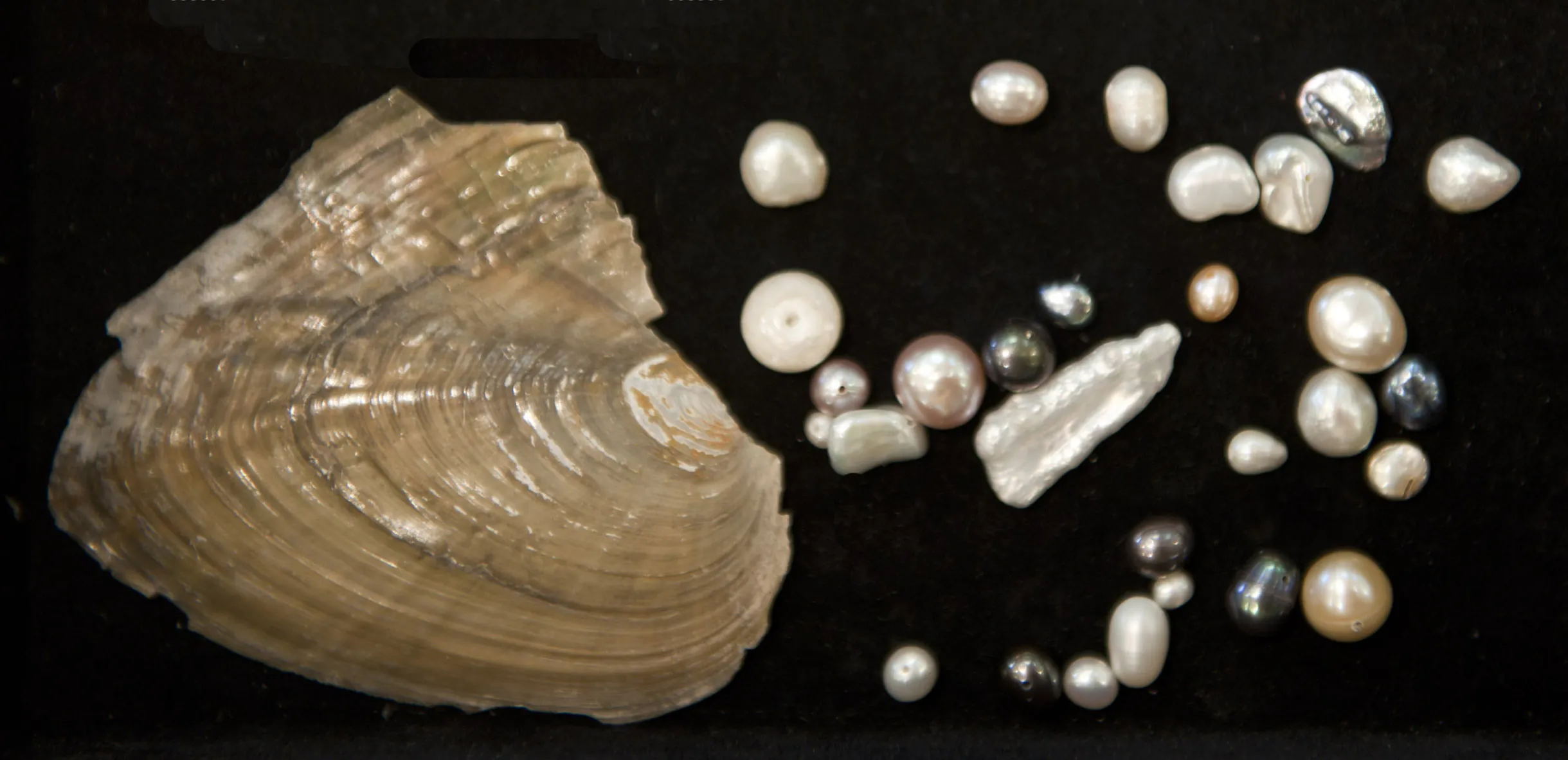
Akoya pearls are saltwater cultured pearls produced primarily by the Akoya pearl oyster group commonly identified as Pinctada fucata or Pinctada fucata martensii. Their familiar market identity—round, relatively small, white to cream pearls with sharp luster—is closely connected to both the biology of the oyster and the bead-nucleated culture method used to grow them.
That makes Akoya easier to understand if you follow a simple chain: oyster species → pearl structure → typical appearance → market position. Akoya is not simply “the expensive white pearl,” and it is not automatically Japanese, top grade, or Hanadama. Those are separate questions.
What Makes a Pearl an Akoya Pearl?
The name Akoya refers to a recognized saltwater cultured pearl type associated with a group of closely related Pinctada pearl oysters. In modern gemological and trade references, you may encounter several closely related scientific names, especially Pinctada fucata, Pinctada fucata (martensii), and Pinctada fucata martensii.
This variation does not mean that three unrelated oysters are being sold under the same name. Taxonomy within the Akoya pearl-oyster complex has been treated somewhat differently by different scientific and industry sources. CIBJO, for example, lists Pinctada fucata as the Akoya pearl oyster and notes that Pinctada martensii is a name used in Japan in connection with the same group. GIA likewise describes Akoya production in terms of the Pinctada fucata/martensii complex.
For a buyer, the practical point is more important than the taxonomic debate: true Akoya pearls are saltwater cultured pearls associated with the Akoya oyster group. A round freshwater cultured pearl may imitate the Akoya look very well, but it does not become an Akoya simply because a seller calls it “freshwater Akoya” or “freshwater AK.”
If you want a broader overview of color, size, luster, nacre, and producing regions, see our complete Akoya pearl guide.
The Akoya Oyster Is Relatively Small—and That Matters
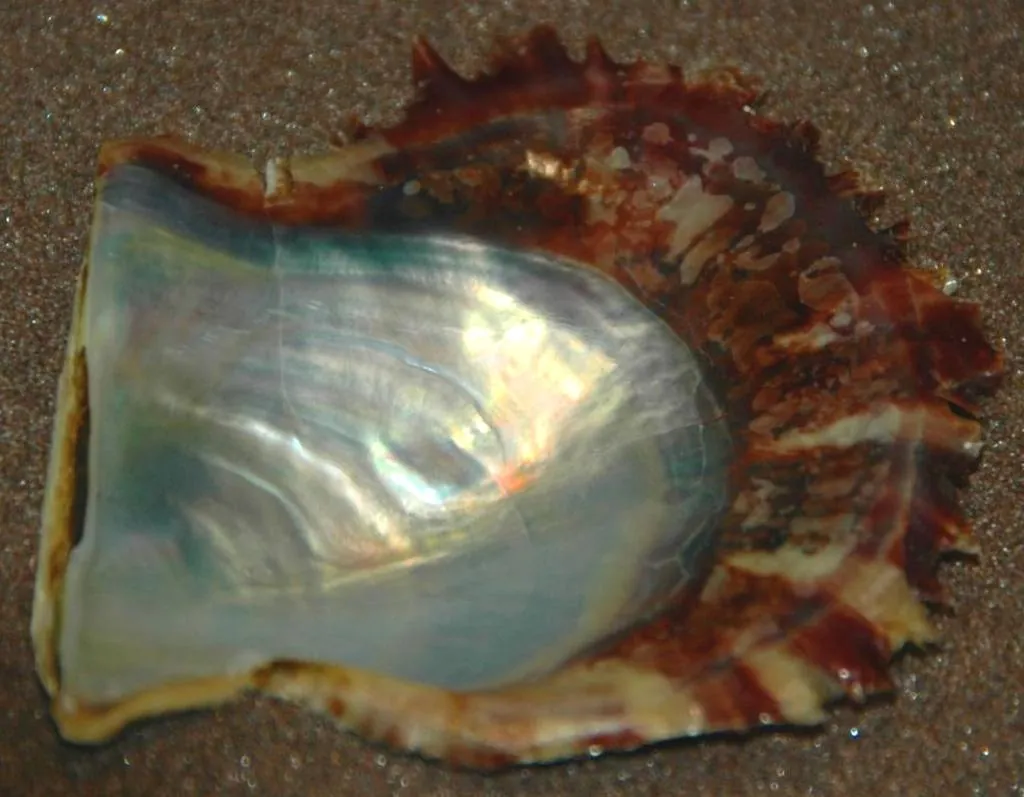
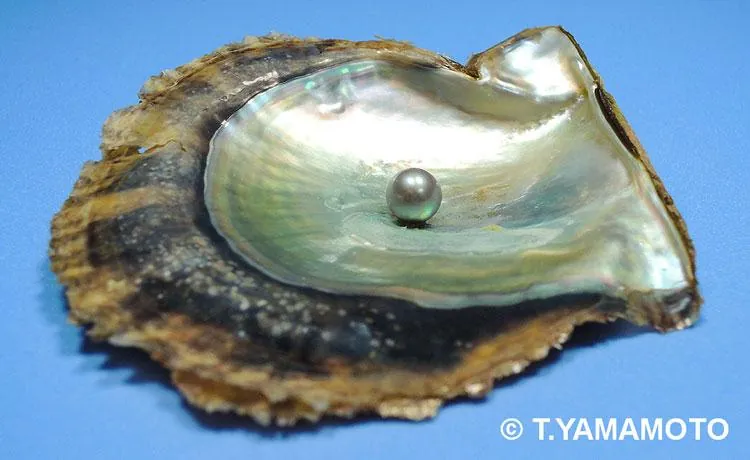
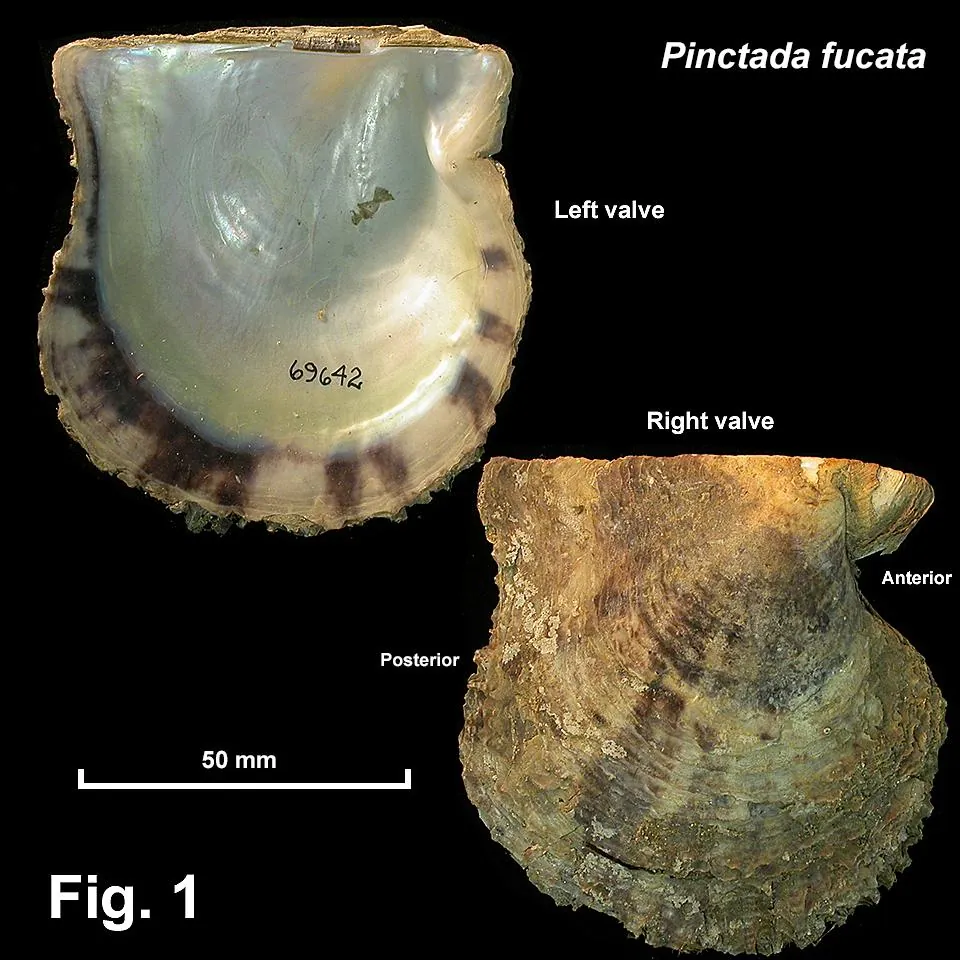
Compared with the oysters used for South Sea pearls, the Akoya oyster is relatively small. That biological scale helps explain one of the most recognizable Akoya traits: Akoya pearls are usually smaller than Tahitian and South Sea pearls.
In everyday jewelry, roughly 6–9 mm is a useful range to think about. Smaller Akoya pearls certainly exist, while pearls above about 9 mm become progressively less common. Akoya pearls over 10 mm can occur, but they should not be treated as routine production.
The size of the oyster is not the only factor controlling pearl diameter. Farmers also have to consider the size of the inserted bead, the condition of the mollusk, survival risk, cultivation time, nacre deposition, and the likelihood of producing a pearl that remains acceptably round and lustrous. This is why “just insert a larger nucleus” is not a reliable shortcut to producing large, fine Akoya pearls.
For a more detailed discussion of where scarcity begins to change, see our guide to the Akoya pearl size range and the rarity of larger sizes.
What Is the Akoya Oyster Shell Made Of?
An Akoya oyster shell is not one uniform material from outside to inside. Like other pearl oysters, it has a layered shell structure. At a simplified level, the shell includes an outer organic covering, a mineralized prismatic region, and an inner nacreous layer—the iridescent “mother-of-pearl” surface visible when the shell is opened.
The nacreous region is especially important because pearl nacre is structurally related to the nacre lining the shell. At the microscopic level, nacre is built from many thin mineral layers, dominated by aragonite calcium carbonate, held within an organic matrix. Research on Pinctada fucata commonly describes this as a highly ordered “brick-and-mortar” type structure.
That layered structure is part of why nacre can interact with light in such a complex way. But it is better to avoid a simplistic formula such as “more nacre always means more luster.” Nacre thickness matters, yet luster also depends on the quality, organization, and surface condition of the deposited layers. A thick but poorly formed surface does not automatically become a top-luster pearl.
Inside an Akoya Pearl: Bead Nucleus Plus Nacre
Most commercial Akoya pearls are bead-nucleated cultured pearls. During culturing, a technician inserts a rounded shell bead together with a small piece of donor mantle tissue into the oyster. The mantle tissue helps form a pearl sac around the bead, and that pearl sac then deposits nacre over the nucleus.
The finished pearl therefore has two major structural parts:
- an internal bead nucleus, which provides much of the spherical core; and
- an outer nacre layer, produced by the living oyster around that nucleus.
This internal construction is important when comparing Akoya with many traditional tissue-nucleated freshwater pearls. A non-bead-nucleated freshwater pearl may be composed predominantly of nacre throughout, while a typical Akoya pearl has a large bead core surrounded by cultured nacre.
That difference does not make Akoya pearls “less real.” Cultured pearls are genuine pearls formed by a living mollusk. The structure simply reflects a different cultivation method.
How Structure Helps Explain the Classic Akoya Look
Akoya pearls are especially associated with three visual traits: roundness, sharp luster, and relatively restrained size. None of these comes from one factor alone, but the oyster and cultivation method make the combination more likely.
Roundness
A spherical bead gives the developing pearl a round starting form. The oyster still has to deposit nacre evenly, and not every cultured pearl finishes perfectly round, but bead nucleation helps explain why round and near-round Akoya pearls are so central to the category.
Sharp luster
High-quality Akoya pearls are famous for reflections that can look crisp and mirror-like rather than soft or diffuse. GIA notes that Akoya pearls can develop tight, even nacre layers associated with this characteristic luster. In practice, however, the word “Akoya” does not guarantee high luster. Lower-quality Akoya pearls can still look dull, chalky, or poorly surfaced.
Smaller classic proportions
Because Akoya oysters are smaller than the mollusks used for Tahitian and South Sea production, Akoya naturally occupies a different size territory. This has helped shape its visual identity in jewelry: refined stud earrings, matched strands, and necklaces where uniformity matters more than dramatic pearl diameter.
Where Akoya Sits in the Pearl Market
Akoya is best understood as the classic fine white saltwater cultured pearl category. It is especially strong where buyers value roundness, bright luster, restrained proportions, and tight matching across a pair or strand.
GIA's comparison of the four major cultured pearl types describes Akoya as generally occupying a mid-range to high value position, while freshwater pearls span a broader and often more accessible market. That is a useful orientation, but it is not a fixed price ladder. Fine freshwater pearls can overlap with or exceed weaker Akoya pearls, and unusually large or exceptional Akoya can move far above ordinary commercial goods.
| Pearl Type | Typical Biological Source | Typical Structure | Common Market Identity |
|---|---|---|---|
| Akoya | Pinctada fucata / Akoya oyster complex | Saltwater bead-nucleated pearl with nacre over a shell bead | Classic white pearl; strong luster, roundness, matched strands and studs |
| Freshwater | Freshwater mussels, commonly Hyriopsis species in modern production | Tissue-nucleated or bead-nucleated depending on type | Broadest variety of shapes, colors, sizes, and price levels |
| Tahitian | Pinctada margaritifera | Saltwater bead-nucleated | Larger naturally dark pearls; stronger statement and color-driven identity |
| South Sea | Pinctada maxima | Saltwater bead-nucleated | Large white, silver, or golden pearls; luxury positioning strongly linked to size |
So Akoya should not be reduced to “better than freshwater but cheaper than South Sea.” That oversimplifies how pearls are actually valued. Pearl type establishes a biological and market context; individual value still depends on luster, surface, shape, nacre quality, color, size, matching, treatment, origin claims, and the finished jewelry itself.
If you are comparing pearl types by origin and biological source, our article on why pearl origin matters explains why origin is useful context but not a quality certificate.
Why Akoya Is So Strong in Strands and Stud Earrings
Akoya's market position is closely tied to matching. A necklace requires dozens of pearls that look coherent together. Stud earrings demand a convincing pair. The combination of bead-nucleated roundness, a relatively narrow classic color palette, and strong luster gives Akoya a natural advantage in these formats.
This is also why an Akoya strand should not be judged only pearl by pearl. Matching becomes part of the product: diameter, bodycolor, overtone, luster, surface appearance, and shape all need to work together across the strand.
For finished pieces, you can browse our Akoya pearl jewelry. If you are comparing quality before buying, the broader pearl grading guide explains how luster, surface, shape, nacre, and matching should be considered together.
What “Akoya” Does Not Tell You
The category name is useful, but buyers often ask it to carry more information than it actually does. “Akoya” alone does not tell you all of the following:
- Country of origin. Japan is historically and commercially central to Akoya culture, but Akoya pearls are also produced in other regions, including China and Vietnam.
- Quality grade. Akoya pearls can range from weak commercial quality to exceptional quality.
- Hanadama status. Hanadama is a quality/certification-related designation used for qualifying Akoya pearls; it is not another oyster species.
- Untreated status. Akoya pearls have a long history of post-harvest processing, and treatment disclosure should be read separately from pearl type.
- Exact origin from appearance alone. Visual appearance may suggest a category, but laboratory analysis can be necessary when identity, environment, or treatment claims materially affect value.
The same caution applies in the other direction: a pearl that looks highly Akoya-like is not necessarily an Akoya. Modern bead-nucleated freshwater pearls can be round, bright, and visually close enough that appearance alone may not settle the identification. GIA has specifically warned that “freshwater Akoya” terminology can create confusion because freshwater cultured pearls are not true Akoya pearls.
How to Read an Akoya Listing More Intelligently
Instead of treating “Akoya” as a complete quality statement, read the listing in layers:
- Confirm the pearl type. Is it actually described as a saltwater Akoya cultured pearl?
- Check origin separately. “Akoya” and “Japanese Akoya” are not identical claims.
- Check size. Large Akoya deserves closer attention because rarity rises quickly toward the upper end of the range.
- Judge luster first with good images. Look for clear, lively reflections rather than generic “shine.”
- Inspect surface and shape. A round bead core does not guarantee a flawless finished surface.
- Consider nacre quality. Thin or weak nacre can affect appearance and durability, while adequate nacre alone does not guarantee excellent luster.
- Evaluate matching in pairs or strands. Uniformity is a major part of the finished Akoya look.
- Read certification and treatment language literally. Do not assume a certificate proves more than it actually reports.
This approach keeps biology, quality, origin, and marketing terminology separate—and that makes Akoya descriptions much easier to evaluate.
FAQ
What oyster produces Akoya pearls?
Akoya pearls are primarily associated with the Akoya pearl oyster complex commonly identified as Pinctada fucata and, in many Japanese and gemological references, Pinctada fucata martensii or Pinctada martensii.
Are Akoya pearls solid nacre?
Typical commercial Akoya pearls are bead-nucleated. They contain a shell-bead nucleus surrounded by nacre deposited by the oyster. This differs from many traditional non-bead-nucleated freshwater pearls, which do not have the same large central bead.
Why are Akoya pearls usually round?
A round bead nucleus gives the pearl a spherical foundation, and successful nacre deposition can preserve that form. Farming, oyster condition, growth, and sorting still matter, so not every Akoya pearl is perfectly round.
Are Akoya pearls always more expensive than freshwater pearls?
No. Akoya pearls are often positioned above mass-market freshwater pearls and can be more expensive at comparable size and quality, but pearl prices overlap. Exceptional freshwater pearls can be more valuable than low-quality Akoya pearls.
Does Akoya mean Japanese pearl?
Not exactly. Japan is the historic center of Akoya cultured pearl production and remains strongly associated with the category, but Akoya pearls are also produced outside Japan. “Japanese Akoya” adds an origin claim that the word “Akoya” alone does not provide.
What to Remember
The clearest way to understand Akoya pearls is not to memorize a list of adjectives. Start with the oyster and the structure. A relatively small saltwater pearl oyster, combined with bead nucleation and nacre deposition, helps create the Akoya category's familiar strengths: restrained sizes, high roundness, crisp luster, and strong suitability for matched strands and earrings.
That biological identity also explains its market position. Akoya is the classic fine white saltwater pearl, but the category name is only the starting point. A good buying decision still depends on the quality of the individual pearl or strand—not simply on the word “Akoya.”
Selected References
- CIBJO Pearl Book 2024 — terminology and pearl-oyster references.
- GIA: Different Pearl Types Explained — Akoya cultivation, typical size, luster, and broad market comparison.
- GIA: Exceptional Nacre Thickness of Hybrid Akoya Bead Cultured Pearls — Akoya species complex and bead/nacre structure.
- PLOS ONE: Matrix Proteins and Aragonite Growth in Pinctada fucata — nacre and shell microstructure.
- GIA: “Freshwater Akoyas” — A Trending Misnomer — distinction between freshwater bead-nucleated pearls and true Akoya pearls.