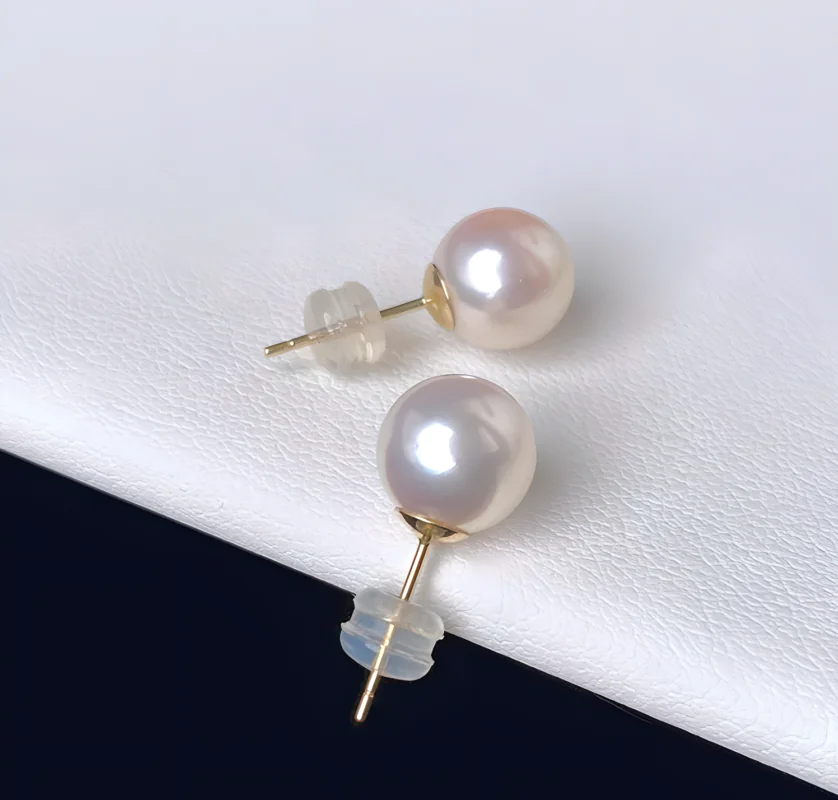
Yes—but ordinary pearl polishing is intended to change the surface presentation much more than the pearl itself. It can make the surface smoother, reduce the visibility of some shallow blemishes, and improve how sharply light reflects from the pearl. What it normally should not do is turn a baroque pearl round, add new nacre, change the pearl's biological origin, or rebuild poor underlying nacre quality.
The important distinction is degree. Light, controlled polishing is a normal post-harvest finishing process. If enough material is removed to change the pearl's contour, eliminate deeper defects, or expose substantially different underlying layers, the work has moved beyond simple polishing and into working, reshaping, peeling, or another more significant form of modification.
So the useful answer is not “polishing changes nothing” or “polishing completely changes the pearl.” It changes some surface characteristics, while the amount of change determines how the process should be understood.
Quick Answer: What Can Polishing Change?
| Feature | Can routine polishing change it? | What to expect |
|---|---|---|
| Surface cleanliness | Yes | Residue and superficial dullness may be reduced |
| Surface smoothness | Yes, slightly | Very small irregularities may become less obvious |
| Apparent luster | Yes | Reflections may look cleaner or sharper |
| Minor shallow blemishes | Sometimes | Some may be reduced, but many remain |
| Overall shape | Normally no | Substantial shape change is better described as working or reshaping |
| Nacre thickness | No increase | Polishing cannot add nacre; aggressive removal can only reduce material |
| Underlying nacre quality | No | Finishing cannot recreate the structure that formed during cultivation |
| Natural vs. cultured identity | No | Polishing does not change how the pearl originally formed |
CIBJO, the World Jewellery Confederation, defines polishing as a technique applied to natural and cultured pearls to remove some surface blemishes and increase luster. Its current Pearl Book also lists polishing among the normal procedures that may be applied to cultured pearls. That wording is useful because it acknowledges two things at once: polishing really can alter the surface appearance, but routine polishing is not treated as the same category as more substantial treatment or heavy working.
What Actually Happens When a Pearl Is Polished?
A pearl's outer surface is not perfectly featureless. Even a high-quality pearl can have microscopic texture, tiny growth marks, residues from post-harvest handling, or shallow irregularities that scatter reflected light.
Controlled polishing works at this outermost level. Depending on the processing method, the pearl may be gently tumbled, buffed, or finished with media selected for delicate pearl surfaces. The practical goal is to improve the finish of the material that is already there.
This can make the pearl look brighter because a smoother, cleaner surface returns light more coherently. GIA notes that pearl luster comes from both reflection at the surface and light interaction with the pearl's concentric nacre layers. Polishing can improve the first part—surface presentation—but it cannot recreate the internal nacre structure responsible for the pearl's deeper optical character.
That is why a poorly grown pearl does not become equivalent to a top-luster pearl simply because it has been polished well.
For the broader sequence after harvest, see our guide to the pearl processing workflow.
Does Polishing Create Luster, or Only Reveal It?
Mostly, it helps present existing luster more clearly.
Imagine two transparent windows made from the same material. One is clean and smooth; the other is covered with residue and fine surface disruption. The first may look brighter even though the underlying material has not fundamentally changed.
Pearls are more complex than glass, but the same basic distinction is useful. A polished surface can produce cleaner reflections and reduce some optical scattering. However, the strength, depth, and character of pearl luster also depend on the nacre or other pearl material that formed inside the mollusk.
Routine polishing therefore cannot:
- add nacre that was never deposited;
- make thin nacre physically thicker;
- reconstruct damaged internal nacre layers;
- turn chalky or fundamentally weak material into the equivalent of fine nacre; or
- guarantee the same luster result on every pearl.
This is also why luster should be judged as part of overall pearl quality rather than as proof of a particular treatment history. Our pearl luster guide explains the quality factor in more detail.
Can Polishing Remove Pearl Blemishes?
Some very shallow surface blemishes may become less visible. Deeper growth features usually cannot be safely polished away.
A pearl may show tiny spots, fine ridges, superficial roughness, pits, grooves, wrinkles, or depressions. These features do not all have the same depth. If an irregularity exists only at or very near the outer surface, light finishing may soften its edges or make reflections more continuous around it.
A deeper pit or growth depression is different. To make that defect disappear completely, material would have to be removed until the surrounding surface reaches the depth of the defect. That may require much more aggressive abrasion.
At that point, the processor is no longer merely improving the existing finish. The work can begin to alter the pearl's contour or remove meaningful amounts of pearl material.
This is the first practical boundary to remember: the deeper the defect you are trying to erase, the more likely the process has moved beyond ordinary polishing.
Can Polishing Change a Pearl's Shape?
Routine polishing should not substantially change the overall shape.
A near-round pearl should remain near-round. A button pearl should remain button-shaped. A baroque pearl should still look baroque after ordinary finishing.
If high areas are deliberately ground away until a visibly irregular pearl becomes rounder, flatter, or otherwise changes contour, that is better described as working or reshaping. Polishing may still be used afterward to finish the newly exposed surface, but polishing is no longer the main modification.
This difference is easy to miss because both processes can involve abrasives and both can make a pearl look “better.” The useful question is not which tool was used. It is:
Was the existing surface merely finished, or was enough pearl material removed to change the pearl's form?
When Does Polishing Become “Working”?
There is no single visible millimeter threshold that consumers can use at home. The distinction depends on the extent and purpose of material removal.
CIBJO separates normal polishing from heavier forms of working. In practical terms, the following signs suggest that the process is no longer just routine polishing:
- the pearl's overall outline has been intentionally changed;
- a deep defect has been removed by grinding down surrounding material;
- the surface has been substantially re-contoured;
- visible portions of the original pearl have been cut away;
- multiple layers have been deliberately removed to reach a different layer below; or
- the amount of modification becomes relevant to how the pearl should be described or valued.
For unusual or high-value natural pearls, this distinction can be especially important. Heavy polishing and working may alter enough of the specimen that laboratories and experienced buyers pay attention to the modified surface rather than treating it as ordinary finishing.
Polishing vs. Other Pearl Processes
The word “polished” is sometimes used loosely, which creates confusion. Several different processes can make a pearl look smoother, brighter, or more uniform, but they are not interchangeable.
| Process | Main effect | Does it remove pearl material? |
|---|---|---|
| Cleaning | Removes residue or contamination | Normally no meaningful removal |
| Buffing / routine polishing | Improves surface finish and apparent luster | May involve very slight surface abrasion |
| Working / reshaping | Changes contour or removes more significant defects | Yes |
| Peeling | Removes loose outer layers to reveal material beneath | Yes |
| Waxing | Applies material to improve appearance or disguise surface features | Not primarily |
| Luster enhancement | Uses chemical and/or special enhancement processes to improve luster | Depends on the method |
| Coating | Adds a layer to the surface | No; material is added instead |
This distinction matters when a seller says only that a pearl is “polished.” That description does not tell you whether the pearl was also bleached, dyed, coated, waxed, filled, chemically luster-enhanced, or heavily worked.
For a broader overview, see our pearl treatments guide.
Does Polishing Reduce Nacre Thickness?
Any abrasive removal takes away some surface material, but the practical significance depends on how aggressive the process is.
Routine polishing is designed to be light enough that it improves the finish without materially compromising the pearl. Aggressive grinding is different: it can remove much more material and, on bead-nucleated pearls with limited nacre thickness, may reduce the safety margin over the nucleus.
That is why it is misleading to say either “polishing never removes nacre” or “every polished pearl has dangerously thinned nacre.” Both statements ignore degree.
The more useful framework is:
- Light finishing: tiny surface change, primarily visual.
- Stronger corrective polishing: more material removed to reduce surface defects.
- Working / reshaping: material removal becomes part of changing contour or eliminating deeper defects.
- Excessive processing: removal can compromise the original surface quality, nacre integrity, or value.
This degree-of-change model is more accurate than treating every polished pearl as equivalent.
Can Over-Polishing Make a Pearl Worse?
Yes. Polishing is not automatically beneficial just because it is called a finishing process.
Pearls are relatively soft compared with many faceted gemstones. If a processor uses inappropriate abrasives, too much pressure, excessive heat, or simply removes too much material, the surface can become damaged rather than improved.
Possible problems from overly aggressive work include:
- flattened or distorted contours;
- visible polishing lines or uneven texture;
- loss of original surface character;
- thinning of nacre on bead-nucleated pearls;
- greater vulnerability around drill holes or weak areas; and
- a lower-value result if the pearl has been substantially altered.
A skilled processor therefore tries to improve presentation without sacrificing more material than necessary.
Does Polishing Change the Value of a Pearl?
It can, but not in one predictable direction.
Good routine finishing may make a pearl easier to grade, match, photograph, and sell because its surface is clean and its reflections are clearer. In that sense, normal processing can improve commercial presentation without changing the basic quality category of the pearl.
More aggressive modification is different. If significant material has been removed to hide defects or change shape, the buyer may care about the original condition, remaining nacre, disclosure, and whether the modified pearl should be compared with naturally cleaner or naturally rounder material.
For ordinary cultured-pearl buying, however, “polished” should not become a shortcut for “good” or “bad.” Continue to evaluate the actual quality factors: luster, surface, shape, color, nacre, size, and matching. Our pearl grading guide provides the broader framework.
Can You Tell If a Pearl Has Been Polished?
Not reliably from ordinary appearance alone.
A well-polished pearl may simply look clean and bright. Those same traits can also occur naturally in a pearl with excellent surface quality and luster. Conversely, visible scratches do not prove that a pearl was never polished; they may have developed later through wear or handling.
Heavy surface modification can sometimes leave microscopic evidence, but interpreting that evidence is a gemological task rather than a simple home test.
If treatment or working history materially affects the price—especially with important natural pearls, unusual specimens, or high-value collector pieces—documentation or laboratory examination may be more useful than visual guessing.
Do Not Confuse Factory Polishing with Home Pearl Care
Consumers often use “polish” to mean wiping jewelry until it shines. Professional pearl finishing is not the same thing as using a metal polishing cloth or abrasive compound at home.
Pearls should generally be maintained with gentle cleaning rather than abrasive refinishing. Metal polish, toothpaste, baking soda, rough polishing cloths, and aggressive buffing can scratch or chemically affect the pearl surface.
For worn jewelry, the safer goal is usually to remove perspiration, cosmetics, and surface residue without trying to grind away scratches. See our pearl care guide for routine maintenance.
What Should a Buyer Ask About a “Polished” Pearl?
If the word appears in a product description, ask questions that reveal the degree of modification rather than reacting to the word itself.
- Was this ordinary surface polishing or heavier working?
- Was the pearl's overall shape intentionally changed?
- Were deep blemishes ground away?
- Was any wax, coating, filler, dye, bleaching, or luster-enhancement process also used?
- If the pearl is high value, is the processing history documented?
For most ordinary cultured pearls, routine polishing is not a reason for alarm. The key is to avoid confusing a normal finishing step with a complete treatment history—or with a guarantee of quality.
The Bottom Line
Polishing does change a pearl, but normally at the surface level. It can improve smoothness, reduce some superficial blemishes, and make reflections look sharper. It does not add nacre, recreate the pearl's internal structure, or normally change the pearl into a different shape.
The more material that must be removed, the more important the terminology becomes. Light polishing is finishing. Removing enough material to change contour or eliminate deep defects becomes working or reshaping. Removing outer layers to expose different material beneath may be described separately again.
So when evaluating a polished pearl, do not ask only, “Was it polished?” Ask how much did the process change? That question tells you far more about the pearl's surface, quality, disclosure, and value.
FAQ
Does polishing remove part of a pearl?
Polishing can involve slight surface abrasion, so a tiny amount of material may be removed. Routine polishing is intended to be minimal. If substantial material is removed to change the contour or eliminate deeper defects, the process is better described as working or reshaping.
Can polishing make a pearl more lustrous?
Yes. Polishing can improve apparent luster by making the surface cleaner and smoother so light reflects more clearly. It cannot create new nacre or fully reproduce the deeper optical character of naturally fine nacre.
Can polishing turn a baroque pearl into a round pearl?
Not through routine polishing. Making a baroque pearl substantially rounder requires deliberate material removal and is more accurately described as working or reshaping.
Can pearl polishing remove scratches?
Very shallow marks may become less visible, but deeper scratches or growth features usually require more material removal. Trying to erase them completely can move the process beyond ordinary polishing and may damage or alter the pearl.
Is a polished pearl considered fake or synthetic?
No. Polishing is a post-harvest finishing process. A genuine natural or cultured pearl remains a pearl after polishing; polishing does not turn it into an imitation.
Should I polish pearl jewelry at home?
Do not use abrasive jewelry polish simply because the pearl trade uses the word “polishing.” Routine home care should focus on gentle cleaning with a soft cloth and pearl-safe methods rather than resurfacing the pearl.