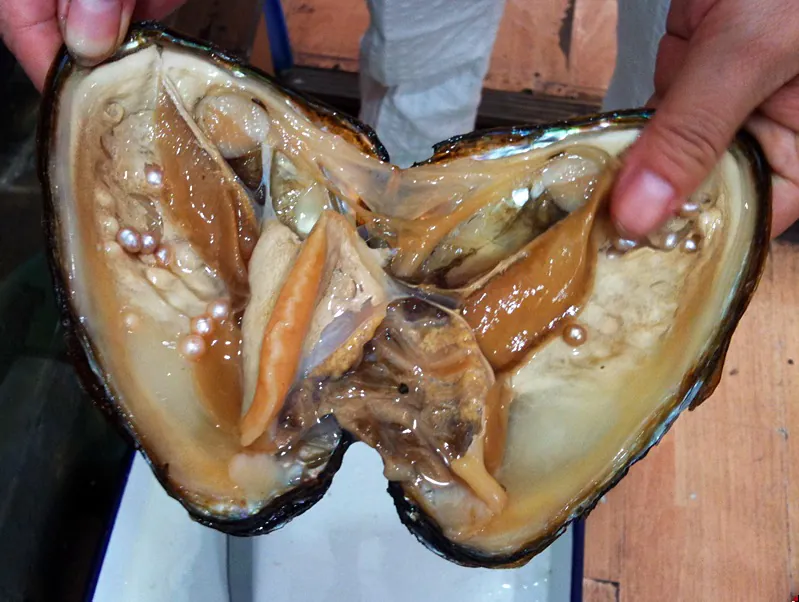
Sometimes—but usually not literally the moment they are removed. A newly harvested pearl may be good enough to sell with very little processing, especially as a loose pearl. But it normally needs at least basic cleaning and inspection before anyone can judge its surface, quality, condition and commercial category accurately.
The important distinction is that a pearl does not have to be bleached, dyed, polished, drilled or made into jewelry before it can be sold. Those are separate possibilities. Some pearls reach the market after relatively minimal preparation; others go through much more sorting, treatment, matching or manufacturing.
So the best answer is: freshly harvested pearls can become saleable very quickly, but “just removed from the mollusk,” “ready to trade,” “ready for retail,” and “ready to wear” are four different stages.
Why Is a Pearl Usually Cleaned Before It Is Sold?
When a pearl first comes out of the mollusk, its surface can still carry moisture, mucus, tissue residue or other material from harvesting. That makes immediate visual judgment less reliable.
Cleaning is therefore one of the most basic post-harvest steps. It allows the actual pearl surface to be seen more clearly and makes later inspection, sorting and handling easier. Field reports published by GIA show harvested Akoya pearls being separated from tissue, washed to remove organic remains, dried and then graded.
This does not mean every pearl must go through heavy chemical processing. Basic cleaning is different from deliberately changing color or appearance. A pearl can remain essentially natural in appearance while still being cleaned and prepared for sale.
“Saleable” Is Not the Same as “Retail-Ready”
This is the part that causes most confusion. A pearl can be commercially saleable before it is ready for a jewelry display case.
For example, a processor, wholesaler or jewelry maker may buy an undrilled loose pearl. That pearl does not need to be matched into a strand or mounted in jewelry first. What the buyer needs is enough information to understand what is being offered: size, shape, color, luster, surface condition, drill status, treatment status when relevant, and the seller's quality description.
A retail necklace is different. Before a strand can be sold as finished jewelry, many individual pearls may need to be sorted, drilled, matched, strung and fitted with a clasp. That additional work does not make the pearls “more real”; it simply turns loose material into a finished product.
For the broader sequence from harvest to finished goods, see our pearl processing workflow.
Why Inspection Matters Before a Price Is Assigned
A mixed harvest can contain pearls with very different commercial outcomes. Two pearls removed on the same day may differ greatly in shape, luster, surface cleanliness, color, size, nacre appearance and structural condition.
Until the pearl is clean and inspected, the seller may not even know which comparison group it belongs in. That matters because a round pearl, a strongly baroque pearl, a damaged pearl and a well-matched strand component are not valued in the same way.
GIA's widely used pearl value framework looks at size, shape, color, luster, surface, nacre and matching. For a single loose pearl, matching is not yet relevant, but the other visible factors still help determine how the pearl should be described and priced. If you want the quality framework in more detail, see our pearl grading guide.
Do Pearls Have to Be Treated Before They Can Be Sold?
No. Treatment is not a universal prerequisite for selling cultured pearls.
Some pearl categories and production systems commonly use post-harvest treatments such as bleaching, tinting, dyeing, irradiation or other appearance-related processes. Other pearls may be sold with very limited intervention beyond cleaning, light surface preparation, drying, sorting and grading.
A useful example comes from GIA's report on an Australian Akoya farm. The harvested pearls were washed, buffed, dried and graded, while the farm emphasized that it did not use the dyes, bleaches or alcohol-based processes associated with some other Akoya production systems. That shows why it is inaccurate to say that a pearl must be bleached or color-treated before it can enter the market.
If treatment matters to your purchase, ask what was actually done instead of relying on broad labels such as “processed” or “untreated.” Our guide to pearl treatments explains the main categories in more detail.
Can a Pearl Be Sold as “Freshly Harvested”?
Yes, but the phrase needs context.
A pearl sold shortly after harvest may still have been cleaned, dried, inspected and sorted. Those steps do not contradict the idea that it is freshly harvested. They are basic handling steps that make the pearl easier to evaluate and trade.
What would be misleading is using “freshly harvested” to imply that nothing whatsoever happened after removal when the pearl was actually bleached, dyed, coated or otherwise appearance-treated. The meaningful question is not how romantic the label sounds; it is what post-harvest work actually occurred.
Does “Untreated” Mean the Pearl Is Better?
Not automatically. Treatment status and quality are different questions.
An untreated pearl can still have weak luster, heavy surface marks, an unattractive shape or poor nacre. A carefully processed pearl can still be a genuine cultured pearl with good visible quality. The presence or absence of treatment may affect rarity, color interpretation, disclosure and value, but it does not replace normal quality evaluation.
This is especially important when buyers encounter marketing phrases such as “straight from the oyster,” “raw pearl” or “natural finish.” Those descriptions can be interesting, but they do not tell you the pearl's size, surface, luster, shape, nacre quality or whether the color is naturally occurring.
What Happens If the Pearl Is Going into Jewelry?
Then the answer becomes much simpler: it cannot be sold immediately as finished jewelry because the jewelry does not exist yet.
A pearl may need to be drilled or half-drilled, paired with another pearl, matched into a strand, selected for a specific setting, mounted, strung or combined with metal findings. A strand can require many rounds of matching because neighboring pearls make differences in color, luster, shape and size easier to notice.
That is why the time between harvest and retail sale can vary widely even when the pearl itself needs little appearance processing. Sometimes the slow part is not “treatment” at all—it is selection and manufacturing.
For designers, makers and businesses sourcing loose pearls or strands, our wholesale pearl selection covers material intended for different production needs.
A Better Way to Think About the Question
Instead of asking only, “Can this pearl be sold immediately after harvest?”, ask which stage of sale you mean:
- Farm or trade sale: Is the pearl clean enough and understood well enough to trade as loose material?
- Wholesale sale: Has it been sorted and described well enough for a professional buyer to compare it with similar pearls?
- Retail loose-pearl sale: Is the buyer given a clear description of quality, dimensions, drill status and relevant treatments?
- Finished-jewelry sale: Has the pearl also been drilled, matched, set or strung as required by the design?
Once those stages are separated, there is no contradiction. A pearl may be perfectly saleable after minimal post-harvest preparation while still being far from ready as finished jewelry.
The Main Takeaway
Pearls do not have to undergo a long list of treatments before they can be sold. Some can enter trade after basic cleaning, inspection, sorting and grading. But a pearl literally seconds after removal from the mollusk is usually not yet in a condition where a professional seller can describe and price it confidently.
The key distinction is between basic preparation and appearance-changing treatment. Cleaning and inspection help reveal what the pearl already is. Optional treatments may alter its appearance. Drilling, matching and setting prepare it for a particular product.
So yes—a pearl can be sold relatively soon after harvest. It just does not follow that every harvested pearl should go straight from the mollusk to the customer without any inspection or preparation in between.
Frequently Asked Questions
Can you wear a pearl immediately after it comes out of an oyster or mussel?
Physically, a loose pearl can be handled after harvest, but it should normally be cleaned first. If you want to wear it as jewelry, it will also need an appropriate setting, drilling or stringing unless the design holds an undrilled pearl.
Are all cultured pearls treated after harvest?
No. Post-harvest treatment varies by pearl type, producer and intended market. Some pearls receive bleaching, tinting, dyeing or other treatment, while others reach the market after comparatively minimal preparation.
Can an undrilled pearl be sold?
Yes. Loose undrilled pearls are legitimate commercial products. Drilling is required only when the intended jewelry design needs a hole.
Does a freshly harvested pearl already have its final luster?
The pearl already has the nacre surface produced by the mollusk, but cleaning and some post-harvest processes can change how clearly that surface is seen or can alter its appearance. The exact workflow varies.
Does “freshly harvested” mean “untreated”?
Not necessarily. “Freshly harvested” describes timing, while “untreated” describes what processes were or were not applied. A pearl can be sold soon after harvest and still have undergone cleaning or other preparation, and the term alone does not prove treatment status.