
Lesson19: Keshi Pearls: What They Are and How They Form

Introduction
In this lesson, we look at what Keshi pearls are, how they form during pearl cultivation, and why they are known for their striking luster.
Keshi pearls are an unusual result of the pearl farming process. In simple terms, they form when a pearl sac continues producing nacre even though a bead nucleus is rejected, lost, or never remains in place. The result is a pearl without a bead nucleus at harvest, often with a free, irregular shape and strong surface life.
In the trade, people often say simply “Keshi pearls.” More precisely, standards such as the CIBJO Pearl Book and the Japan Pearl Standard treat Keshi cultured pearl as a trade term for a non-beaded cultured pearl formed as a by-product of marine pearl cultivation. That terminology matters, because Keshi pearls are often confused with natural pearls or described too loosely in retail writing.
What you will learn in this lesson
- what a Keshi pearl is
- how Keshi pearls form during cultivation
- the main pearl categories in which Keshi pearls are found
- why Keshi pearls often show vivid luster and orient
- how Keshi pearls differ from natural pearls and from baroque pearls
What Are Keshi Pearls?
Keshi pearls are non-beaded cultured pearls that form during pearl cultivation as an unintended by-product. They are usually associated with saltwater pearl oysters such as Akoya, South Sea, and Tahitian-producing oysters.
Because they do not contain a bead nucleus at harvest, Keshi pearls are typically composed almost entirely of nacre. This is why they are often admired for their brightness, sharp reflections, and layered visual depth.
That said, the word “Keshi” is used very loosely in the market. Some sellers use it for almost any small, irregular pearl. A better educational approach is to treat Keshi as a formation-related term, not just a shape description.
How Keshi Pearls Form During Pearl Cultivation
A standard saltwater cultured pearl is produced by inserting a bead nucleus together with mantle tissue into a host oyster. As the pearl sac develops, nacre is secreted over the bead.
A Keshi pearl can form when that process does not proceed in the usual way. If the bead is rejected, displaced, or not properly retained, but the pearl sac remains active, the oyster may continue secreting nacre. Over time, that nacreous material develops into a non-beaded cultured pearl.
This is one reason Keshi pearls are so interesting from both a gemological and farming perspective: they are still tied to the cultivation process, but they do not follow the standard bead-cultured outcome.
In some cases, Keshi formation is connected to bead rejection. In other cases, it may relate to the behavior of the grafted mantle tissue and the pearl sac that forms around it. The result is a pearl that is often more organic in shape and more variable in outline than a standard round bead-cultured pearl.
What Types of Keshi Pearls Can You Find?
In trade usage, people commonly refer to several kinds of Keshi pearls according to the oyster that produced them.
Akoya Keshi pearls
Akoya Keshi pearls are generally associated with Pinctada fucata oysters. They are often smaller than South Sea Keshi pearls and are frequently seen in white, cream, or light silver tones. Because Akoya pearls are strongly associated with fine luster, Akoya Keshi pearls can be especially bright-looking.
Tahitian Keshi pearls
Tahitian Keshi pearls come from black-lipped oysters associated with Pinctada margaritifera. As noted in GIA’s research on non-bead cultured pearls from Pinctada margaritifera, these pearls are commonly associated with gray-to-black bodycolor, but may also show green, blue, peacock, and mixed overtones that create dramatic color play.
South Sea Keshi pearls
South Sea Keshi pearls come from Pinctada maxima oysters. Depending on whether the oyster is silver-lipped or gold-lipped, they may appear silver-white, cream, or golden. South Sea Keshi pearls are often larger and can have especially expressive, sculptural shapes.
A note on “freshwater Keshi” terminology
In everyday trade language, you may still hear terms such as “freshwater Keshi pearls.” This usage appears in the market because small, irregular, all-nacre freshwater pearls can resemble what buyers expect a Keshi pearl to look like.
However, stricter industry terminology is more careful. The Japan Pearl Standard recommends using Keshi cultured pearl for seawater cultured pearls without bead nuclei that form as by-products during marine pearl cultivation, while freshwater cultured pearls are described separately. For that reason, “freshwater Keshi” is better treated as an informal market expression rather than the most rigorous naming standard.


Why Keshi Pearls Often Have Such Strong Luster
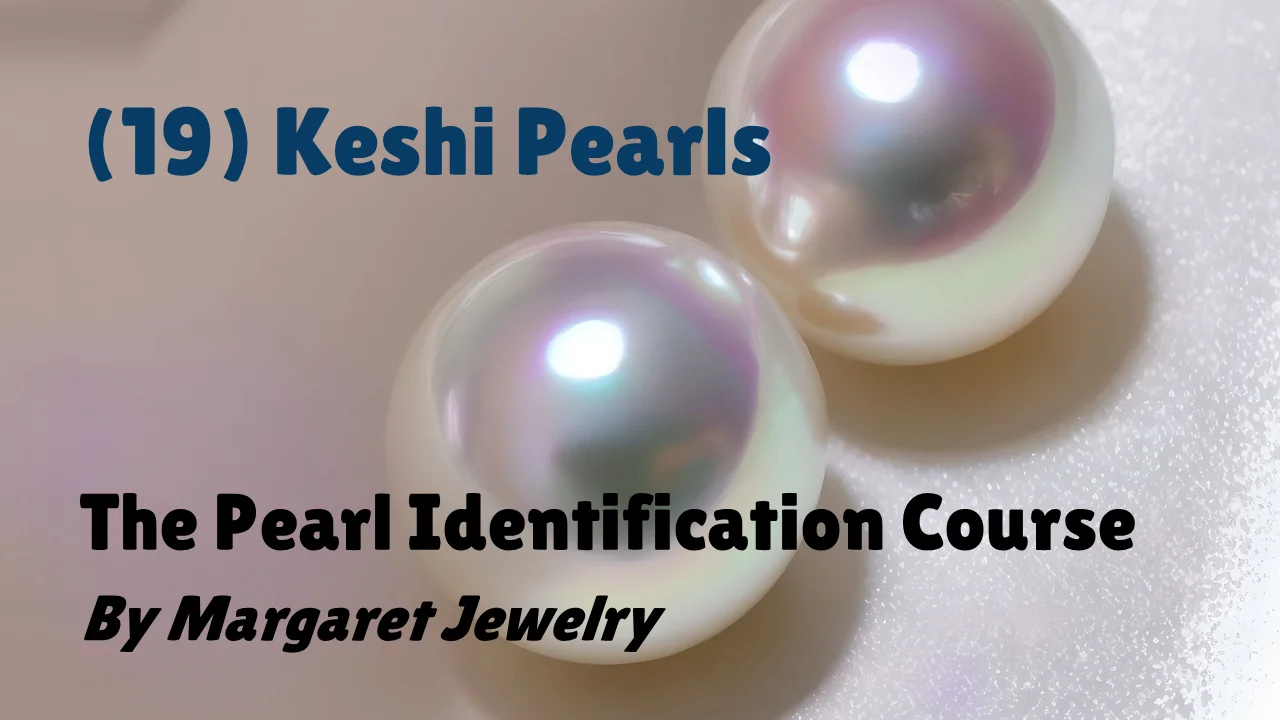
One of the most appealing features of Keshi pearls is their luster. Because they are generally composed almost entirely of nacre rather than nacre layered over a bead, they often show vivid reflections, strong orient, and a sense of inner depth.
This does not mean every Keshi pearl looks the same. Luster still depends on many factors, including nacre quality, surface condition, shape, species, and cultivation environment. But as a group, Keshi pearls are widely appreciated for the visual richness that comes from their nacreous structure.
Their texture and outline also add to their appeal. Many Keshi pearls are baroque, elongated, petal-like, or otherwise freeform, which gives designers more creative possibilities than highly standardized round pearls.
Keshi Pearl Colors and Appearance
Keshi pearls can appear in many colors. Their bodycolor and overtone are influenced by the oyster species, the donor mantle tissue, and the growing environment.
Tahitian Keshi pearls may show silvery gray, charcoal, green, blue, peacock, aubergine, or mixed overtones. South Sea Keshi pearls are often silver-white or cream, while gold-lipped oysters may produce golden tones. Akoya Keshi pearls are commonly white, cream, or light silver.
Even within one category, Keshi pearls are rarely identical. Their irregular shapes, changing surface reflections, and overtone shifts are part of what makes them distinctive.
Keshi Pearls vs. Natural Pearls
This is one of the most important distinctions to understand.
A Keshi pearl may form accidentally during cultivation, but that does not make it a natural pearl. As explained in GIA’s pearl overview, natural pearls form without human intervention of any kind. Keshi cultured pearls, by contrast, are linked to a farming process in which human intervention created the conditions for the pearl sac to form.
This is why standards and gemological sources treat Keshi pearls within the cultured pearl framework, even when they are non-beaded.
Keshi Pearls vs. Baroque Pearls
Keshi and baroque are not the same kind of term.
Baroque describes shape. A baroque pearl is simply a pearl with an irregular, non-symmetrical outline.
Keshi describes formation and type. It refers to a non-beaded cultured pearl produced as a by-product of cultivation.
Many Keshi pearls are baroque, but not all baroque pearls are Keshi pearls. Keeping that distinction clear helps avoid one of the most common mistakes in pearl writing.
Final Notes
Keshi pearls are among the most fascinating by-products of pearl cultivation. They show how the biology of pearl formation can produce outcomes that are less standardized, but often visually more expressive, than conventional bead-cultured pearls.
For readers moving through the Pearl Academy in sequence, this lesson connects naturally to the broader topic of pearl identification. It also helps prepare for the next lesson, where we shift from naturally formed and cultured pearl materials to Lesson 20: Artificial Pearls.
Are Keshi pearls natural pearls?
No. Keshi cultured pearls are connected to a pearl farming process, even though they do not contain a bead nucleus at harvest.
Are Keshi pearls always baroque?
Many are baroque, but “baroque” refers to shape, while “Keshi” refers to how the pearl formed.
Can freshwater pearls be called Keshi pearls?
In informal market language, some sellers do use that phrase. In stricter terminology, however, Keshi cultured pearl is generally reserved for seawater by-products of marine pearl cultivation.