
Lesson 1: Formation of Pearls — How Pearls Form Naturally and in Culture


Pearls are not simply “found” inside a mollusk. They form as part of a biological defense response. When an irritant, parasite, damaged tissue, or intentionally implanted material interacts with sensitive soft tissue, the mollusk may isolate that stimulus and begin depositing nacre around it. In both natural pearls and cultured pearls, the core biological logic is the same: mantle-related epithelial cells form a pearl sac, and that pearl sac secretes the material that builds the pearl.
In this lesson, we will look at what starts pearl formation, how the pearl sac works, how nacre builds layer by layer, and why natural and cultured pearls follow the same biological principle even though human intervention may be involved in one and not the other.
What Starts Pearl Formation?
Pearl formation usually begins with an irritation or abnormal stimulus inside the mollusk. In popular writing, this is often simplified into the idea that “a grain of sand” enters an oyster and becomes a pearl. That version is easy to remember, but it is too narrow. In reality, pearl formation may begin because of parasites, organic debris, tissue injury, or other material interacting with the mollusk’s soft tissues. In cultured pearl production, the starting point is introduced deliberately by human hands, but the mollusk still completes the pearl biologically on its own.
This is why pearl formation should first be understood as a defensive reaction, not as a decorative miracle. The mollusk is protecting itself. The pearl is the result of that protective process becoming stable and layered over time.
How the Mantle and Pearl Sac Build a Pearl
The most important structure in pearl formation is not just the irritant itself, but the pearl sac. Once the mantle or mantle-related epithelial cells are stimulated, those cells may surround the irritant or affected area and form a sac-like structure. That pearl sac becomes the living tissue responsible for secreting the material that will eventually form the pearl. This point matters in real pearl study and real pearl farming, because the pearl sac is the biological engine of pearl formation.
In other words, the foreign material does not “turn into” the pearl by itself. The mollusk’s own cells do the real work. Once the pearl sac is established, it continues secreting nacre inward, gradually building a pearl around the central stimulus or around the space created by tissue abnormality. That is why the biological condition of the mollusk, the tissue involved, and the stability of the environment all matter to the final result.
How Nacre Builds Layer by Layer
The material secreted by the pearl sac is called nacre, also known as mother-of-pearl. Nacre is made primarily of calcium carbonate, especially aragonite, together with organic materials that help bind and organize the structure. Layer by layer, nacre is deposited in extremely thin sheets. As those layers accumulate, the pearl becomes larger, denser, and more visually complex.
This layered growth is one of the reasons pearls have such a distinctive look. Their luster is not created by a single outer coat, but by the way light interacts with many fine layers of nacre. In practical terms, pearl formation is a slow building process. One layer alone means very little, but continuous, orderly deposition over time can produce a pearl with good body, attractive luster, and stronger visual depth.
Natural and Cultured Pearls Follow the Same Biological Logic
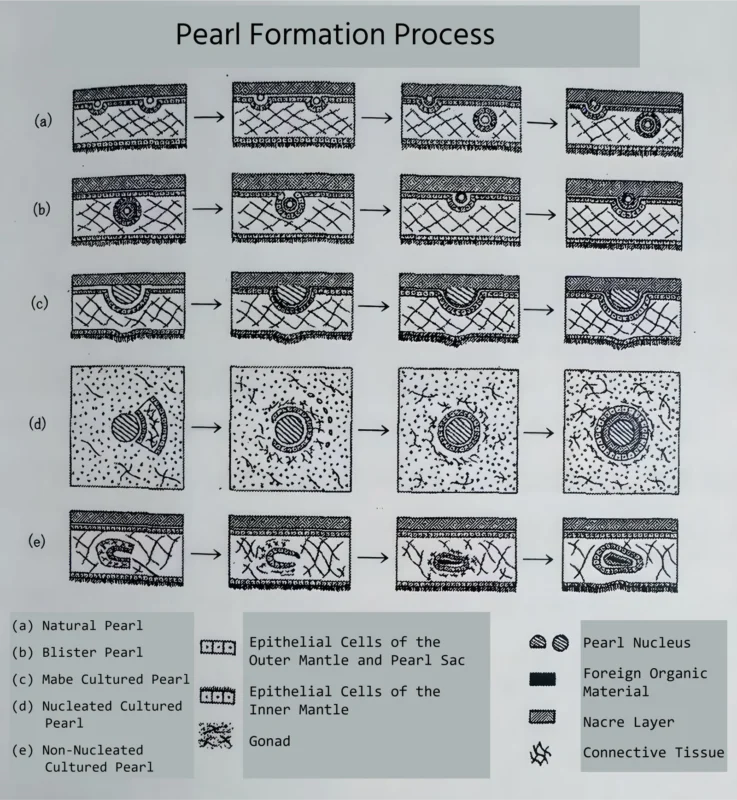
A natural pearl forms without direct human intervention. A cultured pearl begins because a technician introduces material into the mollusk in a controlled way. But once the process begins successfully, both depend on the same biological mechanism: tissue response, pearl sac formation, and nacre secretion. This is why cultured pearls are still real pearls. They are not imitation products. Their growth is biological, even if the starting point was created intentionally.
At this stage, it is also useful to introduce the difference between nucleated and non-nucleated pearls in a basic way. A nucleated pearl develops around a distinct nucleus, often a bead in bead-cultured pearl production. A non-nucleated pearl does not have a bead nucleus. It may form naturally from tissue-related irregularities, or it may be cultured without a bead, depending on the species and farming method. We will go deeper into these structures in later lessons, but for Lesson 1, the key point is simple: whether bead-nucleated or non-bead, pearl formation still depends on a functioning pearl sac and nacre deposition.
Why the Mollusk Influences Pearl Color
Pearl color is not random. It is influenced by several factors, including species, nacre structure, and the biological characteristics of the mollusk or donor tissue involved. In practical pearl work, this is why different mollusks are associated with different color ranges. For example, Pinctada margaritifera is known for producing the bodycolors commonly associated with Tahitian pearls, while Akoya oysters and many freshwater mussels are more often linked with lighter color families.
That said, this lesson only introduces the idea. Pearl color is a bigger subject than formation alone. Treatment, environment, nacre quality, and later processing all deserve their own discussion, so here we keep the focus where it belongs: the biological origin of pearl formation and the fact that the mollusk itself is a major part of the story.
From Formation to Maturity
Once nacre deposition has begun, the pearl continues developing over time inside the pearl sac. Depending on the mollusk, the environment, the stability of the culture conditions, and the nature of the initiating stimulus, the process may take months or several years. During this period, the pearl gradually gains size, surface character, luster, and structural maturity.
This is also why pearls from different species and different production systems can look so different from one another. The final pearl is not determined by one factor alone. It reflects the interaction between living tissue, time, environment, and the internal structure created during formation. That is one reason pearl formation remains such a fascinating subject for both gemologists and pearl farmers.
Pearl Formation in Illustrations
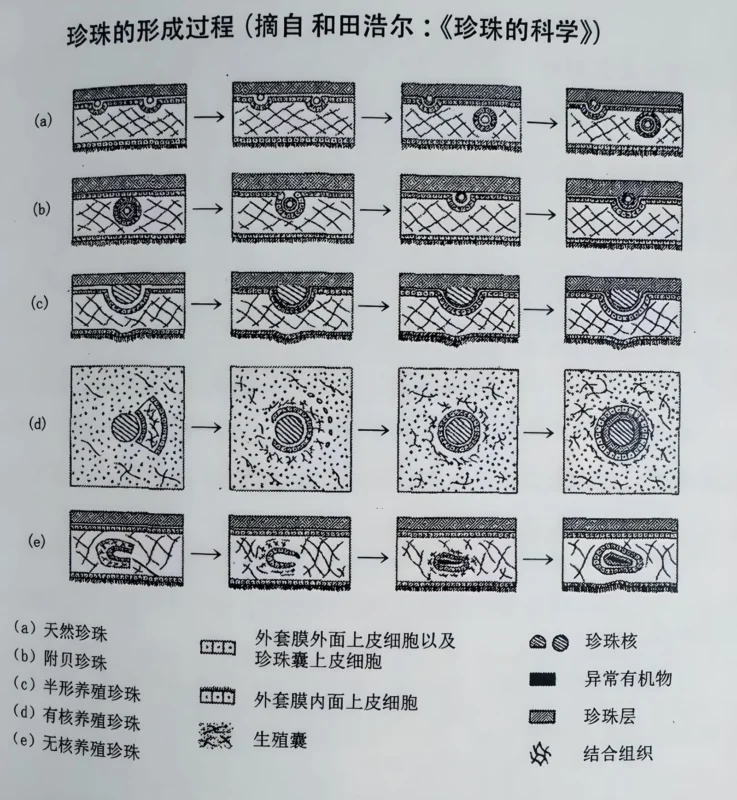
The following diagrams visualize the same sequence discussed above: a stimulus enters or affects soft tissue, mantle-related cells form a pearl sac, nacre is secreted in layers, and a pearl gradually develops.
Thank You